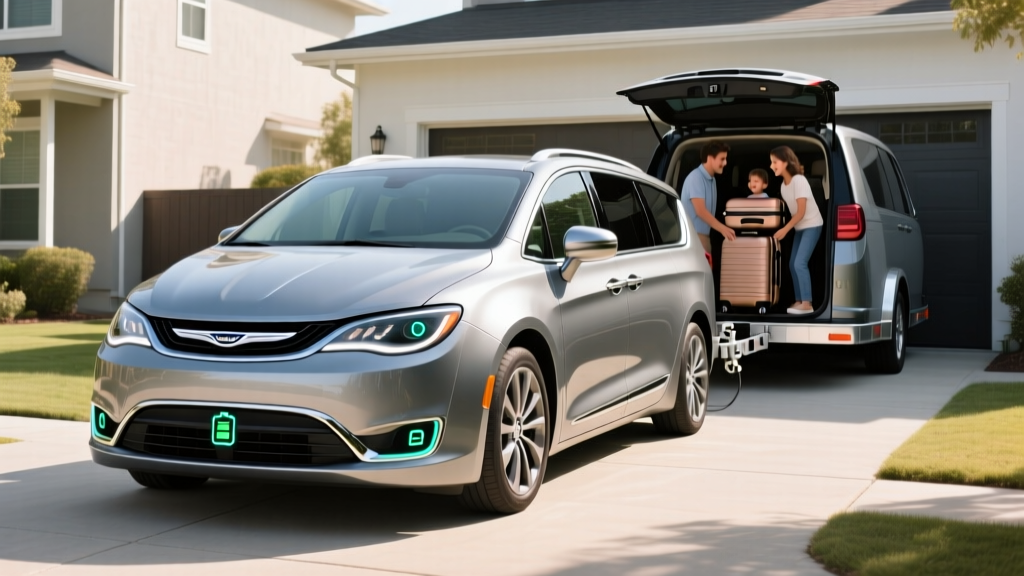
If you're researching the Chrysler Pacifica Hybrid towing capacity, here's the unambiguous answer up front: the Pacifica Hybrid is not rated to tow anything. Chrysler explicitly prohibits trailer towing on the plug-in hybrid (PHEV) variant of the Pacifica minivan, and no factory or dealer-installed hitch is offered for it. If you need to pull a camper, boat, or utility trailer, you'll need to look at the gas-only Pacifica or a different PHEV SUV.
That restriction doesn't make the Pacifica Hybrid a bad vehicle — it makes it a purpose-built family hauler optimized for fuel savings, school runs, and road trips where the cargo goes inside, not behind. This guide breaks down the full 2026 Chrysler Pacifica PHEV powertrain, efficiency, electric-only range, battery warranty, and what the no-tow rule means for your purchase decision.
Why the Chrysler Pacifica Hybrid Cannot Tow
The gas-only Chrysler Pacifica (with the 3.6-liter Pentastar V6) is rated to tow up to 3,600 pounds when properly equipped with the factory Trailer-Tow Group. The PHEV version shares the same basic chassis, but Chrysler engineers made deliberate trade-offs that eliminate its towing rating:
- Battery mass. The 16-kWh lithium-ion battery pack adds roughly 600 pounds to the vehicle's curb weight compared to the gas model, reducing the available payload and gross combined weight rating (GCWR) headroom needed for safe towing.
- Thermal management. Towing places sustained high load on the powertrain. The PHEV's smaller engine and electric motor combination is calibrated for efficiency, not sustained heavy-load operation, and the thermal envelope doesn't account for trailer drag on long grades.
- Drivetrain calibration. The eFlite dual-motor electrically variable transmission (EVT) prioritizes seamless gas-to-electric blending. Chrysler has not validated this system's durability under towing stress.
- No hitch hardware. There is no factory tow package, no hitch receiver, and no wiring harness available for the PHEV trim. Aftermarket hitches exist, but installing one and towing with it voids your powertrain warranty.
If you see an aftermarket hitch listed as "compatible" with a Pacifica Hybrid online, that compatibility typically refers to the gas Pacifica. Always verify the part number against your specific VIN before purchasing.
2026 Chrysler Pacifica Hybrid: Full PHEV Powertrain Specs
| Specification | 2026 Chrysler Pacifica Hybrid (PHEV) |
|---|---|
| Powertrain type | Plug-in hybrid (PHEV) |
| Engine | 3.6L Pentastar V6 (Atkinson cycle) |
| Electric motors | Dual-motor eFlite EVT |
| Combined system horsepower | 260 hp |
| Battery capacity | 16 kWh (lithium-ion) |
| EPA electric-only range | 32 miles |
| EPA combined range (EV + gas) | 520 miles |
| MPGe (electric + gas combined) | 82 MPGe |
| Gas-only MPG (combined) | 30 MPG |
| EPA city / highway (gas-only) | 29 city / 30 highway |
| Level 2 charge time (0–100%) | ~2 hours at 7.2 kW (240V) |
| Level 1 charge time (0–100%) | ~14 hours at 1.4 kW (120V) |
| DC fast charging | Not available |
| Towing capacity | 0 lbs — not rated for towing |
| Cargo volume (behind 3rd row) | 32.3 cu ft |
| Cargo volume (all rows folded) | 140.5 cu ft |
| 0–60 mph | ~7.1 seconds |
| Base MSRP (Select trim) | $51,095 |
For official EPA data, the fueleconomy.gov side-by-side comparison is the authoritative source for all Pacifica Hybrid trims.
Electric-Only Range: 32 Miles and How to Maximize It
The EPA rates the 2026 Pacifica Hybrid at 32 miles of electric-only driving on a full charge. In real-world use, expect 25–30 miles in mixed driving, and as few as 20–22 miles in cold weather (below 40°F) or at sustained highway speeds above 65 mph. The lithium-ion pack is relatively small at 16 kWh, and the minivan's aerodynamic profile and 5,000+ pound curb weight work against efficiency at higher speeds.
For a family whose daily round-trip commute, school runs, and errands total under 30 miles, the Pacifica Hybrid can function as a de facto EV most days — you'll only burn gas on road trips or when you exceed the battery buffer. Many PHEV owners report driving 70–80% of their annual miles on electricity alone, which is where the 82 MPGe figure comes from.
Fuel Economy: Real-World MPG vs. EPA Sticker
Once the 16-kWh battery is depleted, the Pacifica Hybrid operates as a conventional hybrid, relying on the 3.6L V6 and regenerative braking. Here's how the EPA numbers break down and what to expect in practice:
| Driving Scenario | EPA Rating | Real-World Expectation |
|---|---|---|
| Combined (charge-depleted, gas-only) | 30 MPG | 28–31 MPG |
| City (charge-depleted) | 29 MPG | 30–33 MPG (regen helps in stop-and-go) |
| Highway (charge-depleted, 70 mph) | 30 MPG | 26–28 MPG (aero drag at speed) |
| Combined MPGe (with battery charge) | 82 MPGe | 70–82 MPGe (depends on % electric miles) |
| Cold weather (below 30°F, gas-only) | N/A | 24–27 MPG (engine runs more for cabin heat) |
Hybrids and PHEVs routinely exceed their EPA city MPG in stop-and-go traffic because regenerative braking recaptures energy that a gas car wastes as brake heat. Highway driving is where PHEVs lose ground — the engine runs continuously, and the battery is dead weight once depleted. Plan your road-trip fuel stops accordingly: you'll see roughly 27 MPG on the interstate, not 30.
Charging the Pacifica Hybrid: Level 1, Level 2, and No DC Fast Charge
The Pacifica Hybrid uses a standard J1772 connector for AC charging. Here's what to expect at each level:
| Charging Level | Power (kW) | Time (0–100%) | Setup |
|---|---|---|---|
| Level 1 (120V household outlet) | 1.4 kW | ~14 hours | Standard 15A outlet, included cordset |
| Level 2 (240V home/public) | 7.2 kW | ~2 hours | Home wall charger or public Level 2 station |
| DC Fast Charging | N/A | N/A | Not supported — no CCS or CHAdeMO port |
Key distinction — kW vs kWh: The Pacifica's battery holds 16 kWh (kilowatt-hours) of energy. A Level 2 charger delivering 7.2 kW (kilowatts) of power can refill that battery in roughly 2 hours (16 ÷ 7.2 ≈ 2.2 hours, minus some charging inefficiency). kW is the rate of flow; kWh is the tank size.
For most PHEV owners, Level 1 overnight charging is sufficient if your daily electric-only needs are under 30 miles. Plug in when you get home, and 14 hours later you have a full battery by morning. A Level 2 home charger is a nice upgrade if you want midday top-ups or have a shorter overnight window, but a $500–$1,200 home electrical installation isn't as critical as it is for a full battery EV with a 75+ kWh pack. A licensed electrician should evaluate your panel before any Level 2 installation.
Pricing, Trims, and Federal Tax Credit Eligibility
The 2026 Chrysler Pacifica Hybrid is available in three trims:
- Select — $51,095 MSRP
- Hybrid Limited — ~$54,595 MSRP
- Pinnacle Hybrid — ~$58,095 MSRP
All trims include the PHEV powertrain, Stow 'n Go second-row seating (a Pacifica Hybrid exclusive among PHEVs), and Uconnect 5 infotainment. The Pinnacle adds Nappa leather, a built-in vacuum, and premium audio.
- The Pacifica Hybrid's MSRP is under the $80,000 SUV/van cap.
- Buyer income must not exceed $150,000 (single), $225,000 (head of household), or $300,000 (joint filers).
- The vehicle must meet critical-mineral and battery-component sourcing thresholds to qualify for the full $7,500 credit. Partial qualification ($3,750) is possible if only one threshold is met.
- Point-of-sale transfer is available — you can apply the credit as a down-payment reduction at the dealer.
- Verify current-year eligibility on IRS.gov §30D and the fueleconomy.gov tax credit lookup. Sourcing rules change frequently — always confirm before signing.
There is no federal tax credit for conventional (non-plug-in) hybrids. Some states offer additional PHEV rebates — check your state's energy office or DMV for current programs.
Reliability, Battery Longevity, and Maintenance
The Pacifica Hybrid's powertrain pairs a proven engine (the Pentastar V6 has been in production since 2011) with Chrysler's eFlite dual-motor transmission. Reliability has been mixed across model years: early 2017–2019 models had some software-related recalls and 12V battery drain issues, while 2021+ refresh models have been more stable. The NHTSA recall database lets you check specific VINs for open campaigns.
For the high-voltage battery specifically:
- Warranty: 10 years / 100,000 miles (federally mandated minimum for PHEV/EV batteries). California-emissions states (CA, NY, MA, WA, and others adopting CARB standards) extend coverage to 10 years / 150,000 miles.
- Expected degradation: Industry data from PHEV fleets suggests 16 kWh packs of this chemistry retain 85–92% capacity after 8–10 years of typical use. You may lose 3–5 miles of electric range over a decade.
- Replacement cost: $6,500–$9,000 out of warranty (parts + labor). This is lower than full-EV battery replacements because the pack is smaller.
- Maintenance advantage: PHEVs use regenerative braking, which extends brake pad life significantly. Oil changes are still required for the V6, but less frequently if most of your miles are electric.
HEV vs. PHEV vs. Full EV: Which Pacifica (or Alternative) Fits You?
| Factor | Gas-Only Pacifica (ICE) | Pacifica Hybrid (PHEV) | Full EV Minivan (e.g., upcoming options) |
|---|---|---|---|
| Towing capacity | 3,600 lbs | 0 lbs (not rated) | Varies (typically 2,000–3,500 lbs) |
| Electric-only range | 0 miles | 32 miles | 250+ miles (full EV) |
| Home charging needed? | No | Recommended (not required) | Essential |
| Annual fuel cost (15k mi/yr) | ~$2,200 | ~$900–$1,400 (mix of gas + electric) | ~$500–$800 (electricity only) |
| Base MSRP | ~$40,000 | ~$51,095 | $50,000+ (limited availability) |
| Tax credit | None | Up to $7,500 (§30D) | Up to $7,500 (§30D) |
| Best for | Towing, budget buyers, no home charging | Short commutes + road-trip flexibility | Full electric lifestyle, home charging access |
- Your daily driving is under 30 miles and you can charge at home overnight.
- You want a minivan with the lowest daily operating cost without range anxiety on road trips.
- You do NOT need to tow anything.
- You need to tow a trailer, boat, or camper (3,600 lb rating).
- You lack home charging access and don't want to rely on public infrastructure.
- Lower upfront cost is a priority and you drive fewer than 12,000 miles per year.
- You want zero tailpipe emissions and have reliable home Level 2 charging.
- You're willing to plan road-trip charging stops.
- You want the lowest possible per-mile energy cost and minimal maintenance.
Real Talk: The Towing Trade-Off Is the PHEV Tax
The Chrysler Pacifica Hybrid's inability to tow isn't a defect — it's an engineering trade-off. Chrysler chose to optimize the PHEV for fuel savings, cabin space (Stow 'n Go seats fold into the floor even with the battery pack), and family comfort rather than towing capability. If your use case includes a 2,000-pound pop-up camper or a small boat, the gas Pacifica or a PHEV SUV like the Toyota Grand Highlander Hybrid (which tows up to 5,000 lbs in gas form, though its PHEV variant also has reduced towing) may be more practical.
For the majority of minivan buyers — school drop-offs, grocery hauls, weekend road trips with luggage inside the van — the Pacifica Hybrid's 32-mile electric cushion and 30 MPG gas-only efficiency deliver meaningful savings without lifestyle compromise. Just don't expect to hitch a trailer to it.
Frequently Asked Questions
Can I install an aftermarket hitch on the Pacifica Hybrid and tow anyway?
You can physically bolt an aftermarket hitch to a Pacifica Hybrid, but Chrysler explicitly states the PHEV is not rated for towing. Doing so voids your powertrain warranty and creates liability and safety risks. The vehicle's GCWR, braking system, and thermal management were not validated for trailer loads.
How many MPG does the Pacifica Hybrid get on a road trip with no battery charge?
Expect 26–28 MPG highway once the battery is depleted and you're cruising at 70+ mph. The EPA rates it at 30 MPG combined in charge-depleted mode, but highway driving at sustained speed is less efficient than the mixed-driving test cycle. In city driving after depletion, regen braking pushes real-world figures to 30–33 MPG.
How far can the Pacifica Hybrid go on electric only?
The EPA rates it at 32 miles electric-only. Real-world results vary: 25–30 miles in moderate weather at moderate speeds, and as few as 20–22 miles in cold weather or at sustained highway speeds above 65 mph.
Does the Chrysler Pacifica Hybrid qualify for the federal tax credit?
It may qualify for up to $7,500 under §30D, depending on your income (must be under $150K single / $300K joint), the vehicle's battery-sourcing compliance, and current-year IRS rules. Always verify on IRS.gov and use the fueleconomy.gov credit lookup tool before purchasing. Point-of-sale transfer is available if eligible.
Is the Pacifica Hybrid battery reliable, and what does replacement cost?
The 16 kWh battery is covered for 10 years / 100,000 miles. Industry data suggests 85–92% capacity retention after 8–10 years. Out-of-warranty replacement runs $6,500–$9,000. This is less than most full-EV battery replacements due to the smaller pack size.
Can the Pacifica Hybrid DC fast charge?
No. The Pacifica Hybrid only supports AC charging (Level 1 at 1.4 kW and Level 2 at 7.2 kW). A full Level 2 charge takes about 2 hours. For a 16 kWh PHEV battery, overnight Level 1 charging is usually sufficient for daily needs.