The Only Plug-In Hybrid Minivan That Still Matters
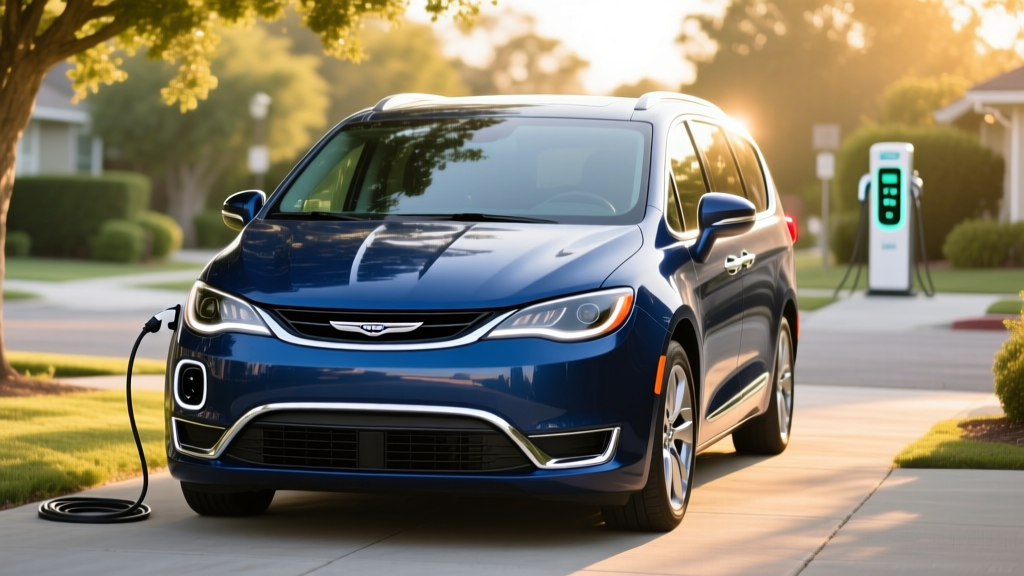
The minivan segment has thinned out dramatically, and the Chrysler Pacifica Hybrid remains the sole plug-in hybrid (PHEV) minivan available in the U.S. market for 2026. For families who want electric-only commuting during the week and gas-powered road-trip flexibility on weekends — without committing to a full battery-electric vehicle — the Pacifica Hybrid plug-in occupies a unique and practical niche.
This guide breaks down everything you need to know: EPA range and MPGe figures, real-world fuel economy, charging logistics, the 16 kWh battery system, powertrain output, pricing across trims, federal tax credit eligibility under current IRS §30D rules, and long-term battery reliability. Whether you're cross-shopping against the Toyota Sienna (a conventional hybrid, not a PHEV) or considering a full EV like the Kia EV9, this is your decision framework.
HEV vs PHEV: Where the Pacifica Hybrid Fits
Before diving into specs, it's critical to distinguish between a conventional hybrid (HEV) and a plug-in hybrid (PHEV), because the Chrysler Pacifica is sold in both forms — and they serve different buyers.
| Feature | Pacifica Hybrid (PHEV) | Pacifica Gas / Toyota Sienna (HEV) |
|---|---|---|
| Plug-in charging | Yes — 16 kWh battery, Level 1 & Level 2 | No — charges via regenerative braking only |
| Electric-only range | 32 miles (EPA) | None (or <1 mile at very low speed) |
| Gasoline engine | 3.6L V6 + dual electric motors | 3.6L V6 (Pacifica) or 2.5L I4 (Sienna) |
| EPA combined | 82 MPGe (electric + gas) / 30 MPG (gas only) | 36 MPG combined (Sienna HEV) |
| Federal tax credit | Eligible up to $7,500 under §30D (with caveats) | Not eligible |
| Starting MSRP (2026) | ~$51,095 | ~$40,995 (Pacifica gas) / ~$39,500 (Sienna) |
The PHEV version is the one with the charging port and the bigger battery. If you see "Pacifica Hybrid" in marketing materials, Chrysler is referring to the PHEV — not a conventional hybrid. The standard Pacifica (non-hybrid) uses a traditional 3.6L V6 with no electric assist. The Toyota Sienna, by contrast, comes exclusively as a conventional HEV — it cannot plug in and has no meaningful electric-only range.
Electric-Only Range, MPGe, and Real-World MPG
The 2026 Chrysler Pacifica Hybrid plug-in carries a 16 kWh lithium-ion battery pack (approximately 14.4 kWh usable), which the EPA rates at 32 miles of electric-only range. That figure assumes moderate temperatures, flat terrain, and mixed driving. In practice, expect the following:
Real-world expectation: 26–30 miles in warm weather; 20–24 miles in cold weather (below 40°F) due to cabin heating demands and reduced battery efficiency.
Total combined range (electric + gas): ~460 miles
Once the battery depletes, the Pacifica Hybrid operates as a conventional hybrid, blending the V6 and electric motors. The EPA rates it at 30 MPG combined in charge-sustaining (gas-only) mode. Here's the full breakdown:
| Mode | City | Highway | Combined |
|---|---|---|---|
| Electric + Gas (MPGe) | 82 MPGe | 82 MPGe | 82 MPGe |
| Gas Only (charge-sustaining) | 29 MPG | 30 MPG | 30 MPG |
Real-world note: PHEVs reward city and suburban driving. In stop-and-go traffic, regenerative braking recaptures energy aggressively, and many owners report 32–35 MPG in gas-only city driving — exceeding the EPA city estimate. Highway driving at 75+ mph will drop gas-only economy to roughly 26–28 MPG due to the Pacifica's 5,000+ lb curb weight and minivan aerodynamics. Source: EPA fueleconomy.gov.
Battery, Charging, and Powertrain Specs
The Pacifica Hybrid's electrified powertrain pairs Chrysler's 3.6-liter Pentastar V6 with a dual-motor eFlite electrically variable transmission (eVT). There is no traditional mechanical transmission — the electric motors and a one-speed gear reduction handle power delivery. Here are the headline numbers:
| Specification | 2026 Chrysler Pacifica Hybrid PHEV |
|---|---|
| Battery capacity | 16 kWh total (~14.4 kWh usable), lithium-ion (NMC chemistry) |
| Electric-only range (EPA) | 32 miles |
| Combined system horsepower | 260 hp |
| Engine | 3.6L V6 Atkinson-cycle, 262 lb-ft torque |
| Electric motors | Dual motor eFlite eVT |
| Level 1 charging (120V, 12A) | ~14 hours (0–100%) |
| Level 2 charging (240V, 32A) | ~2 hours (0–100%) |
| DC fast charging | Not supported — AC charging only |
| Charge port | J1772 (driver-side front fender) |
| 0–60 mph | ~7.1 seconds |
| Curb weight | ~5,055 lbs |
| Cargo volume (behind 3rd row) | 32.3 cu ft |
| Towing capacity | Not rated (PHEV AWD not available; FWD only) |
kW vs kWh reminder: The battery stores 16 kWh (kilowatt-hours) of energy. The Level 2 onboard charger accepts up to ~7.2 kW (kilowatts) of power. Dividing 16 kWh by 7.2 kW gives roughly 2.2 hours — consistent with Chrysler's stated 2-hour Level 2 charge time.
Pricing, Trims, and Federal Tax Credit Eligibility
The 2026 Chrysler Pacifica Hybrid plug-in is available in Select, Limited, and Pinnacle trims. Pricing starts around $51,095 (including destination) for the Select trim and climbs to approximately $57,000+ for the Pinnacle. All-wheel drive is not available on the PHEV — it is front-wheel drive only. (The non-hybrid Pacifica offers AWD as an option.)
- Maximum credit: Up to $7,500, split into two halves ($3,750 for critical minerals + $3,750 for battery component sourcing)
- MSRP cap: Vans/SUVs capped at $80,000 — the Pacifica Hybrid qualifies on MSRP
- Buyer income cap: $150,000 single / $225,000 head of household / $300,000 joint (modified AGI)
- Battery sourcing: Critical minerals and battery components must meet escalating domestic/free-trade-partner thresholds — Chrysler's supply chain compliance varies by model year; verify current eligibility
- Point-of-sale transfer: Buyers can transfer the credit to the dealer for an upfront price reduction, rather than waiting for a tax refund
- Verify before buying: Check the latest eligibility on fueleconomy.gov and consult a tax professional — sourcing rules tighten annually
The Pacifica Hybrid's PHEV battery is large enough (16 kWh exceeds the §30D minimum of 7 kWh) to qualify in principle, but the critical-mineral and battery-component sourcing requirements are the swing factor. These thresholds tighten each year under the Inflation Reduction Act. Always confirm the specific VIN's eligibility before finalizing a purchase.
Battery Warranty, Reliability, and Replacement Cost
Hybrid system warranty: 8 years / 100,000 miles for the eFlite transmission and electric motors.
Estimated out-of-warranty battery replacement: $7,000–$10,000+ (parts and labor). This is a significant expense, but PHEV batteries in normal use rarely require full replacement within the warranty period. Degradation is gradual — expect 85–90% capacity retention at 100,000 miles under typical use.
Chrysler's Pacifica Hybrid has been in production since the 2017 model year, giving us nearly a decade of real-world data. Early model years (2017–2019) experienced some recalls related to the high-voltage battery system — specifically, a fire risk linked to battery cell manufacturing defects that prompted a 2022 recall and software update. Stellantis addressed this with a revised battery management system and, in some cases, battery pack replacements under warranty.
For 2024–2026 models, reliability has improved. The NMC (nickel-manganese-cobalt) battery chemistry is well-proven in PHEV applications. To maximize battery longevity:
- Avoid routinely charging to 100% and leaving the vehicle sitting in extreme heat — the Pacifica's battery management system includes a buffer, but thermal stress accelerates degradation
- Use Level 2 charging when possible rather than relying solely on Level 1, as Level 2 charging generates less sustained heat at the cell level for this pack size
- Precondition the cabin while still plugged in (using the Uconnect app) to reduce the battery's thermal load during cold-weather starts
For ongoing safety and reliability data, check NHTSA.gov for recalls and owner complaints.
Driving Experience: What It's Actually Like
In electric mode, the Pacifica Hybrid is genuinely quiet and smooth — a stark contrast to the engine drone of a conventional minivan on the school-run commute. The 260 combined horsepower is adequate for merging and passing, though the 5,055-lb curb weight is noticeable during spirited cornering. This is a comfort-oriented family hauler, not a performance vehicle.
The transition from electric to gas is seamless. When the battery depletes (or when you demand hard acceleration), the V6 fires up with minimal drama. The eFlite eVT doesn't have the rubber-band sensation of some older CVTs — power delivery is linear and predictable.
One practical compromise: the PHEV battery pack sits under the second-row floor, which eliminates the Stow 'n Go seating feature for the second row. You can still fold the third row flat, and the second-row captain's chairs are comfortable and removable, but you lose the minivan party trick of folding everything into the floor for a flat cargo area. If maximum cargo flexibility is a priority, the gas-only Pacifica (with Stow 'n Go in both rows) or the Toyota Sienna (which also lacks Stow 'n Go but offers more standard cargo volume) may be better fits.
Pacifica Hybrid Plug-In vs. the Alternatives
Pros
- Only PHEV minivan on the market — no direct competitor
- 32 miles electric-only covers most daily school runs and errands
- Strong combined system output (260 hp) for a minivan
- Federal tax credit potential up to $7,500 (verify eligibility)
- 10-year / 100,000-mile battery warranty
- Premium Pinnacle trim offers luxury-minivan experience
- Uconnect 5 infotainment is one of the best in the segment
Cons
- No DC fast charging — AC only
- FWD only — AWD not available on PHEV trim
- Second-row Stow 'n Go eliminated by battery pack
- Starting MSRP ~$51K is steep before incentives
- Gas-only highway MPG (~26–28) lags Toyota Sienna HEV (~36 combined)
- Early model-year recalls damaged brand trust (addressed, but noted)
- 32-mile electric range is modest vs. newer PHEVs (RAV4 Prime: 42 mi)
vs. Toyota Sienna (HEV): The Sienna delivers a superior 36 MPG combined without ever plugging in, starts around $39,500, and offers available AWD. It cannot, however, drive on electric power alone for any meaningful distance. If you can't charge at home and just want excellent fuel economy, the Sienna HEV is the more rational pick. If you can charge at home and want to eliminate gas use on short daily trips, the Pacifica PHEV wins.
vs. Full EV (Kia EV9, Tesla Model X): A three-row EV like the Kia EV9 (EPA range ~304 miles, starting ~$56,000) eliminates gas entirely but costs more upfront, requires reliable home charging infrastructure, and may cause range stress on long family road trips. The Pacifica PHEV is the bridge — zero-emissions daily driving with a gas tank as a safety net.
Decision Framework: Who Should Buy the Pacifica Hybrid Plug-In?
Choose the Chrysler Pacifica Hybrid PHEV if:
- You have access to home Level 2 charging (or at least a dedicated 120V outlet in the garage)
- Your daily driving is under 30 miles round-trip — you'll run almost entirely on electricity
- You need a minivan (not a three-row SUV) for sliding doors, kid-hauling, and accessibility
- You take 2+ road trips per year where a full EV would cause range anxiety
- You qualify for the federal §30D tax credit and/or your state offers additional PHEV incentives
Choose the Toyota Sienna HEV instead if:
- You cannot charge at home (apartment, street parking, no garage outlet)
- You prioritize the lowest possible fuel cost without behavioral changes
- You need AWD for snow/ice climates
- Starting price is a primary concern
Choose a full EV (Kia EV9, etc.) instead if:
- You want zero tailpipe emissions and have reliable home + destination charging
- You drive under 250 miles daily and can plan road-trip charging stops
- You want to eliminate oil changes and gas-engine maintenance entirely
Frequently Asked Questions
How many MPG does the Chrysler Pacifica Hybrid plug-in get?
The EPA rates the Pacifica Hybrid at 82 MPGe combined when operating on both electric and gas power, and 30 MPG combined (29 city / 30 highway) once the battery is depleted and the vehicle runs on gas alone. In real-world city driving, many owners report 32–35 MPG in gas-only mode thanks to aggressive regenerative braking. Highway gas-only economy drops to roughly 26–28 MPG at speeds above 70 mph.
How far can the Pacifica Hybrid go on electric only?
The EPA rates it at 32 miles of electric-only range. In warm weather with moderate driving, expect 26–30 real-world miles. In cold weather (below 40°F), cabin heating and reduced battery efficiency cut that to approximately 20–24 miles. For families with a sub-25-mile daily commute, this covers nearly all weekday driving without using a drop of gasoline.
Does the Chrysler Pacifica Hybrid qualify for a tax credit?
It may qualify for up to $7,500 under the federal §30D clean vehicle credit, but eligibility depends on your income (capped at $150K single / $300K joint), the vehicle's battery sourcing compliance (critical minerals and component rules that tighten annually), and the MSRP cap ($80K for vans, which the Pacifica clears). The credit can be transferred to the dealer at point of sale for an upfront price reduction. Always verify the specific VIN on fueleconomy.gov and consult a tax professional before relying on the credit.
Is the Pacifica Hybrid reliable, and what does battery replacement cost?
Reliability has improved significantly since the 2017–2019 launch years, which saw battery-related recalls. The 2024–2026 models benefit from revised battery management software and improved cell quality. The high-voltage battery is covered by a 10-year / 100,000-mile warranty. Out-of-warranty replacement is estimated at $7,000–$10,000+, but most PHEV batteries retain 85–90% capacity at 100K miles and rarely need full replacement. Routine maintenance (cabin air filter, brake fluid, tire rotation) is lower than a gas-only minivan because regenerative braking reduces brake wear.
Can the Pacifica Hybrid DC fast charge?
No. The Pacifica Hybrid supports only AC charging: Level 1 (120V, ~14 hours for a full charge) and Level 2 (240V, ~2 hours for a full charge) via a J1772 connector. There is no DC fast-charge port. For a PHEV with a 16 kWh battery, Level 2 overnight charging at home is the intended use case, and most owners find the 2-hour Level 2 time perfectly adequate.
Hybrid vs PHEV vs EV — which is right for my family?
If you can charge at home and your daily driving is under 30 miles, the Pacifica PHEV gives you EV-like daily driving with gas-engine backup for road trips — the best of both worlds. If you can't charge at home, a conventional HEV like the Toyota Sienna delivers excellent MPG without any plug-in requirement. If you have reliable charging access and want to eliminate gasoline entirely, a three-row BEV like the Kia EV9 offers 300+ miles of range and near-zero running costs, at a higher purchase price and with road-trip planning required.