The Chrysler Pacifica Hybrid remains the only plug-in hybrid minivan on the U.S. market, and for families weighing electrification without range anxiety, it occupies a unique lane. But buying one isn't just about comparing trims — it's about understanding how financing, federal tax incentives, and real-world fuel savings stack up against both the gas-only Pacifica and a full battery-electric alternative. This guide breaks down the numbers you need to decide whether the Pacifica PHEV fits your garage and your budget in 2026.
HEV vs PHEV: What the Pacifica Hybrid Actually Is
Chrysler sells two flavors of Pacifica, and confusing them at the dealership is the single most common buyer mistake:
Conventional Hybrid (HEV) — Not Offered on Pacifica
A standard hybrid uses regenerative braking and a small battery to assist a gas engine. It never plugs in and offers no electric-only driving. The Pacifica does not come in a conventional HEV variant — unlike the Toyota Sienna, which is HEV-only.
Plug-In Hybrid (PHEV) — Pacifica Hybrid
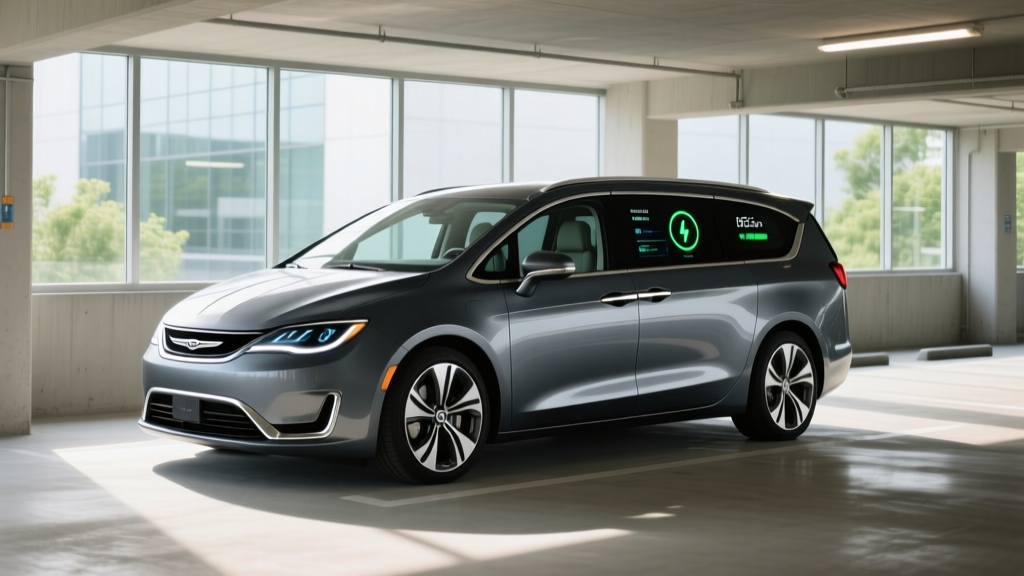
The Pacifica Hybrid pairs a 3.6-liter V6 with two electric motors and a 16 kWh lithium-ion battery pack. You plug it in to charge (Level 1 or Level 2), get up to 32 miles of electric-only range, and when the battery depletes, it operates as a conventional hybrid. This gives families short electric commutes plus gas-engine flexibility for road trips.
Powertrain, Range, and EPA Fuel Economy
The Pacifica Hybrid's powertrain produces a combined 260 horsepower from its V6 engine and dual electric motors, routed through a dedicated continuously variable transmission (eVT). The 16 kWh battery pack uses NMC (nickel-manganese-cobalt) chemistry and sits beneath the second-row floor — which means the Pacifica Hybrid sacrifices the Stow 'n Go second-row seating found on the gas model. The seats fold forward but do not stow into the floor.
| Spec | Value |
|---|---|
| Powertrain | 3.6L V6 + dual electric motors (260 hp combined) |
| Battery | 16 kWh (NMC lithium-ion) |
| Electric-only range (EPA) | 32 miles |
| Total combined range | ~520 miles |
| MPGe (electric + gas, EPA) | 82 MPGe combined |
| Gas-only MPG (after battery depletes) | 30 MPG combined |
| 0–60 mph | ~7.1 seconds |
| Level 2 charge time (0–100%) | ~2 hours at 7.2 kW |
| DC fast charging | Not supported |
| Towing capacity | Not rated (gas Pacifica: 3,600 lbs) |
Real-World Range vs. EPA Sticker
EPA electric range: 32 miles. In real-world driving, expect 26–30 miles on a full charge in mixed city/highway use. Cold weather (below 40°F) can reduce electric-only range by 20–30%, dropping to roughly 22–26 miles. Highway driving at 70+ mph depletes the battery faster than the EPA cycle assumes. Once the battery is depleted, the hybrid system delivers approximately 28–31 MPG combined in real-world conditions — close to the EPA's 30 MPG rating, and sometimes better in stop-and-go city traffic where regenerative braking shines.
| Mode | City | Highway | Combined |
|---|---|---|---|
| Electric + Gas (MPGe) | — | — | 82 MPGe |
| Gas-only (after depletion) | 29 MPG | 30 MPG | 30 MPG |
For context, the gas-only Pacifica with the same V6 rates at 19 city / 28 highway / 22 combined (source: fueleconomy.gov). The Sienna hybrid (HEV, not PHEV) delivers 36 MPG combined but offers zero electric-only miles. The Pacifica Hybrid's advantage is daily electric commuting; its disadvantage is lower gas-only MPG than the Sienna once the battery is spent.
Charging: What You Need at Home
The Pacifica Hybrid charges exclusively via AC — there is no DC fast-charging capability, which is typical for PHEVs with smaller battery packs.
| Level | Power | Time (0–100%) | Setup |
|---|---|---|---|
| Level 1 (120V household outlet) | ~1.4 kW | ~14 hours | Included cord, standard outlet |
| Level 2 (240V) | 7.2 kW | ~2 hours | Home wall charger or public Level 2 |
A Level 2 home charger is strongly recommended. Overnight charging on Level 2 fully replenishes the 16 kWh battery in about two hours, meaning you'll start every morning with a full 32-mile electric range. A Level 2 charger installation typically costs $500–$1,500 depending on your electrical panel's capacity and the distance from panel to garage (source: energy.gov). If your home has a 200-amp panel with spare breaker slots, expect the lower end of that range.
Financing the Pacifica Hybrid: Payments, Incentives, and Total Cost
The 2026 Chrysler Pacifica Hybrid starts at approximately $51,095 MSRP for the Select trim, with the Limited Pinnacle trim reaching roughly $57,895. These prices place it at a significant premium over the gas-only Pacifica (starting ~$39,000) and above the Toyota Sienna hybrid (~$38,000).
Federal Tax Credit Eligibility (§30D)
Here's where Pacifica Hybrid finance planning gets complicated. Under the current IRS §30D Clean Vehicle Credit rules, the Pacifica Hybrid faces several hurdles:
- MSRP cap: Vans and SUVs must have an MSRP below $80,000 — the Pacifica Hybrid clears this threshold.
- Buyer income cap: Modified adjusted gross income must not exceed $150,000 (single), $225,000 (head of household), or $300,000 (joint). (source: irs.gov)
- Battery sourcing requirements: A percentage of critical minerals and battery components must be sourced from the U.S. or free-trade-agreement countries. This requirement tightens annually and has disqualified several PHEVs from the full $7,500 credit. Stellantis has not consistently confirmed full §30D eligibility for the Pacifica Hybrid in recent model years.
- Point-of-sale transfer: If eligible, the credit can be transferred to the dealer at purchase, reducing your financed amount directly — a significant cash-flow advantage.
Bottom line: Do not assume a $7,500 credit. Verify current eligibility on the IRS qualified vehicle list and consult a tax professional before finalizing your purchase. If the Pacifica Hybrid qualifies for even a partial credit, it meaningfully reduces the effective price gap with the gas model.
Sample Finance Scenario
| Variable | Amount |
|---|---|
| MSRP | $51,095 |
| Estimated incentives / credit | –$3,750 (partial, if eligible) |
| Down payment | $5,000 |
| Amount financed | $42,345 |
| Term / APR | 72 months / 5.9% |
| Estimated monthly payment | ~$698 |
Compare this to a gas Pacifica Touring at ~$39,000 MSRP with a $3,000 down payment, financed at the same terms: roughly $575/month. The PHEV premium is approximately $123/month before fuel savings. If you drive 12,000 miles annually and charge at home (at ~$0.14/kWh national average), the Pacifica Hybrid saves roughly $800–$1,100/year in fuel versus the gas Pacifica — partially offsetting the higher payment. The breakeven point depends heavily on your electric rate, daily mileage, and whether you actually plug in every night.
Reliability, Battery Warranty, and Replacement Costs
Battery and Powertrain Coverage
Hybrid battery warranty: 10 years / 100,000 miles (federal emissions-related component coverage). Chrysler warrants the 16 kWh battery pack against defects and excessive capacity loss for this period.
Powertrain warranty: 5 years / 60,000 miles, covering the V6 engine, electric motors, and eVT transmission.
Bumper-to-bumper: 3 years / 36,000 miles.
The Pacifica Hybrid's reliability record has been mixed. Early model years (2017–2019) saw recalls related to the high-voltage battery system, including a fire-risk recall that required software updates and, in some cases, battery pack replacements. More recent model years have shown improved stability. The NHTSA lists multiple recalls for early Pacifica Hybrids — buyers of used models should verify recall completion (source: nhtsa.gov).
If the battery pack requires out-of-warranty replacement, expect a cost between $7,000 and $9,500 including parts and labor. This is comparable to other PHEV battery replacements and significantly less than a full-EV pack replacement. In practice, PHEV batteries experience less stress than BEV batteries because the smaller pack is buffered by the gas engine — you rarely cycle it to true zero. Most Pacifica Hybrid owners report minimal degradation over 80,000–100,000 miles.
Pacifica Hybrid vs. Full EV vs. Gas Minivan: Which Fits?
Decision Framework
Choose the Pacifica Hybrid if:
- Your daily driving is under 30 miles and you can charge at home every night
- You need minivan space (7 passengers, sliding doors, cargo room) but also take road trips where charging infrastructure is sparse
- You want electric daily driving without committing to a full EV
- You value the Pacifica's available AWD-delete, luxury trims, and Uconnect infotainment
Choose a full EV (e.g., Kia EV9, Tesla Model X) if:
- Your daily range needs are under 250 miles and you have reliable home + public charging
- You want zero tailpipe emissions and minimal maintenance (no oil changes, no V6)
- You're willing to pay a higher upfront price for lower per-mile energy cost
- You don't need minivan-specific features like Stow 'n Go or sliding-door kid access
Choose a gas-only or conventional hybrid minivan (Toyota Sienna HEV) if:
- You cannot charge at home (apartment, street parking, no garage outlet)
- Your budget is tighter and the PHEV premium doesn't pencil out
- You want maximum cargo flexibility (Sienna's HEV system doesn't compromise interior space)
- You prioritize proven long-term reliability with lower upfront cost
Pros
- Only PHEV minivan available — 32 electric miles covers most school runs and commutes
- 30 MPG gas-only mode is respectable for a V6 minivan
- Level 2 charging in ~2 hours is fast for a PHEV
- Available luxury features (Pinnacle trim: quilted leather, dual-pane sunroof)
- Qualifies for HOV lane access in several states (check local rules)
Cons
- No Stow 'n Go second-row seats (battery occupies the floor well)
- No DC fast charging — road-trip electric range is limited to the first 32 miles
- Significant price premium over gas Pacifica and Sienna hybrid
- Early-model-year reliability concerns and battery recalls
- Federal tax credit eligibility uncertain due to battery-sourcing rules
- No AWD option (gas Pacifica offers available AWD)
Frequently Asked Questions
How many MPG does the Chrysler Pacifica Hybrid get?
The EPA rates the Pacifica Hybrid at 82 MPGe combined when using both electric and gas power. Once the 16 kWh battery is depleted, it operates as a conventional hybrid at 30 MPG combined (29 city / 30 highway). In real-world city driving with frequent regenerative braking, owners often see 31–33 MPG in hybrid mode.
How far can the Pacifica Hybrid go on electric only?
The EPA rates it at 32 miles of electric-only range. Real-world results typically fall between 26–30 miles in moderate weather, dropping to 22–26 miles in cold conditions or at sustained highway speeds above 70 mph.
Does the Chrysler Pacifica Hybrid qualify for a federal tax credit?
Eligibility under IRS §30D depends on current battery-sourcing requirements, your income, and the vehicle's MSRP. The Pacifica Hybrid's MSRP is under the $80,000 van cap, but critical-mineral and battery-component rules may limit the credit to a partial amount or zero. Always verify on the IRS qualified vehicles list and consult a tax professional before purchase.
Is the Pacifica Hybrid reliable, and what does a battery replacement cost?
Reliability has improved in recent model years after early recalls for high-voltage battery issues. The battery is warranted for 10 years / 100,000 miles. Out-of-warranty replacement costs approximately $7,000–$9,500. Most owners report minimal battery degradation within the warranty period.
Do I need to plug in the Pacifica Hybrid every night?
You don't have to — the gas engine takes over seamlessly when the battery depletes. But to capture the fuel savings that justify the PHEV premium, you should plug in nightly. A Level 2 home charger refills the battery in about 2 hours. If you never plug in, you're carrying 16 kWh of dead battery weight and getting only 30 MPG — worse than a Toyota Sienna hybrid's 36 MPG combined.
Can the Pacifica Hybrid DC fast charge?
No. The Pacifica Hybrid supports only Level 1 (120V) and Level 2 (240V) AC charging. This is standard for PHEVs with smaller battery packs. On road trips, you'll use the first ~30 miles on electric, then rely on the gas engine and regenerative braking to maintain hybrid efficiency.