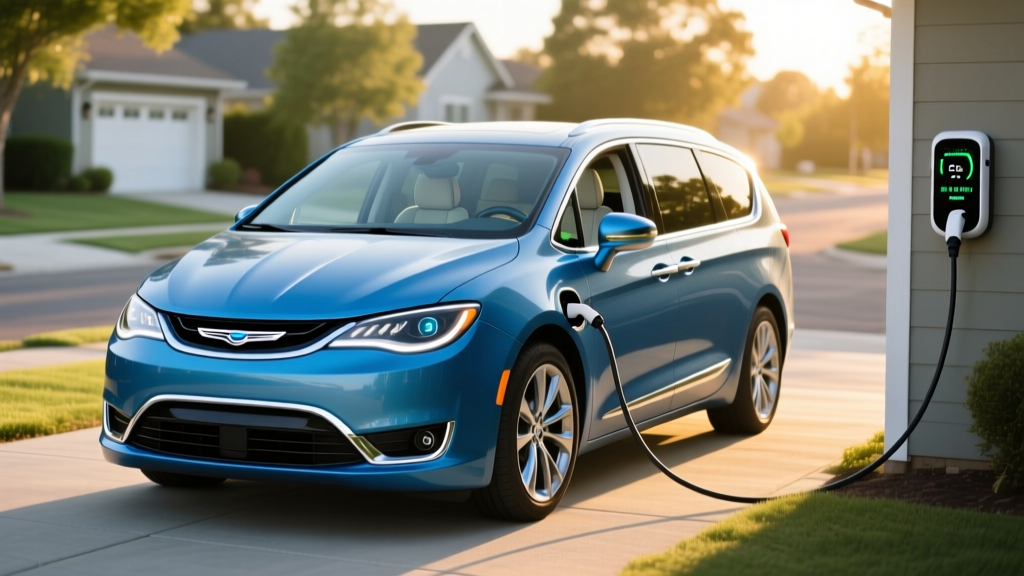
If you're researching the 2018 Chrysler Pacifica Hybrid on the used market, you're looking at what was — and in many ways still is — the only plug-in hybrid minivan sold in the United States. Chrysler paired a 3.6-liter V6 with a 16 kWh battery and two electric motors to create a family hauler that can handle school runs on electricity alone and road trips on gasoline. But with a 2018 model now six years old, the critical questions shift from brochure specs to battery health, real-world efficiency, and whether a used PHEV still makes financial sense in 2026.
This guide covers every number you need: EPA range, MPGe, battery capacity, charging times, warranty status, and used-market pricing — plus a clear framework for deciding whether this PHEV, a conventional hybrid, or a full EV better fits your family.
HEV vs PHEV: Where the Pacifica Hybrid Fits
Before diving into specs, it's essential to distinguish between the two hybrid architectures buyers encounter:
| Feature | Conventional Hybrid (HEV) | Plug-In Hybrid (PHEV) | Full EV (BEV) |
|---|---|---|---|
| Plugs in? | No — self-charging via regen & engine | Yes — plus regenerative braking | Yes — only electricity |
| Electric-only range | 0–2 miles at low speed | 20–50 miles typical | 200–400+ miles |
| Gas engine? | Yes (primary) | Yes (backup/extended range) | No |
| Example | Toyota Sienna Hybrid | 2018 Chrysler Pacifica Hybrid | Kia EV9 |
The 2018 Chrysler Pacifica Hybrid is a PHEV. It can plug into a Level 1 (120V) or Level 2 (240V) charger and drive up to 32 miles on electricity alone before the V6 engine engages. This is fundamentally different from the Toyota Sienna Hybrid, which is a conventional HEV — it never plugs in and has no meaningful electric-only range, but achieves strong MPG continuously through regenerative braking and engine optimization.
Powertrain Specs: What Moves the Pacifica PHEV
| Specification | 2018 Chrysler Pacifica Hybrid |
|---|---|
| Engine | 3.6L Pentastar V6 (Atkinson cycle) |
| Electric Motors | 2 integrated motors (within eFlite CVT) |
| Combined System Output | 262 hp |
| Battery Capacity | 16 kWh lithium-ion (NMC chemistry) |
| Usable Battery Capacity | ~13 kWh (buffer protects longevity) |
| Transmission | eFlite electrically variable transmission (SI-EVT) |
| Drivetrain | Front-wheel drive |
| 0–60 mph | ~7.4 seconds (hybrid mode) |
| Towing Capacity | Not rated (PHEV variant) |
| DC Fast Charging | Not supported — AC only (J1772) |
The dual-motor eFlite transmission is the engineering centerpiece. One motor primarily drives the wheels while the second can either assist or function as a generator. Chrysler's one-way clutch allows the V6 to disconnect entirely during electric-only operation, eliminating parasitic drag. The result is seamless transitions between EV and hybrid modes that most passengers won't notice.
One important limitation: the 2018 Pacifica Hybrid cannot DC fast charge. It accepts only AC charging via a J1772 connector, topping out at roughly 6.6 kW on Level 2. This is typical for PHEVs of this era — the battery is small enough that overnight Level 2 charging fully replenishes it.
Range, MPGe, and MPG: The Numbers That Matter
| Metric | EPA Rating | Real-World Expectation |
|---|---|---|
| Electric-only range | 32 miles | 25–30 mi (highway/cold); 30–35 mi (city/mild weather) |
| MPGe (charge-sustaining + electric) | 84 MPGe combined | Varies heavily by plug-in frequency |
| MPG (gas-only, hybrid mode) | 32 combined / 32 city / 31 highway | 28–33 combined depending on driving style |
| Total range (full tank + full battery) | 566 miles | ~500–550 miles |
| Fuel tank capacity | 16.0 gallons | — |
The 32 city / 31 highway split in hybrid mode is unusual. Most hybrids score higher in the city, where regenerative braking and electric assist shine. The Pacifica's relatively flat city/highway numbers reflect its 5,000+ pound curb weight and minivan aerodynamics. Still, 32 MPG combined in a three-row, seven-passenger vehicle remains competitive with the Toyota Sienna Hybrid's ~36 MPG combined — especially considering the Pacifica's electric-only capability.
Charging the Pacifica PHEV: Times, Levels, and Costs
| Charging Level | Power | Time (0–100%) | Connector |
|---|---|---|---|
| Level 1 (120V household) | ~1.4 kW | ~14 hours | J1772 (standard 3-prong plug) |
| Level 2 (240V home/public) | ~6.6 kW | ~2 hours | J1772 |
| DC Fast Charge | — | Not supported | — |
The 2-hour Level 2 time is the practical sweet spot. Most PHEV owners install a basic 240V Level 2 charger (such as a ChargePoint Home Flex or Emporia Vue) in their garage, plug in overnight, and wake to a full 32-mile electric buffer every morning. A Level 2 installation typically costs $500–$1,500 including equipment and electrician labor, depending on panel proximity and local permitting.
Level 1 charging from a standard outlet technically works, but at 14 hours for a full charge, it's only practical if the van sits unused for extended periods. For daily use, Level 2 is strongly recommended.
Charging cost per full battery (16 kWh): at the US average residential rate of ~$0.17/kWh in 2026, a full charge costs roughly $2.72 for 32 miles of driving — equivalent to about $0.085 per mile electric. Compare that to $0.14–$0.18 per mile on gasoline at $3.50/gallon and 32 MPG.
Battery Health, Warranty, and Replacement Cost
This is the single most important consideration for anyone buying a used 2018 Pacifica Hybrid in 2026. If the vehicle is registered in a CARB state (California, New York, Massachusetts, and about a dozen others), the battery warranty may still be active for roughly two more years. In non-CARB states, the 8-year warranty has likely expired unless the vehicle has very low mileage and was purchased late in the 2018 calendar year.
Degradation reality: Owner reports and fleet data suggest the 16 kWh NMC battery in the 2018 Pacifica Hybrid holds approximately 80–90% of original capacity at the 6-year mark, depending on climate and charging habits. Vehicles in hot climates (Arizona, Texas) that were frequently charged to 100% and left sitting in heat show more degradation. A Pacifica that was charged nightly to 100% but driven and cycled regularly in moderate climates tends to fare better. Expect roughly 26–29 miles of real-world electric range on a well-maintained 2018 unit today.
Battery replacement cost: If the battery falls below the warranty threshold within the coverage period, Chrysler replaces it at no cost. Out of warranty, a replacement high-voltage battery pack runs approximately $7,000–$9,500 including parts and labor at a dealership. Third-party refurbished batteries are emerging in the 2026 aftermarket at $4,500–$6,000, but availability varies. Before purchasing any used 2018 Pacifica Hybrid, have the dealer run a State of Health (SoH) diagnostic on the HV battery — this is non-negotiable.
Used Pricing and Tax Credit Eligibility in 2026
As of early 2026, a used 2018 Chrysler Pacifica Hybrid typically lists between $18,000 and $27,000 depending on mileage, condition, and trim (Touring L, Limited, or Platinum). The original MSRP ranged from approximately $42,990 (Touring L) to $47,990 (Platinum), before the $7,500 federal credit that applied at new-vehicle purchase.
Used EV tax credit (IRS §25E): Under current IRS rules, buyers of a used Pacifica Hybrid from a dealer may qualify for a federal tax credit of 30% of the sale price, up to $4,000. Key eligibility requirements:
- Vehicle price cap: Sale price must be $25,000 or less
- Buyer income cap: AGI must not exceed $75,000 (single), $112,500 (head of household), or $150,000 (joint)
- Vehicle age: Must be at least 2 model years old (2018 qualifies)
- Battery capacity: Must have at least 7 kWh (Pacifica's 16 kWh qualifies)
- Dealer sale: Must be purchased from a licensed dealer, not private party
- First use: Must be first time the buyer claims this credit for this vehicle
At a $22,000 purchase price, the credit would be $4,000 (30% exceeds the cap), effectively reducing net cost to $18,000. This makes a used Pacifica Hybrid significantly more attainable than its original sticker suggested. Consult a tax professional and review current IRS §25E guidance before finalizing a purchase, as rules are subject to legislative change.
Who Should Buy the 2018 Pacifica Hybrid — And Who Shouldn't
Choose the 2018 Pacifica Hybrid if:
- You need three rows and can charge at home nightly
- Most daily trips are under 30 miles (school, groceries, activities)
- You want electric daily driving but gas flexibility for road trips
- You find one with verified battery SoH above 80% and under 80,000 miles
- You qualify for the used-EV tax credit
Choose the Toyota Sienna Hybrid (HEV) instead if:
- You cannot install a home charger (apartment, street parking)
- You want simpler ownership with no plug-in routine
- You prioritize slightly higher combined MPG (36 vs 32) over electric-only miles
- You want AWD (Pacifica Hybrid is FWD only)
Choose a full EV (like a Kia EV9 or Tesla Model X) if:
- You have reliable home and workplace charging
- You rarely drive more than 250 miles without stopping
- You want to eliminate gasoline entirely and minimize maintenance
- You have a higher budget ($45,000+ for a capable three-row EV)
The Pacifica Hybrid occupies a very specific niche: families who want electric commuting without range anxiety on long trips, and who need the cargo space and sliding doors that no current three-row EV matches at a comparable used price.
- 32-mile electric range covers most daily family logistics
- Stow 'n Go second-row seating (unique to PHEV variant: third row only — second-row seats don't fold into floor due to battery, but are removable)
- 566-mile total range eliminates road-trip charging dependence
- Smooth, quiet electric driving in EV mode
- Used-EV tax credit can reduce effective cost by up to $4,000
- Strong cargo volume (140.5 cu ft behind first row)
- Battery warranty expiring or expired on 2018 models (non-CARB states)
- No DC fast charging — irrelevant for daily PHEV use but limits flexibility
- FWD only — no AWD option for snow-belt buyers
- Second-row Stow 'n Go eliminated (battery occupies under-floor space)
- Outdated infotainment vs 2026 standards (Uconnect 4, no wireless CarPlay)
- $7,000+ out-of-warranty battery replacement risk
Reliability and Common Issues
The 2018 Pacifica Hybrid's powertrain has proven generally reliable, but a few known issues warrant a pre-purchase inspection:
- High-voltage battery coolant leak: Some owners report coolant seepage near the battery housing. Check for crusty residue and verify coolant levels.
- 12V auxiliary battery drain: The conventional 12V battery can drain if the vehicle sits unplugged for extended periods. A dead 12V battery prevents the HV system from starting.
- Power sliding door mechanisms: A Pacifica-wide issue (not hybrid-specific) — test all powered doors and liftgate for smooth operation.
- Uconnect 4 software glitches: Freezing or slow response. Check for available firmware updates at the dealer.
For authoritative reliability data, consult NHTSA recall records — the 2018 Pacifica Hybrid had recalls related to the high-voltage battery shutdown procedure and powertrain control module software. Verify all recall work was completed before purchase.
Frequently Asked Questions
How many MPG does the 2018 Chrysler Pacifica Hybrid get?
The EPA rates it at 32 MPG combined (32 city / 31 highway) when operating in hybrid mode on gasoline. When factoring in electric-only driving, the combined rating is 84 MPGe. Real-world gas-only MPG typically ranges from 28–33 combined depending on driving style and conditions. The more often you plug in and drive within the 32-mile electric window, the less gasoline you consume overall.
How far can the 2018 Pacifica Hybrid go on electric only?
The EPA rates it at 32 miles of electric-only range. In real-world conditions, expect 25–30 miles in cold weather or highway driving, and 30–35 miles in mild-weather city driving. On a used 2018 model with some battery degradation, plan for 26–29 miles realistically.
Does the 2018 Pacifica Hybrid qualify for any tax credit?
It no longer qualifies for the new-vehicle §30D credit (that applied at original purchase). However, it may qualify for the used clean vehicle credit (§25E): up to $4,000 (30% of sale price) if purchased from a dealer for $25,000 or less, subject to buyer income limits. Verify eligibility on IRS.gov and with your tax professional.
Is the 2018 Pacifica Hybrid reliable, and what does battery replacement cost?
The powertrain is generally reliable with proper maintenance. The primary risk is the high-voltage battery: CARB-state warranty coverage may extend through 2028, but non-CARB 8-year coverage has likely expired. Out-of-warranty battery replacement costs approximately $7,000–$9,500 at a dealer, or $4,500–$6,000 through emerging third-party refurbished options. Always get a battery SoH diagnostic before purchasing.
Can I DC fast charge the 2018 Pacifica Hybrid?
No. The Pacifica Hybrid supports only AC charging via a J1772 connector: Level 1 (120V, ~14 hours) or Level 2 (240V, ~2 hours). This is standard for PHEVs — the 16 kWh battery is small enough that Level 2 overnight charging is fully sufficient for daily use.
Does the 2018 Pacifica Hybrid have Stow 'n Go seating?
Only the third row folds into the floor. The second-row seats are removable but do not fold into the floor because the high-voltage battery occupies that under-floor space. This is a trade-off versus the gas-only Pacifica, which offers full Stow 'n Go in both rows.
Hybrid vs PHEV vs EV — which should I choose for a family vehicle?
If you can charge at home and most trips are under 30 miles, the Pacifica PHEV offers the best of both worlds: electric daily driving with gas backup. If you can't charge at home, a conventional hybrid like the Toyota Sienna HEV is simpler. If you have a higher budget, reliable charging access, and rarely exceed 250 miles between stops, a three-row EV like the Kia EV9 eliminates gasoline entirely but costs significantly more.
The 2018 Chrysler Pacifica Hybrid remains a compelling used buy for the right family — one with home charging, mostly local driving, and a pre-purchase battery health check. At $18,000–$27,000 before the potential $4,000 used-EV credit, it delivers electric commuting that no other minivan on the used market can match. Just go in with eyes open about warranty status and battery replacement cost.