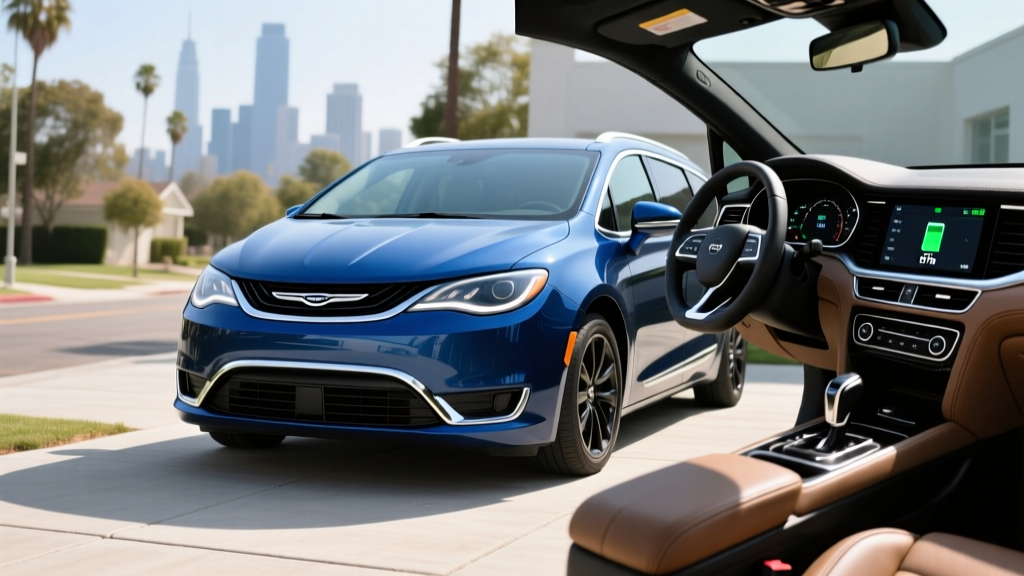
Chrysler's electrified lineup in 2026 remains tightly focused on one vehicle: the Chrysler Pacifica Hybrid, a plug-in hybrid (PHEV) minivan that has held its segment virtually unchallenged since its debut. While competitors like Toyota and Honda offer conventional hybrid minivans, Chrysler is the only automaker selling a plug-in hybrid minivan in the U.S. market — making the 2026 Pacifica Hybrid a singular proposition for families who want electric-only commuting without sacrificing the cargo space and seating flexibility a minivan provides.
But Chrysler's hybrid story in 2026 is not just about the PHEV. The brand also offers a conventional hybrid variant of the Pacifica (HEV) on select trims, which requires no plug-in charging and delivers strong fuel economy through regenerative braking and engine optimization alone. Understanding the difference between these two powertrains — and which one fits your driving pattern — is the key to making the right purchase decision.
HEV vs PHEV: What Chrysler Offers in 2026
Before diving into specs, it is critical to understand the distinction between the two hybrid types Chrysler sells, because the ownership experience differs substantially.
Conventional Hybrid (HEV) vs Plug-In Hybrid (PHEV)
| Feature | Pacifica Hybrid (HEV) | Pacifica Hybrid (PHEV) |
|---|---|---|
| Needs to be plugged in? | No — charges via regenerative braking and engine | Yes — for electric-only range; also self-charges |
| Electric-only driving? | Limited low-speed EV mode (~1 mi) | 32 miles EPA at highway-capable speeds |
| Battery size | ~1.0 kWh (small buffer) | 16.0 kWh usable |
| Federal tax credit (§30D)? | No | Potentially — see eligibility section |
| Best for | No home charging access; want better MPG | Home charging + short commute; want EV-like daily driving |
The conventional HEV is simpler: you drive it exactly like a gas car, and the hybrid system automatically manages the battery and electric motor to optimize fuel consumption. The PHEV adds a much larger battery and a charge port, letting you drive on electricity alone for a meaningful distance before the gas engine kicks in.
2026 Chrysler Pacifica Hybrid: Powertrain & Performance Specs
Both the HEV and PHEV versions of the 2026 Pacifica share the same foundational powertrain: a 3.6-liter Pentastar V6 engine paired with two electric motors integrated into a continuously variable transmission (eVT). The combined system output is 260 horsepower, which is adequate for a vehicle with a curb weight near 5,000 pounds.
| Spec | Pacifica PHEV | Pacifica HEV |
|---|---|---|
| Combined horsepower | 260 hp | 260 hp |
| Engine | 3.6L V6 Atkinson-cycle | 3.6L V6 Atkinson-cycle |
| Electric motors | 2 (integrated in eVT) | 2 (integrated in eVT) |
| Battery (usable) | 16.0 kWh lithium-ion | ~1.0 kWh lithium-ion |
| Electric-only range (EPA) | 32 miles | N/A (EV mode ~1 mi) |
| Total range (EPA) | ~460 miles | ~540 miles |
| EPA combined MPG | 30 MPG (hybrid mode) / 82 MPGe | 30 MPG |
| Level 2 charge time | ~2 hours (7.2 kW onboard) | N/A |
| DC fast charging | Not supported | N/A |
| Seating | 7 passengers | 7–8 passengers |
| Base MSRP | ~$51,095 | ~$44,595 |
Sources: EPA Fueleconomy.gov, Stellantis/Chrysler official specifications.
Fuel Economy Breakdown: EPA vs Real-World MPG
The headline number for the Pacifica PHEV is 82 MPGe when operating in electric mode — this is the miles-per-gallon-equivalent metric the EPA uses to compare electricity consumption to gasoline. Once the battery is depleted and the vehicle operates as a conventional hybrid, the Pacifica PHEV returns 30 MPG combined (29 city / 30 highway).
| Mode | City | Highway | Combined |
|---|---|---|---|
| PHEV — Electric (MPGe) | — | — | 82 MPGe |
| PHEV — Hybrid mode (MPG) | 29 | 30 | 30 |
| HEV — Hybrid mode (MPG) | 29 | 30 | 30 |
Hybrids typically exceed their EPA city estimates in stop-and-go traffic because regenerative braking recaptures energy that a gas car wastes as heat. In our experience with Chrysler's eVT hybrid system, expect 31–33 MPG in city driving and 27–29 MPG on sustained highway trips at 70+ mph. The PHEV's electric-only range of 32 miles EPA can shrink to 25–28 miles in cold weather (below 40°F) due to reduced battery efficiency and cabin heating demands. In warm weather with moderate speeds, some owners report 34–36 electric miles.
For context, the non-hybrid gas-only Pacifica with the standard V6 returns about 22 MPG combined — so the hybrid powertrain delivers a meaningful 36% improvement in fuel economy even without plugging in.
Charging the Pacifica PHEV: Level 1, Level 2, and What to Expect
The Pacifica PHEV's 16.0 kWh battery is sized for daily electric commuting, and the charging infrastructure required is modest compared to a full battery-electric vehicle. Here is what charging looks like at each level:
| Charge Level | Power | 0–100% Time | Notes |
|---|---|---|---|
| Level 1 (120V household) | ~1.4 kW | ~13 hours | Included cordset; overnight charge |
| Level 2 (240V) | 7.2 kW | ~2 hours | Home wall charger or public L2 |
| DC Fast Charge | N/A | N/A | Not supported on Pacifica PHEV |
A critical note: the Pacifica PHEV does not support DC fast charging. This is common for plug-in hybrids — the battery is small enough that Level 2 charging fills it quickly, and the added cost and weight of DC fast-charge hardware would not be justified. For most PHEV owners, a Level 2 home charger (a 240V outlet or wall-mounted unit) is the ideal setup, delivering a full charge in about two hours.
If you only have access to a standard 120V outlet, Level 1 charging will replenish the battery overnight. This works fine for drivers who park in a garage or driveway with an outlet nearby and whose daily driving stays within the 32-mile electric range.
Pricing, Trims, and Federal Tax Credit Eligibility
The 2026 Chrysler Pacifica Hybrid (PHEV) starts at approximately $51,095 for the Select trim, with the Limited and Pinnacle trims climbing to roughly $54,000 and $57,000 respectively. The conventional HEV variant is available on lower trims starting around $44,595.
- Battery capacity: Must be ≥ 7 kWh — Pacifica PHEV qualifies (16.0 kWh) ✓
- MSRP cap: Vans/SUVs must be ≤ $80,000 — Pacifica qualifies ✓
- Buyer income cap: AGI ≤ $150,000 (single) / $300,000 (joint) — varies by buyer
- Critical minerals & battery sourcing: Must meet phased-in percentage thresholds for North American processing/recycling — verify current-year compliance on IRS qualified vehicles list
- Assembly: Must be assembled in North America — Pacifica qualifies (Windsor, Ontario) ✓
- Point-of-sale transfer: Eligible buyers can transfer the credit to the dealer for an upfront price reduction
⚠️ Credit amount and eligibility rules change annually. Always verify on IRS.gov or consult a tax professional before purchase.
The Pacifica PHEV has historically qualified for a partial or full federal tax credit, but battery-sourcing requirements under the Inflation Reduction Act have tightened eligibility. The critical-minerals and battery-component thresholds increase each year, so a model that qualified in 2024 may see a reduced credit or no credit in 2026. Check the IRS qualified vehicles list before committing to a purchase.
State incentives vary widely. California's CVRP program, for example, has undergone funding changes; some states offer additional rebates for PHEVs while others limit incentives to full BEVs. Check your state energy office or AFDC state incentive database for current local programs.
Battery Warranty, Reliability, and Replacement Cost
- Hybrid battery: 10 years / 100,000 miles (federal emissions warranty; 8 yr/80,000 mi in some states, 10 yr/150,000 mi in CARB states like CA, NY, MA)
- Hybrid system components: 8 years / 80,000 miles
- Capacity retention threshold: Chrysler warrants the battery against failure, not a specific degradation percentage — unlike full EVs that warrant ≥70% capacity
Chrysler's hybrid battery warranty is competitive with the industry standard for PHEVs. The 10-year/100,000-mile coverage applies in CARB-adopting states (California, New York, Massachusetts, and others), while non-CARB states receive 8 years/80,000 miles. This is a significant advantage if you live in a CARB state.
Is the Pacifica Hybrid reliable? The Pacifica PHEV has accumulated several years of real-world data since its 2017 launch. Early model years (2017–2018) saw some recalls related to the hybrid system, including a notable battery-pack fire recall that required a software update and inspection. For 2026 models, these issues have been addressed, and the powertrain is considered mature. The 3.6L Pentastar V6 is one of Stellantis's most widely deployed engines with a long reliability track record.
Battery replacement cost: If the high-voltage battery fails out of warranty, expect a replacement cost in the range of $7,000–$9,500 including parts and labor. This is a figure buyers should factor into long-term ownership planning, though most hybrid batteries last well beyond their warranty period. According to industry data, PHEV battery failure rates remain low within the first 150,000 miles.
Who Should Buy the Chrysler Pacifica Hybrid — And Who Shouldn't
Choose the Pacifica PHEV if:
- Your daily round-trip commute is under 32 miles and you have home Level 2 charging
- You need minivan cargo space and 7-passenger seating but want EV-like daily driving
- You take occasional long road trips and cannot deal with BEV charging logistics
- You qualify for the federal or state PHEV tax credit
Choose the Pacifica HEV (conventional hybrid) if:
- You lack access to home or workplace charging
- You want better MPG than the gas model without changing your fueling habits
- Lower purchase price is a priority ($6,500 less than PHEV)
Consider a full BEV (e.g., Kia EV9, Tesla Model X) if:
- You have reliable home charging and your trips rarely exceed 250 miles
- You want zero tailpipe emissions and lower per-mile fuel costs
- You can accommodate a BEV's charging time on longer road trips
The Pacifica PHEV occupies a narrow but important niche. It is the only plug-in hybrid minivan available, and for families who need the space but want to drive on electricity for daily school runs, grocery trips, and commutes, there is no direct substitute. The trade-off is price — the PHEV carries a significant premium over the gas Pacifica, and the Stow 'n Go second-row seating that makes the gas Pacifica so versatile is not available on the PHEV (the battery occupies that under-floor space). The second-row captain's chairs are comfortable but fixed.
- Only PHEV minivan on the market
- 32 mi electric range covers most daily driving
- 30 MPG hybrid mode is excellent for the class
- Strong 10yr/100k mi battery warranty in CARB states
- Mature powertrain with years of refinement
- No Stow 'n Go second row (battery in the way)
- No DC fast charging
- Starting price above $51,000
- Tax credit eligibility uncertain year-to-year
- Third row and cargo space slightly reduced vs gas model
Frequently Asked Questions
How many MPG does the Chrysler Pacifica Hybrid get?
The 2026 Pacifica Hybrid (both PHEV and HEV) achieves an EPA-rated 30 MPG combined (29 city / 30 highway) when operating as a conventional hybrid. The PHEV additionally achieves 82 MPGe when running on its electric battery. In real-world city driving with frequent stops, expect 31–33 MPG thanks to regenerative braking. Highway driving at sustained speeds above 70 mph typically yields 27–29 MPG.
How far can the Pacifica PHEV go on electric only?
The EPA rates the 2026 Pacifica PHEV at 32 miles of electric-only range. In warm weather with moderate speeds (under 55 mph), some drivers achieve 34–36 miles. In cold weather (below 40°F), expect 25–28 miles due to reduced battery efficiency and electric cabin heating demand. Once the battery is depleted, the vehicle seamlessly switches to hybrid mode with no driver action required.
Does the Chrysler Pacifica Hybrid qualify for a tax credit?
The Pacifica PHEV may qualify for the federal §30D clean vehicle credit, but eligibility depends on several factors: your adjusted gross income (≤$150K single / ≤$300K joint), the vehicle's MSRP (must be ≤$80,000 for vans/SUVs — Pacifica qualifies), North American assembly (qualifies), and critically, battery-component and critical-minerals sourcing requirements that tighten each year. The conventional HEV does not qualify for the §30D credit. Always verify current eligibility on the IRS qualified vehicles list.
Is the Pacifica Hybrid reliable, and what does a battery replacement cost?
The Pacifica PHEV's powertrain is mature after nearly a decade of production. Early model years had recalls (notably a battery fire-related recall in 2020–2021), but these have been resolved. The hybrid battery is covered by a 10-year/100,000-mile warranty in CARB states and 8 years/80,000 miles elsewhere. Out-of-warranty battery replacement runs approximately $7,000–$9,500. Hybrid battery failure rates are historically low within the first 150,000 miles of use.
Hybrid vs PHEV vs EV — which Pacifica should I choose?
If you have home charging and your daily driving is under 30 miles, the PHEV lets you drive on electricity most days while keeping a gas engine for road trips — the best of both worlds. If you cannot charge at home, the HEV gives you a significant MPG boost over the gas model with zero behavior change. A full EV (like the Kia EV9) offers lower running costs and zero tailpipe emissions but requires commitment to charging logistics and a higher starting price. The right answer depends on your charging access, daily mileage, and road-trip frequency.
Can I charge the Pacifica PHEV at a public DC fast charger?
No. The Pacifica PHEV does not have a DC fast-charge port. It uses a standard J1772 connector for Level 1 (120V) and Level 2 (240V) charging only. A full Level 2 charge takes approximately 2 hours. This is typical for plug-in hybrids — the 16 kWh battery is small enough that DC fast charging hardware would add unnecessary cost and weight.