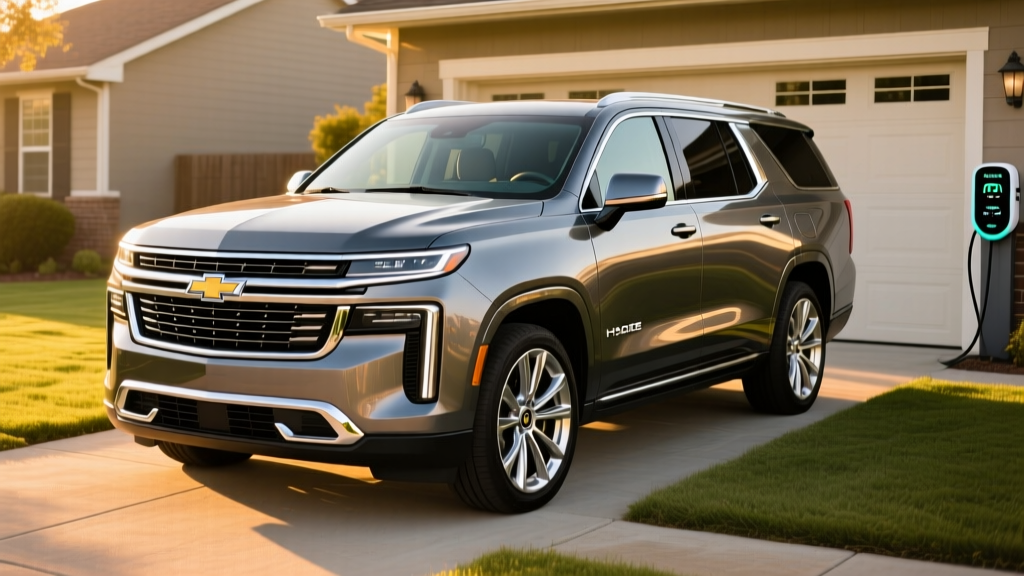
If you need three rows, 8,000 pounds of towing, and better fuel economy than a traditional V8 full-size SUV, the 2026 Chevy Suburban Hybrid sits in a narrow lane. GM's mild-hybrid system on the 5.3L and 6.2L V8 engines promises incremental MPG gains without sacrificing the Suburban's core identity: massive space, body-on-frame capability, and long-distance comfort. But is the hybrid premium worth it, and how does it stack up against a plug-in hybrid or full EV alternative?
This guide breaks down the real-world fuel economy, powertrain details, battery longevity, pricing, and tax-credit eligibility for the 2026 Suburban Hybrid — so you can decide if it's the right electrified step for your family hauler.
What Kind of Hybrid Is the Chevy Suburban?
The 2026 Chevy Suburban Hybrid uses a mild-hybrid system — not a full hybrid (HEV) like the Toyota Highlander Hybrid, and not a plug-in hybrid (PHEV) like the Chrysler Pacifica Hybrid. This distinction matters enormously for your expectations around fuel savings, electric-only driving, and charging.
HEV vs. PHEV vs. Mild Hybrid — Where the Suburban Fits
| Type | Plug In? | Electric-Only Driving | Battery Size | Typical MPG Gain |
|---|---|---|---|---|
| Mild Hybrid (Suburban) | No | None — motor assists engine only | ~0.5–1.5 kWh | 1–3 MPG combined |
| Full Hybrid (HEV) | No | Brief, low-speed only | 1.5–5 kWh | 5–15 MPG combined |
| Plug-In Hybrid (PHEV) | Yes | 20–50 mi typical | 12–25 kWh | Variable; 30+ mi electric + engine MPG after |
GM's mild-hybrid setup pairs a compact electric motor/generator with the V8 engine and a small lithium-ion battery pack. The system enables auto stop/start, brief torque-fill during acceleration, and minor regenerative braking — but it cannot propel the Suburban on electric power alone. There is no plug, no EV mode, and no electric-only range. You fuel it like a conventional Suburban; the hybrid system works invisibly in the background.
Fuel Economy: EPA MPG and Real-World Expectations
The 2026 Chevy Suburban Hybrid is rated by the EPA at approximately 20 MPG city / 27 MPG highway / 23 MPG combined with the 5.3L V8 mild-hybrid powertrain and 2WD. Four-wheel-drive models drop to roughly 19 city / 25 highway / 21 combined. These figures represent a 2–3 MPG improvement over the non-hybrid 5.3L V8 Suburban, which returns about 15/20/17 MPG.
| Configuration | City MPG | Highway MPG | Combined MPG |
|---|---|---|---|
| Suburban Hybrid 5.3L V8 2WD | 20 | 27 | 23 |
| Suburban Hybrid 5.3L V8 4WD | 19 | 25 | 21 |
| Suburban Gas 5.3L V8 2WD (non-hybrid) | 15 | 20 | 17 |
Source: fueleconomy.gov — verify exact trim ratings as EPA certifies final configurations.
Real-World MPG: What to Actually Expect
Mild hybrids tend to deliver their biggest gains in stop-and-go city driving, where the auto stop/start and regenerative braking recapture energy that a conventional V8 would waste. On the highway at sustained speeds, the electric motor contributes less, so real-world highway MPG may land closer to 23–24 MPG for 2WD models — slightly below the EPA sticker.
In mixed suburban and highway driving, owners typically report 20–22 MPG combined for 4WD models. Towing will drop fuel economy significantly — expect 10–14 MPG when pulling a loaded trailer near the Suburban's max rating.
Powertrain Specs: Horsepower, Torque, and the Mild-Hybrid System
| Specification | Detail |
|---|---|
| Engine | 5.3L EcoTec3 V8 (with mild-hybrid assist) |
| Combined Horsepower | ~355 hp (engine) + ~20 hp (electric assist) |
| Combined Torque | ~383 lb-ft (engine) + electric torque fill |
| Transmission | 10-speed automatic |
| Drivetrain | 2WD or 4WD |
| Hybrid Battery | ~0.9 kWh lithium-ion (estimated) |
| Towing Capacity | Up to ~8,100 lbs (properly equipped) |
| 0–60 mph | ~6.8 seconds (est.) |
The electric motor/generator in GM's mild-hybrid system doesn't add massive power — its job is smoothing out the stop/start experience, providing a small torque boost off the line, and enabling cylinder deactivation to operate more seamlessly. The result is a Suburban that feels nearly identical to the gas model from the driver's seat, just slightly more refined at idle and low speeds.
The 6.2L V8 (available in High Country trims) produces 420 hp and may also incorporate mild-hybrid tech depending on the model year configuration. Always verify the specific powertrain on your trim level, as GM adjusts availability across model years.
Pricing and Tax Credit Eligibility
The 2026 Chevy Suburban Hybrid carries a starting MSRP of approximately $63,000–$68,000 depending on trim (LT, RST, Z71, Premier, High Country). The hybrid system typically adds $1,000–$2,500 over the equivalent gas-only configuration.
Does the Suburban Hybrid Qualify for a Federal Tax Credit?
No. Under IRS §30D rules, the federal clean vehicle credit applies only to battery electric vehicles (BEVs) and plug-in hybrid electric vehicles (PHEVs) with a battery capacity of at least 7 kWh. The Suburban's mild-hybrid battery (~0.9 kWh) does not meet this threshold. There is no federal tax credit for conventional hybrids or mild hybrids.
§30D Federal Tax Credit — Why the Suburban Hybrid Doesn't Qualify
- Vehicle type: Must be BEV or PHEV — mild hybrids excluded
- Battery capacity: Minimum 7 kWh required — Suburban hybrid has ~0.9 kWh
- MSRP cap: SUVs capped at $80,000 — Suburban pricing is under this, but vehicle type disqualifies it
- Income cap: $150K single / $300K joint — irrelevant here since vehicle doesn't qualify
- Point-of-sale transfer: Available for qualifying vehicles only
Source: IRS §30D Clean Vehicle Credits
Some states and local utilities offer rebates or incentives for hybrid vehicles, but these vary widely by jurisdiction. Check your state's energy office or utility provider for current programs.
Battery Warranty, Reliability, and Replacement Costs
Hybrid Battery Coverage
GM covers the Suburban's hybrid battery and related components under its powertrain warranty: 5 years / 60,000 miles (bumper-to-bumper) and 5 years / 60,000 miles (powertrain). Hybrid-specific components may carry extended coverage — verify with your dealer at purchase, as warranty terms for mild-hybrid systems differ from full-hybrid or PHEV battery warranties that often extend to 8–10 years.
Reliability Outlook
GM's mild-hybrid system is mechanically simple compared to a full hybrid or PHEV. The small battery and motor/generator add minimal complexity, and there's no high-voltage system requiring specialized service. The 5.3L V8 is one of GM's most proven engines, with decades of production history.
The main reliability consideration is the lithium-ion hybrid battery itself. While mild-hybrid batteries are smaller and less stressed than PHEV or BEV packs, they can still degrade or fail. Replacement cost for a mild-hybrid battery is estimated at $1,500–$3,000 — significantly less than a full-hybrid or PHEV battery replacement ($4,000–$12,000+).
For comparison, full-hybrid batteries (like those in the Toyota Highlander Hybrid) are typically warranted for 10 years/150,000 miles and cost $3,000–$5,000 to replace out of warranty. The Suburban's mild-hybrid system is lower-risk but also lower-reward in terms of fuel savings.
Suburban Hybrid vs. Full Hybrid vs. EV: Which Fits Your Life?
Who Should Choose the Suburban Hybrid?
Choose the Suburban Hybrid if:
- You need 3 rows, 100+ cu ft of cargo space, and 8,000+ lb towing — no current BEV or PHEV matches this combination
- You drive mostly suburban/city routes where stop/start savings add up
- You want marginally better MPG without changing your fueling habits
- You don't have access to home charging and aren't ready for a plug-in vehicle
Look at a PHEV instead if:
- You can charge at home and want 20–40 miles of daily electric driving
- Your daily commute is under 40 miles round-trip
- You want to qualify for the §30D federal tax credit (up to $7,500)
- You're okay with less cargo space and towing (e.g., Chrysler Pacifica Hybrid, Kia Sorento PHEV)
Look at a full EV instead if:
- You have reliable home Level 2 charging
- You want the lowest per-mile energy cost and zero tailpipe emissions
- You can accept less towing capacity and potentially higher upfront cost
- Models like the Rivian R1S, Tesla Model X, or upcoming GM Ultium-based SUVs fit your space needs
The honest reality: the Suburban Hybrid is a refinement upgrade, not a fuel-economy revolution. You'll save roughly $300–$500 per year in fuel compared to the gas V8 (assuming 15,000 miles/year and $3.50/gallon), which means the hybrid premium pays for itself in 3–5 years. If you need the Suburban's unique combination of space and towing, the hybrid is the more efficient choice within that narrow segment. If fuel savings are your top priority, you'll need to look at smaller PHEVs or full EVs.
Pros and Cons at a Glance
Pros
- 2–3 MPG improvement over gas V8 without any behavior change
- Smoother stop/start and low-speed refinement
- Retains full Suburban towing (8,100 lbs), cargo (144 cu ft max), and 3-row seating
- Simple system — minimal added maintenance or repair risk
- No charging infrastructure needed
Cons
- No electric-only driving — still 100% gasoline-powered
- No federal tax credit eligibility
- MPG still trails full hybrids (Toyota Highlander Hybrid: 35 MPG combined) by a wide margin
- Hybrid premium adds $1,000–$2,500 to purchase price
- Real-world towing MPG remains poor (~10–14 MPG)
Frequently Asked Questions
How many MPG does the Chevy Suburban Hybrid get?
The 2026 Suburban Hybrid with the 5.3L V8 and 2WD is EPA-rated at approximately 20 city / 27 highway / 23 combined MPG. The 4WD version rates about 19/25/21 MPG. Real-world results typically land within 1–2 MPG of these figures, with city driving sometimes exceeding the EPA estimate thanks to regenerative braking.
Can the Suburban Hybrid drive on electric power only?
No. The Suburban's mild-hybrid system cannot propel the vehicle without the gasoline engine running. The electric motor assists the engine during acceleration and enables smoother stop/start operation, but there is no EV mode and no electric-only range.
Do I need to plug in the Chevy Suburban Hybrid?
No. The Suburban Hybrid is a mild-hybrid system that charges its small battery through regenerative braking and the engine. There is no plug and no external charging capability.
Is the Suburban Hybrid reliable?
GM's mild-hybrid system adds minimal mechanical complexity, and the 5.3L V8 is a well-proven engine. The hybrid battery is smaller and less stressed than full-hybrid or PHEV packs, reducing failure risk. GM provides a 5-year/60,000-mile powertrain warranty. Long-term reliability data for this specific system is still accumulating.
How much does it cost to replace the Suburban Hybrid battery?
Mild-hybrid battery replacement is estimated at $1,500–$3,000 out of warranty — substantially less than full-hybrid or PHEV battery replacements. The battery is covered under GM's powertrain warranty for the first 5 years or 60,000 miles.
Does the Suburban Hybrid qualify for any tax credits?
Not at the federal level. The IRS §30D clean vehicle credit requires a battery capacity of at least 7 kWh and applies only to BEVs and PHEVs. The Suburban's mild-hybrid battery (~0.9 kWh) doesn't qualify. Some state or utility incentives may apply — check local programs.
How does the Suburban Hybrid compare to the Toyota Highlander Hybrid?
The Highlander Hybrid is a full hybrid (HEV) rated at 35 MPG combined — roughly 12 MPG better than the Suburban Hybrid. However, the Highlander offers significantly less cargo space (84 cu ft vs. 144 cu ft), lower towing capacity (5,000 lbs vs. 8,100 lbs), and a smaller third row. They serve different needs: the Highlander Hybrid maximizes efficiency, while the Suburban Hybrid maximizes space with modest efficiency gains.
Should I buy the Suburban Hybrid or wait for a full EV SUV?
If you need 8,000+ lb towing and maximum cargo space today, no current BEV matches the Suburban's capabilities. Full-size electric SUVs from GM (based on the Ultium platform) are expected but timelines remain uncertain. If you can wait 1–2 years and your towing needs are under 7,500 lbs, the Rivian R1S or upcoming electric SUVs may be worth considering.