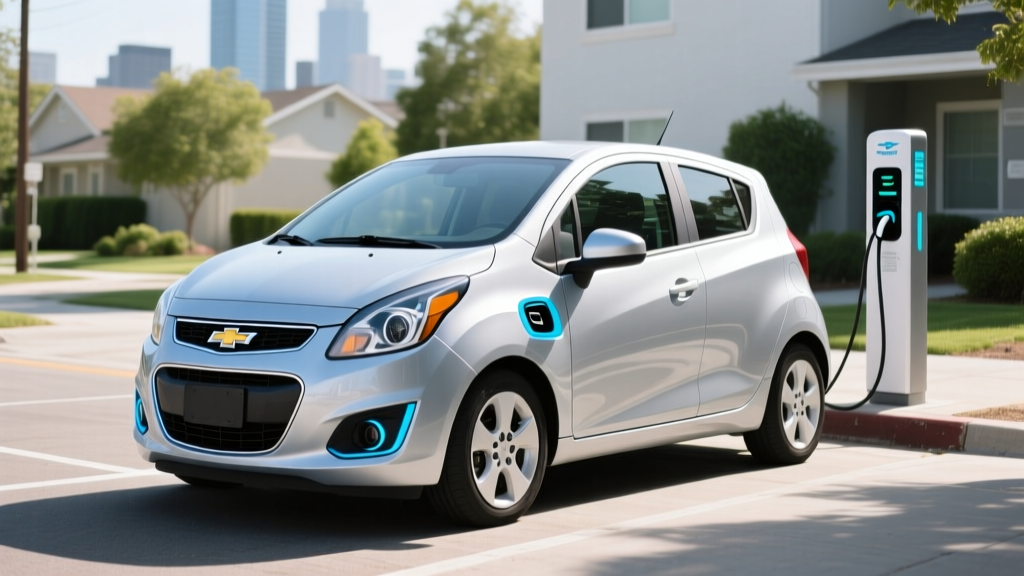
If you've been searching for a Chevy Spark hybrid, you've likely noticed a frustrating lack of results — and there's a straightforward reason for that. Chevrolet never produced a hybrid version of the Spark. The subcompact Spark was sold exclusively as a gasoline-only model (2013–2022 in the U.S.) and, for a brief window, as the all-electric Spark EV (2014–2016). No conventional hybrid (HEV) or plug-in hybrid (PHEV) variant was ever built.
That doesn't mean Chevrolet doesn't offer electrified options in 2026, or that the Spark's spirit — an affordable, efficient city commuter — is dead. This guide clarifies exactly what the Spark lineup included, why the hybrid variant never materialized, and which current Chevrolet (and competitor) models fill the role a "Chevy Spark hybrid" would have occupied.
The Chevy Spark EV: What Chevrolet Actually Built
Before discussing what doesn't exist, it's worth covering what did. The Chevrolet Spark EV was a battery-electric city car sold for the 2014, 2015, and 2016 model years, primarily in California and Oregon to meet zero-emission vehicle (ZEV) mandate requirements. It was never a hybrid of any kind.
| Specification | Value |
|---|---|
| Powertrain Type | Battery Electric (BEV) — not hybrid |
| Battery Capacity | 18.4 kWh usable (LFP chemistry, LG Chem) |
| EPA Range | 82 miles |
| Motor Output | 143 hp / 400 lb-ft torque |
| 0–60 mph | |
| DC Fast Charge (CCS) | Up to 50 kW; ~20 min to 80% |
| Level 2 Charge (240V) | ~7 hours (3.3 kW onboard charger) |
| EPA Efficiency | 119 MPGe combined |
| Original MSRP | ~$25,995 (before incentives) |
The Spark EV was notable for its punchy torque delivery and surprisingly quick acceleration for a subcompact, but its 82-mile EPA range was limiting even by 2014 standards. Chevrolet discontinued it after 2016 to focus on the Bolt EV, which launched for the 2017 model year with a then-class-leading 238 miles of range.
Why There Was Never a Chevy Spark Hybrid
Chevrolet's hybrid strategy during the Spark's production run focused on larger vehicles. The Chevy Volt (a plug-in hybrid, 2011–2019) and Chevy Malibu Hybrid (2008–2019) carried the brand's electrification efforts. The Spark, positioned as the cheapest car in Chevrolet's lineup (starting under $13,000 for the gas model), simply didn't have the margin or platform architecture to absorb the added cost of a hybrid powertrain.
By the time the Spark was discontinued after the 2022 model year, Chevrolet's electrification roadmap had shifted decisively toward full battery-electric vehicles under the Ultium platform — making a last-minute Spark hybrid even less likely.
HEV vs PHEV vs BEV: Understanding Your Options
If you were hoping a "Chevy Spark hybrid" would deliver a blend of electric efficiency and gas flexibility, it helps to understand exactly what each electrified powertrain type offers so you can find the right substitute.
| Feature | HEV (Conventional Hybrid) | PHEV (Plug-In Hybrid) | BEV (Battery Electric) |
|---|---|---|---|
| Plug-In Required? | No — charges via regen & engine | Yes — plug in for best results | Yes — sole energy source |
| Electric-Only Range | ~1 mile or less (assist only) | 20–50 miles typical | 200–400+ miles |
| Gas Engine | Yes — primary power source | Yes — kicks in after battery depletes | None |
| Fuel Cost Savings | Moderate (20–35% vs gas-only) | High if daily driving < electric range | Highest (electricity vs gas) |
| Home Charging Needed? | No | Recommended for max benefit | Essential |
| Federal Tax Credit (§30D) | No — not eligible | Up to $7,500 (eligibility varies) | Up to $7,500 (eligibility varies) |
The Spark EV was a BEV. If you want something that blends electric and gas like a hypothetical Spark hybrid would have, you're looking for either an HEV or a PHEV from another manufacturer — or a modern Chevrolet BEV that far exceeds the old Spark EV's capabilities.
What to Buy Instead: 2026 Alternatives to a Chevy Spark Hybrid
Here are the closest current-production vehicles that deliver what a "Chevy Spark hybrid" would have offered — affordable, efficient, city-friendly transportation with electrified powertrains.
2026 Chevrolet Equinox EV (BEV)
The most direct Chevrolet successor in spirit. Starting at approximately $33,000, the Equinox EV offers up to 319 miles of EPA range, DC fast charging up to 150 kW (10–80% in roughly 30 minutes), and a 17.7-inch infotainment screen. It's larger than the Spark, but it's Chevy's most affordable long-range EV. Per fueleconomy.gov, the Equinox EV achieves approximately 95–100 MPGe combined depending on trim.
2026 Toyota Prius (HEV)
The gold standard for affordable hybrid commuting. The current-generation Prius delivers an EPA-estimated 57 MPG combined (57 city / 56 highway for the LE trim), starts around $28,000, and requires no plug-in charging. Real-world city driving often exceeds the EPA estimate thanks to Toyota's series-parallel hybrid system, which favors electric assist in stop-and-go traffic. The Prius is the closest thing to what a Chevy Spark hybrid would have been — a small, efficient, no-plug-required commuter. See official figures at fueleconomy.gov.
2026 Toyota Prius Prime (PHEV)
If you want electric-only commuting with gas backup, the Prius Prime offers 44 miles of EPA electric-only range on its 13.6 kWh lithium-ion battery, then operates as a conventional hybrid achieving 52 MPG combined once the battery is depleted. Total combined range exceeds 480 miles. Level 2 charging takes approximately 4 hours at 240V; DC fast charging is not available. Starting around $33,000, the Prime may qualify for a partial federal tax credit under §30D — check current IRS sourcing and income requirements, as eligibility rules shift frequently.
2026 Hyundai Elantra Hybrid (HEV)
Starting around $26,000 with an EPA-estimated 54 MPG combined (53 city / 56 highway), the Elantra Hybrid undercuts the Prius on price while matching it on efficiency. It's a strong choice for budget-conscious buyers who want hybrid savings without plug-in infrastructure.
Used Spark EV: Is It Worth Considering in 2026?
If you're specifically drawn to the Spark nameplate, used 2014–2016 Spark EV examples trade for roughly $6,000–$9,000 depending on mileage and condition. Before buying, consider these factors:
- Battery degradation: The Spark EV's 18.4 kWh LFP battery has held up reasonably well — LFP chemistry is known for long cycle life and minimal degradation. Expect roughly 85–92% state of health (SoH) on a 10-year-old pack, meaning real-world range may be closer to 65–75 miles.
- Charging connector: The Spark EV uses CCS1 for DC fast charging and J1772 for Level 2. Both remain standard in 2026, though the industry is shifting toward NACS. Adapters are available.
- Battery warranty: Chevrolet's original 8-year/100,000-mile battery warranty has expired on all Spark EV examples. A replacement battery, if needed, would likely cost $5,000–$8,000 through a dealer — a significant fraction of the car's value.
- Practicality: 82 miles of EPA range (less when degraded) limits the Spark EV to short urban commutes with reliable home charging. It cannot serve as a sole vehicle for most households.
Tax Credits: What Qualifies in 2026?
A common question is whether a used Spark EV or a new alternative qualifies for the federal EV tax credit. Here's the current landscape under IRS §30D rules:
- New clean vehicle credit (up to $7,500): Available for new BEVs and PHEVs meeting battery sourcing, critical mineral, MSRP cap ($55,000 for cars, $80,000 for SUVs/trucks), and buyer income limits ($150K single / $300K joint). Conventional HEVs do NOT qualify.
- Used clean vehicle credit (up to $4,000 or 30% of sale price): Available for used BEVs and PHEVs priced at $25,000 or less, purchased from a dealer, at least 2 model years old. The Spark EV could theoretically qualify if sold by a dealer under $25K — and most examples are well under that threshold. Buyer income limits apply ($75K single / $150K joint).
- Point-of-sale transfer: As of 2024, eligible buyers can transfer the new-vehicle credit to the dealer at purchase, reducing the sale price directly rather than waiting for a tax refund.
- State incentives: Vary widely by jurisdiction. Check your state's energy office or afdc.energy.gov for local rebates and HOV lane access programs.
Who Should Choose What: Decision Framework
Choose a conventional hybrid (HEV) — like the Toyota Prius or Hyundai Elantra Hybrid — if you want maximum MPG without changing your habits. No plug, no range anxiety, 50+ MPG in real-world driving. Best for apartment dwellers without charging access.
Choose a plug-in hybrid (PHEV) — like the Toyota Prius Prime — if you have home charging and a commute under 40 miles round-trip. You'll drive on electricity most days and use gas only for longer trips. Best of both worlds.
Choose a full EV (BEV) — like the Chevrolet Equinox EV — if you have reliable home charging, want the lowest per-mile fuel cost, and your daily driving is under 250 miles. Best for homeowners with a garage or driveway where a Level 2 charger can be installed.
Skip the Spark EV unless you need a dirt-cheap second car for short urban errands and have confirmed the battery's state of health with a pre-purchase inspection.
Frequently Asked Questions
Did Chevrolet ever make a Chevy Spark hybrid?
No. The Chevrolet Spark was sold only as a gasoline model (1.2L or 1.4L four-cylinder) and as the Spark EV (battery-electric, 2014–2016). No hybrid (HEV) or plug-in hybrid (PHEV) version was ever produced.
How many MPG did the gas Chevy Spark get?
The final-generation gas Spark (2016–2022) with the 1.4L engine and CVT achieved an EPA-estimated 29 city / 38 highway / 33 combined MPG. The 5-speed manual version rated slightly lower. These figures are modest by 2026 standards — the Toyota Prius hybrid delivers 57 MPG combined for comparison.
Is the used Spark EV a good buy in 2026?
It can be, but only for a specific use case: a secondary vehicle for short urban trips (under 60 miles round-trip) with guaranteed home Level 2 charging. Verify the battery's state of health before purchasing, and budget for the possibility that the original battery warranty has expired. At $6,000–$9,000, it's one of the cheapest ways into an EV — but the 82-mile original range (likely 65–75 miles when degraded) is very limiting.
Does a hybrid or PHEV qualify for a tax credit?
Conventional hybrids (HEVs) like the Toyota Prius do not qualify for the federal §30D clean vehicle credit. Plug-in hybrids (PHEVs) like the Prius Prime may qualify for up to $7,500, subject to MSRP caps, buyer income limits, and battery sourcing requirements that change periodically. Always verify current eligibility on irs.gov before purchasing.
What is the cheapest Chevrolet electrified vehicle in 2026?
The 2026 Chevrolet Equinox EV, starting at approximately $33,000 before incentives, is Chevrolet's most affordable electrified vehicle. If the §30D credit applies (up to $7,500, depending on eligibility), the effective price can drop to around $25,500. Chevrolet does not currently offer a hybrid or PHEV model — the brand's electrification strategy focuses exclusively on BEVs.
How long do hybrid batteries last and what does replacement cost?
Modern hybrid battery packs (nickel-metal hydride or lithium-ion) are designed to last the life of the vehicle. Real-world data from Toyota Prius fleets shows most hybrid batteries retain functional capacity beyond 150,000 miles. Replacement cost for a hybrid battery typically ranges from $2,000–$4,000 (aftermarket or refurbished) to $4,000–$6,000 (OEM dealer). All new hybrids carry a minimum 8-year/100,000-mile battery warranty per federal mandate.