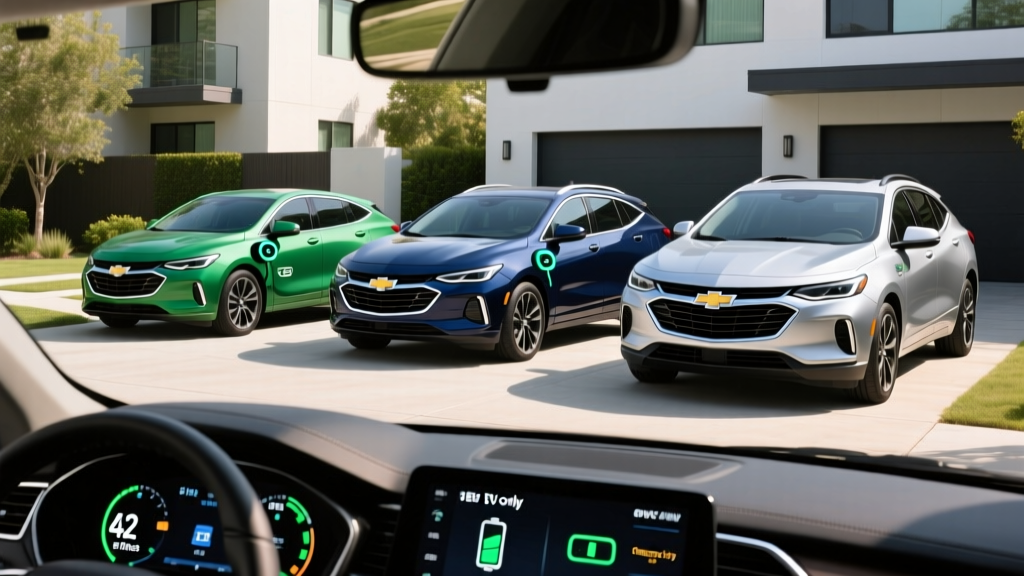
For buyers not quite ready to commit to a full battery-electric vehicle (BEV) but wanting to reduce fuel consumption and emissions, a plug-in hybrid electric vehicle (PHEV) offers a compelling middle ground. Chevrolet's strategy for 2026 focuses on providing versatile PHEV options across its most popular segments: the compact SUV, the midsize crossover, and the performance sedan. This guide details the specifications, real-world efficiency, and ownership economics of the current Chevy plug in hybrid lineup.
Understanding the Chevy Plug in Hybrid Lineup
Chevrolet currently offers two primary PHEV models in the US market for the 2026 model year, alongside the extended-range EV (EREV) Corvette E-Ray, which uses a different architecture. The core PHEV offerings are the Chevrolet Equinox PHEV and the Chevrolet Traverse PHEV. These vehicles pair a gasoline engine with a high-voltage battery and electric motor, allowing for a specific distance of all-electric driving before the hybrid system takes over.
HEV vs. PHEV: What's the Difference?
- Hybrid (HEV): Uses a small battery charged only by regenerative braking and the engine. Cannot be plugged in. Electric-only driving is minimal (usually under 1 mile).
- Plug-in Hybrid (PHEV): Features a larger battery that can be charged via an external power source (Level 1 or Level 2). Offers 25-50 miles of electric-only range before operating as a conventional hybrid.
2026 Chevrolet Equinox PHEV: Efficiency and Range
The Equinox PHEV is designed for the daily commuter who wants to handle most weekday driving on electricity but needs the flexibility of a gas engine for weekend road trips. It utilizes a 1.5L turbocharged engine paired with a dual-motor electric drive unit.
| Specification | 2026 Equinox PHEV |
|---|---|
| Battery Capacity | 17.7 kWh (Usable) |
| EPA Electric Range | 38 miles |
| Total Combined Range | ~430 miles |
| Combined Horsepower | 217 hp |
| MPGe (Combined) | 92 MPGe |
| Charge Time (Level 2) | ~2.5 hours (7.7 kW) |
Real-World MPG and Electric Range
While the EPA estimates 38 miles of electric range, real-world testing shows that conservative driving in moderate temperatures can yield up to 42 miles. However, highway speeds (75+ mph) and cold weather (below 40°F) can reduce this to approximately 28-30 miles. Once the battery is depleted, the Equinox PHEV operates as a hybrid, delivering an EPA-estimated 42 MPG combined (43 city / 41 highway).
2026 Chevrolet Traverse PHEV: Family-Sized Electrification
The Traverse PHEV brings plug-in capability to the three-row SUV segment. It uses a more powerful 2.5L turbocharged engine and a larger battery pack to move its substantial weight while maintaining meaningful electric-only utility.
| Model | City MPG | Highway MPG | Combined MPG | Electric Range |
|---|---|---|---|---|
| Traverse PHEV | 35 | 32 | 34 | 32 miles |
| Equinox PHEV | 43 | 41 | 42 | 38 miles |
The Traverse PHEV's 32-mile electric range is sufficient for school runs and grocery trips. Its combined output of 295 horsepower ensures adequate merging power even with a full load of passengers. Unlike many competitors, the Traverse PHEV maintains a towing capacity of up to 3,500 lbs, though towing significantly reduces electric-only range.
Charging Requirements and Infrastructure
Neither the Equinox nor the Traverse PHEV supports DC Fast Charging. This is typical for PHEVs, as their smaller batteries (under 20 kWh) are designed to be replenished overnight at home or during the workday using Level 2 AC charging.
- Level 1 (120V): Takes approximately 8-10 hours for a full charge. Suitable for owners with low daily mileage.
- Level 2 (240V): Takes 2.5-3.5 hours for a full charge. Recommended for maximizing electric-only driving throughout the day.
Pricing, Tax Credits, and Ownership Costs
The 2026 Equinox PHEV starts at an MSRP of approximately $38,500, while the Traverse PHEV begins near $52,000. Buyers must navigate the complex IRS §30D Clean Vehicle Credit to determine eligibility for the federal tax credit.
Battery Warranty and Lifespan
Chevrolet covers the high-voltage battery and PHEV-specific components for 8 years or 100,000 miles (whichever comes first). This warranty guarantees the battery will retain a minimum percentage of its original capacity (typically 60-70%). Replacement costs outside of warranty range from $6,000 to $9,000 depending on the model, but data suggests most PHEV batteries last 12-15 years before significant degradation.
Tax Credit Eligibility Checklist
- MSRP Cap: SUVs must be under $80,000; sedans/cars under $55,000.
- Income Cap: Adjusted Gross Income (AGI) must not exceed $150k (single) or $300k (joint).
- Battery Sourcing: A percentage of critical minerals and battery components must be sourced from the US or FTA partners. This requirement increases annually, making some models ineligible for the full $7,500 credit.
Who Should Choose a Chevy PHEV?
Choose a Chevy PHEV if:
- You have access to home or workplace Level 2 charging.
- Your daily commute is under 35 miles round-trip.
- You frequently take long road trips (>300 miles) and want to avoid public charging delays.
- You need the cargo space and towing capacity of an SUV.
Consider a Full EV (BEV) if:
- You want zero tailpipe emissions and minimal maintenance (no oil changes).
- Your daily driving exceeds 40 miles but is under 250 miles.
- You want access to DC Fast Charging for rapid road-trip replenishment.
- You want to qualify for the full $7,500 federal tax credit (more BEVs meet sourcing requirements).
Frequently Asked Questions
Does the Chevy PHEV qualify for the $7,500 tax credit?
Eligibility is model-specific and subject to change based on battery component sourcing. For 2026, many PHEVs qualify for a partial credit ($3,750) or the full $7,500 if they meet the critical mineral and component requirements. Always check the latest IRS guidance or use the point-of-sale transfer option at a participating dealer.
What happens if I never plug in my PHEV?
The vehicle will operate as a conventional hybrid. While you won't benefit from the electric-only range, you will still see improved fuel economy compared to a gas-only model, typically achieving 34-42 MPG combined.
Is the PHEV battery reliable in cold weather?
Yes, but expect a 20-30% reduction in electric-only range when temperatures drop below freezing. The gasoline engine will engage more frequently to provide cabin heat and maintain battery temperature.
How does the Corvette E-Ray fit into this?
The Corvette E-Ray is an EREV (Extended-Range EV) or performance hybrid. It uses an electric motor for the front wheels and a V8 for the rear, but its small battery is not designed for long electric-only commutes; it is designed for performance boosts and silent neighborhood driving.