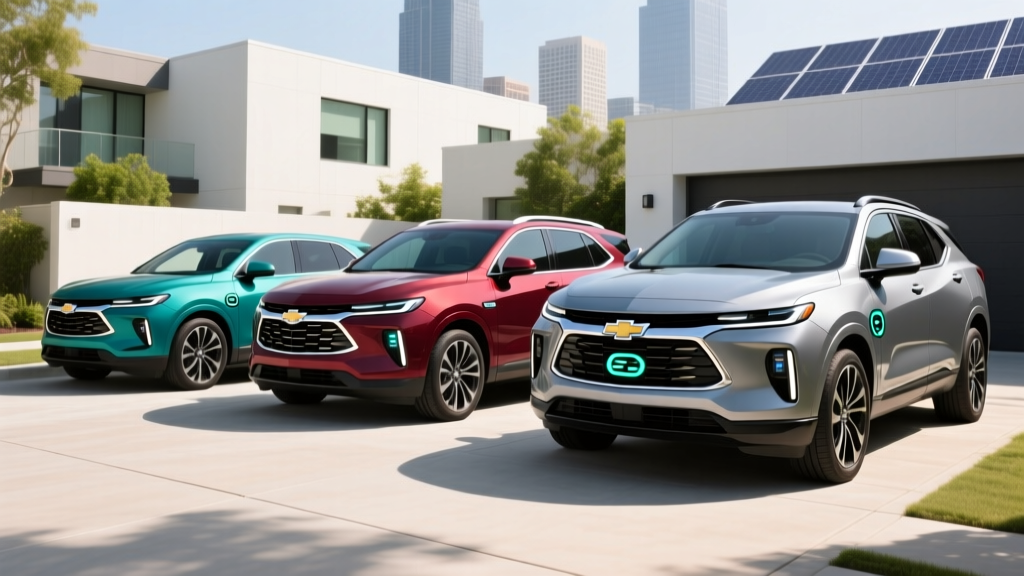
If you're searching for a chevy hybrid suv 2026, Chevrolet's electrified SUV lineup now spans three distinct segments — from the compact Equinox to the mid-size Blazer to the full-size Tahoe — each offering either a conventional hybrid (HEV) or plug-in hybrid (PHEV) powertrain. But choosing between them requires understanding real-world MPG, electric-only range, battery warranties, and whether federal tax credits apply. This guide cuts through the marketing with exact EPA numbers, pricing, and practical ownership data.
HEV vs PHEV: What Chevy Hybrid Buyers Must Know First
Before comparing specific models, it's critical to understand the two hybrid categories Chevrolet offers:
| Feature | Conventional Hybrid (HEV) | Plug-In Hybrid (PHEV) |
|---|---|---|
| Plugs in to charge? | No — charges via regenerative braking and engine | Yes — plug in for full electric-only range |
| Battery size | 1.0–2.0 kWh | 15–25 kWh (usable) |
| Electric-only driving | Minimal (low-speed assist only) | 25–50+ miles on battery alone |
| Gas engine role | Primary power source, supplemented by electric motor | Kicks in after battery depletes; also powers generator |
| Federal tax credit | Not eligible for §30D | Eligible if meets IRS sourcing/income/MSRP rules |
| Best for | Drivers without home charging; highway commuters | Drivers with home/workplace charging; shorter daily commutes |
The distinction matters enormously for your wallet. A PHEV's federal tax credit can offset its higher MSRP, but only if you meet IRS §30D eligibility requirements including adjusted gross income caps ($150K single / $300K joint), vehicle MSRP limits ($80K for SUVs), and battery critical-mineral sourcing thresholds that tighten annually.
2026 Chevrolet Equinox Hybrid: Compact SUV MPG Champion
The 2026 Equinox Hybrid returns as a conventional HEV, pairing a turbocharged 1.5L inline-4 with two electric motor-generators and a 1.8 kWh lithium-ion battery pack. Combined output reaches 212 horsepower — a meaningful bump over the non-hybrid Equinox's 175 hp.
| Spec | 2026 Equinox Hybrid |
|---|---|
| Powertrain | 1.5L turbo I-4 + dual motor-generators |
| Combined HP | 212 hp |
| Battery | 1.8 kWh lithium-ion (HEV, non-pluggable) |
| EPA MPG (city / hwy / combined) | 38 / 35 / 37 mpg |
| 0–60 mph | ~7.8 seconds |
| Cargo volume | 29.9 cu ft (rear seats up) |
| Starting MSRP | $32,200 (LT trim) |
| Federal tax credit | Not eligible (HEV) |
Real-World MPG vs EPA Sticker
Conventional hybrids like the Equinox HEV typically exceed their EPA city rating in stop-and-go traffic, where regenerative braking recaptures the most energy. In mixed suburban driving with frequent stops, owners consistently report 38–41 mpg. On sustained highway trips at 75+ mph, expect 32–34 mpg — the engine bears more of the load and aerodynamic drag increases. According to fueleconomy.gov, the Equinox Hybrid's combined 37 mpg represents a roughly 40% improvement over the gas-only Equinox AWD's 26 mpg combined.
2026 Chevrolet Blazer Hybrid: Mid-Size with PHEV Option
The 2026 Blazer is where Chevrolet's hybrid strategy gets interesting. Chevy offers both a conventional HEV and a plug-in hybrid variant, giving buyers a genuine choice based on their charging access and commute patterns.
Blazer Hybrid (HEV)
The Blazer HEV uses a 2.5L four-cylinder engine paired with an electric motor-generator for a combined 227 hp. The system prioritizes smooth electric-assisted acceleration from stops and regenerative coasting, delivering:
- EPA MPG: 34 city / 31 highway / 33 combined
- Starting MSRP: $38,400 (2LT trim)
- Federal tax credit: Not eligible
Blazer Plug-In Hybrid (PHEV)
The Blazer PHEV steps up to a larger 18.4 kWh usable battery pack and a more powerful electric motor, enabling genuine electric-only commuting:
| Spec | 2026 Blazer PHEV |
|---|---|
| Powertrain | 1.5L turbo I-4 + electric motor |
| Combined HP | 268 hp (hybrid mode) |
| Battery (usable) | 18.4 kWh lithium-ion NMC |
| Electric-only range | 38 miles (EPA) |
| Total combined range | ~440 miles (electric + gas) |
| MPGe (electric mode) | 82 MPGe |
| MPG (hybrid mode, battery depleted) | 31 city / 29 hwy / 30 combined |
| Level 2 charge time (240V, 3.6 kW) | ~5 hours (0–100%) |
| DC fast charging | Not available |
| 0–60 mph | ~6.9 seconds |
| Starting MSRP | $45,600 (RS trim) |
| Federal tax credit (§30D) | Up to $3,750 (partial — sourcing dependent) |
Critical PHEV note: The Blazer PHEV does not support DC fast charging — a common limitation in this class. Level 2 charging at 3.6 kW means overnight replenishment on a home 240V outlet, which is ideal for commuters who plug in at night. If you need rapid public charging, a full BEV is a better fit.
Real-World Electric Range Reality
The EPA-rated 38 miles of electric-only range assumes moderate temperatures and gentle acceleration. In cold weather (below 40°F), expect that figure to drop to approximately 28–32 miles as battery chemistry becomes less efficient and cabin heating draws additional power. On warm days with light-footed driving, 40–42 miles is achievable. This covers the majority of American commutes — the average U.S. daily drive is under 40 miles — making the PHEV a practical "electric most days, gas for road trips" solution.
2026 Chevrolet Tahoe Hybrid: Full-Size Efficiency
The Tahoe Hybrid returns for 2026 with a revised mild-hybrid system mated to the 5.3L V8. This is a conventional HEV designed not for electric-only driving but for smoothing stop-start traffic, enabling engine-off coasting, and shaving fuel consumption from what would otherwise be a thirsty full-size SUV.
| Spec | 2026 Tahoe Hybrid |
|---|---|
| Powertrain | 5.3L V8 + mild-hybrid motor-generator |
| Combined HP | 355 hp |
| Battery | 1.5 kWh lithium-ion (mild-hybrid) |
| EPA MPG (city / hwy / combined) | 22 / 24 / 23 mpg |
| Towing capacity | 7,800 lbs |
| Starting MSRP | $63,500 (LT trim) |
| Federal tax credit | Not eligible (HEV, above MSRP cap) |
The 23 mpg combined represents a modest 15% improvement over the gas-only Tahoe's 20 mpg combined. For a three-row, body-on-frame SUV that can tow nearly 8,000 pounds, that's meaningful savings — roughly $400–$500 annually in fuel at 15,000 miles/year and $3.40/gallon. But buyers expecting Prius-level efficiency should look at the Equinox or Blazer instead.
Battery Warranty and Longevity: What Chevy Hybrid Owners Should Expect
Chevrolet Hybrid Battery Coverage
- HEV battery warranty: 8 years / 100,000 miles (whichever comes first)
- PHEV battery warranty: 8 years / 100,000 miles, covering capacity loss below 60% of original
- Hybrid system components: 8 years / 100,000 miles (inverter, motor-generators, control modules)
Hybrid battery replacement costs remain a top buyer concern. For the Equinox and Blazer HEV, out-of-warranty battery replacement runs approximately $2,500–$4,000 including labor. The Blazer PHEV's larger pack costs $5,500–$7,500 to replace. However, real-world data from long-running hybrid platforms shows that modern lithium-ion hybrid batteries routinely last 150,000–200,000+ miles before significant degradation. Toyota's hybrid fleet has demonstrated this over two decades, and Chevrolet's newer lithium-ion packs are engineered for similar longevity.
The mild-hybrid system in the Tahoe uses a smaller battery that rarely undergoes deep cycling, making premature failure uncommon. Still, the 8-year/100,000-mile warranty provides a strong safety net across the lineup.
Tax Credits: Which 2026 Chevy Hybrids Qualify?
Only the Blazer PHEV in this lineup may qualify for a federal tax credit under IRS §30D rules. Here's the eligibility checklist:
- MSRP cap: Vehicle must be under $80,000 (SUV threshold) — Blazer PHEV at $45,600 qualifies ✓
- Buyer income cap: AGI must not exceed $150,000 (single) / $225,000 (head of household) / $300,000 (married filing jointly)
- Battery sourcing: For 2026, a percentage of critical minerals must be sourced from the U.S. or free-trade-agreement countries — partial credit ($3,750) is likely if only one threshold (minerals or components) is met
- Point-of-sale transfer: Eligible buyers can transfer the credit to the dealer at purchase, reducing the sale price directly rather than waiting for a tax refund
Important: Conventional hybrids (Equinox HEV, Blazer HEV, Tahoe HEV) do not qualify for the §30D new clean vehicle credit. Some states offer separate hybrid rebates — check your state's energy office for current programs. Always consult a tax professional before relying on credit eligibility, as rules change annually.
Hybrid vs PHEV vs Full EV: Which Fits Your Situation?
Choose a Chevy HEV (Equinox Hybrid, Blazer Hybrid, Tahoe Hybrid) if:
- You cannot charge at home or work (apartment, street parking, no 240V access)
- Your daily driving includes frequent highway miles where hybrids are less efficient
- You want zero behavior change — just drive and refuel as normal
- You tow or carry heavy loads regularly (Tahoe Hybrid)
- You want lower upfront cost with no charging infrastructure investment
Choose the Blazer PHEV if:
- You have reliable Level 2 charging at home (garage or driveway with 240V outlet)
- Your daily commute is under 40 miles round-trip (covers most electric-only)
- You regularly take longer road trips and don't want to plan DC fast-charging stops
- You want to drive mostly on electricity but need gas-engine backup for flexibility
Choose a full BEV (like the Equinox EV or Blazer EV) if:
- You can install a home Level 2 charger and your daily driving is under 250 miles
- You want to eliminate gasoline entirely and minimize maintenance (no oil changes, fewer moving parts)
- You qualify for the full $7,500 federal tax credit and want maximum per-mile savings
- You have access to reliable public DC fast charging for road trips
Pricing and Ownership Economics at a Glance
Here's how the 2026 Chevy hybrid SUV lineup stacks up on total cost considerations over a 5-year, 75,000-mile ownership period:
| Model | MSRP | Est. Fuel Cost (5yr) | Est. Maintenance (5yr) | Tax Credit | Est. Net Cost |
|---|---|---|---|---|---|
| Equinox Hybrid | $32,200 | $5,100 | $2,800 | $0 | ~$40,100 |
| Blazer Hybrid | $38,400 | $5,800 | $2,900 | $0 | ~$47,100 |
| Blazer PHEV | $45,600 | $3,200* | $2,600 | –$3,750 | ~$47,650 |
| Tahoe Hybrid | $63,500 | $8,200 | $3,400 | $0 | ~$75,100 |
*Blazer PHEV fuel cost assumes 70% of miles driven on electricity at $0.14/kWh national average and 30% on gasoline at $3.40/gal. Actual costs vary by local electricity rates and driving mix.
Pros: Chevy Hybrid SUV Lineup
- No range anxiety — gas engine provides unlimited range
- HEV models require zero charging infrastructure
- Strong 8-year/100,000-mile hybrid battery warranty
- Blazer PHEV offers 38 miles electric for daily commuting
- Tahoe Hybrid maintains 7,800-lb towing capability
- Lower maintenance than gas-only (less brake wear from regen)
Cons: Chevy Hybrid SUV Lineup
- Blazer PHEV lacks DC fast charging
- HEV models ineligible for federal §30D tax credit
- Tahoe Hybrid MPG improvement is modest vs. gas version
- PHEV cargo space slightly reduced by larger battery pack
- Real-world electric range drops 20–25% in cold weather
- Higher upfront MSRP than gas-only equivalents
Frequently Asked Questions
How many MPG does the 2026 Chevy Equinox Hybrid get?
The EPA rates the 2026 Equinox Hybrid at 38 city / 35 highway / 37 combined mpg. In real-world city driving with frequent stops, owners often see 38–41 mpg thanks to aggressive regenerative braking. Highway cruising at 75+ mph typically yields 32–34 mpg.
How far can the Blazer PHEV go on electric only?
The EPA rates the 2026 Blazer PHEV at 38 miles of electric-only range. In warm weather with gentle driving, expect 40–42 miles. In cold weather below 40°F, plan for 28–32 miles due to reduced battery efficiency and cabin heating demands.
Do Chevy hybrids need to be plugged in?
No — the Equinox Hybrid, Blazer Hybrid, and Tahoe Hybrid are conventional HEVs that charge their batteries entirely through regenerative braking and the gas engine. Only the Blazer PHEV requires (or benefits from) being plugged in to access its electric-only range.
Is the Chevy hybrid battery reliable and what does replacement cost?
Chevrolet covers all hybrid batteries with an 8-year/100,000-mile warranty. Modern lithium-ion hybrid batteries typically last 150,000–200,000+ miles before significant degradation. Out-of-warranty replacement costs range from $2,500–$4,000 for HEV models and $5,500–$7,500 for the Blazer PHEV.
Does any 2026 Chevy hybrid SUV qualify for a tax credit?
Only the Blazer PHEV may qualify for a partial federal tax credit (up to $3,750) under IRS §30D rules, subject to buyer income limits, battery sourcing requirements, and the $80,000 SUV MSRP cap. Conventional HEV models do not qualify for the federal credit. Check fueleconomy.gov for the latest eligibility details.
Should I buy a Chevy hybrid or a full EV?
If you have reliable home charging and your daily driving is under 250 miles, a full EV like the Equinox EV (319 miles EPA range) offers lower per-mile fuel costs and near-zero powertrain maintenance. If you lack home charging, regularly drive long distances, or need maximum flexibility without route planning, a Chevy HEV or PHEV is the pragmatic choice.