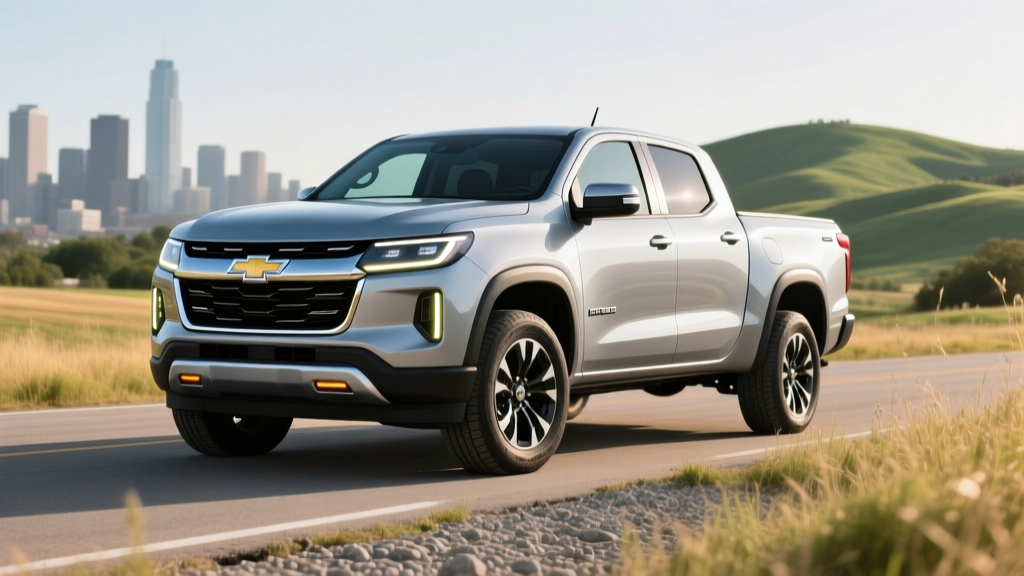
If you've been searching for a Chevy Colorado hybrid, you're not alone — midsize pickup buyers increasingly want better fuel economy without sacrificing payload or towing. But here's the reality check upfront: as of the 2026 model year, Chevrolet does not offer the Colorado as a hybrid (HEV) or plug-in hybrid (PHEV). The current third-generation Colorado (introduced for 2023) is powered exclusively by a turbocharged 2.7-liter four-cylinder gasoline engine across all trims.
That doesn't mean your quest for an efficient midsize truck is over. Below, we break down what the 2026 Colorado actually delivers in fuel economy, which hybrid and PHEV trucks do exist as viable alternatives, and how to decide whether a hybrid, PHEV, or full EV pickup is the right call for your driving pattern.
What the 2026 Chevy Colorado Actually Offers
The 2026 Chevrolet Colorado continues with the turbocharged 2.7L I-4 engine that replaced the old 3.6L V6 and 2.8L diesel. Chevy markets this engine in different output states depending on trim, but there is no electrification of any kind — no 48-volt mild-hybrid system, no full hybrid, and no plug-in variant.
| Spec | WT / LT (Base Turbo) | Z71 / Trail Boss / ZR2 (High-Output Turbo) |
|---|---|---|
| Engine | 2.7L Turbo I-4 | 2.7L Turbo I-4 (High-Output) |
| Horsepower | 310 hp | 310 hp |
| Torque | 390 lb-ft | 430 lb-ft |
| Transmission | 8-speed automatic | 8-speed automatic |
| EPA City MPG (2WD) | 20 mpg | 19 mpg |
| EPA Highway MPG (2WD) | 24 mpg | 23 mpg |
| EPA Combined MPG (2WD) | 22 mpg | 21 mpg |
| Max Towing | 7,700 lbs | 6,000 lbs (ZR2) |
| Base MSRP | ~$31,995 | ~$41,395 (Z71) |
Source: fueleconomy.gov (EPA estimates). Real-world MPG may vary based on payload, terrain, and driving style.
HEV vs PHEV: What Hybrid Truck Buyers Need to Know
Since the Colorado itself isn't electrified, let's clarify what you'd be looking at if you pivot to a hybrid truck from another brand. The terms get thrown around loosely, and the distinction matters enormously for your wallet and daily routine.
| Feature | Conventional Hybrid (HEV) | Plug-In Hybrid (PHEV) |
|---|---|---|
| Plug in to charge? | No — regenerates via braking & engine | Yes — plug in for electric-only miles |
| Electric-only range | None (motor assists engine only) | Typically 20–40 miles |
| Battery size | ~1–2 kWh | ~12–20 kWh |
| Home charging needed | No | Yes, Level 2 recommended (240V) |
| Federal tax credit | No | Potentially, up to $7,500 (§30D) |
| Example trucks | Ford Maverick Hybrid | Ford F-150 PowerBoost (mild hybrid — no EV mode) |
The critical takeaway: a conventional hybrid like the Ford Maverick Hybrid never needs a plug — it captures energy from braking and the engine to charge a small battery that assists acceleration. A plug-in hybrid gives you genuine electric-only driving for short commutes but requires home charging infrastructure to realize its benefits.
Hybrid Truck Alternatives to the Chevy Colorado
If fuel economy in a midsize or compact truck is your priority, here are the electrified pickups you can actually buy for 2026:
| Vehicle | Type | EPA City | EPA Hwy | EPA Combined | EV Range (PHEV) | Starting MSRP |
|---|---|---|---|---|---|---|
| Ford Maverick Hybrid | HEV | 42 mpg | 33 mpg | 37 mpg | N/A | ~$28,495 |
| Hyundai Santa Cruz (est.) | Gas only | 22 mpg | 26 mpg | 23 mpg | N/A | ~$29,750 |
| Chevy Colorado 2WD | Gas only | 20 mpg | 24 mpg | 22 mpg | N/A | ~$31,995 |
| Toyota Tacoma i-FORCE MAX | HEV | 24 mpg | 27 mpg | 25 mpg | N/A | ~$42,090 |
| Ford F-150 PowerBoost | HEV | 25 mpg | 26 mpg | 25 mpg | N/A | ~$58,000 |
Sources: fueleconomy.gov, manufacturer specifications.
Ford Maverick Hybrid: The Efficiency King
The Maverick Hybrid remains the only compact truck offering genuine hybrid fuel economy. At 42 mpg city, it nearly doubles the Colorado's city efficiency. The trade-off: it's smaller than the Colorado (compact vs midsize), max towing is 2,000 lbs (vs 7,700 for the Colorado), and AWD is not available on the hybrid powertrain. If you need a true midsize truck with serious towing and off-road chops, the Maverick won't substitute directly.
Toyota Tacoma i-FORCE MAX: The Midsize Hybrid
The Tacoma's i-FORCE MAX hybrid powertrain pairs a turbocharged 2.4L four-cylinder with an electric motor integrated into the transmission. Combined output is 326 hp and 465 lb-ft of torque. EPA combined fuel economy lands at approximately 25 mpg — a meaningful improvement over the non-hybrid Tacoma's ~22 mpg combined, though not the dramatic leap you see in compact hybrids. The Tacoma i-FORCE MAX is the closest direct competitor to a hypothetical Chevy Colorado hybrid, and it's available now on TRD Off-Road, TRD Pro, and Trailhunter trims.
Real-World MPG: What Hybrid Truck Owners Actually Report
EPA estimates are a starting point, not a guarantee. Here's what real-world data and testing patterns tell us about hybrid trucks:
- City driving favors hybrids heavily. The Maverick Hybrid's 42 mpg city EPA rating is achievable and sometimes exceeded in stop-and-go traffic, where regenerative braking recaptures the most energy. Owners on fuel-tracking platforms regularly report 38–44 mpg in urban commutes.
- Highway driving narrows the gap. At sustained 70+ mph speeds, the electric motor contributes less and aerodynamic drag dominates. The Maverick Hybrid drops to ~33 mpg highway — still better than the Colorado, but the advantage shrinks.
- Towing and payload crush hybrid efficiency. Any hybrid truck towing near its max capacity will see fuel economy drop 30–50%. The Tacoma i-FORCE MAX towing 5,000+ lbs may return 15–18 mpg.
- Cold weather reduces hybrid gains. Battery efficiency drops in freezing temperatures, and the engine runs more frequently for cabin heat. Expect a 10–15% MPG reduction in winter for HEVs.
Hybrid Battery Warranty: What's Covered
Federal emissions regulations mandate that hybrid battery packs carry a minimum warranty of 8 years / 80,000 miles. Many manufacturers exceed this:
- Toyota: 10 years / 150,000 miles on hybrid batteries (from 2020 model year onward)
- Ford: 8 years / 100,000 miles on hybrid system components
Hybrid battery replacement costs vary widely: $2,000–$4,000 for a compact hybrid like the Maverick, $3,000–$6,000 for a midsize like the Tacoma. However, hybrid battery failures before 150,000 miles are statistically rare — most degradation is gradual capacity loss, not catastrophic failure.
Hybrid vs PHEV vs Full EV Truck: Which Fits You?
The decision framework depends on three variables: your daily mileage, your charging access, and your towing needs.
Choose a Hybrid (HEV) Truck If:
- You drive 20–60 miles daily in mixed city/highway traffic
- You have no home charging option (apartment, street parking)
- You want better MPG with zero behavioral change
- Towing needs are moderate (under 5,000 lbs)
- Example: Ford Maverick Hybrid, Toyota Tacoma i-FORCE MAX
Choose a PHEV Truck If:
- Your commute is under 30 miles round-trip and you can charge at home
- You want electric-only daily driving but gas flexibility for road trips
- You want to potentially claim the §30D federal tax credit (up to $7,500)
- Currently very limited options — no midsize PHEV trucks available in the US for 2026
Choose a Full EV Truck If:
- You have reliable Level 2 home charging
- Most trips are under 250 miles or you're willing to plan DC fast-charging stops
- You want maximum torque, lowest per-mile fuel cost, and minimal maintenance
- Examples: Ford F-150 Lightning, Rivian R1T, Chevrolet Silverado EV
Tax Credits: Do Any Hybrid Trucks Qualify?
This is where many buyers get confused. Under the current IRS §30D rules for 2026:
- Conventional hybrids (HEVs) do NOT qualify for the federal §30D clean vehicle credit. The Maverick Hybrid and Tacoma i-FORCE MAX are ineligible.
- Plug-in hybrids (PHEVs) may qualify for up to $7,500, subject to MSRP caps ($80,000 for trucks/vans/SUVs), buyer income limits ($300,000 joint / $150,000 single), and battery critical-mineral and component sourcing requirements.
- Full EV trucks may qualify under the same §30D rules, though sourcing requirements have eliminated some models from eligibility.
- The credit can now be transferred to the dealer at point of sale, reducing your purchase price directly rather than waiting for tax filing.
Bottom line: the Chevy Colorado, being gas-only, qualifies for no federal electrification credit. Neither does the Maverick Hybrid. If the tax credit is a priority, you'd need to look at PHEV or full EV trucks — and the midsize PHEV truck segment is currently empty in the US market.
Will Chevy Ever Build a Colorado Hybrid?
Chevrolet has not announced a hybrid or PHEV Colorado as of early 2026. GM's electrification strategy has focused heavily on full EVs built on its Ultium platform (Silverado EV, Blazer EV, Equinox EV) rather than hybrid powertrains. The company has signaled that hybrid development is lower priority compared to competitors like Toyota and Ford.
That said, industry pressure from tightening CAFE standards and strong hybrid demand could shift GM's calculus. The competing Toyota Tacoma hybrid and strong Maverick Hybrid sales give Chevy clear market signals. If a Colorado hybrid arrives, it would most likely be a conventional HEV using a turbo-four paired with an electric motor integrated into the transmission — similar to the Tacoma i-FORCE MAX architecture. Until then, it remains speculative.
Frequently Asked Questions
How many MPG does the 2026 Chevy Colorado get?
The 2026 Chevy Colorado with 2WD gets an EPA-estimated 20 city / 24 highway / 22 combined mpg. AWD and off-road trims like the ZR2 drop to approximately 18 city / 22 highway / 20 combined. These are gas-only figures — there is no hybrid option.
Is there a plug-in hybrid Chevy Colorado?
No. Chevrolet does not offer the Colorado as a PHEV or HEV for the 2026 model year. The closest midsize hybrid truck alternative is the Toyota Tacoma i-FORCE MAX.
Does the Chevy Colorado qualify for any tax credit?
No. The gas-only Colorado does not qualify for the federal §30D clean vehicle credit, which is limited to plug-in electric vehicles (BEVs and PHEVs) meeting battery sourcing, MSRP, and buyer income requirements.
What is the best hybrid truck to buy instead of a Colorado?
For maximum fuel economy in a small truck, the Ford Maverick Hybrid (37 mpg combined, ~$28,495) is the clear leader. For a midsize truck closer to the Colorado's size and capability, the Toyota Tacoma i-FORCE MAX (25 mpg combined, ~$42,090) is the strongest hybrid option.
Are hybrid truck batteries reliable and expensive to replace?
Hybrid batteries are covered for at minimum 8 years/80,000 miles (Toyota covers 10 years/150,000 miles). Replacement costs range from $2,000–$6,000 depending on the model, but failures before 150,000 miles are uncommon. Hybrid trucks use proven powertrain architectures with millions of real-world miles of data supporting their longevity.
How far can a PHEV truck go on electric only?
Currently, there are no midsize PHEV trucks available in the US market for 2026. For reference, PHEV SUVs typically offer 25–40 miles of electric-only range. If a PHEV midsize truck arrives, expect a similar figure — enough for most daily commutes before the gas engine engages.