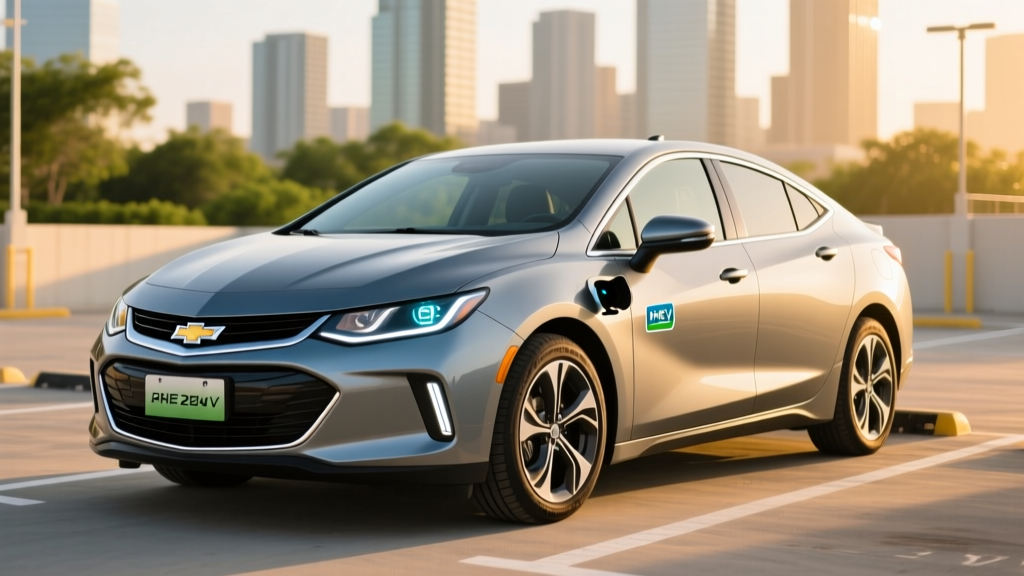
The Short Answer: The Chevrolet Volt Is a Plug-In Hybrid, Not a Conventional Hybrid
If you've been searching whether the Chevrolet Volt is a hybrid, the precise answer is that it's a plug-in hybrid electric vehicle (PHEV) — specifically, what GM called an "extended-range electric vehicle" (EREV). That distinction matters enormously for how you drive it, fuel it, and maintain it compared to a conventional hybrid like the Toyota Prius.
The Volt was sold in the U.S. from the 2011 through 2019 model years before Chevrolet discontinued it. It does not exist as a new 2026 model. However, it remains one of the most popular used PHEVs on the market, and understanding exactly what it is — and isn't — is critical before you buy one today.
- Conventional Hybrid (HEV): Small battery (~1-2 kWh), recharged only by the engine and regenerative braking. You never plug it in. Examples: Toyota Prius, Honda Accord Hybrid.
- Plug-In Hybrid (PHEV): Larger battery (the Volt uses 18.4 kWh usable in Gen 2), rechargeable from a wall outlet or charger. You can drive on electric-only power for a meaningful distance before the gas engine activates. Examples: Chevrolet Volt, Toyota RAV4 Prime, Chrysler Pacifica Hybrid.
How the Volt's Extended-Range Powertrain Actually Works
The Volt's architecture is unique among PHEVs and worth understanding because it affects real-world driving behavior. In most PHEVs, the gas engine can directly drive the wheels. In the Volt, the electric motors always drive the wheels. Here's the sequence:
- Charge-depleting mode (electric-only): The Volt runs purely on battery power, using its electric motors for all propulsion. The 1.5L gas engine stays completely off.
- Charge-sustaining mode (gas engine activates): Once the battery is depleted to its buffer threshold, the 1.5L inline-4 engine turns on — but primarily acts as a generator to produce electricity for the motors. At certain highway speeds, a clutch can mechanically link the engine to the drivetrain for efficiency, but this is the exception, not the rule.
This means the Volt drives like an EV in all conditions — smooth, quiet, instant torque — even after the battery is "empty." You never feel a clunky engine handoff because there isn't one in the traditional sense.
Gen 1 (2011–2015) vs. Gen 2 (2016–2019): What Changed
| Specification | Gen 1 (2011–2015) | Gen 2 (2016–2019) |
|---|---|---|
| Battery (usable) | 10.3 kWh (2011-12) / 10.9 kWh (2013-15) | 18.4 kWh |
| EPA Electric Range | 35 mi (2011-12) / 38 mi (2013-15) | 53 mi |
| Gas Engine | 1.4L I4 (range extender) | 1.5L I4 (range extender) |
| Combined System HP | 149 hp | 149 hp |
| EPA MPG (gas mode) | 37 combined | 42 combined |
| Total Combined Range | ~375 mi | ~420 mi |
| 0-60 mph | ~9.0 sec | ~8.4 sec |
| Seats | 4 | 5 (optional middle rear seat) |
For used buyers in 2026, the Gen 2 (2016–2019) is the stronger pick: 53 miles of electric range covers most daily commutes entirely on electricity, and the 42 MPG combined in gas mode is competitive with many conventional hybrids.
Chevrolet Volt Fuel Economy and Electric Range Breakdown
| Mode | City | Highway | Combined |
|---|---|---|---|
| Electric-only (MPGe) | 113 MPGe | 99 MPGe | 106 MPGe |
| Gas engine (charge-sustaining) | 43 MPG | 42 MPG | 42 MPG |
| Electric-only range | 53 miles (EPA) | ||
| Total range (electric + gas) | ~420 miles | ||
Source: EPA fueleconomy.gov — 2019 Chevrolet Volt
In our experience and owner reports, the Gen 2 Volt's 42 MPG combined gas-mode figure is achievable in mixed suburban driving. In city-heavy driving with frequent regen braking, owners often see 44-48 MPG. On sustained highway trips at 75+ mph, expect 38-40 MPG as the engine works harder and aerodynamic drag increases. Electric-only range of 53 miles EPA can stretch to 58-62 miles in mild weather city driving with gentle acceleration — or drop to 40-45 miles in freezing temperatures with cabin heat on.
Charging the Volt: Battery Specs, Times, and Connector Details
The Gen 2 Volt's 18.4 kWh battery pack (lithium-ion, NMC chemistry) uses a standard J1772 connector for AC charging. Here's the critical detail many used buyers miss: the Volt cannot DC fast charge. There is no CCS or CHAdeMO port. All charging is AC-only.
| Charging Level | Power | 0–Full Time | Notes |
|---|---|---|---|
| Level 1 (120V outlet) | ~1.4 kW (12A) | ~13 hours | Standard household outlet; ~4 mi/hr of range added |
| Level 2 (240V, 12A) | ~3.6 kW | ~4.5 hours | Default Level 2 setting; ~12 mi/hr |
| Level 2 (240V, 32A)* | ~7.2 kW | ~2.3 hours | Requires upgraded onboard charger (2019 model year only) |
| DC Fast Charge | N/A | N/A | Not supported — no DC port |
*The 7.2 kW onboard charger was available as an option on 2019 models only. Most 2016-2018 Volts are limited to 3.6 kW Level 2 charging.
For daily use, Level 1 charging from a standard 120V outlet is actually practical for many Volt owners. If your commute is 30-40 miles and you plug in when you get home, 13 hours of overnight charging at 1.4 kW replenishes the full 53-mile electric range. A Level 2 home charger is faster but not strictly necessary the way it is for a full EV with a 75+ kWh battery.
Battery Health, Warranty, and Replacement Costs
GM warranted the Volt's battery for 8 years / 100,000 miles (10 years / 150,000 miles in CARB states like California, New York, and others adopting California emissions standards). The warranty covers capacity loss below approximately 60-70% of original capacity, depending on model year terms.
As of 2026, here's the warranty math for used buyers:
- 2016 models: Original 8-year warranty expired in 2024. You're on your own unless the car is in a CARB state with the 10-year coverage (valid through 2026).
- 2017 models: Standard 8-year warranty expires in 2025. CARB-state 10-year coverage runs through 2027.
- 2018 models: Standard warranty expires in 2026. CARB-state coverage runs through 2028.
- 2019 models: Standard warranty expires in 2027. CARB-state coverage runs through 2029.
Real-World Battery Degradation
The Volt's battery management system is conservative — it maintains a large buffer at both the top and bottom of the pack, which is why the usable capacity is 18.4 kWh out of a gross ~18.4 kWh (Gen 2) that still shields cells from deep cycling stress. Owner data from Volt forums and battery-health checks show typical degradation of 8-15% after 100,000 miles. That means a Gen 2 Volt that originally delivered 53 electric miles might deliver 45-48 miles after a decade of use. This is acceptable degradation and far from catastrophic.
Battery Replacement Cost
If the battery does fail outside warranty, a replacement from GM runs approximately $3,500–$5,500 for the pack itself, plus $500–$1,200 in labor, putting total replacement in the $4,000–$6,700 range. Some independent EV shops offer refurbished pack replacements for $2,500–$3,500. While not cheap, this is lower than many full-EV battery replacements because the Volt's pack is smaller.
Does the Chevrolet Volt Qualify for a Tax Credit in 2026?
Here's where the used-buying picture gets interesting. The Volt originally qualified for the full $7,500 federal tax credit under §30D when sold new. However, GM hit the 200,000-unit cap in 2019, which phased out the new-vehicle credit for all GM products.
For 2026 used purchases: The Volt can qualify for the Used Clean Vehicle Credit (IRS §25E), which provides up to $4,000 or 30% of the sale price (whichever is less). Here are the current requirements per IRS guidelines:
- Sale price cap: The vehicle must sell for $25,000 or less (most used Volts in 2026 fall in the $10,000–$20,000 range, so this is easily met).
- Buyer income limits: Adjusted gross income must not exceed $75,000 (single), $112,500 (head of household), or $150,000 (joint filers).
- Vehicle age: Must be at least 2 model years old (all Volts qualify since production ended in 2019).
- Dealer requirement: Must be purchased from a licensed dealer (private-party sales don't qualify).
- Battery capacity: Must have at least 7 kWh of battery capacity (the Volt's 18.4 kWh easily qualifies).
- One-time use: The specific VIN can only claim this credit once. Check with the dealer to confirm it hasn't been previously claimed.
At typical 2026 used prices of $12,000–$18,000 for a Gen 2 Volt, the credit would be 30% of the sale price — so roughly $3,600–$5,400, capped at $4,000. A $14,000 Volt, for example, nets a $4,000 credit, bringing effective cost to $10,000. That's exceptional value for a 53-mile electric-range PHEV.
Who Should Buy a Used Chevrolet Volt in 2026?
✓ The Volt Is Right for You If:
- Your daily commute is under 50 miles round-trip and you can charge at home
- You want EV-like driving for daily errands but need gas flexibility for road trips
- You live in a cold climate where EV range loss is a concern (the gas engine eliminates range anxiety)
- You want a low-risk entry into electrified driving without committing to a full BEV
- You want to qualify for the $4,000 used-EV tax credit on a budget-friendly car
✗ Look Elsewhere If:
- You need DC fast charging for road trips (the Volt tops out at Level 2 AC)
- You regularly carry more than 4 passengers (Gen 1 seats only 4; Gen 2 has a tight 5th seat)
- You want a new vehicle with a full factory warranty
- Your commute is mostly highway at 80+ mph (a conventional hybrid may match the Volt's efficiency in this scenario)
- You need significant cargo space (the Volt's hatchback trunk is 10.6 cu ft — smaller than many compact sedans)
Volt vs. Full EV vs. Conventional Hybrid: Which Fits Your Life?
| Factor | Volt (PHEV) | Prius (HEV) | Model 3 / Bolt (BEV) |
|---|---|---|---|
| Plug in required? | Recommended, not required | No — never | Yes — mandatory |
| Electric-only range | 53 mi | ~1 mi (assist only) | 250-350+ mi |
| Road-trip fueling | Gas stations (42 MPG) | Gas stations (57 MPG) | DC fast chargers (20-40 min stops) |
| Home charging needed? | Helpful but optional | No | Essential for most owners |
| Maintenance complexity | Engine + electric (oil changes needed) | Engine + electric (oil changes needed) | Electric only (minimal) |
| Best for | Short commutes + occasional long trips | High-mileage drivers, no home charging | Home-charging access + predictable routes |
The Volt occupies a uniquely practical middle ground. If you can charge at home and your daily driving stays under 53 miles, you'll burn almost zero gasoline on weekdays — yet you can drive to another state on the weekend without planning a single charging stop. No full EV offers that flexibility, and no conventional hybrid gives you 53 miles of silent, gas-free electric driving.
Frequently Asked Questions
Is the Chevrolet Volt a hybrid or an electric car?
It's technically both — a plug-in hybrid (PHEV) that GM marketed as an "extended-range electric vehicle." The electric motors always drive the wheels, but a gas engine generates electricity once the battery depletes. It's not a conventional hybrid like a Prius, and it's not a pure EV like a Bolt.
How many MPG does the Chevrolet Volt get?
The Gen 2 Volt (2016–2019) achieves 42 MPG combined (43 city / 42 highway) when running on gasoline after the battery is depleted. In electric-only mode, it achieves 106 MPGe combined. Real-world results vary: city drivers often see 44-48 MPG in gas mode, while sustained highway driving at high speeds drops to 38-40 MPG.
How far can the Volt go on electric only?
The Gen 2 Volt is EPA-rated for 53 miles of electric-only range. Gen 1 models (2011–2015) are rated for 35-38 miles depending on model year. In mild weather with gentle driving, Gen 2 owners often see 55-62 miles. In freezing temperatures with the heater on, expect 40-45 miles.
Is the Chevrolet Volt reliable?
The Volt has a strong reliability record. The electric drivetrain has fewer moving parts than a conventional transmission, and the gas engine runs infrequently for many owners (reducing wear). Common issues include the 12V auxiliary battery needing replacement every 4-5 years and occasional coolant system maintenance. The high-voltage battery has proven durable, with most units retaining 85-92% capacity after 100,000 miles.
What does a Volt battery replacement cost?
A new replacement battery pack from GM costs approximately $3,500–$5,500 for the part, plus $500–$1,200 in labor, totaling $4,000–$6,700. Refurbished packs from independent shops run $2,500–$3,500. Given the Volt's conservative battery management, full replacement is uncommon before 150,000+ miles.
Can I charge a Volt at a Tesla Supercharger or DC fast charger?
No. The Volt only supports AC charging (Level 1 and Level 2) via a J1772 connector. It has no DC fast-charge capability. You can use any public Level 2 charger (ChargePoint, EVgo Level 2, etc.) with the standard J1772 plug, but DC fast chargers (Tesla Supercharger, Electrify America CCS, CHAdeMO) are not compatible.
Does the Volt qualify for any tax credit in 2026?
The Volt no longer qualifies for the new-vehicle §30D credit (GM hit the manufacturer cap in 2019). However, buying a used Volt from a dealer can qualify you for the Used Clean Vehicle Credit (§25E) — up to $4,000 or 30% of the sale price, subject to buyer income limits ($75K single / $150K joint) and a $25,000 maximum sale price. Consult a tax professional to confirm eligibility for your situation.