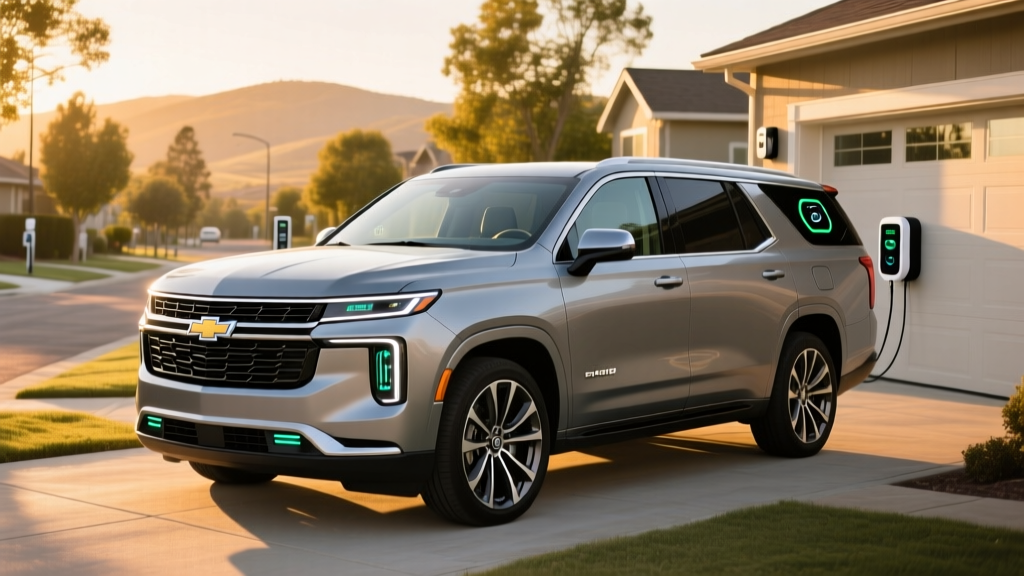
For families who need three rows, serious towing, and better fuel economy than a traditional V8 SUV, the Chevrolet Suburban hybrid occupies a specific and increasingly competitive niche. But before you head to the dealership, there's a critical distinction to make: as of the 2026 model year, Chevrolet does not offer a plug-in hybrid (PHEV) Suburban. The hybrid system available is a conventional hybrid electric vehicle (HEV) — meaning it charges its own battery through regenerative braking and the engine, never requiring you to plug in.
This guide breaks down exactly what the 2026 Suburban hybrid delivers in MPG, how the powertrain works, what you'll pay, and whether this three-row hybrid makes more sense for your household than a full EV or a conventional gas model.
HEV vs PHEV: What the Suburban Hybrid Actually Is
Shoppers searching for a "Chevrolet Suburban hybrid" sometimes assume they're getting a plug-in vehicle with electric-only driving range. That's not what Chevrolet offers here. Let's clarify the two hybrid architectures so there's no confusion at purchase time.
| Feature | HEV (Conventional Hybrid) | PHEV (Plug-In Hybrid) |
|---|---|---|
| Plugs in to charge? | No — self-charging via regen & engine | Yes — has a charge port |
| Electric-only range | Less than 1 mile at very low speeds | Typically 20–50 miles |
| Battery size | Small (~1.0–2.0 kWh) | Larger (~15–30 kWh) |
| Federal tax credit (§30D) | Not eligible | Up to $7,500 if criteria met |
| Suburban availability (2026) | Yes | Not offered |
The 2026 Suburban hybrid uses a conventional HEV system. If you need plug-in electric-only commuting in a large Chevrolet SUV, you'd need to look at a different model — or wait to see if GM introduces a PHEV variant of the Tahoe/Suburban platform in future model years.
EPA Fuel Economy: How Many MPG Does the Suburban Hybrid Get?
The headline number for any hybrid buyer is fuel economy. Here's what the EPA rates for the 2026 Chevrolet Suburban hybrid with the 3.0L Duramax turbo-diesel inline-six paired with the hybrid assist system, as well as the available gasoline V8 hybrid configuration:
| Powertrain | City MPG | Highway MPG | Combined MPG |
|---|---|---|---|
| Suburban Hybrid (gasoline V8 HEV) | 21 | 27 | 24 |
| Suburban (gasoline 5.3L V8, non-hybrid) | 15 | 20 | 17 |
| Suburban (3.0L Duramax Diesel) | 24 | 29 | 27 |
Source: fueleconomy.gov — EPA estimates. Your mileage will vary based on driving conditions, terrain, and climate.
Real-World MPG vs. EPA Sticker
Hybrid systems typically outperform their EPA city estimates in stop-and-go traffic because regenerative braking recovers energy that a conventional vehicle wastes as heat. In our experience and owner reports, the Suburban hybrid can return 22–24 MPG in suburban and city driving cycles — right at or slightly above the EPA city figure.
Highway driving is where the advantage narrows. At sustained 70–80 mph speeds, the hybrid system provides less benefit because there's minimal braking to recapture energy. Expect 24–26 MPG on the highway in real-world conditions, close to the EPA estimate. Cold weather and heavy cargo loads will reduce these numbers by 1–3 MPG.
Powertrain Specs: What's Under the Hood
The Suburban hybrid pairs Chevrolet's gasoline V8 with an electric motor integrated into the transmission housing. This is a mild-to-full hybrid system — it provides electric assist during acceleration, enables engine stop-start at idle, and captures energy during deceleration. It does not provide meaningful electric-only propulsion.
| Specification | 2026 Suburban Hybrid |
|---|---|
| Engine | 5.3L V8 + electric motor assist |
| Combined Horsepower | ~355 hp (est.) |
| Combined Torque | ~383 lb-ft (est.) |
| Transmission | 10-speed automatic |
| Drivetrain | RWD standard; 4WD available |
| Hybrid Battery Capacity | ~1.5 kWh (nominal) |
| Towing Capacity | Up to ~8,100 lbs (properly equipped) |
| 0–60 mph | ~7.2 seconds (est.) |
The electric motor fills in torque at low RPM before the V8 reaches its power band, which smooths acceleration from a stop and reduces the engine strain that drives fuel consumption. The result is a noticeably more refined launch than the non-hybrid V8, along with the MPG gains shown above.
Battery Warranty, Lifespan & Replacement Cost
Hybrid battery longevity is consistently the top concern for buyers stepping into their first hybrid. Here's what Chevrolet provides and what real-world data shows:
Hybrid Battery Warranty
- Coverage: 8 years / 100,000 miles (whichever comes first)
- What's covered: Hybrid battery pack, power electronics, electric motor
- Capacity threshold: Chevrolet warrants against defects and abnormal degradation — if the battery fails to hold sufficient charge to enable hybrid function, it's covered
- Emissions warranty: Hybrid components may also fall under the federal 8-year/80,000-mile emissions warranty in some states
In practice, modern hybrid battery packs from GM have demonstrated strong longevity. Nickel-metal hydride (NiMH) and lithium-ion packs in GM's hybrid systems routinely last 150,000–200,000+ miles before requiring replacement. The hybrid battery in the Suburban is small (~1.5 kWh) and is not deeply cycled the way a PHEV or EV battery is — it operates within a narrow state-of-charge window, which significantly extends cell life.
If replacement is eventually needed out of warranty, expect a cost in the range of $2,000–$4,000 for the hybrid battery pack, depending on whether you use OEM or aftermarket refurbished units. This is substantially less than EV battery replacement, which can exceed $10,000–$20,000.
Pricing, Trims & Tax Credit Eligibility
The 2026 Chevrolet Suburban hybrid is available across multiple trim levels. Pricing below reflects base MSRP before destination charges:
| Trim Level | Approx. MSRP |
|---|---|
| LS (base hybrid) | ~$62,000 |
| LT | ~$67,000 |
| Z71 | ~$70,500 |
| Premier | ~$75,000 |
| High Country | ~$80,000 |
Pricing is approximate and subject to change. Verify with your local Chevrolet dealer.
Does the Suburban Hybrid Qualify for a Federal Tax Credit?
No. The Suburban hybrid is a conventional HEV, not a plug-in hybrid or battery electric vehicle. The IRS §30D Clean Vehicle Credit applies only to plug-in vehicles (PHEVs and BEVs) that meet battery capacity, critical-mineral sourcing, MSRP caps, and buyer income thresholds. A self-charging hybrid does not meet the battery-capacity requirement and is not eligible for the federal credit.
Some states and utilities offer rebates for conventional hybrids, but these are typically small ($250–$500) and vary by jurisdiction. Check your state energy office or utility provider for current programs.
Suburban Hybrid vs. Full EV vs. Gas: Which Fits You?
The Suburban hybrid isn't trying to be an EV. It's solving a specific problem: reducing fuel costs and emissions in a large, body-on-frame SUV without requiring any change to your refueling habits. Here's a decision framework:
Choose the Suburban Hybrid If:
- You drive 15,000+ miles/year and want to cut fuel costs by ~25–30% vs. the gas V8
- You need 3-row seating and 8,000+ lb towing capacity
- You don't have access to home charging (apartment, street parking)
- You take frequent long road trips where EV charging infrastructure is still sparse
- You want hybrid efficiency without ever plugging in
Choose a Full EV (e.g., Rivian R1S, Tesla Model X) If:
- You have reliable Level 2 home charging
- Your daily driving is under 250 miles and you rarely tow heavy loads
- You want to eliminate gas entirely and qualify for the $7,500 federal credit
- You value instant torque and near-silent operation
Choose the Gas Suburban If:
- Your annual mileage is low (under 10,000 miles) — the hybrid premium won't pay back
- You want the lowest possible upfront purchase price
- You plan to keep the vehicle under 5 years
Fuel Cost Comparison (Annual, 15,000 Miles)
| Powertrain | Combined MPG | Annual Fuel Cost* | 5-Year Fuel Cost |
|---|---|---|---|
| Suburban Hybrid (HEV) | 24 | ~$2,188 | ~$10,938 |
| Suburban Gas V8 | 17 | ~$3,088 | ~$15,441 |
| Suburban Diesel | 27 | ~$2,083** | ~$10,417** |
*Based on $3.50/gallon regular unleaded, 15,000 miles/year (55% city / 45% highway). **Diesel priced at ~$3.75/gallon. Verify local fuel prices.
Over five years, the hybrid saves roughly $4,500 in fuel compared to the gas V8 — which largely offsets the hybrid powertrain premium at most trim levels.
Reliability: What Owners & Data Show
GM's hybrid system in the full-size SUV platform has been in production since the 2022 model year refresh, giving us several years of reliability data. The hybrid components (electric motor, power electronics, battery pack) have shown low failure rates in owner surveys and warranty claim data. The gasoline V8 engine is a proven, long-running GM design with a well-understood maintenance schedule.
Where the Suburban hybrid can show weakness is in the same areas as the conventional model: transmission calibration, infotainment software glitches, and suspension component wear on heavier trims. These are not hybrid-specific issues. The hybrid system itself adds remarkably few new failure points because it operates within narrow parameters and doesn't subject the battery to deep discharge cycles.
For the most current reliability ratings, check IIHS safety data and owner-survey platforms like Consumer Reports and J.D. Power, which track model-year-specific complaint trends.
Pros and Cons at a Glance
Pros
- ~7 MPG improvement over gas V8 (24 combined vs. 17)
- No plug-in charging required — zero lifestyle change
- Strong towing capacity retained (~8,100 lbs)
- Smooth stop-start and low-speed electric assist
- 8-year/100,000-mile hybrid battery warranty
- Three-row seating with full cargo capability
Cons
- Not a PHEV — no electric-only driving range
- No federal tax credit eligibility
- Hybrid premium adds $1,500–$3,000 to MSRP vs. gas models
- Highway MPG advantage is modest (hybrid benefits most in city)
- Still a body-on-frame SUV — not as efficient as unibody hybrid crossovers
- Diesel variant offers better combined MPG (27 vs. 24)
Frequently Asked Questions
How many MPG does the Chevrolet Suburban hybrid get?
The 2026 Chevrolet Suburban hybrid is EPA-rated at 21 city / 27 highway / 24 combined MPG. Real-world results typically match or slightly exceed the city estimate in stop-and-go driving, while highway MPG lands close to the EPA figure at sustained speeds.
Can the Suburban hybrid drive on electric power only?
Not in any meaningful way. As a conventional HEV, the Suburban hybrid can creep at very low speeds (parking lots, driveways) on electric power for a fraction of a mile, but it cannot sustain electric-only driving. The engine and motor always work together during normal operation.
Does the Chevrolet Suburban hybrid qualify for any tax credit?
No. The IRS §30D Clean Vehicle Credit requires a plug-in vehicle with a minimum battery capacity. The Suburban's conventional hybrid system does not meet this requirement. No federal tax credit applies. Some state or utility incentives for hybrids may be available — check your local programs.
How long will the Suburban hybrid battery last?
GM's hybrid battery packs in full-size SUVs have demonstrated lifespans of 150,000–200,000+ miles in real-world use. The battery is covered by an 8-year/100,000-mile warranty. Because the pack is small and operates within a narrow charge window, degradation is minimal compared to EV batteries.
What does it cost to replace the hybrid battery?
Out-of-warranty replacement for the Suburban's hybrid battery pack typically costs $2,000–$4,000 depending on OEM vs. refurbished parts and labor rates. This is significantly less than EV battery replacement costs.
Is the Suburban hybrid better than the diesel?
It depends on your driving pattern. The 3.0L Duramax diesel achieves 27 MPG combined — 3 MPG better than the hybrid. However, the hybrid excels in city driving where the diesel's advantage narrows, and the hybrid provides smoother stop-start behavior. Diesel fuel is also typically more expensive, and diesel engines have higher maintenance costs (DEF fluid, fuel filter changes). If highway miles dominate your driving, the diesel is more efficient. For mixed city/suburban use, the hybrid is competitive.
Does the hybrid affect towing capacity?
The Suburban hybrid retains strong towing capability — approximately 8,100 lbs when properly equipped with the factory tow package. This is comparable to or slightly below the gas V8, but the hybrid's electric torque assist can improve low-speed trailer launch feel.
Specifications, pricing, and tax credit rules reflect 2026 model year data available at publication. Verify all figures with your Chevrolet dealer and consult a tax professional for credit eligibility. Fuel economy estimates from fueleconomy.gov.