The 2009 Silverado Hybrid: GM's First Full-Size Truck Electrification Bet
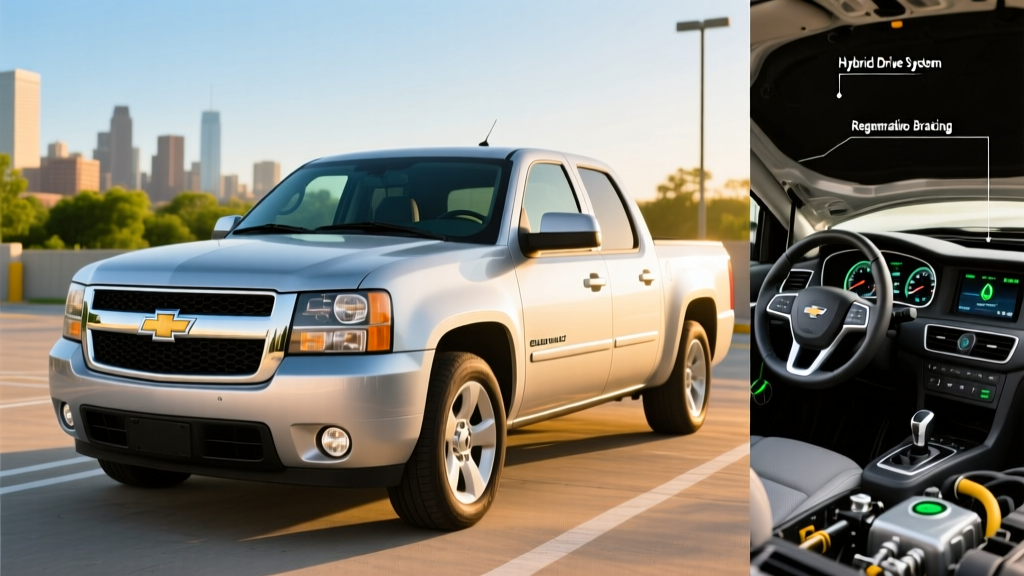
Long before the Ford F-150 PowerBoost or the Silverado PHEV concepts made headlines, General Motors launched a genuinely ambitious project: the Two-Mode Hybrid full-size pickup. The 2009 Chevrolet Silverado Hybrid paired a 6.0-liter V8 with a twin-motor hybrid transmission, delivering meaningful fuel economy gains without sacrificing the towing and payload capabilities truck buyers demanded. It was a conventional hybrid (HEV) — no plug required — and it represented the most sophisticated hybrid truck powertrain on the market at the time.
If you're researching a chevrolet silverado hybrid 2009 as a used purchase in 2026, this guide covers everything: real-world MPG, the Two-Mode system's engineering, battery longevity and replacement costs, and how this truck stacks up against modern hybrid and EV alternatives. We'll also clarify the HEV vs. PHEV distinction, since this truck predates the plug-in era entirely.
HEV vs. PHEV: Where the 2009 Silverado Hybrid Fits
Before diving into specs, it's critical to understand what this truck is — and isn't.
Conventional Hybrid (HEV) — This Truck
- No plug, no external charging required. The battery recharges through regenerative braking and the gasoline engine.
- No electric-only driving range beyond very low-speed creep (under ~30 mph for short distances).
- No federal tax credit eligibility under current IRS §30D rules, which apply only to plug-in vehicles.
- Lower upfront complexity; no home charging infrastructure needed.
Plug-In Hybrid (PHEV) — Modern Alternative
- Plugs in to a standard 120V outlet or Level 2 (240V) charger.
- 20-50 miles of electric-only range before the gas engine engages (varies by model).
- May qualify for up to $7,500 federal tax credit if battery capacity ≥ 7 kWh and sourcing/income requirements are met.
- Best for drivers with short commutes who want EV-like daily driving with gas-engine road-trip flexibility.
The 2009 Silverado Hybrid is firmly in the HEV column. You fuel it like any other truck, and the hybrid system works invisibly in the background to reduce fuel consumption. There is no plug, no electric-only commute mode, and no EV tax credit.
Powertrain & Performance: The Two-Mode Hybrid System
The heart of this truck is GM's Two-Mode Hybrid transmission, co-developed with BMW and Chrysler (then DaimlerChrysler). It's a fundamentally different design from the simpler single-mode systems Toyota used in the Prius, and it was engineered specifically to handle heavy-load truck duty cycles.
| Specification | Value |
|---|---|
| Engine | 6.0L V8 (Vortec) with Active Fuel Management (cylinder deactivation) |
| Engine HP / Torque | 332 hp @ 5,100 rpm / 367 lb-ft @ 4,100 rpm |
| Electric Motors | Twin 60-kW motors integrated into transmission |
| Combined System Output | 379 hp |
| Transmission | Two-Mode Hybrid CVT (electronically variable) |
| Hybrid Battery | Nickel-Metal Hydride (NiMH), ~1.8 kWh, 300V nominal |
| Drivetrain | 2WD or 4WD |
| 0-60 mph | ~7.8 seconds (4WD Crew Cab) |
| Max Towing Capacity | 5,800 lbs (properly equipped) |
| Payload Capacity | ~1,300 lbs (varies by configuration) |
| Body Style | Crew Cab only (short bed or standard bed) |
The Two-Mode system operates in two distinct regimes. In Mode 1 (low speed / city driving), the system functions like a traditional hybrid CVT: the electric motors handle launch from stop, low-speed propulsion, and regenerative braking. The V8 can shut off entirely at stops and during light-load coasting. At speeds above roughly 30 mph or under heavier throttle, Mode 2 engages fixed mechanical gear ratios, allowing the truck to tow and haul without the efficiency penalties that plague single-mode hybrid CVTs at highway speeds.
This dual-mode architecture gave the Silverado Hybrid a genuine advantage: it didn't sacrifice highway capability for city efficiency. The truck could tow a 5,000-lb trailer and still deliver better fuel economy than the gas-only 5.3L V8 Silverado of the same era.
Fuel Economy: EPA Ratings vs. Real-World MPG
| Configuration | City MPG | Highway MPG | Combined MPG |
|---|---|---|---|
| 2WD Crew Cab | 21 | 22 | 21 |
| 4WD Crew Cab | 20 | 20 | 20 |
For context, the conventional 2009 Silverado 1500 with the 5.3L V8 and 4WD was rated at 14 city / 20 highway / 16 combined by the EPA. The hybrid's 20/20/20 rating represented a roughly 25% improvement in combined fuel economy and a dramatic 43% improvement in city driving.
Real-World MPG: What Owners Actually Report
Hybrid trucks typically match or slightly exceed their EPA city ratings because stop-and-go driving maximizes regenerative braking and engine-off time. Owner-reported data from Fuelly and truck forums suggests:
- City driving (mixed suburban/stoplight): 19-22 MPG — generally near or slightly above the EPA 20-21 rating.
- Highway cruising (70-75 mph): 18-20 MPG — the hybrid advantage narrows at sustained highway speeds, where the V8 carries most of the load.
- Towing (5,000+ lbs): 12-15 MPG — the hybrid system still helps, but physics dominates under heavy load.
- Cold weather (below 30°F): Expect a 1-2 MPG drop as the engine runs more frequently to maintain cabin heat and battery temperature.
The real-world combined figure for a 4WD model driven in mixed conditions typically lands at 18-21 MPG, which tracks closely with the EPA's 20 MPG combined estimate. This is honest data — not marketing inflation.
Battery Longevity, Warranty & Replacement Costs
For a 2009 model now approaching 17 years old, battery health is the single most important question for used buyers. Here's what you need to know.
Original Battery Warranty
GM warranted the hybrid battery and related components for 8 years / 100,000 miles (whichever came first). For trucks sold new in California and states that adopted CARB emissions standards, the hybrid system warranty extended to 10 years / 150,000 miles.
All original factory warranties have expired as of 2026. Any battery replacement will be an out-of-pocket expense.
NiMH Battery Lifespan
The Silverado Hybrid uses a nickel-metal hydride (NiMH) battery pack — the same chemistry Toyota used in millions of Prius hybrids. NiMH is well-understood and generally robust, but it does degrade over time and with heat exposure.
- Typical lifespan: 10-15 years / 150,000-200,000 miles before significant capacity loss.
- Failure mode: Unlike lithium-ion batteries that gradually lose capacity, NiMH packs tend to fail when individual cells develop voltage imbalances. This often triggers a "Service Hybrid System" warning and can disable the hybrid functionality entirely, reverting the truck to gas-only operation.
- Heat sensitivity: Trucks operated in hot climates (Arizona, Texas, Southern California) may experience earlier battery degradation. The battery pack is located under the rear seat, which provides some thermal insulation but is not actively cooled.
Battery Replacement Cost
| Option | Estimated Cost (2026) | Notes |
|---|---|---|
| New OEM battery (GM dealer) | $3,500 - $5,000 | May be difficult to source; GM has discontinued some hybrid parts |
| Remanufactured battery (specialty hybrid shops) | $2,000 - $3,500 | Rebuilt with new cells; typically 1-3 year warranty |
| Used/salvage battery | $800 - $1,500 | Risky — unknown remaining lifespan; no warranty |
| Individual cell reconditioning | $500 - $1,200 | Requires specialized hybrid shop; replaces only failed cells |
Before purchasing, request a hybrid battery health report from a qualified hybrid technician. This diagnostic checks individual cell voltages and identifies weak modules before they cause a complete failure. Expect to pay $100-$200 for this inspection — it's worth every dollar.
Reliability & Common Issues
The 2009 Silverado Hybrid is mechanically robust in most respects, but its complexity introduces failure points that the gas-only Silverado doesn't have.
Known Issues
- Hybrid battery failure: The most expensive single repair. As noted above, NiMH cells degrade and eventually require replacement or reconditioning.
- Inverter/coolant system: The hybrid system has its own dedicated coolant loop. Coolant leaks or pump failures can damage the power electronics (inverter). Check for proper coolant levels and any history of inverter replacement.
- Active Fuel Management (AFM) lifter issues: The 6.0L V8 uses cylinder deactivation (AFM) to shut down four cylinders under light load. This system is known for lifter failure on high-mileage GM V8s of this era, potentially requiring a $2,000-$4,000 engine repair. Many owners choose to have AFM permanently disabled by a tuner.
- Transmission: The Two-Mode hybrid transmission is generally reliable but expensive to replace ($4,000-$7,000) if it fails. Parts availability is declining as GM phases out support.
- Standard Silverado issues: Rust (frame and body mounts), power window regulators, and HVAC blend door actuators — common to all GMT900-platform trucks.
Overall Reliability Verdict
A well-maintained 2009 Silverado Hybrid with a healthy battery can be a reliable daily driver. However, buyers should budget $2,000-$4,000 in reserve for hybrid-specific repairs within the first few years of ownership. The non-hybrid mechanical components (suspension, brakes, engine block) are proven and parts are widely available.
Pros
- 25%+ better city fuel economy than the gas V8 Silverado
- Retains full towing (5,800 lbs) and payload capability
- No plug-in charging needed — fuel and drive like a normal truck
- Crew Cab configuration with practical rear seating
- Proven NiMH battery chemistry with known repair paths
- Available at a significant discount vs. new hybrid trucks
Cons
- Hybrid battery nearing end-of-life on most surviving examples
- Declining OEM parts support from GM for hybrid-specific components
- No electric-only driving range — always burns gasoline
- No federal or state tax credit eligibility
- AFM lifter risk on the 6.0L V8
- Fuel economy advantage shrinks at highway speeds and under towing
Pricing & Tax Credit Eligibility in 2026
Used Market Pricing
As of early 2026, the 2009 Silverado Hybrid trades in the used market at roughly:
- High mileage (150,000+ miles), fair condition: $6,000 - $9,000
- Average mileage (100,000-150,000), good condition: $9,000 - $13,000
- Lower mileage (<100,000), excellent condition: $13,000 - $17,000
Prices vary significantly by region, configuration (2WD vs. 4WD), and documented maintenance history. Trucks with a recently replaced hybrid battery command a $2,000-$3,000 premium.
Tax Credit Status
The 2009 Silverado Hybrid does not qualify for any federal tax credit under current IRS §30D rules. The federal credit applies exclusively to new plug-in electric vehicles (BEVs and PHEVs) with battery packs of at least 7 kWh. This truck's ~1.8 kWh NiMH pack and conventional hybrid architecture place it outside all current federal incentive programs.
Some states have offered hybrid-specific incentives historically, but virtually all have expired or transitioned to EV-only programs. Check your state's alternative fuel vehicle incentive page for any remaining local benefits, though none are expected for a 2009 model-year vehicle.
2009 Silverado Hybrid vs. Modern Alternatives
If you're weighing this used truck against newer options, here's how the comparison breaks down:
| Vehicle | Type | EPA Combined MPG | Towing | Approx. Price (2026) |
|---|---|---|---|---|
| 2009 Silverado Hybrid | HEV | 20-21 MPG | 5,800 lbs | $6,000-$17,000 (used) |
| 2025 Ford F-150 PowerBoost | HEV | 22-24 MPG | 12,700 lbs | $58,000-$75,000 (new) |
| 2025 Silverado 1500 3.0L Duramax | Diesel | 24-26 MPG | 9,300 lbs | $50,000-$65,000 (new) |
| 2025 Ford F-150 Lightning | BEV | 70-78 MPGe | 7,700 lbs | $55,000-$90,000 (new) |
The 2009 Silverado Hybrid occupies a unique niche: it's the most affordable way to get a full-size hybrid truck. The F-150 PowerBoost is objectively superior in every metric — more power, better MPG, higher towing, modern tech — but it costs 4-5x more. If your budget is under $15,000 and you need a full-size truck with better-than-average fuel economy, the 2009 Silverado Hybrid has no direct competitor at this price point.
Who Should Buy This Truck (And Who Shouldn't)
Choose the 2009 Silverado Hybrid If:
- You need a full-size crew cab truck on a budget under $15,000
- You drive primarily in city/suburban conditions where the hybrid system delivers maximum MPG benefit
- You don't have access to home charging and can't consider a PHEV or BEV
- You're comfortable budgeting $2,000-$4,000 for potential hybrid battery replacement
- You value fuel savings over modern infotainment, safety tech, and driver assistance features
Look Elsewhere If:
- You primarily drive highway miles (the hybrid advantage is minimal at 70+ mph)
- You need the latest safety features (automatic emergency braking, blind-spot monitoring, lane-keep assist — none available on this truck)
- You want electric-only commuting capability (look at a PHEV like the Ford F-150 PowerBoost or a plug-in SUV)
- You plan to tow frequently above 5,000 lbs (the hybrid system's MPG advantage shrinks significantly under load)
- You want a warranty-backed vehicle with predictable repair costs
Frequently Asked Questions
How many MPG does the 2009 Chevrolet Silverado Hybrid get?
The EPA rates the 2WD model at 21 city / 22 highway / 21 combined MPG, and the 4WD model at 20 city / 20 highway / 20 combined. Real-world reports cluster around 18-21 MPG combined, with city driving often matching or slightly exceeding the EPA rating thanks to regenerative braking.
Does the 2009 Silverado Hybrid need to be plugged in?
No. This is a conventional hybrid (HEV), not a plug-in hybrid (PHEV). The battery charges through regenerative braking and the gasoline engine. You fuel it exactly like a standard truck — there is no plug, no charging cable, and no electric-only driving range.
How far can it go on electric power alone?
Essentially zero miles in practical terms. The electric motors assist during acceleration and can propel the truck at very low speeds (under ~30 mph) for brief distances, but there is no meaningful electric-only range. The gas engine is always the primary power source.
Is the 2009 Silverado Hybrid reliable?
The conventional mechanical components (engine block, frame, suspension) are durable and well-supported by the aftermarket. The hybrid-specific components — battery, inverter, and Two-Mode transmission — are generally reliable but expensive to repair when they fail, and OEM parts availability is declining. Budget $2,000-$4,000 for potential hybrid repairs.
What does a replacement hybrid battery cost?
A new OEM battery from GM costs $3,500-$5,000 but may be difficult to source. Remanufactured batteries from hybrid specialty shops run $2,000-$3,500 with a 1-3 year warranty. Used salvage batteries are $800-$1,500 but carry significant risk. Individual cell reconditioning is $500-$1,200 at a qualified hybrid shop.
Does it qualify for any tax credit?
No. The 2009 Silverado Hybrid does not qualify for the federal §30D EV tax credit, which applies only to plug-in vehicles with batteries of 7 kWh or larger. This truck's 1.8 kWh NiMH battery and non-plug-in architecture make it ineligible. State-level hybrid incentives for this model year have also largely expired.
How does it compare to a modern hybrid truck like the F-150 PowerBoost?
The Ford F-150 PowerBoost (introduced for 2021) is significantly more capable: 430 combined hp, 22-24 MPG combined, up to 12,700 lbs towing, and modern safety/tech features. However, it starts around $58,000 new. The 2009 Silverado Hybrid is a budget option — it delivers hybrid fuel economy at a fraction of the price, but with older technology, lower towing capacity, and no modern safety systems.
Should I buy a 2009 Silverado Hybrid or a gas-only Silverado from the same year?
If you drive mostly in the city and put on 15,000+ miles per year, the hybrid's 4-5 MPG advantage translates to roughly $400-$600 in annual fuel savings (at $3.50/gallon). That savings can offset the hybrid battery replacement risk over 4-5 years. If you drive mostly highway or low annual miles, the gas-only 5.3L V8 Silverado is simpler, cheaper to repair, and the fuel economy difference is negligible. For a detailed comparison, check fueleconomy.gov for side-by-side EPA data.