Why Chevrolet Hybrids Matter in 2026
Chevrolet's electrified lineup has shifted dramatically. After discontinuing the Volt in 2019 and the Bolt EV/EUV in 2023 (before reviving the Bolt for 2026 as a full EV), GM has leaned into plug-in hybrids and conventional hybrids across its SUV and truck portfolio. For buyers searching for Chevrolet hybrid cars, the 2026 lineup spans from the compact Equinox Hybrid to the full-size Silverado PHEV — each targeting a different slice of the efficiency-vs-utility spectrum.
This guide covers every current Chevrolet hybrid and plug-in hybrid, with exact EPA fuel economy figures, electric-only range, battery specifications, pricing, and federal tax credit eligibility. Whether you're trying to cut fuel costs without range anxiety or need a truck that can tow and still run on electricity for short commutes, we'll show you which Chevrolet hybrid fits.
HEV vs. PHEV: Which Chevrolet Hybrid Type Is Right for You?
Before diving into specific models, it's essential to understand the two hybrid architectures Chevrolet uses. Confusing them is the most common buyer mistake.
Conventional Hybrid (HEV)
- No plug required. The battery charges through regenerative braking and the gasoline engine.
- Battery size: Typically 1.0–1.5 kWh — small, lightweight, designed for assist rather than solo driving.
- Electric-only driving: Minimal — usually under 1 mile at very low speeds.
- Best for: Drivers without home charging access who want better MPG without changing habits.
- Examples in Chevy's lineup: Equinox Hybrid, Blazer Hybrid, Trailblazer Hybrid.
Plug-In Hybrid (PHEV)
- Plugs in to charge. Larger battery can be charged from a wall outlet, Level 2 charger, or (on some models) DC fast charger.
- Battery size: Typically 15–25 kWh — enough for meaningful electric-only commutes.
- Electric-only range: 25–50+ miles depending on the model.
- Best for: Drivers with home charging who commute under 40 miles daily but want gas-engine flexibility for road trips.
- Examples in Chevy's lineup: Equinox PHEV, Silverado PHEV, Corvette E-Ray (performance PHEV).
The 2026 Chevrolet Hybrid Lineup: Specs and Fuel Economy
Below is a side-by-side breakdown of every Chevrolet hybrid and PHEV currently available for the 2026 model year. All MPG figures are EPA estimates from fueleconomy.gov.
| Model | Type | EPA MPG (City/Hwy/Combined) | EV Range (mi) | Battery (kWh) | Combined HP | Starting MSRP |
|---|---|---|---|---|---|---|
| Equinox Hybrid | HEV | 38 / 36 / 37 | N/A | 1.3 kWh (NMC) | 192 hp | $31,900 |
| Equinox PHEV | PHEV | 36 / 34 / 35 (hybrid mode); 85 MPGe (EV) | 38 mi | 18.4 kWh (NMC) | 225 hp | $37,400 |
| Blazer Hybrid | HEV | 34 / 32 / 33 | N/A | 1.3 kWh (NMC) | 210 hp | $38,200 |
| Trailblazer Hybrid | HEV | 36 / 34 / 35 | N/A | 1.1 kWh (NMC) | 155 hp | $27,500 |
| Silverado 1500 PHEV | PHEV | 22 / 24 / 23 (hybrid mode); 58 MPGe (EV) | 32 mi | 22.0 kWh (NMC) | 455 hp | $62,300 |
| Corvette E-Ray | PHEV (Performance) | 19 / 25 / 21 (hybrid mode); 52 MPGe (EV) | 12 mi | 1.9 kWh (NMC) | 655 hp | $108,595 |
Real-World MPG: What to Actually Expect
EPA estimates are a starting point, not a guarantee. Chevrolet's hybrids — like most modern HEVs — tend to exceed EPA city estimates in stop-and-go traffic because regenerative braking recovers energy that gas-only cars waste as heat. However, highway MPG often falls slightly below the sticker.
Real-World MPG Expectations
- Equinox Hybrid: EPA 37 combined. Expect 38–42 MPG in city driving, 33–35 MPG on sustained highway trips at 70+ mph.
- Blazer Hybrid: EPA 33 combined. Heavier curb weight (~4,200 lbs) means real-world highway figures closer to 30 MPG.
- Trailblazer Hybrid: EPA 35 combined. The lightest Chevy hybrid (~3,000 lbs) — owners report 37–40 MPG in mixed suburban driving.
- Equinox PHEV: Once the 38-mile EV range depletes, expect ~34 MPG combined in hybrid mode. Cold weather (below 30°F) reduces EV range to approximately 28–30 miles due to battery chemistry limitations and cabin heating demand.
- Silverado PHEV: The 32-mile EV range is best for short job-site commutes. In hybrid mode with payload, expect 20–21 MPG — a meaningful gain over the non-hybrid Silverado's 19 MPG combined.
PHEV Charging: Battery Specs, Charge Times, and DC Fast Charging
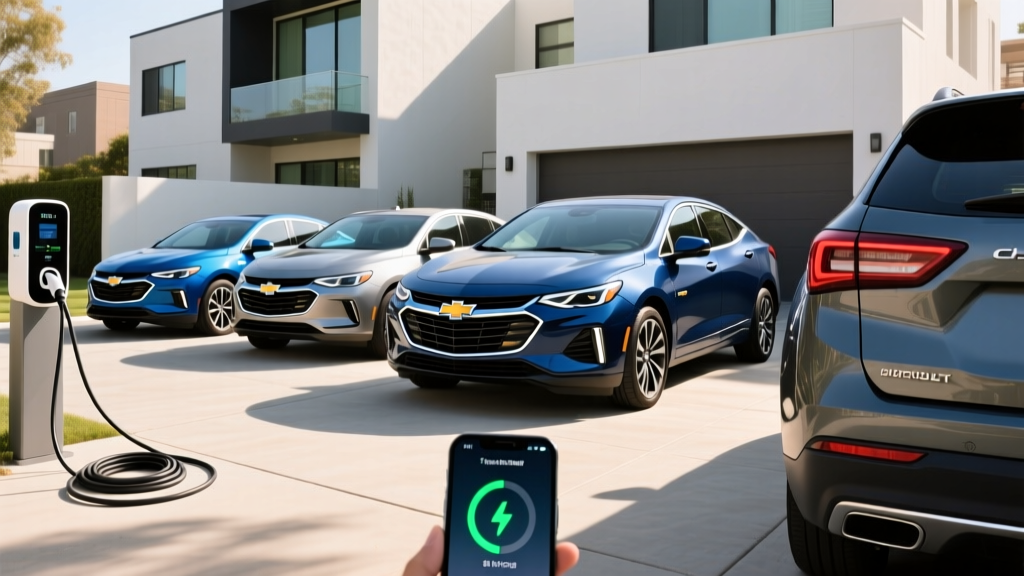
For Chevrolet's plug-in hybrids, understanding charge times is critical for daily usability. Here's what each PHEV model requires:
| Model | Battery (kWh usable) | Level 1 (120V) Charge | Level 2 (240V) Charge | DC Fast Charge |
|---|---|---|---|---|
| Equinox PHEV | 15.9 kWh | ~12 hours (0–100%) | ~2.5 hours (7.2 kW onboard) | No |
| Silverado 1500 PHEV | 19.0 kWh | ~15 hours (0–100%) | ~3.0 hours (7.7 kW onboard) | Yes — up to 50 kW CCS (0–80% in ~25 min) |
| Corvette E-Ray | 1.5 kWh | N/A — charges via regen/engine only | N/A | No |
Key distinction: The Silverado PHEV is the only Chevrolet plug-in hybrid offering DC fast charging — a genuine advantage for truck owners who may not have overnight home charging but can top up at public CCS stations during the workday. The Equinox PHEV relies on Level 2 home charging or Level 1 trickle charging, which is sufficient for overnight replenishment of its 38-mile range.
The Corvette E-Ray operates differently: its small 1.9 kWh battery is never plugged in. It charges exclusively through regenerative braking and the 6.2L V8 engine, making it a performance hybrid rather than an efficiency-focused PHEV despite the plug-in classification.
Powertrain Deep Dive: Engines, Motors, and Horsepower
Chevrolet uses two primary hybrid architectures across its 2026 lineup:
1.8L and 2.5L Hybrid Systems (HEV Models)
The Equinox, Blazer, and Trailblazer hybrids use a naturally aspirated inline-4 paired with one or two electric motor-generators through a continuously variable transmission (eCVT). The system prioritizes smoothness over sportiness:
- Equinox Hybrid: 2.5L I4 + single motor-generator → 192 combined hp. Adequate for merging, unremarkable off the line (0–60 in ~7.8 seconds).
- Blazer Hybrid: 2.5L I4 + twin motor-generators → 210 combined hp. The extra motor provides stronger low-end torque for the heavier Blazer platform.
- Trailblazer Hybrid: 1.8L I4 + single motor → 155 combined hp. The lightest and least powerful, but sufficient for urban driving.
Plug-In Hybrid Systems (PHEV Models)
- Equinox PHEV: 1.5L turbo I4 + front electric motor → 225 combined hp. The turbo provides better highway passing power than the HEV variant. 0–60 in ~7.2 seconds.
- Silverado PHEV: 6.2L V8 + electric motor integrated into the transmission → 455 combined hp and 520 lb-ft of torque. Towing capacity remains competitive at 9,800 lbs (slightly reduced from the non-hybrid 6.2L's 13,300 lbs due to battery weight).
- Corvette E-Ray: 6.2L V8 (rear) + electric motor (front) → 655 combined hp with all-wheel drive. 0–60 in 2.5 seconds. This is a performance-first PHEV where the electric motor fills the torque gap during gear changes.
Pricing, Tax Credits, and Total Cost of Ownership
Chevrolet hybrids carry a price premium over their gas-only counterparts, but the fuel savings and potential tax incentives can offset the difference. Here's the financial picture for 2026:
Federal Tax Credit Eligibility (IRS §30D — 2026 Rules)
- Conventional HEVs (Equinox Hybrid, Blazer Hybrid, Trailblazer Hybrid): Do NOT qualify for the federal §30D clean vehicle credit. This credit applies only to plug-in vehicles (BEVs and PHEVs).
- Equinox PHEV: Qualifies for up to $7,500 if all conditions are met — buyer income below $150K single / $300K joint, MSRP under $80,000 (SUV cap), and battery critical minerals and components meet domestic sourcing thresholds. The point-of-sale transfer option lets you apply the credit as a down payment reduction at the dealer.
- Silverado PHEV: The base MSRP of $62,300 is under the $80,000 truck/van cap. Eligibility for the full $7,500 depends on battery sourcing compliance — check the latest IRS qualifying vehicle list before purchase, as sourcing requirements tighten annually.
- Corvette E-Ray: MSRP of $108,595 exceeds the $80,000 cap for all vehicle categories. Not eligible for §30D credit regardless of buyer income.
- Income caps apply: Modified AGI must not exceed $150,000 (single), $225,000 (head of household), or $300,000 (joint filing). Verify with a tax professional — state-level incentives may also apply.
5-Year Cost Comparison: Hybrid vs. Gas vs. EV
To put the economics in perspective, here's a rough 5-year/75,000-mile ownership comparison for the Equinox lineup, assuming $3.50/gallon gas and $0.14/kWh electricity:
| Cost Factor | Equinox Gas (26 MPG) | Equinox Hybrid (37 MPG) | Equinox PHEV (38 mi EV + 35 MPG) | Equinox EV (319 mi range) |
|---|---|---|---|---|
| Vehicle MSRP (base) | $28,600 | $31,900 | $37,400 (−$7,500 credit = $29,900) | $34,900 (−$7,500 credit = $27,400) |
| Fuel/Energy (5 yr) | $10,096 | $7,095 | $4,450* | $3,150 |
| Maintenance (5 yr) | $3,500 | $3,200 | $3,000 | $2,100 |
| Estimated Total | $42,196 | $42,195 | $37,350 | $32,650 |
*PHEV fuel cost assumes 70% of miles driven on electricity (home charging nightly) and 30% on gasoline (road trips). Actual costs vary by driving pattern and local electricity rates.
Battery Reliability, Warranty, and Replacement Costs
Hybrid battery longevity is the top concern for buyers moving from conventional gas cars. Here's what Chevrolet offers and what real-world data shows:
Chevrolet Hybrid Battery Warranty (2026 Models)
- All HEV and PHEV models: 8 years / 100,000 miles (whichever comes first) on the hybrid battery pack and related powertrain components.
- California and CARB-adopting states: Extended to 10 years / 150,000 miles on emissions-related components including the hybrid battery.
- Warranty covers: Battery capacity loss below 60% of original capacity, cell failures, and inverter/converter malfunctions.
What Does Replacement Actually Cost?
If a Chevrolet hybrid battery fails outside warranty, replacement costs vary significantly by model:
- Equinox / Trailblazer Hybrid (HEV): $2,000–$3,500 — the small 1.1–1.3 kWh battery is relatively inexpensive. Individual cell module replacement (rather than the full pack) may be possible for $800–$1,200.
- Equinox PHEV: $5,500–$7,500 for the 18.4 kWh pack. The larger NMC battery requires dealer-level programming and thermal management system recalibration.
- Silverado PHEV: $8,000–$12,000 — the 22 kWh pack is the largest and most expensive. However, Silverado PHEV batteries have shown strong longevity in fleet data, with minimal degradation over the first 100,000 miles.
Reliability track record: GM's hybrid systems have been in production since the 2016 Volt/Malibu Hybrid generation. The eCVT transmissions used in current HEVs are among the most reliable in the industry — they have no traditional gears or clutch packs to wear out. According to NHTSA complaint databases, hybrid battery failures in GM vehicles within the first 100,000 miles are rare, with most reported issues involving 12V auxiliary batteries rather than the high-voltage traction pack.
Who Should Buy a Chevrolet Hybrid — and Who Shouldn't?
Choose a Chevrolet HEV (Equinox, Blazer, Trailblazer Hybrid) If:
- You don't have access to home or workplace charging.
- You want 30–40 MPG without changing any driving or fueling habits.
- Your budget is under $35,000 and you want the lowest upfront cost in a hybrid.
- You drive mostly in the city, where hybrids shine (regenerative braking maximizes efficiency).
Choose a Chevrolet PHEV (Equinox PHEV, Silverado PHEV) If:
- You can install a Level 2 home charger (a standard 240V outlet handles both PHEVs overnight).
- Your daily commute is under 35 miles — you'll rarely use gasoline on weekdays.
- You take road trips where a full EV's range or charging infrastructure would be inconvenient.
- You qualify for the $7,500 federal tax credit, making the PHEV cost-competitive with the gas model.
Choose a Full EV Instead If:
- You drive over 50 miles daily and want to eliminate gasoline entirely.
- You have reliable home charging and access to DC fast chargers for road trips.
- You want the lowest per-mile energy cost ($0.04–$0.06/mile vs. $0.08–$0.12/mile for PHEV hybrid mode).
- Maintenance minimization is a priority — EVs have no oil changes, spark plugs, or transmission fluid.
Frequently Asked Questions
How many MPG does the Chevrolet Equinox Hybrid get?
The 2026 Equinox Hybrid achieves an EPA-estimated 38 city / 36 highway / 37 combined MPG. In real-world city driving with frequent stops, many owners report 38–42 MPG thanks to aggressive regenerative braking. Highway driving at 75+ mph typically yields 33–35 MPG.
How far can the Equinox PHEV go on electric only?
The EPA rates the 2026 Equinox PHEV at 38 miles of electric-only range. In warm weather (60–80°F), expect close to the full 38 miles on a mix of city and suburban roads. In cold weather (below 30°F), range drops to approximately 28–30 miles due to battery chemistry limitations and energy consumed by cabin heating.
Does the Chevrolet Blazer Hybrid need to be plugged in?
No. The Blazer Hybrid is a conventional HEV — it charges its small 1.3 kWh battery through regenerative braking and the gasoline engine. You fuel it like any other car at a gas station. There is no plug, no charging cable, and no electric-only driving mode of any meaningful distance.
Is the Silverado PHEV worth the premium over the gas Silverado?
It depends on your use case. If you commute 20–30 miles daily and can charge at home, the 32-mile EV range means you'll burn almost no gasoline on weekdays while retaining full V8 towing capability on weekends. The $7,500 federal tax credit (if eligible) significantly narrows the price gap. However, if you primarily drive highway miles or tow frequently, the hybrid system adds weight without proportional fuel savings.
Are Chevrolet hybrid batteries reliable?
Yes. Chevrolet covers all hybrid batteries with an 8-year/100,000-mile warranty (10 years/150,000 miles in CARB states). GM's hybrid powertrains have been in production since 2016, and large-scale fleet data shows battery replacement within the warranty period is uncommon. The eCVT transmission design used in these vehicles has fewer moving parts than a conventional automatic, contributing to long-term reliability.
What does it cost to replace a Chevrolet hybrid battery out of warranty?
Replacement costs range from $2,000–$3,500 for conventional hybrid models (Equinox, Blazer, Trailblazer HEV) to $5,500–$12,000 for PHEV models (Equinox PHEV, Silverado PHEV), depending on the battery capacity. Individual cell module repair may be possible for less on HEV models.
Do Chevrolet hybrids qualify for any tax credits?
Conventional hybrids (HEVs) do not qualify for the federal §30D clean vehicle credit. Only the plug-in hybrids — Equinox PHEV and Silverado PHEV — are potentially eligible for up to $7,500, subject to buyer income limits ($150K single / $300K joint), MSRP caps ($80,000), and battery sourcing requirements. The Corvette E-Ray's MSRP exceeds the cap, making it ineligible. Always verify current eligibility on the fueleconomy.gov tax credit page before purchasing.
Can I charge the Equinox PHEV at a public DC fast charger?
No. The Equinox PHEV accepts only Level 1 (120V) and Level 2 (240V) AC charging through its J1772/CCS inlet. It does not support DC fast charging. Only the Silverado PHEV in Chevrolet's lineup offers DC fast charge capability (up to 50 kW). For most PHEV owners, overnight Level 2 home charging fully replenishes the battery in approximately 2.5 hours.