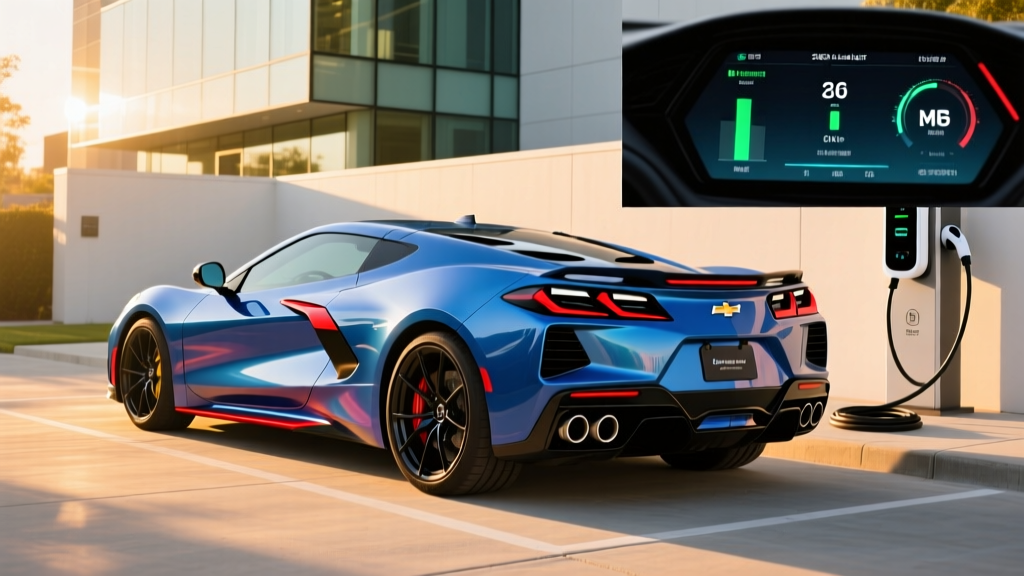
The Chevrolet Corvette E-Ray occupies a category of one: a hybrid supercar that pairs a 6.2-liter V8 with an electric front axle to deliver all-wheel drive, 655 combined horsepower, and a 0-60 mph time of 2.5 seconds. But beyond the performance headlines, buyers want to know the practical details — what does it actually get for fuel economy, how does the hybrid system work, what does the battery warranty cover, and does it qualify for any tax incentives?
This guide covers the Corvette E-Ray as a conventional hybrid (HEV), not a plug-in, and breaks down every spec you need to make an informed purchase decision.
HEV vs PHEV: What Kind of Hybrid Is the E-Ray?
Before diving into specs, it's essential to distinguish between hybrid types, because the Corvette E-Ray is a conventional hybrid (HEV), not a plug-in hybrid (PHEV).
| Feature | Conventional Hybrid (HEV) | Plug-In Hybrid (PHEV) |
|---|---|---|
| Plug-in charging? | No — charges via engine and regen | Yes — requires outlet or charger |
| Electric-only range | Very limited (under 1 mi at low speed) | Typically 20–50 miles |
| Battery size | Small (1–2 kWh) | Larger (10–30 kWh) |
| Federal tax credit | Not eligible under §30D | Up to $7,500 if requirements met |
| Corvette E-Ray? | ✅ Yes, this is what the E-Ray is | ❌ No |
The E-Ray's 1.9 kWh lithium-ion battery pack is charged exclusively through regenerative braking and the V8 engine. You never plug it in. The electric motor provides short bursts of torque for launches and all-wheel-drive traction, not sustained electric-only commuting. This is a performance hybrid system, not an efficiency-first one.
EPA Fuel Economy and Real-World MPG
The Corvette E-Ray sacrifices a small amount of fuel economy compared to the standard Stingray in exchange for AWD grip and electric torque fill. Here's what the EPA says, according to fueleconomy.gov:
| Driving Cycle | EPA Estimate |
|---|---|
| City | 16 MPG |
| Highway | 24 MPG |
| Combined | 19 MPG |
Real-World MPG Expectations
Hybrid systems typically outperform EPA city estimates in stop-and-go traffic, where regenerative braking recaptures energy most effectively. However, the E-Ray is a performance car — most owners will drive it harder than the EPA test cycle assumes. Expect:
- Mixed driving (normal pace): 18–21 MPG combined
- Highway cruising (70–80 mph): 22–25 MPG
- Aggressive/canyon driving: 12–15 MPG
- Cold weather: Expect a 1–2 MPG reduction due to denser air and engine running richer during warmup
For comparison, the RWD Corvette Stingray with the same 6.2L V8 rates at 16/25/19 MPG (city/highway/combined). The E-Ray's AWD system and added weight (~300 lbs over the Stingray) cost it roughly 1 MPG on the highway, while city figures remain comparable thanks to electric torque assist reducing engine load at low speeds.
Powertrain: 655 HP and Electrified AWD
The E-Ray's powertrain is a unique front-electric, rear-combustion layout that delivers all-wheel drive without a mechanical driveshaft to the front wheels.
| Specification | Detail |
|---|---|
| Rear engine | 6.2L LT2 V8, 495 HP / 470 lb-ft torque |
| Front electric motor | Permanent-magnet, 160 HP / 125 lb-ft torque |
| Combined output | 655 HP |
| Battery pack | 1.9 kWh lithium-ion (mounted in center tunnel) |
| 0-60 mph | 2.5 seconds (Chevrolet-claimed, with 1LT coupe) |
| Quarter mile | 10.5 seconds @ 130 mph |
| Top speed | 183 mph (AWD-limited) |
| Drivetrain | AWD — electric front axle, 8-speed DCT rear |
| Stealth Mode (EV-only) | Up to ~4 miles at speeds under 45 mph |
Stealth Mode is the E-Ray's party trick for early-morning neighborhood exits: it allows electric-only propulsion for roughly 4 miles at speeds up to 45 mph. This is not a practical commute mode — it's a low-speed, short-distance feature that uses the small battery quickly. Once the battery depletes or you exceed the speed threshold, the V8 fires up seamlessly.
Corvette E-Ray Pricing and Tax Credit Eligibility
The E-Ray commands a premium over the standard Stingray but undercuts exotic AWD supercars by a wide margin.
| Trim | 2025 MSRP (approx.) |
|---|---|
| E-Ray 1LZ Coupe | $105,695 |
| E-Ray 2LZ Coupe | $111,695 |
| E-Ray 3LZ Coupe | $116,695 |
| E-Ray Convertible (1LZ) | $112,695 |
Note: MSRP figures reflect the most recent published pricing. Confirm current model-year pricing with your dealer, as Chevrolet adjusts destination charges and package availability annually.
Federal Tax Credit: Does the E-Ray Qualify?
No. Under IRS §30D rules, the federal clean vehicle credit applies only to plug-in electric vehicles — battery-electric vehicles (BEVs) and plug-in hybrids (PHEVs) with a minimum battery capacity of 7 kWh. The Corvette E-Ray's 1.9 kWh battery and conventional hybrid architecture make it ineligible for the §30D credit.
Key §30D requirements the E-Ray does not meet:
- Must be a plug-in vehicle (BEV or PHEV)
- Battery capacity must be at least 7 kWh (E-Ray has 1.9 kWh)
- Vehicle must be capable of being recharged from an external power source
For the full rules, see IRS.gov §30D Clean Vehicle Credits.
Some states offer their own hybrid incentives, but these are uncommon and typically modest. Check your state's energy or DMV website for current programs.
Battery Warranty, Reliability, and Replacement Costs
Hybrid battery longevity is the top concern for any hybrid buyer. Here's what Chevrolet covers and what you should expect.
Corvette E-Ray Hybrid Battery Warranty
| Hybrid-specific components | 8 years / 100,000 miles |
| Powertrain (engine, DCT, e-motor) | 5 years / 60,000 miles |
| Bumper-to-bumper | 3 years / 36,000 miles |
The 8-year/100,000-mile hybrid component warranty covers the battery pack, electric motor, and associated power electronics. This aligns with the federal minimum standard for hybrid and EV components.
Is the E-Ray Reliable?
The C8 Corvette platform has been in production since the 2020 model year, and the LT2 V8 is a proven, well-understood engine shared across the GM performance lineup. The E-Ray's front electric motor and battery system add complexity, but the components are relatively simple compared to a full EV powertrain:
- Battery degradation risk: Low. The 1.9 kWh pack is small and rarely cycled deeply — it's used for short torque bursts, not sustained discharge. Shallow cycles dramatically extend lithium-ion battery life.
- E-motor reliability: Electric motors have far fewer moving parts than internal combustion engines. Permanent-magnet motors are among the most reliable drivetrain components in modern vehicles.
- DCT transmission: The rear 8-speed dual-clutch is shared with the standard Stingray and has proven robust in track and street use.
Battery Replacement Cost
Should the E-Ray's hybrid battery require replacement outside of warranty, expect a cost in the $2,000–$4,000 range for the battery module, plus labor. This is significantly less than a full EV battery replacement because the pack is small (1.9 kWh vs. 60–100+ kWh in a BEV). However, this is an estimate — confirm current parts pricing with a Chevrolet dealer, as hybrid-specific components for low-volume vehicles can carry premium pricing.
Who Should Choose the Corvette E-Ray?
The E-Ray is not an efficiency play — it's a performance car that uses hybrid technology for traction, launch performance, and all-weather capability. Here's who it fits and who should look elsewhere.
Choose the Corvette E-Ray if:
- You want supercar performance (2.5s 0-60) with all-weather AWD capability
- You live in a region with rain or light snow and want year-round usability from a sports car
- You want the C8 Corvette experience but value the electric torque fill and Stealth Mode for quiet neighborhood driving
- You don't need or want plug-in charging infrastructure
- You accept 19 MPG combined as the cost of 655 HP and AWD
Choose a PHEV or BEV instead if:
- Your primary goal is reducing fuel consumption and emissions
- You want electric-only commuting range (20–50 miles in a PHEV like the Toyota RAV4 Prime or BMW X5 xDrive50e)
- You want to qualify for the §30D federal tax credit (up to $7,500 for eligible plug-in vehicles)
- You have home charging access and want to minimize gas station visits
Choose the standard Corvette Stingray if:
- You don't need AWD and prefer a lighter, more traditional RWD sports car
- You want slightly better highway fuel economy (25 vs. 24 MPG)
- Price sensitivity matters — the Stingray starts ~$40,000 lower
Pros and Cons
Pros
- 2.5-second 0-60 mph — among the quickest production cars at any price
- AWD traction for rain, light snow, and hard launches
- Stealth Mode enables quiet, EV-only low-speed driving
- No plug-in charging required — zero infrastructure dependency
- 8-year/100,000-mile hybrid component warranty
- Proven LT2 V8 with extensive aftermarket support
Cons
- 19 MPG combined — no fuel-economy advantage over the standard Stingray
- No federal tax credit eligibility
- ~300 lbs heavier than the RWD Stingray
- Top speed limited to 183 mph (vs. 194 mph for Stingray Z51)
- Premium starting price above $105,000
- Small frunk eliminated to accommodate front e-motor
Frequently Asked Questions
How many MPG does the Chevrolet Corvette E-Ray hybrid get?
The EPA rates the Corvette E-Ray at 16 MPG city, 24 MPG highway, and 19 MPG combined. Real-world results vary: expect 18–21 MPG in normal mixed driving, 22–25 MPG on highway cruises, and 12–15 MPG during aggressive driving. It gets roughly the same fuel economy as the RWD Stingray, with a slight highway penalty due to AWD weight.
Can the Corvette E-Ray drive on electric power only?
Yes, but only in limited circumstances. Stealth Mode allows electric-only propulsion for approximately 4 miles at speeds under 45 mph. This is designed for quiet residential departures, not commuting. The 1.9 kWh battery depletes quickly under electric-only use, and the V8 resumes once the battery is low or speed increases.
Does the Corvette E-Ray qualify for a federal tax credit?
No. The §30D Clean Vehicle Credit requires a plug-in vehicle (BEV or PHEV) with at least 7 kWh of battery capacity. The E-Ray is a conventional hybrid with a 1.9 kWh battery and no plug-in capability, making it ineligible. See IRS.gov for current credit rules.
Is the E-Ray hybrid system reliable long-term?
The hybrid system uses proven components: the LT2 V8 has been in production since 2020, the electric motor is a simple permanent-magnet design, and the small battery undergoes only shallow charge cycles, which extends its lifespan. Chevrolet backs hybrid-specific components with an 8-year/100,000-mile warranty, which is the federal standard for hybrid and EV components.
What does the E-Ray's hybrid battery cost to replace?
Estimated at $2,000–$4,000 for the battery module plus labor, significantly less than a full EV battery replacement due to the small 1.9 kWh pack size. However, the shallow-cycle usage pattern makes premature battery failure unlikely. Confirm current pricing with a Chevrolet dealer at the time of need.
Do I need to plug in the Corvette E-Ray?
No. The E-Ray is a conventional hybrid (HEV), not a plug-in hybrid. The battery charges exclusively through regenerative braking and the gasoline engine. There is no charge port and no requirement for home or public charging infrastructure.
Hybrid vs PHEV vs EV — which Corvette should I consider?
The E-Ray is Chevrolet's only electrified Corvette and is a conventional hybrid. If you want a plug-in vehicle for electric-only commuting, you'll need to look outside the Corvette lineup (e.g., PHEVs from BMW, Toyota, or Jeep). If you want a full EV sports car, options like the Porsche Taycan or Tesla Model S Plaid offer electric performance with different trade-offs — higher efficiency but dependence on charging infrastructure.
The Bottom Line
The Chevrolet Corvette E-Ray uses hybrid technology not to save fuel but to go faster, grip harder, and drive in more conditions. At 19 MPG combined and $105,000+, it's a performance investment, not an economy play. But as a hybrid supercar that requires zero lifestyle changes — no plug, no range anxiety, no charging apps — it's the most accessible 655-HP AWD car on the market. The 8-year hybrid warranty provides peace of mind, and the proven LT2 V8 means long-term serviceability should be straightforward.
If your priority is electrified efficiency, look to PHEVs and BEVs. If your priority is electrified performance in a daily-drivable supercar, the E-Ray stands alone.