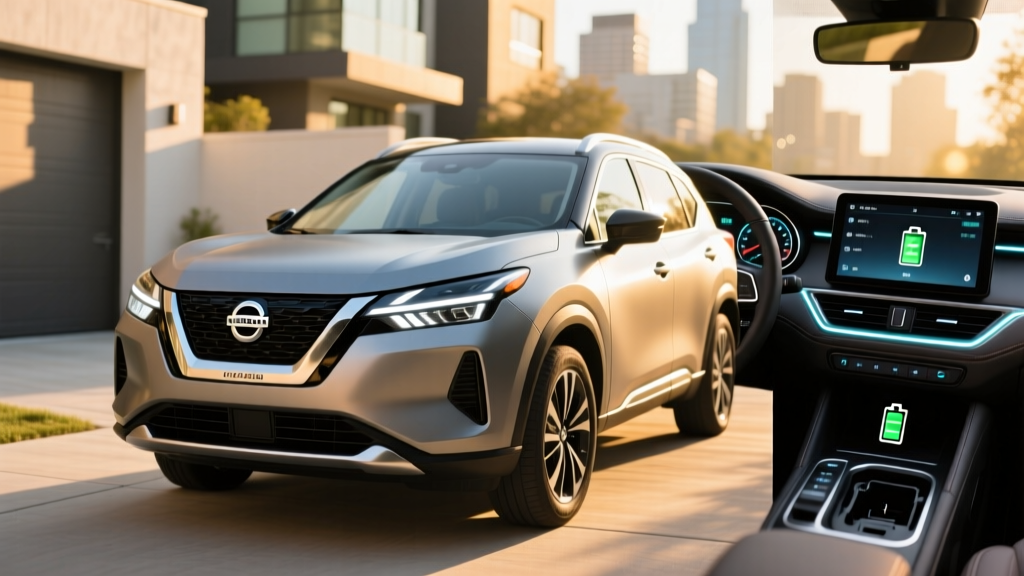
If you've been searching for a fuel-efficient compact SUV that doesn't require plugging in, the Nissan Rogue Hybrid likely crossed your radar. Nissan's electrified crossover has carved out a niche for buyers who want better fuel economy without the lifestyle adjustments of a full EV or plug-in hybrid. But before you sign the paperwork, there are specifics you need — exact MPG figures, real-world efficiency expectations, powertrain details, battery warranty coverage, and whether any tax incentives apply.
This guide breaks down everything you need to know to decide whether the Nissan Rogue Hybrid is the right electrified vehicle for your driveway in 2026.
First: Is the Nissan Rogue a Conventional Hybrid or a Plug-In?
This is the single most important distinction to make before shopping. The Nissan Rogue Hybrid is a conventional hybrid electric vehicle (HEV). It pairs a gasoline engine with a small electric motor and a compact battery pack that recharges through regenerative braking and the engine — you never plug it in.
Nissan does not currently offer a plug-in hybrid (PHEV) version of the Rogue in the U.S. market. If you're looking for electric-only driving range and the ability to charge at home, you'd need to look at competitors like the Toyota RAV4 Prime or the Hyundai Tucson PHEV.
HEV vs. PHEV — Quick Comparison
| Feature | Conventional Hybrid (HEV) | Plug-In Hybrid (PHEV) |
|---|---|---|
| Plugs in to charge? | No | Yes (Level 1 or Level 2) |
| Electric-only range | Minimal (low-speed assist only) | Typically 25–42 miles |
| Battery size | ~1–2 kWh | ~13–20 kWh |
| Federal tax credit (§30D) | No | Up to $7,500 (if eligible) |
| Best for | No home charging, simplicity | Home charging access, short commutes |
The Rogue Hybrid falls firmly in the HEV column. That's not a drawback — it's a design choice that prioritizes simplicity and accessibility for buyers who lack home charging infrastructure or who want an electrified vehicle that works exactly like a conventional gas car at the pump.
Nissan Rogue Hybrid MPG: EPA Numbers and Real-World Expectations
Fuel economy is the headline reason buyers consider the Rogue Hybrid. Here's what the EPA rates it at for the current model year:
| Drivetrain | City MPG | Highway MPG | Combined MPG |
|---|---|---|---|
| FWD | 35 | 33 | 34 |
| AWD | 34 | 32 | 33 |
Source: fueleconomy.gov — EPA estimates. Your mileage will vary based on driving conditions, terrain, and climate.
Real-World MPG: What to Actually Expect
Hybrids tend to outperform their EPA estimates in city driving, where regenerative braking and electric-motor assist do the most work. In mixed suburban commuting with stoplights and lower speeds, owners frequently report 35–37 MPG in the FWD Rogue Hybrid — slightly above the EPA sticker.
Highway driving tells a different story. At sustained 70–80 MPH speeds, the hybrid system's advantages diminish. The gasoline engine carries the load, and aerodynamic drag dominates. Expect highway-only trips to yield closer to 30–32 MPG in real-world conditions. In cold weather (below 30°F), fuel economy can dip another 2–4 MPG as the engine runs more frequently to maintain cabin heat and battery temperature.
For comparison, the standard gas-only Nissan Rogue with its 1.5L turbocharged three-cylinder achieves an EPA combined 30 MPG (FWD). The hybrid's advantage is roughly 3–4 MPG combined — meaningful over 15,000 miles per year, but not transformative.
Powertrain and Performance Specs
The Nissan Rogue Hybrid uses a series-parallel hybrid system built around a naturally aspirated 2.5-liter four-cylinder engine paired with one or two electric motors (depending on FWD or AWD configuration).
| Specification | Detail |
|---|---|
| Engine | 2.5L inline-4 (naturally aspirated) |
| Combined system horsepower | ~201 hp (FWD) / ~201 hp (AWD) |
| Transmission | e-CVT (electronically controlled CVT) |
| Hybrid battery | ~1.5 kWh lithium-ion (approx.) |
| Drivetrain options | FWD or AWD (e-AWD with rear electric motor) |
| 0–60 mph (est.) | ~7.8 seconds |
| Towing capacity | 1,500 lbs (when properly equipped) |
The e-CVT is smooth and eliminates the shift-shock you feel in conventional automatics, though it can produce a droning quality under hard acceleration — a characteristic of all CVT-based hybrid systems. The 201-hp combined output is adequate for merging and passing but won't feel sporty. This is a fuel-economy-first powertrain, and it drives like one.
The AWD system is worth noting: rather than a mechanical driveshaft, the AWD Rogue Hybrid uses a rear-mounted electric motor to power the rear wheels when traction demands it. This "e-AWD" approach is lighter and more efficient than traditional mechanical AWD, but it's designed for wet roads and light snow — not off-road use.
Pricing, Trims, and Tax Credit Eligibility
The Nissan Rogue Hybrid is offered across multiple trims, generally starting in the mid-$30,000s for the base S Hybrid and climbing to the low-$40,000s for a fully loaded Platinum Hybrid with AWD.
| Trim (est.) | MSRP Range (FWD) | MSRP Range (AWD add ~$1,500) |
|---|---|---|
| S Hybrid | ~$34,000 | ~$35,500 |
| SV Hybrid | ~$36,500 | ~$38,000 |
| SL Hybrid | ~$39,000 | ~$40,500 |
| Platinum Hybrid | ~$42,000 | ~$43,500 |
Pricing is approximate and based on manufacturer MSRP before destination charges. Confirm current pricing at NissanUSA.com.
Does the Nissan Rogue Hybrid Qualify for a Federal Tax Credit?
No. The federal §30D Clean Vehicle Credit applies only to plug-in electric vehicles (BEVs and PHEVs) that meet specific battery-sourcing, critical-mineral, MSRP cap, and buyer income requirements. Because the Rogue Hybrid is a conventional HEV that cannot be plugged in, it does not qualify for the federal EV tax credit.
Some states and local utilities offer rebates for conventional hybrids, but these are less common and vary significantly by jurisdiction. Check your state's energy office or utility provider for any current hybrid-specific incentives. A tax professional can confirm eligibility for any credits you may find.
Battery Longevity, Warranty, and Replacement Cost
Battery reliability is one of the top concerns for hybrid buyers — and it's an area where modern hybrids have a strong track record. The Rogue Hybrid's lithium-ion battery pack is relatively small (~1.5 kWh), operates within a narrow state-of-charge window (typically 40–60% SoC to minimize stress), and is managed by an active thermal system.
Nissan Hybrid Battery Warranty
Nissan covers the hybrid battery with a 8-year / 100,000-mile warranty (whichever comes first). In California-emissions states (which include CA, CT, ME, MA, NJ, NY, OR, RI, VT, WA, and others adopting CARB standards), hybrid battery coverage may extend to 10 years / 150,000 miles. This warranty covers battery capacity loss below a defined threshold and defects.
Confirm exact warranty terms with your dealer, as coverage details can vary by model year and state.
How Long Will the Hybrid Battery Actually Last?
Real-world data from Nissan's hybrid fleet suggests that the Rogue Hybrid battery is designed to last the life of the vehicle under normal use. Unlike full EVs, which cycle their large batteries through deep charge-discharge ranges, hybrid batteries operate in a shallow, buffered window that dramatically reduces degradation. Most hybrid batteries from major manufacturers (Toyota, Honda, Nissan) are lasting 150,000–200,000+ miles before significant capacity loss.
Battery Replacement Cost
If a replacement is needed out of warranty, a Nissan Rogue Hybrid battery pack typically costs between $2,000 and $3,500 including parts and labor. This is significantly less than a full EV battery replacement ($5,000–$20,000+) because the hybrid battery is small. Independent hybrid battery refurbishers also offer reconditioned packs at lower cost, though this may affect warranty coverage.
Reliability and Ownership Costs
Nissan's hybrid system is less widely deployed than Toyota's, which has decades of Prius-derived data behind it. However, the Rogue Hybrid's powertrain is mechanically simpler than a turbocharged gas engine (no turbo, no traditional transmission with fixed gears), and hybrid components like the e-CVT have proven durable across the industry.
According to IIHS and NHTSA records, the Rogue platform has performed well in crash testing. Maintenance costs for the hybrid are comparable to or slightly lower than the gas Rogue — regenerative braking reduces brake pad wear, and the engine runs fewer hours per mile driven, which can extend oil-change intervals and reduce long-term engine wear.
Insurance premiums for the Rogue Hybrid are generally in line with the gas version. According to industry averages, expect annual insurance costs of roughly $1,400–$1,800 depending on your profile, location, and coverage level.
Pros
- No plug-in required — works with any gas station
- 3–4 MPG improvement over gas Rogue in combined driving
- Smooth e-CVT and quiet low-speed electric assist
- 8-year / 100k-mile hybrid battery warranty (10yr/150k in CARB states)
- AWD available via efficient rear electric motor
- Lower brake wear from regenerative braking
Cons
- No federal tax credit eligibility (HEV, not PHEV)
- Highway MPG advantage over gas model is modest
- CVT drone under hard acceleration
- Hybrid premium adds ~$2,000–$3,000 vs. gas Rogue at equivalent trim
- Less electric assist than a PHEV for stop-and-go city driving
- Towing limited to 1,500 lbs
Hybrid vs. PHEV vs. EV: Which Powertrain Fits Your Life?
The Rogue Hybrid competes not just against other hybrids but against the broader question of whether you should go PHEV or full BEV instead. Here's a practical decision framework:
| Choose the Rogue Hybrid (HEV) if... | Consider a PHEV (e.g., RAV4 Prime) if... | Consider a full EV (e.g., Ioniq 5, Model Y) if... |
|---|---|---|
| You can't charge at home (apartment, street parking) | You have home charging and a short commute (<35 miles) | You have reliable home or workplace Level 2 charging |
| You want zero behavior change from a gas car | You want some electric-only driving but road-trip flexibility | You want the lowest per-mile fuel cost and zero tailpipe emissions |
| You drive 12,000–15,000 miles/year mostly mixed use | You want tax credit eligibility (§30D) | You drive 10,000–20,000 miles/year and want max savings |
| You want the lowest upfront cost among electrified SUVs | You can absorb a higher MSRP for bigger fuel savings | You're ready for a higher purchase price and long-term payoff |
The Rogue Hybrid's strongest advantage is accessibility. It requires no charging infrastructure, no behavioral change, and no range planning. If you live in an apartment, park on the street, or frequently take long road trips through areas with sparse charging networks, the HEV is the most pragmatic electrified choice.
But if you have a garage with a 120V or 240V outlet and a commute under 35 miles, a PHEV like the Toyota RAV4 Prime (42 miles electric-only range, EPA-estimated) could eliminate most of your gasoline use while still offering a gas engine for road trips. And if you're ready to commit to charging, a full EV like the Hyundai Ioniq 5 (EPA range up to 305 miles) offers dramatically lower per-mile energy costs — roughly $0.04–$0.06 per mile on home electricity vs. $0.12–$0.15 per mile in the Rogue Hybrid at current gas prices.
Competitors to Cross-Shop
The compact hybrid SUV segment is competitive. Before committing to the Rogue Hybrid, consider these alternatives:
- Toyota RAV4 Hybrid: The segment benchmark. EPA 39 MPG combined (FWD), proven hybrid system, slightly higher base price. Available as RAV4 Prime PHEV.
- Honda CR-V Hybrid: EPA 40 MPG combined (FWD), refined two-motor hybrid system, strong reliability reputation.
- Hyundai Tucson Hybrid: EPA 38 MPG combined (AWD standard), available as PHEV with 33 miles electric range, longer standard warranty (10yr/100k powertrain).
- Kia Sportage Hybrid: EPA 38 MPG combined (FWD), also available as PHEV, competitive pricing.
The Rogue Hybrid holds its own on price and features, but the RAV4 Hybrid and CR-V Hybrid deliver 5–7 more MPG combined — a gap that compounds meaningfully over years of ownership.
Bottom Line: Should You Buy the Nissan Rogue Hybrid?
The Nissan Rogue Hybrid is a sensible, accessible entry into hybrid ownership. It delivers a modest but real fuel-economy improvement over the gas Rogue, requires no charging infrastructure, and comes with a strong battery warranty. For buyers who value simplicity, competitive pricing, and Nissan's dealer network, it's a solid pick.
However, if fuel economy is your primary motivation, the Toyota RAV4 Hybrid and Honda CR-V Hybrid deliver measurably better MPG for a similar or slightly higher price. And if you have home charging access, a PHEV or full EV will deliver significantly greater fuel savings — and potentially a federal tax credit the Rogue Hybrid cannot offer.
Test-drive the Rogue Hybrid back-to-back with the RAV4 Hybrid and CR-V Hybrid. Pay attention to the CVT feel, real-time fuel-economy readout on your typical route, and total out-the-door pricing. The numbers — not the marketing — should drive your decision.
How many MPG does the Nissan Rogue Hybrid get?
The EPA rates the Nissan Rogue Hybrid at 35 city / 33 highway / 34 combined MPG for FWD models, and 34/32/33 for AWD. Real-world city driving often yields 35–37 MPG; sustained highway driving at 75+ MPH typically returns 30–32 MPG.
Does the Nissan Rogue Hybrid need to be plugged in?
No. The Rogue Hybrid is a conventional hybrid (HEV). Its battery recharges through regenerative braking and the gasoline engine. You fuel it at any gas station, just like a conventional car.
Does the Nissan Rogue Hybrid qualify for the federal EV tax credit?
No. The federal §30D Clean Vehicle Credit applies only to plug-in vehicles (BEVs and PHEVs) that meet battery-sourcing, MSRP, and income requirements. The conventional hybrid Rogue does not qualify. Check IRS.gov for current credit rules.
How long will the Nissan Rogue Hybrid battery last?
Nissan covers the hybrid battery for 8 years / 100,000 miles (10 years / 150,000 miles in CARB states). Based on industry data, modern hybrid batteries typically last 150,000–200,000+ miles before significant degradation. Replacement cost, if needed out of warranty, is approximately $2,000–$3,500.
Is the Nissan Rogue Hybrid available as a plug-in hybrid (PHEV)?
No. As of the 2026 model year, Nissan does not offer a plug-in hybrid version of the Rogue in the U.S. market. If PHEV capability is a priority, consider the Toyota RAV4 Prime, Hyundai Tucson PHEV, or Kia Sportage PHEV.
Is the Nissan Rogue Hybrid reliable?
The Rogue Hybrid's powertrain is mechanically simpler than a turbocharged gas engine (no turbo, e-CVT instead of a traditional automatic), which reduces potential failure points. Nissan's hybrid system has proven durable, and the 8-year battery warranty provides long-term peace of mind. Overall reliability ratings are competitive within the segment.
Hybrid vs. PHEV vs. EV — which should I choose?
Choose a conventional hybrid (like the Rogue Hybrid) if you lack home charging and want zero lifestyle change. Choose a PHEV if you have home charging and want electric-only commuting with gas-engine flexibility. Choose a full EV if you want the lowest per-mile cost, have reliable charging access, and are ready for a higher upfront investment.