Why Electrified Homeowners Are Researching Bradford White Hybrid Water Heaters
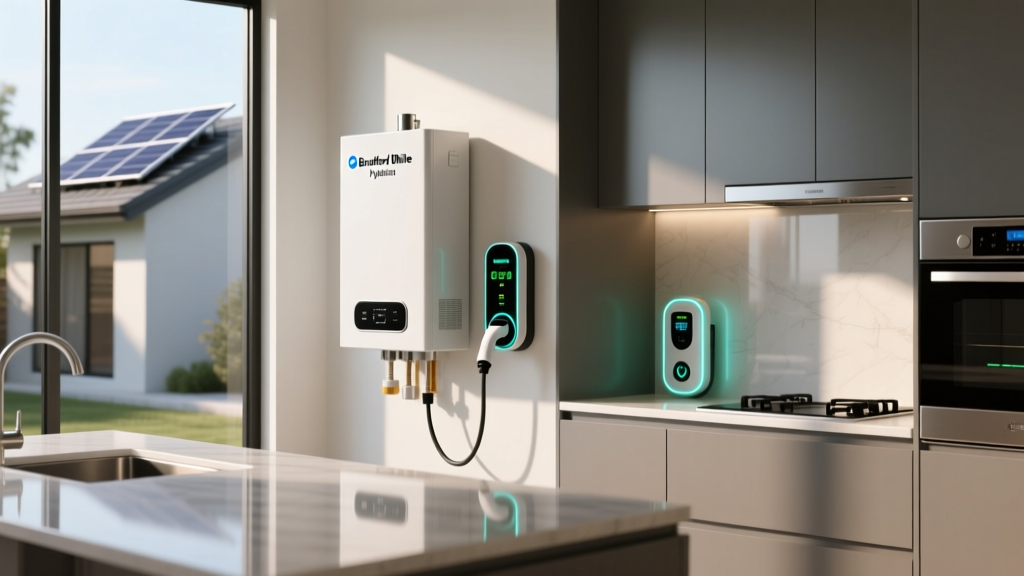
If you're shopping for an electric vehicle and upgrading home infrastructure in 2026, you've likely encountered Bradford White hybrid water heaters — heat-pump units that extract warmth from surrounding air rather than generating it with resistance elements. These units share a home's electrical panel with your EV charger, and understanding both systems' energy demands is essential before you commit to either.
This guide bridges two worlds: residential heat-pump water heating and Level 2 EV charging. We'll quantify the electrical load, compare operating costs, and help you plan a panel that supports both.
How Heat-Pump Water Heaters Work (and Why "Hybrid" Is Misleading)
Bradford White's AeroTherm line uses heat-pump technology — the same thermodynamic principle as your refrigerator, reversed. A compressor and refrigerant loop pull ambient heat from the basement or garage air and transfer it into the water tank. When demand outpaces the heat pump, electric resistance backup elements engage. That dual-mode operation is why manufacturers call them "hybrid."
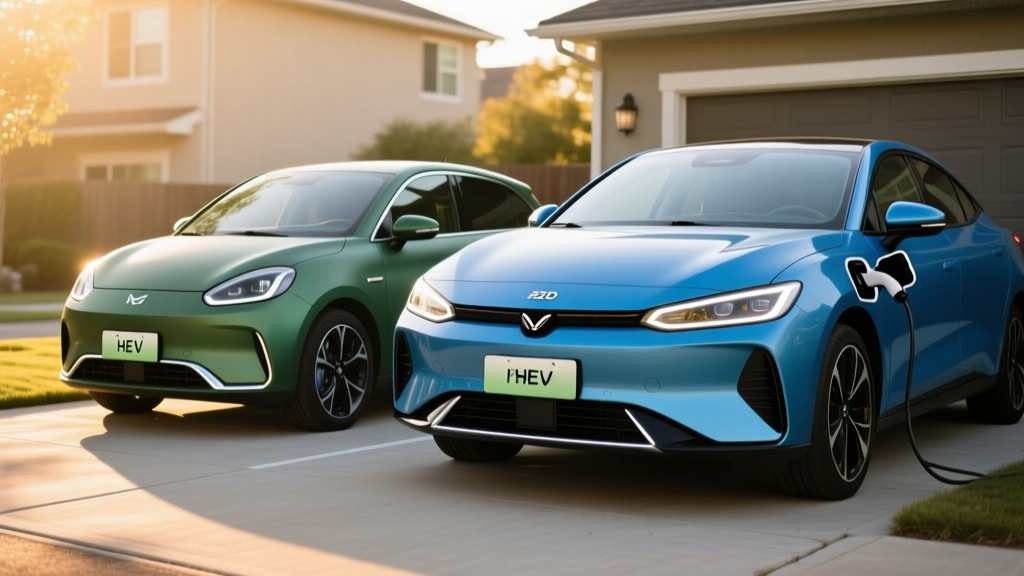
This has nothing to do with hybrid vehicles (HEVs), which pair an internal-combustion engine with an electric motor and battery. The terminology overlap confuses buyers, so let's separate them clearly:
Hybrid Water Heater vs. Hybrid Vehicle — Different Systems
| Attribute | Hybrid Water Heater | Hybrid Vehicle (HEV) | Plug-in Hybrid (PHEV) |
|---|---|---|---|
| Primary energy source | Ambient air heat + electric resistance | Gasoline + regenerative braking | Grid electricity + gasoline |
| Plug-in required? | Yes (240V circuit) | No | Yes (120V or 240V) |
| Backup system | Resistance heating elements | Gasoline engine | Gasoline engine |
| Tax credit available | Federal 25C (up to $2,000) | None (HEV) | Up to $7,500 (§30D) |
Bradford White AeroTherm Specs: Electrical Load and Efficiency
The current-generation Bradford White AeroTherm heat-pump water heaters come in 50-gallon and 80-gallon capacities. Here's what matters for your electrical panel:
| Specification | RE2H50S6-1NCWW (50 gal) | RE2H80S6-1NCWW (80 gal) |
|---|---|---|
| Uniform Energy Factor (UEF) | 3.75 | 3.50 |
| Voltage | 240V | 240V |
| Circuit breaker required | 30A dedicated | 30A dedicated |
| Heat-pump wattage | ~550W | ~550W |
| Resistance backup wattage | 4,500W | 4,500W |
| First-hour rating | 67 gallons | 88 gallons |
| Operating modes | Heat Pump, Hybrid, Electric, Vacation | Heat Pump, Hybrid, Electric, Vacation |
| Approx. installed cost | $2,800–$3,800 | $3,200–$4,400 |
| Federal tax credit (25C) | Up to $2,000 | Up to $2,000 |
The UEF of 3.75 means the unit delivers 3.75 units of hot-water energy for every unit of electricity consumed — possible because it's moving heat, not creating it. A standard electric resistance water heater has a UEF near 0.95. This efficiency gap translates directly into lower operating costs.
Level 2 EV Chargers: Electrical Demand Side by Side
A typical Level 2 home EV charger draws between 7.2 kW (30A circuit) and 11.5 kW (50A circuit) at 240V. That's a substantially larger instantaneous load than a heat-pump water heater running in heat-pump mode (~550W), but comparable when the water heater's resistance elements kick in (4,500W).
| System | Circuit | Max Draw | Daily Runtime (typical) | Daily Energy |
|---|---|---|---|---|
| Bradford White AeroTherm (heat-pump mode) | 30A / 240V | ~550W | 2–4 hours | ~1.5–2.5 kWh |
| Bradford White AeroTherm (hybrid mode w/ resistance) | 30A / 240V | 4,500W | ~30–45 min | ~2–3 kWh |
| Level 2 EV charger (32A) | 40A / 240V | 7,700W | 3–6 hours | ~25–45 kWh |
| Level 2 EV charger (48A) | 60A / 240V | 11,500W | 2–4 hours | ~25–45 kWh |
The critical insight: your EV charger will dominate daily electrical consumption. A 75 kWh battery pack charged from 20% to 80% requires roughly 45 kWh — equivalent to about two weeks of heat-pump water heating. If both systems run simultaneously on a 200A panel, you'll likely stay within capacity, but a load calculation by a licensed electrician is non-negotiable.
Operating Cost Comparison: Water Heating vs. EV Charging
At the U.S. average residential electricity rate of approximately $0.16/kWh (EIA, 2025 data), here's how annual costs break down:
- Bradford White AeroTherm (heat-pump mode): ~800 kWh/year = ~$128/year for a household of three.
- Standard electric resistance water heater: ~3,000 kWh/year = ~$480/year.
- EV charging (12,000 miles/year at 3.5 mi/kWh): ~3,430 kWh/year = ~$549/year.
- Gasoline equivalent (25 MPG at $3.40/gallon): ~$1,632/year.
The AeroTherm saves roughly $350/year over resistance heating — enough to offset about 64% of your annual EV charging cost. Combined with the federal 25C tax credit (up to $2,000), the payback period versus a standard electric unit is typically 2–4 years.
Panel Capacity: Can Your Home Handle Both?
This is where many electrification projects stall. Here's a practical decision framework:
Panel Upgrade Decision Matrix
Choose no upgrade if: You have a 200A panel, your existing load calculation is below 140A, and you're adding a 32A (7.7 kW) EV charger plus the AeroTherm on a 30A circuit.
Choose a panel upgrade (to 200A or 400A) if: Your existing panel is 100A or 150A, you already run electric HVAC, an electric dryer, and an electric range, or you plan a 48A (11.5 kW) EV charger.
Consider a smart panel or load-management device if: Upgrade costs are prohibitive ($3,000–$6,000 for a 400A upgrade). Devices like the SPAN panel or Emporia load manager can dynamically shed loads to stay within capacity.
A licensed electrician must perform a NEC Article 220 load calculation. Never self-assess panel capacity — the consequences of overloading include tripped mains, damaged equipment, or fire.
Bradford White vs. Competitors: AeroTherm in Context
Bradford White is a professional-grade brand sold primarily through licensed plumbers and wholesalers, not big-box retail. This affects pricing, availability, and installation quality. Here's how it compares to the other major heat-pump water heater brands:
| Brand / Model | Capacity | UEF | Circuit | Approx. Installed Cost | Warranty |
|---|---|---|---|---|---|
| Bradford White AeroTherm | 50 gal | 3.75 | 30A / 240V | $2,800–$3,800 | 10-year tank & parts |
| Rheem ProTerra | 50 gal | 3.70 | 30A / 240V | $2,200–$3,200 | 10-year tank & parts |
| A.O. Smith Voltex | 50 gal | 3.45 | 30A / 240V | $2,500–$3,500 | 10-year tank & parts |
Bradford White's UEF is marginally higher, but the real differentiator is the distribution model. Because units are installed by licensed professionals, you're less likely to encounter the warranty disputes that plague DIY or big-box-store installations of competitor units. Bradford White's warranty typically requires professional installation to remain valid.
Tax Credits and Incentives: Stacking Water Heater + EV Credits
One of the most common questions: can you claim both the water heater credit and the EV credit in the same year? Yes — they are separate Internal Revenue Code sections:
- IRC §25C (Energy Efficient Home Improvement Credit): Up to $2,000 per year for qualifying heat-pump water heaters. This is a nonrefundable credit — it reduces your tax liability to zero but won't generate a refund beyond that. Available annually, meaning you could claim a heat-pump water heater this year and a heat-pump HVAC system next year.
- IRC §30D (Clean Vehicle Credit): Up to $7,500 for qualifying new EVs and PHEVs. Subject to MSRP caps ($55,000 for sedans, $80,000 for SUVs/trucks/vans), buyer income limits ($150K single / $300K joint), and battery critical-mineral and component sourcing requirements. Available as a point-of-sale transfer to the dealer since 2024. This is also nonrefundable. See IRS §30D guidance for current-year eligibility.
Credit Stacking Example (2026)
A married couple filing jointly (AGI under $300K) buys a qualifying PHEV SUV ($52,000 MSRP, meets sourcing rules) and installs a Bradford White AeroTherm in the same tax year. They can claim up to $7,500 under §30D and up to $2,000 under §25C — a combined $9,500 in federal tax credits, assuming sufficient tax liability. Consult a tax professional to confirm your specific situation.
Installation Realities: What Bradford White's Pro-Only Channel Means
Unlike Rheem or A.O. Smith units available at Home Depot or Lowe's, Bradford White products are sold exclusively through wholesale plumbing suppliers to licensed contractors. This has practical implications:
- Higher installation quality: Your plumber handles permitting, electrical connection (or coordinates with an electrician for the 240V circuit), condensate drain routing, and expansion tank installation.
- Less price transparency: You won't find retail pricing online. Expect quotes in the $2,800–$3,800 range for the 50-gallon AeroTherm, installed, depending on your region and existing plumbing configuration.
- Longer lead times: Wholesale availability varies. If your current water heater fails unexpectedly, you may need a temporary solution while waiting for AeroTherm stock.
- Stronger warranty support: Bradford White's warranty claims process routes through the installing contractor, reducing the runaround common with retail-purchased units.
Real-World Efficiency: What UEF Doesn't Tell You
The UEF rating assumes standardized test conditions. In practice, your AeroTherm's efficiency depends on several factors:
- Ambient temperature: Heat-pump mode works best when surrounding air is 40–110°F. In a cold basement (below 40°F), the unit will default to resistance heating, dropping effective UEF closer to 0.95. Garage installations in warm climates maximize heat-pump runtime.
- Space requirements: The AeroTherm needs approximately 700–1,000 cubic feet of air volume around it, or a louvered door / ducted air supply. A tight utility closet will cause the unit to cool its own intake air, reducing efficiency and potentially triggering resistance mode.
- Dehumidification bonus: Heat-pump water heaters dehumidify and slightly cool the space they occupy. In humid basements, this is a meaningful side benefit — effectively a free dehumidifier running 2–4 hours daily.
- Noise: The compressor generates roughly 49–55 dB during heat-pump operation — comparable to a refrigerator or quiet conversation. If the unit is near living spaces, this matters.
Frequently Asked Questions
Do Bradford White hybrid water heaters require a 240V circuit?
Yes. The AeroTherm line requires a dedicated 30-amp, 240V circuit — the same voltage as a Level 2 EV charger. If your panel doesn't have spare capacity for two 240V circuits, an electrical upgrade or load-management device may be necessary.
How much does a Bradford White AeroTherm save versus a standard electric water heater?
With a UEF of 3.75 versus ~0.95 for resistance units, expect roughly 60–70% lower water-heating electricity consumption. For a household of three at $0.16/kWh, that's approximately $300–$400/year in savings. After the $2,000 federal 25C credit, payback versus a new standard electric unit is typically 2–4 years.
Can I install a Bradford White AeroTherm myself?
Bradford White sells exclusively through licensed plumbing wholesalers, and the warranty requires professional installation. DIY installation will void the warranty and may violate local plumbing and electrical codes. Budget for a licensed plumber plus an electrician for the 240V circuit if one isn't already available.
Does the AeroTherm qualify for the same tax credit as an EV?
No — they're separate credits. The AeroTherm qualifies for the IRC §25C Energy Efficient Home Improvement Credit (up to $2,000). EVs and PHEVs qualify for the IRC §30D Clean Vehicle Credit (up to $7,500). You can claim both in the same tax year if you meet eligibility requirements for each.
Will a heat-pump water heater cool my garage or basement too much?
The AeroTherm extracts heat from surrounding air, dropping ambient temperature by roughly 2–5°F during active heat-pump operation. In most spaces, this is negligible or even beneficial (dehumidification in basements, slight cooling in hot garages). In a small, sealed closet, the unit may cool its own air supply enough to trigger less-efficient resistance mode — which is why Bradford White specifies minimum air volume.
What is the warranty and expected lifespan?
Bradford White provides a 10-year limited warranty on the tank and parts. Real-world lifespan for heat-pump water heaters is typically 10–15 years. The compressor and fan are the components most likely to require service; replacement parts are available through Bradford White's contractor network. Tank failure within the warranty period is covered, though labor coverage varies by installing contractor.