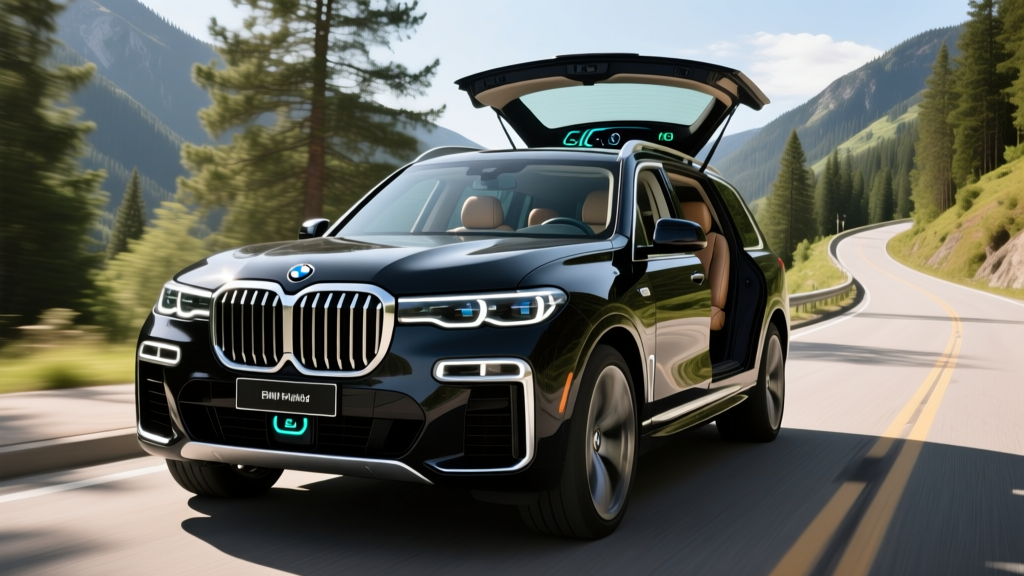
If you have been searching for a BMW X7 hybrid, the current-generation model you will find in showrooms is the BMW X7 xDrive50e — a plug-in hybrid electric vehicle (PHEV) that pairs BMW's turbocharged inline-six with an electric motor integrated into the transmission. BMW discontinued the older mild-hybrid xDrive45e after the 2023 model year and replaced it with the more powerful, longer-electric-range 50e variant.
This guide breaks down exactly what the X7 xDrive50e delivers in electric-only range, fuel economy, charging logistics, powertrain output, tax-credit eligibility, and long-term battery reliability — with real-world context that spec sheets leave out.
HEV vs PHEV: What the BMW X7 Hybrid Actually Is
Before examining specs, it is critical to understand the distinction between conventional hybrids and plug-in hybrids, because it determines how you will use the vehicle daily.
| Feature | Conventional Hybrid (HEV) | Plug-in Hybrid (PHEV) — X7 xDrive50e |
|---|---|---|
| Plug-in charging | No — charges via regenerative braking and engine | Yes — has a charge port for Level 1/Level 2 |
| Electric-only range | 0–2 miles at low speed | EPA-estimated ~33 miles |
| Battery size | 1–2 kWh | 29.5 kWh (gross) / ~25.7 kWh usable |
| Gas engine | Primary propulsion, assisted by motor | Engine + motor both provide full propulsion |
| Federal tax credit | None | Potential partial credit (see §30D rules below) |
| Best for | Drivers who cannot charge at home | Drivers with home charging and short commutes |
The X7 xDrive50e is strictly a PHEV. There is no conventional HEV version of the current X7. This means you get meaningful electric-only driving — but you also need access to a plug (standard 120V outlet or 240V Level 2 charger) to unlock the vehicle's efficiency advantage.
Powertrain: Engine, Motor, and Combined Output
BMW's xDrive50e powertrain is a substantial upgrade over the outgoing 45e. Here is the hardware breakdown:
| Specification | BMW X7 xDrive50e (2025–2026) |
|---|---|
| Engine | 3.0L turbocharged inline-six (B58) |
| Engine output | 312 hp / 332 lb-ft |
| Electric motor | Integrated into 8-speed ZF transmission |
| Motor output | 184 hp / 207 lb-ft |
| Combined system output | 483 hp / 516 lb-ft |
| 0–60 mph | 4.7 seconds (manufacturer estimate) |
| Drivetrain | xDrive all-wheel drive |
| Transmission | 8-speed automatic (ZF) |
| Towing capacity | 7,500 lbs (with factory hitch) |
The combined 483 hp makes the X7 xDrive50e the quickest variant in the non-M lineup, outpacing the mild-hybrid xDrive40i by a significant margin. The electric motor fills in torque at low RPMs before the turbo spools, eliminating the lag typical of large turbocharged engines in heavy vehicles.
Electric-Only Range and Total Range
EPA-estimated electric range: ~33 miles
Real-world expectation: 25–30 miles at highway speeds or in cold weather; up to 35 miles in mild city driving with light throttle.
Total combined range (electric + gas): approximately 460 miles (18.4-gallon tank + full battery).
The 29.5 kWh gross battery (roughly 25.7 kWh usable, as BMW maintains a top-and-bottom buffer to protect long-term cell health) is sized for the daily commute, not cross-country EV driving. If your round-trip commute falls under 30 miles and you charge nightly, you could go weeks without the inline-six firing up — except for occasional engine-maintenance cycles that BMW's software triggers automatically to keep the gas engine lubricated.
Cold-weather caveat: At 20°F or below, expect the electric range to drop to roughly 20–24 miles. The X7 xDrive50e uses battery energy to heat the cabin in EV mode, and cold lithium-ion cells have higher internal resistance, reducing usable capacity. BMW does offer a preconditioning feature via the iDrive app — schedule your departure time while plugged in, and the vehicle warms the battery and cabin using grid power instead of battery energy.
Fuel Economy: EPA MPG and Real-World Numbers
Once the battery depletes, the X7 xDrive50e operates as a conventional hybrid — the inline-six and regenerative braking handle all propulsion. Here is what the EPA estimates and what owners typically see:
| Mode | City | Highway | Combined |
|---|---|---|---|
| Charge-sustaining (hybrid mode, battery depleted) | 22 MPG | 27 MPG | 24 MPG |
| Charge-depleting (full battery, mixed EV + gas) | 56 MPGe combined (EPA) | ||
| Real-world owner average (mixed driving, regular charging) | 30–40 MPG equivalent, depending on EV-mode share | ||
Why real-world numbers often beat EPA in the city: Like most PHEVs and hybrids, the X7 xDrive50e benefits disproportionately from stop-and-go traffic, where regenerative braking recaptures kinetic energy and the electric motor handles low-speed propulsion more efficiently than the gas engine. On sustained 75-mph highway runs, the aerodynamic drag of a 5,500-pound SUV works against it, and the engine carries more of the load.
If you charge every night and drive fewer than 30 miles daily, your effective fuel consumption can approach zero gallons for months at a time — the EPA's MPGe figure tries to capture this, but the real metric that matters is how many gallons of gas you actually buy.
Charging: Speed, Connector, and Home Setup
| Level | Power | Time (0–100%) | Notes |
|---|---|---|---|
| Level 1 (120V household outlet) | ~1.4 kW | ~18–20 hours | Trickle charge; fine for overnight top-ups if battery is not fully depleted |
| Level 2 (240V, 32A) | 7.4 kW | ~4.5 hours | Standard BMW Wallbox or third-party J1772 charger; recommended for daily use |
| DC Fast Charge | Not supported | N/A | The X7 xDrive50e has no DC fast-charge capability |
The absence of DC fast charging is typical for PHEVs in this segment. The battery is small enough that Level 2 charging fully replenishes it overnight, and BMW's engineering calculus is that PHEV owners are not relying on public fast-charging networks the way BEV owners do.
Home charging cost estimate: At the US average residential electricity rate of ~$0.17/kWh (EIA, 2025), fully charging the ~25.7 kWh usable battery costs roughly $4.37 — which translates to about $0.13–$0.15 per electric mile. Compare that to $3.50/gallon premium fuel at 22 MPG, which is ~$0.16 per mile on gas. The electric advantage grows substantially in states with lower electricity rates or if you have solar.
Level 2 home installation: Expect $800–$2,200 for a professional installation of a 240V/40A circuit with a NEMA 14-50 outlet or hardwired charger, depending on panel proximity and local permitting. If your electrical panel needs a 200A upgrade, add $1,500–$3,500. Always get a quote from a licensed electrician — do not rely on online estimates for your specific home.
Pricing, Trims, and Federal Tax Credit Eligibility
The BMW X7 xDrive50e starts at approximately $84,300 MSRP (2025–2026 model year, before destination). Well-equipped examples with the Executive Package, Driving Assistance Professional, and premium leather push into the $95,000–$102,000 range.
Federal §30D tax credit for the X7 xDrive50e:
- MSRP cap: PHEV SUVs must have an MSRP at or below $80,000 to qualify. The X7 xDrive50e base MSRP exceeds this cap, making it ineligible for the federal §30D new-vehicle credit at most trim levels.
- Battery sourcing: Even if MSRP were within limits, critical-mineral and battery-component sourcing requirements under the Inflation Reduction Act further restrict eligibility. BMW's battery supply chain for US-market PHEVs has faced partial compliance.
- Income limits: Modified AGI caps apply ($150K single / $300K joint / $225K head of household) — moot here given the MSRP barrier.
- Point-of-sale transfer: For qualifying vehicles, the credit can be transferred to the dealer at purchase. Since the X7 xDrive50e does not qualify, this option is unavailable.
- State incentives: Some states (e.g., California, Colorado, New York) offer separate PHEV rebates that are not subject to federal MSRP caps. Check your state energy office or DMV for current programs.
Source: IRS §30D Clean Vehicle Credit. Rules are subject to change; consult a tax professional for your specific situation.
The bottom line: do not buy the X7 xDrive50e expecting a federal tax credit. The purchase is justified by the powertrain refinement, electric commuting capability, and BMW's luxury execution — not by incentive arithmetic.
Battery Warranty, Reliability, and Replacement Cost
BMW High-Voltage Battery Warranty: 8 years / 80,000 miles (whichever comes first)
Capacity retention threshold: BMW warrants that the battery will retain at least 70% of its original capacity during the warranty period. If degradation drops below 70%, BMW will repair or replace the battery at no cost.
Powertrain warranty: 4 years / 50,000 miles (standard BMW limited warranty)
Reliability context: BMW's B58 inline-six is widely regarded as one of the most reliable engines in the brand's modern lineup — it has been in production since 2015 with a strong track record in the 3 Series, 5 Series, X5, and now the X7. The electric motor, integrated into the ZF 8-speed housing, is a simpler component with fewer wear items than a standalone motor. The main reliability risk for any PHEV is not the battery itself but the added complexity of managing two complete powertrains (cooling systems, power electronics, charge port mechanisms).
Battery replacement cost: If the high-voltage battery requires replacement out of warranty, expect a parts-and-labor cost in the range of $12,000–$18,000 based on current BMW PHEV battery pricing. However, PHEV batteries experience less stress than BEV batteries because they operate in a narrower state-of-charge window (the buffer prevents full 0% or 100% cycling), and real-world degradation data from the prior-generation X5 xDrive45e shows modest capacity loss over 5+ years of typical use.
Hybrid system warranty: Beyond the high-voltage battery, BMW covers the electric motor, power electronics, and associated hybrid-system components under the standard 4-year/50,000-mile new-vehicle warranty, with the battery-specific 8-year/80,000-mile coverage as the longer backstop.
X7 Hybrid vs Full EV vs Gas: Which Fits You?
Choose the BMW X7 xDrive50e (PHEV) if:
- You can charge at home (Level 2 strongly recommended) and your daily driving is under 35 miles round-trip
- You want a three-row luxury SUV with genuine 7,500-lb towing capability
- You take regular road trips where BEV charging logistics would be inconvenient
- You want EV-like commuting without range anxiety on longer drives
Choose a full EV (e.g., BMW iX, Rivian R1S, Tesla Model X) if:
- You want zero tailpipe emissions and minimal maintenance (no oil changes, no engine)
- You have reliable home and/or workplace charging
- Your daily driving exceeds 35 miles and you want to maximize electric operation
- You want access to DC fast charging for road trips (200+ kW capability)
Choose the gas-only BMW X7 xDrive40i if:
- You cannot charge at home or at work
- Your annual mileage is low and fuel cost is not a primary concern
- You want a lower purchase price (~$10,000 less than the 50e)
- You prefer mechanical simplicity with a proven mild-hybrid powertrain
Pros and Cons of the BMW X7 xDrive50e
Pros
- 483 hp combined output — genuinely quick for a 5,500-lb three-row SUV
- ~33 miles of electric range covers most daily commutes
- B58 inline-six is proven, smooth, and reliable
- 7,500-lb towing without range anxiety on long hauls
- Regenerative braking and hybrid mode yield strong city MPG
- BMW iDrive 8.5 infotainment with wireless CarPlay/Android Auto
Cons
- No DC fast charging — strictly Level 1/Level 2
- Base MSRP exceeds the $80K federal tax credit cap for SUVs
- Electric range drops significantly in cold weather (~20–24 mi)
- Out-of-warranty battery replacement is expensive ($12K–$18K)
- Third row is tight for adults on longer trips
- Premium fuel required for the inline-six
Frequently Asked Questions
How many MPG does the BMW X7 hybrid get?
In charge-sustaining mode (battery depleted, operating as a hybrid), the X7 xDrive50e is EPA-rated at 22 city / 27 highway / 24 combined MPG. With regular plug-in charging and short commutes, real-world effective economy can reach 30–40 MPG equivalent or higher, depending on how often you drive in EV mode. For detailed EPA data, see fueleconomy.gov.
How far can the BMW X7 xDrive50e go on electric only?
The EPA estimates approximately 33 miles of electric-only range. In real-world highway driving or cold weather, expect 25–30 miles. City driving in mild conditions can stretch this to 35 miles. The vehicle will automatically switch to hybrid mode when the battery reaches its lower buffer threshold.
Does the BMW X7 hybrid qualify for a tax credit?
The X7 xDrive50e does not qualify for the federal §30D Clean Vehicle Credit because its MSRP exceeds the $80,000 cap for SUVs. Some state-level PHEV incentives may still apply — check your state's energy office. Always consult a tax professional and reference IRS guidelines for the latest rules.
Is the BMW X7 hybrid reliable, and what does battery replacement cost?
The B58 inline-six engine has a strong reliability record. The high-voltage battery is warrantied for 8 years/80,000 miles with a 70% capacity-retention guarantee. Out-of-warranty battery replacement runs approximately $12,000–$18,000. PHEV batteries generally degrade more slowly than BEV batteries due to the narrower charge-discharge window enforced by BMW's battery management system.
Can I charge the BMW X7 xDrive50e at a public fast charger?
No. The X7 xDrive50e does not support DC fast charging. It can charge at Level 2 public stations (J1772 connector, up to 7.4 kW), which will fully replenish the battery in about 4.5 hours. For daily use, a home Level 2 charger is the most practical solution.
What is the difference between the X7 xDrive40i and the xDrive50e?
The xDrive40i uses a 375 hp mild-hybrid inline-six with no plug-in capability and no meaningful electric-only range. The xDrive50e is a full PHEV with 483 combined hp, ~33 miles of EV range, and a charge port. The 50e costs roughly $10,000 more but delivers significantly better commuting efficiency and stronger acceleration.
Does the X7 xDrive50e require premium fuel?
Yes. BMW recommends premium unleaded (91 octane or higher) for the B58 turbocharged inline-six. Using lower-octane fuel may cause the engine management system to reduce timing advance, slightly reducing power and efficiency.