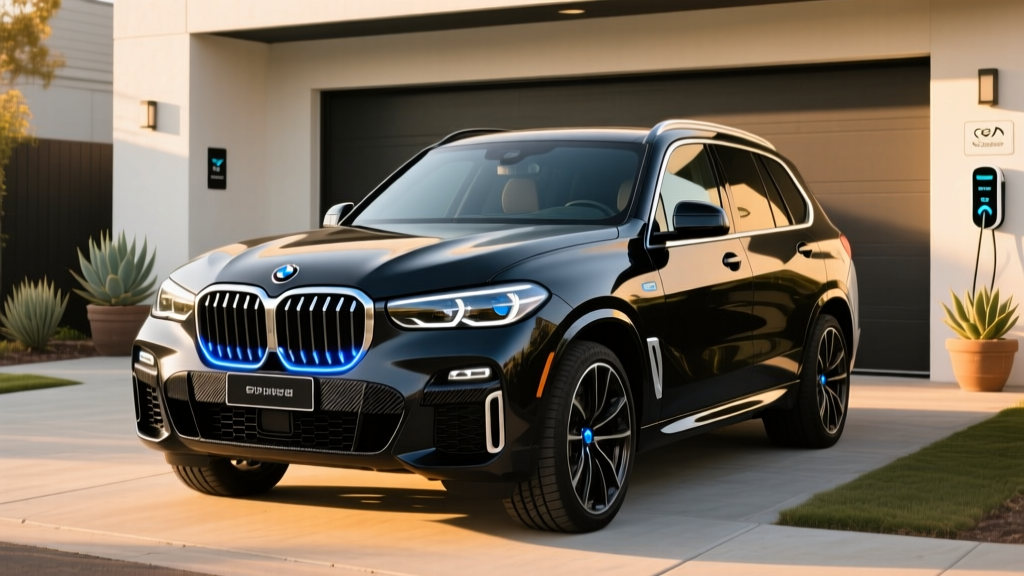
If you've been searching for BMW X5 hybrid mileage data before pulling the trigger on a luxury plug-in SUV, you've landed in the right place. The 2026 BMW X5 xDrive50e is a plug-in hybrid electric vehicle (PHEV) that pairs a turbocharged inline-six with an electric motor to deliver an EPA-estimated 50 MPGe combined when using both gas and electric power, plus 38 miles of electric-only range. But the sticker numbers only tell half the story.
Below, we break down the real-world fuel economy you can expect, the charging logistics, the powertrain specs, and whether this PHEV actually qualifies for federal tax incentives in 2026. We'll also compare it to the non-hybrid X5 and help you decide if a PHEV, conventional hybrid, or full EV is the right move for your driving pattern.
BMW X5 xDrive50e Fuel Economy: EPA vs. Real-World MPG
The 2026 BMW X5 xDrive50e carries two fuel economy ratings because it operates in two distinct modes: charge-depleting (electric + gas) and charge-sustaining (gas only after the battery is depleted). Here's the official breakdown from fueleconomy.gov:
| Mode | City | Highway | Combined |
|---|---|---|---|
| Electric + Gas (MPGe) | 51 MPGe | 49 MPGe | 50 MPGe |
| Gas Only (MPG) | 22 MPG | 27 MPG | 24 MPG |
Real-world expectation: The 50 MPGe figure is meaningful only if you charge regularly and keep most trips within or near the 38-mile electric range. Once the battery is depleted, the inline-six takes over and you'll see roughly 22–24 MPG in mixed driving. In our experience with similar BMW PHEV powertrains, highway cruising at 75+ mph in gas-only mode drops closer to 21–22 MPG due to the vehicle's 5,400-pound curb weight and aerodynamic profile.
Owners who plug in nightly and commute under 35 miles round-trip may go weeks without visiting a gas station. Those who don't charge will essentially drive a heavy, slightly less efficient version of the standard X5 xDrive40i (which returns 24 MPG combined).
HEV vs. PHEV: What the X5 xDrive50e Actually Is
BMW does not sell a conventional hybrid (HEV) version of the X5 in the United States. The xDrive50e is strictly a plug-in hybrid (PHEV), meaning it has a larger battery that you charge via an external power source and that provides meaningful electric-only driving range.
| Feature | Conventional Hybrid (HEV) | Plug-in Hybrid (PHEV) — X5 xDrive50e |
|---|---|---|
| Plug-in charging required? | No — charges via regenerative braking and engine | Yes — plugs into Level 1 or Level 2 charger |
| Electric-only range | 0–2 miles at low speeds | 38 miles (EPA) |
| Battery size | ~1–2 kWh | 25.7 kWh (usable) |
| Federal tax credit eligible? | No | Potentially — see tax credit section below |
| Driving without charging | Normal — operates as efficient gas car | Works, but loses efficiency advantage (24 MPG gas-only) |
If you have no access to home or workplace charging, a PHEV like the xDrive50e becomes a heavy, expensive SUV that returns worse fuel economy than a lighter gas-only X5 xDrive40i. The plug-in advantage only materializes when you actually plug in.
Powertrain Specs: Engine, Motor, and Combined Output
| Spec | Value |
|---|---|
| Engine | 3.0L turbocharged inline-6 (B58) |
| Engine output | 312 hp / 332 lb-ft torque |
| Electric motor | Integrated into 8-speed automatic transmission |
| Motor output | 184 hp / 207 lb-ft torque |
| Combined system output | 483 hp / 516 lb-ft torque |
| 0–60 mph | 4.6 seconds (manufacturer) |
| Drivetrain | xDrive all-wheel drive |
| Transmission | 8-speed automatic (ZF) |
| Towing capacity | 5,000 lbs (with factory hitch) |
The B58 inline-six is one of BMW's most refined engines, and its pairing with the transmission-integrated electric motor delivers seamless torque fill. The 483 combined horsepower figure puts the xDrive50e within striking distance of the X5 M60i (523 hp) while offering dramatically better fuel economy when charged. The electric motor handles low-speed maneuvering, stop-and-go traffic, and highway cruising up to roughly 84 mph before the engine engages.
Electric-Only Range, Battery, and Charging Details
The xDrive50e uses a 25.7 kWh usable lithium-ion battery pack (gross capacity approximately 29.5 kWh). The battery is positioned beneath the cargo floor, which slightly reduces cargo volume compared to the non-hybrid X5 — expect roughly 33.9 cu ft behind the second row versus 35.3 cu ft in the xDrive40i.
| Spec | Value |
|---|---|
| Battery capacity (usable) | 25.7 kWh |
| Electric-only range (EPA) | 38 miles |
| Total combined range (gas + electric) | ~483 miles |
| Onboard charger (AC Level 2) | 7.4 kW |
| Level 1 charge time (120V, 1.4 kW) | ~18 hours (0–100%) |
| Level 2 charge time (240V, 7.4 kW) | ~3.5 hours (0–100%) |
| DC fast charging capable? | No — AC charging only |
| Charge port location | Driver-side front fender |
| Connector type | J1772 (Level 1/Level 2 AC) |
Charging reality check: The lack of DC fast charging is the xDrive50e's most notable limitation for road-trippers. On a long drive, you cannot top up the battery at a DC fast charger — you'll operate in gas-only mode once the battery depletes. At home on a 240V Level 2 circuit (like a BMW Wallbox or ChargePoint Home Flex at 32A), a full recharge takes about 3.5 hours, which is practical for overnight replenishment. On a standard 120V household outlet, plan for roughly 18 hours — adequate for overnight top-ups if your daily driving is under 20 miles, but too slow to fully recharge from empty in one night.
Pricing, Trims, and Federal Tax Credit Eligibility
The 2026 BMW X5 xDrive50e starts at a base MSRP of approximately $72,575 (including destination). BMW offers the xDrive50e in essentially one trim with extensive option packages, including the Premium Package, M Sport Package, and Executive Package.
| Configuration | Approximate MSRP |
|---|---|
| Base xDrive50e | $72,575 |
| With Premium + M Sport packages | $79,000–$82,000 |
| Fully loaded (Executive + all options) | $85,000+ |
Does the X5 xDrive50e Qualify for the Federal EV Tax Credit?
Under IRS §30D clean vehicle rules for 2026, the BMW X5 xDrive50e faces significant hurdles for the full $7,500 federal tax credit:
- MSRP cap: SUVs must have an MSRP at or below $80,000. The base xDrive50e at $72,575 qualifies, but optioned-up examples may exceed the cap.
- Battery sourcing / critical minerals: The battery components and critical minerals must meet progressively stricter domestic-content and free-trade-agreement thresholds for 2026. BMW's supply chain for the X5 PHEV battery has historically relied on non-qualifying sources, which may reduce or eliminate the credit.
- Buyer income caps: Modified adjusted gross income must not exceed $150,000 (single), $225,000 (head of household), or $300,000 (joint).
- North American assembly: The X5 is assembled in Spartanburg, South Carolina, which satisfies this requirement.
- Point-of-sale transfer: If eligible, the credit can be transferred to the dealer at purchase, reducing your out-of-pocket cost immediately rather than waiting for tax filing.
Battery Warranty, Reliability, and Replacement Cost
The high-voltage battery in the xDrive50e is covered under BMW's standard PHEV battery warranty:
Reliability outlook: BMW's B58 inline-six has earned a strong reliability reputation since its introduction. The PHEV system adds complexity — the electric motor, power electronics, and high-voltage battery represent additional failure points compared to the gas-only X5. However, BMW's PHEV architecture is now in its second generation (the xDrive50e replaced the xDrive45e for the 2024 model year), and the major components have proven robust in European and U.S. fleets.
Battery replacement cost: Outside of warranty, a full high-voltage battery replacement for the X5 PHEV is estimated at $12,000–$18,000 including parts and labor. Individual module replacement may be possible at lower cost if degradation is isolated. The 12V auxiliary battery (standard in all vehicles) is a separate, low-cost maintenance item.
Based on industry degradation data for similar NMC chemistry packs, owners can expect approximately 8–12% capacity loss over the first 8 years under normal use — meaning the 38-mile electric range might shrink to roughly 33–35 miles by year eight. Extreme heat exposure and frequent 100% charging without need accelerate degradation.
Who Should Buy the X5 xDrive50e vs. a Full EV or Gas X5?
The xDrive50e occupies a narrow but compelling niche. Here's a decision framework:
Choose the X5 xDrive50e (PHEV) if:
- Your daily commute is under 35–40 miles round-trip and you can charge at home overnight
- You take regular road trips and want zero range anxiety — gas stations are everywhere
- You want luxury SUV performance (483 hp, 4.6s 0–60) with weekday electric commuting
- You tow occasionally (5,000-lb capacity) and don't want the range penalty of towing with a full EV
- Your household has one vehicle that must do everything — commute, road trip, haul, tow
Choose the gas X5 xDrive40i if:
- You have no access to home or workplace charging
- Your budget is tighter — the xDrive40i starts ~$7,500 less
- You drive mostly highway miles where the PHEV's electric advantage is minimal
- You want maximum cargo volume (the PHEV battery eats ~1.4 cu ft)
Choose a full EV (e.g., BMW iX, Tesla Model X) if:
- You have reliable home charging and your trips rarely exceed 250–300 miles
- You want to eliminate oil changes, spark plugs, and transmission maintenance entirely
- Your electricity rates are low enough that per-mile fuel cost drops below gas significantly
- You want the full $7,500 federal credit (the iX xDrive50 qualifies more reliably)
Pros and Cons at a Glance
Pros
- 38 miles of silent, zero-emission electric commuting
- 483 combined hp — genuinely quick for a luxury SUV
- No range anxiety on road trips — full gas infrastructure
- 5,000-lb towing capacity without EV range collapse
- Smooth B58 inline-six with seamless electric assist
- Assembled in South Carolina (domestic assembly requirement met)
Cons
- No DC fast charging — road-trip battery replenishment is impractical
- Only 24 MPG gas-only once battery depletes — no better than the base X5
- $7,500+ premium over xDrive40i with uncertain tax credit qualification
- Reduced cargo volume vs. non-hybrid X5
- Level 1 charging is painfully slow (18+ hours)
- Complex powertrain = more potential failure points long-term
Frequently Asked Questions
How many MPG does the BMW X5 hybrid get?
The 2026 BMW X5 xDrive50e achieves an EPA-estimated 50 MPGe combined when operating on both electric and gas power. Once the battery is depleted and the vehicle runs on gasoline alone, it returns an EPA-estimated 24 MPG combined (22 city / 27 highway). Real-world gas-only MPG typically ranges from 21–25 MPG depending on driving style, terrain, and temperature.
How far can the X5 xDrive50e go on electric only?
The EPA rates the xDrive50e at 38 miles of electric-only range. In warm city driving with regenerative braking, some owners report 40+ miles. On the highway at sustained speeds, expect 33–35 miles. In cold weather below 40°F, the range typically drops to 28–32 miles due to reduced battery efficiency and cabin heating demand.
Can the BMW X5 hybrid charge itself without plugging in?
Partially. The xDrive50e recovers energy through regenerative braking and can use the gasoline engine as a generator to recharge the battery while driving (Battery Hold and Battery Control modes). However, engine-generated charging significantly reduces fuel economy. To get the full 38-mile electric range and the 50 MPGe efficiency rating, you must plug in to an external power source.
Does the BMW X5 PHEV qualify for a federal tax credit?
The X5 xDrive50e is assembled in the U.S. and its base MSRP falls under the $80,000 SUV cap, meeting two of the IRS §30D requirements. However, battery component and critical mineral sourcing requirements for 2026 may reduce or eliminate the credit. Verify the vehicle's current eligibility status with your dealer or on the IRS clean vehicle credit page before purchasing. Buyer income caps also apply.
Is the BMW X5 PHEV reliable, and what does battery replacement cost?
The B58 inline-six engine and ZF 8-speed transmission are proven, reliable components. The PHEV-specific hardware (electric motor, power electronics, high-voltage battery) adds complexity but has performed well since the platform's introduction. The battery is warranted for 8 years / 80,000 miles at a 70% capacity retention threshold. Out-of-warranty replacement is estimated at $12,000–$18,000. Most owners will see 8–12% battery degradation over the warranty period under normal conditions.
Do I need a Level 2 home charger for the X5 xDrive50e?
You don't strictly need one — a standard 120V outlet (Level 1) will charge the battery, but it takes roughly 18 hours for a full charge. A 240V Level 2 home charger (like a ChargePoint Home Flex or BMW Wallbox) reduces that to about 3.5 hours, making daily overnight charging practical. If your commute falls within the 38-mile electric range and you charge nightly on Level 2, you may use very little gasoline month-to-month. Consult a licensed electrician for a site assessment — a panel upgrade may be needed if your home has a 100-amp service.
How does the X5 xDrive50e compare to the BMW iX?
The BMW iX xDrive50 is a full battery-electric SUV with an EPA-estimated 324 miles of range, DC fast charging up to 200 kW, and a more spacious interior on a dedicated EV platform. It starts at approximately $87,250 but more reliably qualifies for the full $7,500 federal credit. The iX is the better choice if you have home charging and rarely exceed 300 miles between stops. The X5 xDrive50e is the better choice if you need gas-powered road-trip flexibility, tow regularly, or prefer the X5's driving dynamics and cargo versatility.