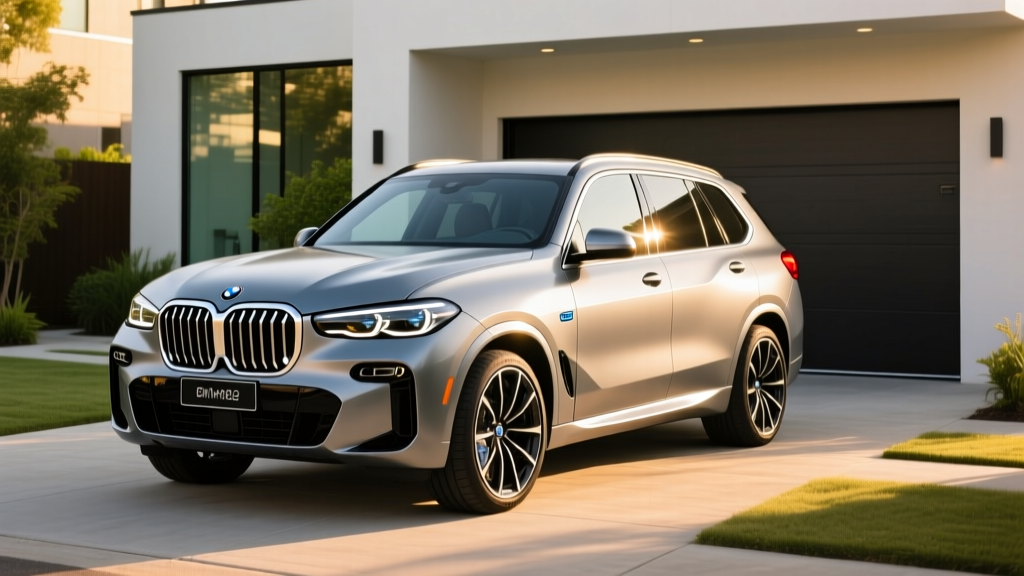
The BMW X5 has long been a benchmark midsize luxury SUV, but for buyers trying to cut fuel costs without going fully electric, the plug-in hybrid variant — currently the BMW X5 xDrive50e — is the model that demands the closest look. If you're searching for BMW X5 hybrid MPG data, you've likely noticed a confusing mix of MPGe, MPG, and electric-range figures scattered across forums and spec sheets. This guide reconciles the EPA sticker with real-world driving and ownership realities for the 2026 model year.
First: The BMW X5 Is a PHEV, Not a Conventional Hybrid
Before parsing fuel economy numbers, it's essential to understand what you're actually buying. BMW does not currently sell a conventional hybrid (HEV) version of the X5 in the United States. The electrified X5 is the xDrive50e, a plug-in hybrid electric vehicle (PHEV).
Here's the difference:
- HEV (conventional hybrid): Charges its small battery through regenerative braking and the gas engine. You never plug it in. Think Toyota RAV4 Hybrid.
- PHEV (plug-in hybrid): Has a larger battery you charge by plugging in (Level 1 or Level 2). It can drive on electricity alone for a meaningful distance before the gas engine kicks in. The X5 xDrive50e falls here.
This distinction matters because PHEVs have two fuel economy ratings: an MPGe figure (when operating on electricity + gas) and a gas-only MPG figure (once the battery is depleted). Both are relevant to your daily driving.
2026 BMW X5 xDrive50e: Fuel Economy Breakdown
| Metric | EPA Rating | Real-World Expectation |
|---|---|---|
| Combined MPGe (charge-sustaining + electric) | 56 MPGe | 50–58 MPGe with regular plug-in charging |
| Gas-only combined MPG (battery depleted) | 25 MPG combined | 22–26 MPG depending on driving style and terrain |
| City MPG (gas-only) | 24 MPG | 22–25 MPG |
| Highway MPG (gas-only) | 26 MPG | 23–27 MPG (aerodynamic drag at 75+ mph hurts) |
| Electric-only range | 38 miles | 30–36 miles (highway/cold weather); up to 38 miles (city/mild weather) |
| Total combined range (full tank + full battery) | ~440 miles | ~380–430 miles depending on conditions |
The 56 MPGe figure from fueleconomy.gov applies when you start with a full battery and drive a mix of electric and gas. It is not what you'll see once the battery depletes. If you rarely plug in and drive the X5 xDrive50e like a conventional gas SUV, expect roughly 25 MPG combined — respectable for a 5,400-pound luxury SUV with 483 horsepower, but not transformative.
The real magic happens when you charge daily. If your commute is under 38 miles round-trip and you plug in every night, you could go weeks without visiting a gas station. In that scenario, your effective "MPG" is essentially infinite for daily driving, with gas reserved for longer road trips.
Battery & Warranty Snapshot
Battery capacity: 25.7 kWh (usable) lithium-ion NMC pack
Federal warranty requirement: PHEV batteries must be warranted for at least 8 years / 100,000 miles (10 years / 150,000 miles in CARB states like California, New York, and others). BMW meets or exceeds this requirement.
Capacity retention threshold: BMW typically warrants the high-voltage battery against defects and excessive capacity loss below approximately 70% of original capacity during the warranty period.
Estimated out-of-warranty replacement cost: $12,000–$18,000 including labor, based on current dealer pricing for comparable BMW PHEV packs. This is a worst-case scenario; most PHEV batteries outlast their vehicles with minimal degradation when properly maintained.
Powertrain: Engine, Motor, and Combined Output
| Specification | Detail |
|---|---|
| Engine | 3.0L turbocharged inline-6 (BMW B58) |
| Engine output | 312 hp / 331 lb-ft torque |
| Electric motor (integrated in transmission) | 184 hp / 207 lb-ft torque |
| Combined system output | 483 hp / 516 lb-ft torque |
| 0–60 mph | 4.6 seconds |
| Transmission | 8-speed automatic (ZF) |
| Drivetrain | xDrive all-wheel drive |
| Battery (usable) | 25.7 kWh NMC lithium-ion |
| Electric-only top speed | 87 mph |
| Towing capacity | 5,950 lbs (when properly equipped) |
The B58 inline-6 is one of the most reliable and refined engines BMW has produced. Paired with the electric motor embedded in the ZF 8-speed transmission, the powertrain delivers seamless torque fill — the electric motor handles low-speed acceleration while the turbo six spools up. The result is 483 hp with none of the turbo lag you'd feel in a gas-only X5 xDrive40i.
Charging the X5 xDrive50e: What You Need to Know
| Charging Level | Power | Time (0–100%) | Notes |
|---|---|---|---|
| Level 1 (120V household outlet) | ~1.4 kW | ~18 hours | Trickle charge; adds ~4 miles of range per hour |
| Level 2 (240V home or public) | 7.4 kW (max onboard charger) | ~3.5 hours | Recommended for daily use; adds ~20 miles of range per hour |
| DC fast charging | Not supported | N/A | The X5 xDrive50e has no DC fast-charge capability |
This is a critical point many buyers overlook: the BMW X5 xDrive50e does not support DC fast charging. There is no CCS or NACS port for 50+ kW rapid charging. You're limited to Level 1 and Level 2 AC charging via a J1772 connector (or J3400/NACS with an adapter for newer Tesla destination chargers).
For most PHEV owners, this isn't a dealbreaker. The 25.7 kWh battery is small enough that a standard Level 2 home charger (7.4 kW) replenishes it in about 3.5 hours — easily done overnight. The lack of DC fast charging only matters if you were hoping to quick-charge on road trips, but with only 38 miles of electric range, the gas engine handles highway stretches regardless.
Home charging setup: A Level 2 home charger installation typically costs $800–$2,500 total (charger hardware + electrician + permit), depending on your electrical panel capacity and the run distance from panel to garage. If you need a 200-amp panel upgrade, add $1,500–$3,000. Consult a licensed electrician for your specific situation.
Pricing and Federal Tax Credit Eligibility
The 2026 BMW X5 xDrive50e starts at approximately $67,675 MSRP (including destination), with the M Sport variant starting around $71,075. Options like the Driving Assistance Professional package, Executive package, and larger wheels can push a well-equipped build past $80,000.
§30D Federal Tax Credit — Key Requirements (2026)
Under current IRS §30D rules, the X5 xDrive50e may qualify for up to $7,500 in federal tax credits, but eligibility depends on several factors that change frequently:
- MSRP cap: SUVs must have an MSRP at or below $80,000. A base X5 xDrive50e qualifies; a heavily optioned build may exceed the cap.
- Buyer income cap: Modified adjusted gross income must not exceed $150,000 (single), $225,000 (head of household), or $300,000 (married filing jointly).
- Battery sourcing requirements: A percentage of critical minerals and battery components must be sourced from the U.S. or free-trade-agreement countries. BMW's supply chain compliance varies by model year — verify current eligibility on the IRS clean vehicle credit page before purchasing.
- Point-of-sale transfer: As of 2024+, you can transfer the credit to the dealer at purchase, reducing your out-of-pocket cost immediately rather than waiting for tax filing.
Tax credit rules are subject to legislative change. Consult a tax professional and check irs.gov for the latest requirements before relying on credit eligibility in your purchase decision.
Real-World MPG: What Owners Actually Report
EPA estimates are a starting point, not a guarantee. Here's what real-world variables do to the X5 xDrive50e's numbers:
City driving (frequent stops, low speeds): This is where the PHEV shines. Regenerative braking recaptures energy at every stoplight, and the electric motor handles most low-speed acceleration. Owners who charge nightly and drive primarily in the city often report using almost no gasoline during the work week. Gas-only city MPG hovers around 22–25 MPG once the battery depletes.
Highway driving (sustained 70–80 mph): Aerodynamic drag is the enemy. Electric-only range drops to roughly 30–33 miles at highway speeds, and gas-only fuel economy settles around 23–27 MPG. On a long road trip where you start with a full charge, expect the first 35 miles to be electric and the remaining miles to average about 25 MPG.
Cold weather (below 35°F): Battery chemistry is less efficient in cold temperatures. Expect a 20–30% reduction in electric-only range (down to roughly 26–30 miles) and a 1–3 MPG drop in gas-only driving due to increased engine load for cabin heating. The X5 xDrive50e uses a heat pump for cabin climate, which helps mitigate electric-range loss compared to PHEVs relying solely on resistive heating.
Towing or heavy cargo: If you're towing near the 5,950-pound maximum, gas-only fuel economy can drop to 16–18 MPG. Electric-only range also decreases significantly under load. PHEVs are not optimized for sustained heavy towing — if that's a primary use case, consider a diesel or a full-hybrid truck platform.
Who Should Choose the X5 xDrive50e vs. a Full EV or Gas X5?
Choose the BMW X5 xDrive50e (PHEV) if:
- Your daily commute is under 40 miles round-trip and you can charge at home
- You take regular road trips where charging infrastructure is sparse or unreliable
- You want meaningful fuel savings without range anxiety on long drives
- You need towing capability (5,950 lbs) that most EVs in this price range can't match
- You live in a cold climate where EV range loss is a concern
Choose a full EV (e.g., BMW iX, Tesla Model X) if:
- You have reliable home and workplace charging
- You want zero tailpipe emissions and minimal maintenance (no oil changes, no gas engine)
- Your daily driving rarely exceeds 250 miles, or you're comfortable with DC fast charging on road trips
- You want the lowest cost-per-mile for fuel (electricity is typically $0.03–$0.05/mile vs. $0.12–$0.18/mile for gas)
Choose the gas BMW X5 xDrive40i if:
- You cannot install a home charger (apartment, street parking, HOA restrictions)
- Your budget is tighter — the xDrive40i starts ~$8,000 lower
- You drive mostly highway miles where the PHEV advantage is smallest
- You plan to keep the vehicle 10+ years and want to avoid any high-voltage battery replacement risk
Pros
- 38 miles of electric-only range covers most daily commutes
- 483 hp and 4.6-second 0–60 — genuinely quick for a family SUV
- B58 inline-6 is proven reliable and smooth
- No range anxiety — gas engine covers any distance
- 5,950-lb towing capacity exceeds most EV competitors
- Potential $7,500 federal tax credit (verify eligibility)
- Quiet electric-only driving in neighborhoods and school zones
Cons
- No DC fast charging — Level 2 only
- 25 MPG gas-only is good but not exceptional for a hybrid
- $67,675 starting price is steep; options push past $80K (above tax credit MSRP cap)
- Heavier than the gas X5 (~5,400 lbs) due to battery and motor
- Cargo space slightly reduced vs. gas X5 due to battery placement
- Electric-only range drops to ~26–30 miles in cold weather
- Complex powertrain means two systems to maintain long-term
Reliability and Long-Term Ownership Outlook
The BMW X5 xDrive50e's powertrain combines two well-proven components: the B58 3.0L inline-6 (in production since 2015, widely regarded as BMW's most reliable modern engine) and a ZF 8-speed transmission with an integrated electric motor. Neither component is experimental.
The high-voltage battery is the wildcard. BMW's PHEV battery packs have shown moderate degradation in real-world use — typically losing 10–15% of capacity over the first 5 years before leveling off. The 8-year/100,000-mile federal warranty (extended in CARB states) provides meaningful protection. If the battery fails outside of warranty, replacement costs are estimated at $12,000–$18,000, though this figure is expected to decline as battery manufacturing scales and refurbishment options expand.
For context, Consumer Reports data suggests that PHEVs, on average, have slightly higher repair costs than conventional hybrids after the warranty period due to the complexity of managing both a gas engine and a high-voltage electric system. However, the X5's B58 engine and ZF transmission are both well-understood by independent BMW specialists, which helps control out-of-warranty maintenance costs.
Frequently Asked Questions
How many MPG does the BMW X5 hybrid get?
The 2026 BMW X5 xDrive50e is rated at 56 MPGe when combining electric and gas driving from a full charge, and 25 MPG combined (24 city / 26 highway) when running on gasoline alone after the battery is depleted. Real-world figures vary: expect 22–27 MPG gas-only depending on driving conditions, and significantly better effective economy if you charge daily and stay within the 38-mile electric range.
How far can the BMW X5 PHEV go on electric only?
The EPA rates the X5 xDrive50e at 38 miles of electric-only range. In real-world driving, expect 30–36 miles at highway speeds or in cold weather, and up to the full 38 miles in mild conditions with city driving. The electric motor can propel the SUV up to 87 mph in EV mode.
Does the BMW X5 hybrid qualify for a tax credit?
It may. Under current IRS §30D rules, the X5 xDrive50e can qualify for up to $7,500 in federal clean vehicle tax credits, subject to the buyer's income limits, the vehicle's MSRP staying at or below $80,000, and battery component/critical mineral sourcing requirements. The credit can be transferred to the dealer at the point of sale. Rules change frequently — verify current eligibility at fueleconomy.gov and consult a tax professional.
Is the BMW X5 PHEV reliable, and what does battery replacement cost?
The B58 engine and ZF transmission in the X5 xDrive50e are proven, reliable components. The high-voltage battery is warranted for 8 years/100,000 miles (10 years/150,000 miles in CARB states). Real-world data suggests 10–15% battery capacity loss over 5 years is typical. Out-of-warranty battery replacement is estimated at $12,000–$18,000, though costs are expected to decrease over time. Most PHEV batteries outlast the vehicle's typical ownership period.
Can the BMW X5 xDrive50e DC fast charge?
No. The X5 xDrive50e supports only AC charging: Level 1 (120V, ~18 hours for a full charge) and Level 2 (240V at up to 7.4 kW, ~3.5 hours). There is no DC fast-charge port. For a 25.7 kWh PHEV battery, overnight Level 2 charging at home is the intended use case.
Hybrid vs. PHEV vs. EV — which fits me?
If you have home charging and a commute under 40 miles, the X5 xDrive50e PHEV gives you electric daily driving with gas flexibility for road trips — the best of both worlds. If you never want to buy gas again and have reliable charging, a full EV like the BMW iX is simpler and cheaper per mile. If you can't charge at home, a conventional hybrid (HEV) like the Toyota Grand Highlander Hybrid is a better fit — but BMW doesn't offer a non-plug-in hybrid X5 in the U.S.