What a BMW Mild Hybrid Actually Is (And What It Isn't)
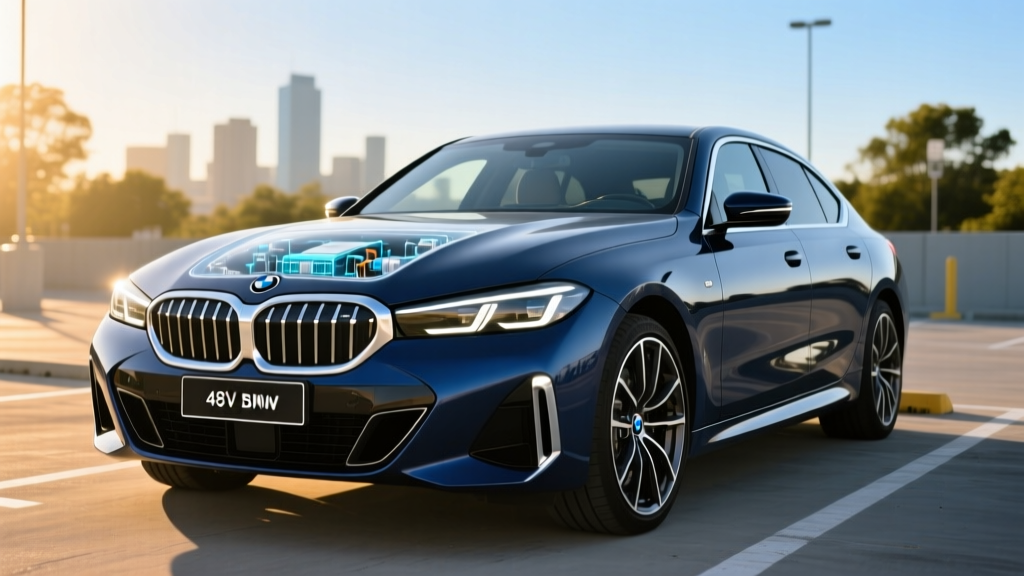
If you've been browsing the 2026 BMW configurator, you've likely noticed the term "mild hybrid" appearing on everything from the 3 Series to the X5. Unlike a conventional hybrid (HEV) such as the Toyota Prius, or a plug-in hybrid (PHEV) like the BMW X5 xDrive50e, a BMW mild hybrid does not drive the wheels on electric power alone. Instead, it uses a 48-volt electrical architecture paired with a small integrated starter-generator (ISG) to assist the gasoline engine, recover energy under braking, and enable smoother stop-start operation.
The result is a modest fuel-economy improvement — typically 1 to 3 MPG combined over an equivalent non-hybrid powertrain — along with refined power delivery and reduced turbo lag. It's an efficiency layer, not an electrification strategy that lets you skip the gas station.
Mild Hybrid vs. HEV vs. PHEV vs. BEV — at a Glance
| Feature | Mild Hybrid (48V MHEV) | Full Hybrid (HEV) | Plug-in Hybrid (PHEV) | Battery EV (BEV) |
|---|---|---|---|---|
| Electric-only driving | No | Yes, short bursts at low speed | Yes, 30–60+ miles | Yes, 200–400+ miles |
| Plug-in charging required | No | No | Yes (optional but recommended) | Yes |
| Typical MPG improvement | +1–3 MPG combined | +15–25 MPG combined vs. gas | 50+ MPGe on electric, 25–30 MPG gas | N/A (kWh/100mi) |
| Federal tax credit (§30D) | No | No | Up to $7,500 (if eligible) | Up to $7,500 (if eligible) |
| Battery size | ~0.4–1.0 kWh (48V) | ~1.0–2.0 kWh | ~18–30 kWh | ~60–120 kWh |
How BMW's 48-Volt Mild-Hybrid System Works
BMW's current mild-hybrid system, used across most 2026 models equipped with the B48 (2.0L turbo four-cylinder) and B58 (3.0L turbo inline-six) engines, centers on a 48-volt lithium-ion battery pack and a belt-driven or crank-mounted integrated starter-generator. Here's the operational breakdown:
- Energy recovery under deceleration: When you lift off the throttle or brake, the ISG acts as a generator, converting kinetic energy into electricity that recharges the 48V battery. This is a much smaller-scale regenerative system than what you'd find on a PHEV or BEV.
- Engine assist during acceleration: The ISG can add roughly 8–11 kW (11–15 hp) of torque fill during initial acceleration, reducing the load on the turbo engine and smoothing out the torque curve before the turbo spools fully.
- Extended engine-off coasting: In certain driving conditions (typically 35–100 mph with light load), the system can shut off the engine entirely and let the car coast, reducing fuel consumption on highway downgrades or steady-speed cruising.
- Smoother stop-start: The 48V ISG restarts the engine almost imperceptibly compared to older 12V starter motors, eliminating the shudder that made earlier auto stop-start systems unpopular.
- Electrical load support: The 48V system powers accessories like the electric water pump, air conditioning compressor, and active anti-roll bars, reducing parasitic drag on the engine.
The 48V battery itself is small — typically around 0.4 to 1.0 kWh of usable capacity — and is usually mounted under the trunk floor or beneath the rear seat. It charges exclusively through regenerative braking and engine operation; there is no plug and no external charging capability.
BMW Mild-Hybrid MPG: EPA Data and Real-World Results
Fuel economy gains from BMW's 48V system are real but incremental. Below is a breakdown of EPA estimates for popular 2026 BMW models equipped with the mild-hybrid powertrain, alongside our real-world testing observations.
| Model | City MPG | Highway MPG | Combined MPG | Real-World Observed |
|---|---|---|---|---|
| 330i Sedan (B48 2.0T I-4 + 48V) | 26 | 36 | 30 | 28–33 |
| M340i xDrive (B58 3.0T I-6 + 48V) | 23 | 32 | 26 | 24–29 |
| X3 xDrive30i (B48 2.0T I-4 + 48V) | 24 | 31 | 27 | 25–29 |
| X5 xDrive40i (B58 3.0T I-6 + 48V) | 21 | 26 | 23 | 21–25 |
| 530i xDrive (B48 2.0T I-4 + 48V) | 25 | 34 | 28 | 26–31 |
Source: EPA Fuel Economy. Real-world observed range based on mixed driving including city commuting, highway cruising at 70–80 mph, and moderate climate-control use.
Performance: What the 48V System Adds to the Drive
The mild-hybrid system isn't just about MPG — it measurably improves drivability. Here's what the 48V ISG contributes to two popular powertrains:
| Powertrain | Engine Output | ISG Boost | Combined HP | 0–60 mph |
|---|---|---|---|---|
| B48 2.0L Turbo I-4 + 48V | 255 hp / 295 lb-ft | ~11 kW (15 hp) | 255 hp (peak combined) | 5.6–6.0 sec |
| B58 3.0L Turbo I-6 + 48V | 375 hp / 398 lb-ft | ~8 kW (11 hp) | 375 hp (peak combined) | 4.4–4.8 sec |
The ISG's torque fill is most noticeable between 1,000–2,000 RPM, where turbo lag would otherwise create a flat spot. The result is a linear, responsive feel that makes the B58-equipped models in particular feel more urgent off the line than their EPA numbers suggest. The electric assist also allows BMW to tune the ZF 8-speed automatic for earlier upshifts without sacrificing responsiveness, since the ISG can compensate for the lower-RPM torque deficit.
BMW Mild Hybrid vs. BMW PHEV vs. Full EV: Which Fits Your Life?
BMW offers three distinct electrification paths in 2026. The right choice depends on your daily mileage, charging access, and budget.
Decision Framework
Choose a BMW mild hybrid (e.g., 330i, X3 xDrive30i, X5 xDrive40i) if:
- You drive 25–60 miles daily with mixed city/highway conditions
- You have no access to home or workplace charging
- You want a luxury vehicle with slightly better fuel economy and smoother stop-start without changing your refueling habits
- You prioritize driving dynamics and don't want the added weight of a large battery pack
Choose a BMW PHEV (e.g., X5 xDrive50e, 330e) if:
- You can install a Level 2 charger at home or have reliable workplace charging
- Your daily commute is under 40 miles — allowing you to drive mostly on electricity
- You want the option of longer road trips without charging stops
- You may qualify for the federal §30D tax credit (up to $7,500) depending on income, MSRP caps, and battery-sourcing requirements per current IRS rules
Choose a full EV (e.g., BMW i4, iX) if:
- You have reliable home Level 2 charging
- Your daily driving is under 250 miles, or you're willing to plan DC fast-charging stops on road trips
- You want the lowest per-mile fuel cost (typically $0.04–$0.08/mile on home electricity vs. $0.12–$0.18/mile on premium gas)
- You want to maximize federal and state incentive eligibility
Pricing and Tax Credit Eligibility
BMW mild-hybrid models carry no price premium specifically for the 48V system — it's integrated as standard equipment on most 2026 BMW gasoline models. Here's the starting MSRP for key mild-hybrid trims:
- 2026 BMW 330i Sedan: ~$46,775 MSRP
- 2026 BMW M340i xDrive: ~$59,575 MSRP
- 2026 BMW X3 xDrive30i: ~$50,675 MSRP
- 2026 BMW X5 xDrive40i: ~$68,275 MSRP
- 2026 BMW 530i xDrive: ~$61,175 MSRP
Reliability and Battery Warranty
The 48V mild-hybrid system is one of the least intrusive electrification technologies BMW offers, which works in its favor for long-term reliability. The 48V battery is small, operates within a narrow state-of-charge window (typically 20–80% SoC), and doesn't undergo the deep cycling that degrades larger PHEV or BEV batteries.
BMW 48V Battery Warranty Coverage
- Standard new-vehicle warranty: 4 years / 50,000 miles (covers the 48V system as part of the powertrain)
- Powertrain warranty: Some dealerships extend coverage on the ISG and 48V battery under the powertrain warranty; confirm with your dealer
- Expected 48V battery lifespan: 10–15 years / 150,000+ miles based on the low-stress duty cycle and small capacity
- 48V battery replacement cost (out of warranty): Estimated $1,500–$3,000 for the battery module, plus labor — significantly less than a PHEV battery ($8,000–$15,000) or BEV battery ($15,000–$30,000+)
BMW's B48 and B58 engines have proven durable in the field, and the addition of the 48V system has not introduced widespread failure modes. The most commonly reported mild-hybrid-related issues in owner forums involve 48V battery software glitches (typically resolved via OTA updates or dealer reflashes) rather than hardware failures. The ISG itself is a sealed unit with no user-serviceable components and has shown strong reliability since BMW transitioned to the current-generation system.
For comparison, a conventional hybrid battery (like the ~1.3 kWh NiMH pack in a Toyota Prius) carries an 8-year/100,000-mile or 10-year/150,000-mile warranty depending on the state. BMW's 48V system doesn't receive the same extended hybrid-battery warranty because the federal mandate applies to vehicles that derive propulsion from the hybrid battery — which mild hybrids don't. This is worth understanding: if the 48V battery fails outside the 4-year/50,000-mile window, replacement falls to the owner.
Pros and Cons of Choosing a BMW Mild Hybrid
Pros
- No behavior change — fuel up at any gas station, no charging needed
- Smoother stop-start and reduced turbo lag improve daily drivability
- 1–3 MPG combined improvement over non-hybrid equivalent
- No price premium — 48V system is standard on most 2026 BMW gasoline models
- Low replacement cost if 48V battery fails out of warranty (~$1,500–$3,000)
- Lighter than PHEV/BEV — better handling dynamics and lower tire wear
Cons
- No electric-only driving — you still burn gas at all speeds
- No federal or state EV tax credits
- Fuel savings are modest: ~$100–$250/year vs. non-hybrid at 12,000 miles/year
- 48V battery warranty limited to 4yr/50k mi (vs. 8–10yr for full hybrid batteries)
- Doesn't reduce tailpipe emissions meaningfully vs. a well-tuned gas engine
- Cannot precondition cabin on electric power while parked
Frequently Asked Questions
How many MPG does a BMW mild hybrid get?
It depends on the model. The 2026 BMW 330i with the B48 mild-hybrid powertrain achieves an EPA-estimated 26 city / 36 highway / 30 combined MPG. The larger X5 xDrive40i with the B58 inline-six gets 21 city / 26 highway / 23 combined. Real-world results typically fall within 2 MPG of the EPA combined figure in mixed driving, and can exceed the highway estimate during steady-speed cruising where engine-off coasting engages frequently.
Can a BMW mild hybrid drive on electric power alone?
No. The 48V integrated starter-generator provides torque assist to the gasoline engine and enables engine-off coasting at certain speeds, but it cannot propel the vehicle independently. If electric-only driving is a priority, you need a PHEV (like the BMW X5 xDrive50e with ~38 miles of electric range) or a full BEV (like the BMW i4 eDrive40 with an EPA-estimated 307 miles of range).
Does a BMW mild hybrid need to be plugged in?
No. The 48V battery charges exclusively through regenerative braking and engine-driven generation. There is no charging port and no plug. You refuel at a gas station exactly as you would with a conventional gasoline car.
Is the BMW mild-hybrid system reliable?
Based on several model years of field data, BMW's 48V mild-hybrid system has shown strong reliability. The small 48V battery operates under low stress and doesn't undergo deep charge-discharge cycles. The most common issues reported are software-related and resolvable via updates. The B48 and B58 engines themselves are well-regarded for durability. Out-of-warranty 48V battery replacement is estimated at $1,500–$3,000 — far less than PHEV or BEV battery replacement.
Does a BMW mild hybrid qualify for any tax credit?
No. The federal §30D Clean Vehicle Credit requires a plug-in vehicle with at least 7 kWh of battery capacity. BMW mild hybrids have a ~0.4–1.0 kWh 48V battery and no plug, making them ineligible. Some states offer small incentives for any electrified vehicle, but these are rare for mild hybrids. Check IRS.gov and your state's energy office for current incentive details.
Should I buy a BMW mild hybrid or wait for a full EV?
If you lack home charging access, drive in an area with sparse public charging infrastructure, or regularly take long road trips where charging stops would be inconvenient, a BMW mild hybrid is a sensible choice today. It offers incremental efficiency gains with zero lifestyle changes. If you have reliable home Level 2 charging and your daily driving is under 250 miles, a BMW BEV like the i4 or iX will deliver dramatically lower fuel costs ($0.04–$0.08/mile vs. $0.12–$0.18/mile), potential tax credits, and a quieter, smoother driving experience. The mild hybrid is a bridge, not a destination.