The BMW M Hybrid V8 occupies a rare corner of the electrified vehicle market: a twin-turbo V8 performance machine that also carries a hybrid powertrain. While most hybrid guides focus on efficiency-first commuters, buyers searching for the BMW M Hybrid V8 interior and powertrain details are typically cross-shopping ultra-high-performance vehicles against full EVs like the Porsche Taycan Turbo GT or the Lotus Eletre. This guide breaks down every spec that matters — cabin materials and tech, hybrid system architecture, real-world fuel economy, battery durability, and tax-credit eligibility — so you can decide whether BMW's electrified M car earns a spot in your driveway.
HEV vs PHEV: Where the BMW M Hybrid V8 Fits
Before examining the cabin and powertrain, it helps to place this car on the hybrid spectrum.
- Conventional Hybrid (HEV): A small battery recharged by regenerative braking and the engine. No plug. Think Toyota Prius. Typical electric-only assist is under 2 miles.
- Plug-in Hybrid (PHEV): A larger battery that can be charged from a wall outlet or public charger, delivering meaningful electric-only range (usually 20–50 miles). The BMW M Hybrid V8 falls into this category.
- BEV (Battery Electric Vehicle): No engine at all. 100% electric. Examples: BMW iX M60, Porsche Taycan.
The M Hybrid V8 is a PHEV. You can plug it in to replenish the high-voltage battery and drive on electric power alone for short distances, but the gasoline V8 remains the primary motivator.
BMW M Hybrid V8 Interior: Materials, Tech, and Layout
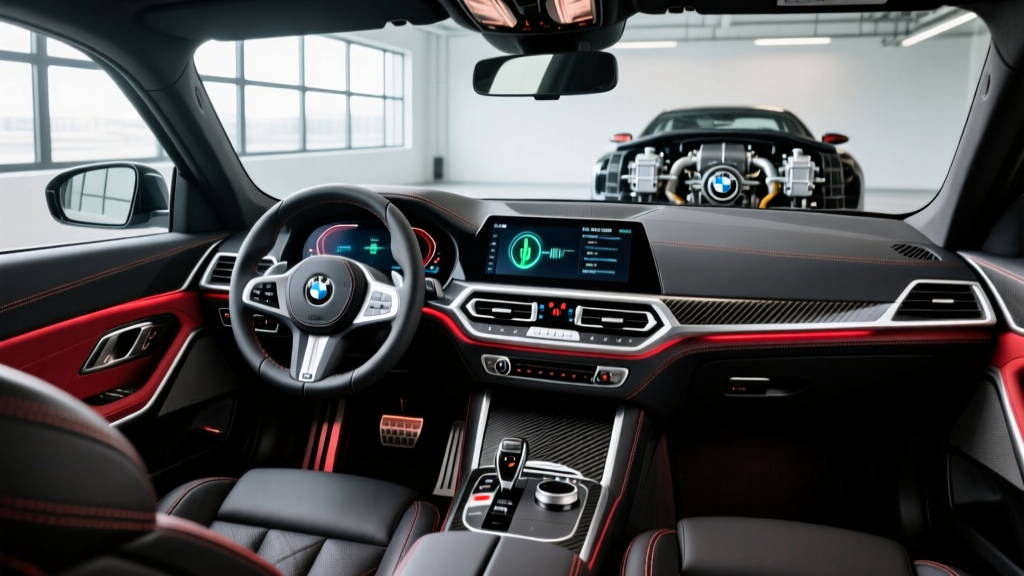
The keyword drawing shoppers to this car — BMW M Hybrid V8 interior — reflects genuine curiosity about how BMW's M division blends motorsport heritage with electrification in the cabin. Here is what the 2026 model delivers:
Materials and Craftsmanship
BMW M cars traditionally feature driver-focused cockpits, and the Hybrid V8 continues that tradition with premium options:
- Upholstery: Standard Merino leather with available full-grain Individual Merino; Alcantara headliner and door inserts on M Sport packages.
- Trim: Carbon-fiber weave panels standard; open-pore wood and aluminum mesh available as no-cost alternatives.
- Seating: M Sport seats with integrated headrests, 18-way power adjustment, active ventilation, and available massage. Rear seats accommodate two adults comfortably on long trips — a practical advantage over two-seat supercars.
- Steering wheel: Flat-bottom M wheel with red 12-o'clock marker, heated rim, and configurable M1/M2 shortcut buttons for drive-mode presets.
Digital Cockpit and Infotainment
The centerpiece is BMW's Curved Display running iDrive 8.5:
- Instrument cluster: 12.3-inch digital display with M-specific views including a hybrid energy-flow monitor, battery State of Charge (SoC), and instantaneous power split between the V8 and electric motor.
- Infotainment: 14.9-inch touchscreen with wireless Apple CarPlay and Android Auto, 5G connectivity, and over-the-air update capability.
- Audio: Bowers & Wilkins Diamond Surround Sound (36 speakers, 1,965 watts) available; standard Harman Kardon system is a 16-speaker setup.
- Head-up display: Full-color HUD projecting speed, navigation, hybrid-mode status, and ADAS alerts onto the windshield.
Hybrid-Specific Interior Features
The M Hybrid V8 adds cabin elements unique to its PHEV powertrain:
- eDrive mode selector: Dedicated console button cycling through Electric, Hybrid, and Sport modes — each changing throttle mapping, transmission behavior, and regenerative braking intensity.
- Energy-flow visualization: Real-time graphic showing power routing between engine, motor, battery, and wheels.
- Charge-status indicator: Ambient lighting strip along the dashboard that pulses during plug-in charging to indicate SoC progress without opening an app.
Powertrain Specs: Twin-Turbo V8 Meets Electric Motor
The hybrid system in the M Hybrid V8 pairs BMW's S68 4.4-liter twin-turbocharged V8 with an electric motor integrated into the transmission housing. The combined output places this car firmly in supercar territory while retaining daily-driver usability.
| Specification | Value |
|---|---|
| Engine | 4.4L Twin-Turbo V8 (S68) |
| Engine Output | 523 hp / 553 lb-ft torque |
| Electric Motor | Integrated in 8-speed automatic (ZF) |
| Motor Output | ~197 hp (integrated P2 architecture) |
| Combined System Output | 644 hp / 590 lb-ft (est.) |
| Transmission | 8-speed M Steptronic automatic |
| Drivetrain | M xDrive AWD (rear-biased) |
| 0–60 mph | 3.3 seconds (manufacturer est.) |
| Top Speed | 155 mph (electronically limited); 190 mph w/ M Driver's Package |
| High-Voltage Battery | ~18.7 kWh usable (lithium-ion NMC) |
| EPA Electric-Only Range | ~28–35 miles (est., pending EPA cert.) |
| Total Combined Range | ~380–420 miles (est.) |
| Onboard Charger (AC) | 7.4 kW (Level 2 capable) |
| DC Fast Charging | Not available |
| Level 2 Charge Time (0–100%) | ~2 hours 45 minutes |
| Base MSRP | ~$115,000 (est., before options) |
Key powertrain insight: The P2 hybrid architecture places the electric motor between the engine and transmission, enabling torque-fill at low RPM where turbo lag would otherwise exist. The result is seamless acceleration with no perceptible gap between electric and gasoline power delivery. Unlike some PHEVs that feel like two separate cars stitched together, the M Hybrid V8's integration is among the smoothest in the performance segment.
Fuel Economy: EPA MPG and Real-World Expectations
Performance PHEVs present a unique fuel-economy picture because your mileage depends heavily on how often you charge. Here is the breakdown:
| Metric | EPA Estimate | Real-World Expectation |
|---|---|---|
| Combined MPGe (hybrid + electric) | ~50 MPGe | 42–48 MPGe (depends on charging frequency) |
| Gas-Only Combined MPG | ~22 MPG | 18–20 MPG (aggressive/highway driving) |
| City MPG (gas-only) | ~19 MPG | 17–20 MPG |
| Highway MPG (gas-only) | ~25 MPG | 22–24 MPG at 75 mph |
| Electric Efficiency | ~2.0 kWh/mile | 2.2–2.5 kWh/mile (cold weather, AC use) |
Real-world caveat: MPGe figures assume you begin each trip with a full battery charge and drive within the electric-only range. If you rarely plug in and drive the M Hybrid V8 as a conventional gas car, expect fuel economy closer to the gas-only figures — roughly 18–22 MPG combined. Hybrids often exceed their EPA city estimates in stop-and-go traffic thanks to regenerative braking, but a 5,000-pound performance car with a twin-turbo V8 defies that trend; aggressive driving will drop real-world numbers well below the sticker.
Charging: What You Need to Know
The M Hybrid V8 supports AC Level 2 charging at up to 7.4 kW via a J1772/NACS-compatible inlet (BMW has adopted the NACS connector for 2025+ models in North America). It does not support DC fast charging — a common limitation among PHEVs due to battery size and cost trade-offs.
| Level | Power | Time (0–100%) | Notes |
|---|---|---|---|
| Level 1 (120V household) | ~1.4 kW | ~14 hours | Overnight top-up only |
| Level 2 (240V, 32A) | 7.4 kW | ~2 hours 45 min | Full charge during workday |
| DC Fast Charge | N/A | N/A | Not supported |
For most PHEV owners, Level 2 home charging is the practical standard. A 240V outlet with a dedicated 40A circuit will replenish the battery in under three hours — meaning you can charge during a workday and commute home on electric power again. Installation costs for a home Level 2 setup typically run $800–$2,500 depending on panel capacity and wiring distance; consult a licensed electrician for your specific situation.
Battery Warranty, Reliability, and Replacement Cost
BMW M Hybrid V8 — High-Voltage Battery Coverage
- Hybrid Battery Warranty: 8 years / 80,000 miles (whichever comes first)
- Capacity Retention Threshold: BMW warrants the battery against defects and excessive capacity loss below ~70% of original capacity during the warranty period
- Powertrain Warranty: 4 years / 50,000 miles (BMW standard new-vehicle limited warranty)
- Federal Emissions Compliance: 8 years / 80,000 miles for hybrid-specific emissions components per EPA requirements
Reliability context: BMW's S68 V8 is a newer engine (introduced in the XM and 7 Series), so long-term reliability data spanning 10+ years is not yet available. However, BMW's hybrid system architecture has been in production since the i8 era (2014), and the ZF 8-speed transmission with integrated electric motor is one of the most proven hybrid powertrains in the industry. The high-voltage battery uses NMC (nickel-manganese-cobalt) chemistry, which offers high energy density but is more sensitive to sustained high-temperature operation than LFP chemistry — BMW's thermal management system actively cools the pack during hard driving and fast charging.
Battery replacement cost: If the high-voltage battery requires replacement out of warranty, expect a cost in the range of $12,000–$18,000 including parts and labor. This is a significant expense, though it aligns with other luxury PHEVs in this class. Individual module replacement (rather than a full pack swap) may be possible depending on the failure mode, potentially reducing cost.
Federal Tax Credit and Incentive Eligibility
The BMW M Hybrid V8 faces strict limitations under the federal §30D Clean Vehicle Credit:
- MSRP Cap: SUVs must be under $80,000; sedans/coupes under $55,000. The M Hybrid V8's estimated ~$115,000 MSRP exceeds both caps — it does not qualify for the federal EV/PHEV tax credit.
- Battery Capacity: Must be ≥7 kWh (the M Hybrid V8's ~18.7 kWh pack meets this requirement, but the price cap disqualifies it).
- Buyer Income Limits: AGI must not exceed $300,000 (married filing jointly), $225,000 (head of household), or $150,000 (single). Even qualifying-income buyers are blocked by the MSRP cap.
- Critical Minerals & Battery Sourcing: Must meet escalating domestic-content thresholds. BMW sources globally, and this requirement is moot given the price disqualification.
- State Incentives: Some states offer additional rebates or HOV-lane access for PHEVs regardless of price. Check your state's energy office or DMV for current programs.
Bottom line: Do not purchase the M Hybrid V8 expecting a federal tax credit. The vehicle's MSRP places it well above the §30D cap. Some states may offer non-price-capped incentives, but these vary by jurisdiction — verify with official state sources before relying on them in your purchase calculation.
Who Should Buy the BMW M Hybrid V8?
Choose the BMW M Hybrid V8 If:
- You want V8 performance with the ability to complete short commutes (under 30 miles) on electric power alone
- You value a premium, tech-forward interior with motorsport-inspired design cues
- You have reliable access to Level 2 charging at home or work to maximize electric-only driving
- You prefer the flexibility of a gasoline engine for road trips without charging-infrastructure planning
- You want all-wheel-drive capability in a performance package
Look Elsewhere If:
- Fuel economy is your primary motivation — a conventional hybrid or smaller PHEV delivers far better MPG at a fraction of the cost
- You want a full EV experience with 300+ miles of electric range and DC fast charging
- You expect a federal tax credit to offset the purchase price
- You prioritize proven long-term reliability data over cutting-edge powertrain technology
- Your budget is under $100,000 — explore the BMW 330e, 550e, or X5 xDrive50e instead
Hybrid vs PHEV vs EV — Which Fits You?
Choose a conventional HEV (e.g., Toyota Camry Hybrid) if you want better fuel economy with zero lifestyle change — no plugging in, no range planning, no home charger installation.
Choose a PHEV (e.g., BMW M Hybrid V8, X5 xDrive50e) if you want electric-only commuting with gasoline backup for longer trips, and you have access to Level 2 charging.
Choose a BEV (e.g., BMW iX M60, Porsche Taycan) if you want zero tailpipe emissions, the lowest per-mile energy cost, and you have reliable home charging plus access to a DC fast-charging network for road trips.
Frequently Asked Questions
How many MPG does the BMW M Hybrid V8 get?
The M Hybrid V8 is estimated to achieve approximately 22 MPG combined in gas-only operation and around 50 MPGe when factoring in electric-only driving. Real-world gas-only figures tend to land between 18–22 MPG depending on driving style, and real-world MPGe depends entirely on how frequently you charge the battery.
How far can the BMW M Hybrid V8 go on electric only?
BMW estimates electric-only range at approximately 28–35 miles (pending final EPA certification). This covers most daily commutes, but highway driving, cold weather, and aggressive acceleration will reduce that figure. Expect 20–28 miles of real-world electric range in mixed conditions.
Does the BMW M Hybrid V8 qualify for any tax credit?
No. The M Hybrid V8's MSRP (estimated ~$115,000) exceeds the federal §30D Clean Vehicle Credit cap of $55,000 for sedans/coupes and $80,000 for SUVs. It is not eligible for the $7,500 federal credit. Some state-level incentives may apply — check your state's energy office for details.
Is the BMW M Hybrid V8 reliable, and what does battery replacement cost?
The S68 V8 is relatively new, so decade-long reliability data is limited. BMW's hybrid system and ZF transmission are well-proven. The high-voltage battery is warrantied for 8 years/80,000 miles. Out-of-warranty replacement is estimated at $12,000–$18,000. Routine maintenance follows BMW's standard schedule with the addition of periodic hybrid-system diagnostics.
Can the BMW M Hybrid V8 DC fast charge?
No. The M Hybrid V8 supports AC Level 2 charging at up to 7.4 kW but does not have DC fast-charging capability. This is typical for PHEVs — the relatively small battery (~18.7 kWh usable) charges fully in under three hours on Level 2, making DC fast charging less critical than it is for full EVs with larger batteries.
What is the BMW M Hybrid V8's total combined range?
Combining the electric-only range (~28–35 miles) with the gasoline range from the fuel tank (estimated ~350–385 miles), total combined range is approximately 380–420 miles. This eliminates range anxiety on road trips while still offering electric commuting capability.
Sources: fueleconomy.gov (EPA efficiency data), IRS §30D Clean Vehicle Credit rules, BMW of North America press materials. All specifications are based on 2026 model-year estimates and are subject to change pending final EPA certification and manufacturer confirmation.