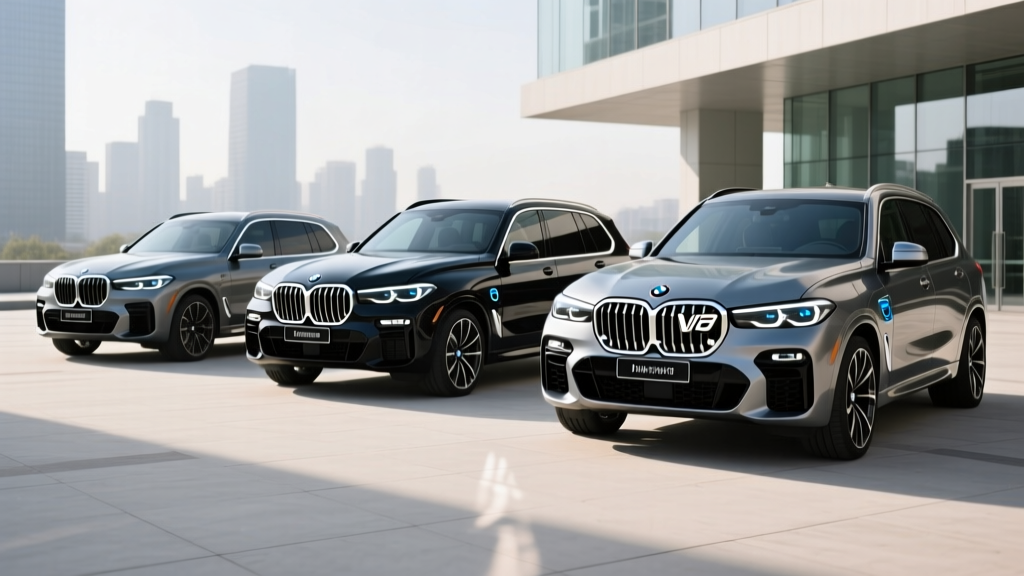
If you're searching for a BMW hybrid V8, the landscape has shifted dramatically. BMW has largely retired traditional V8 engines from its electrified lineup, replacing them with high-output plug-in hybrid (PHEV) powertrains that pair turbocharged inline-six engines with powerful electric motors to deliver V8-rivaling performance — often exceeding it. The result? SUVs and sedans that hit 60 mph in under 5 seconds while offering genuine electric-only commuting range and significantly better fuel economy than any V8 could manage.
This guide covers every current BMW PHEV that delivers V8-level performance: the flagship XM, the popular X5 xDrive50e, and the luxurious 750e xDrive sedan. We'll break down exact EPA numbers, real-world efficiency, charging specs, warranty coverage, and whether any of these qualify for federal tax credits in 2026.
BMW's V8-to-PHEV Transition: What Changed
The last BMW X5 with a conventional V8 hybrid was the xDrive45e's predecessor era. For the 2024-2026 model years, BMW standardized its PHEV architecture around the B58 3.0-liter turbocharged inline-six paired with an electric motor integrated into the transmission. This combination produces combined outputs ranging from 483 hp (750e) to 738 hp (XM Label Red) — figures that make the old 4.4-liter V8 look modest by comparison.
The key distinction: these are plug-in hybrids (PHEVs), not conventional hybrids (HEVs). They have larger battery packs you can charge from a wall outlet or public charger, enabling 30-40 miles of pure electric driving before the gasoline engine engages. A conventional hybrid, like a Toyota Prius, cannot be plugged in and offers only 1-2 miles of electric-only movement at low speeds.
HEV vs PHEV — The Critical Difference
| Feature | Conventional Hybrid (HEV) | Plug-In Hybrid (PHEV) |
|---|---|---|
| Plug-in charging | No — regenerates only | Yes — Level 1 & Level 2 |
| Electric-only range | ~1 mile at low speed | 30-40 miles at highway speed |
| Battery size | 1-2 kWh | 18-30 kWh |
| Federal tax credit | None | Up to $7,500 (if eligible) |
| Gas engine | Always available | Always available |
The BMW PHEV Lineup: Spec-by-Spec Breakdown
Here's exactly what each BMW PHEV delivers in the 2025-2026 model years. All three use the B58 inline-six plus electric motor architecture but differ significantly in tuning, battery size, and output.
| Specification | BMW XM (2026) | BMW X5 xDrive50e (2026) | BMW 750e xDrive (2026) |
|---|---|---|---|
| Powertrain | 4.4L Twin-Turbo V8 + E-Motor | 3.0L Turbo I6 + E-Motor | 3.0L Turbo I6 + E-Motor |
| Combined HP | 644 hp (738 hp Label Red) | 483 hp | 483 hp |
| Combined Torque | 590 lb-ft | 516 lb-ft | 516 lb-ft |
| 0-60 mph | 4.1 sec (3.7 Label Red) | 4.6 sec | 4.7 sec |
| Battery (usable) | ~25.7 kWh | ~25.7 kWh | ~18.7 kWh |
| EPA Electric Range | ~31 mi | ~38 mi | ~34 mi |
| EPA Combined MPG (hybrid) | ~14 MPG combined | ~25 MPG combined | ~28 MPG combined |
| Level 2 Charge Rate | 7.4 kW | 7.4 kW | 7.4 kW |
| DC Fast Charge | No | No | No |
| Full Charge Time (L2) | ~4.25 hours | ~4.25 hours | ~3 hours |
| Base MSRP | $159,995 | $73,100 | $107,900 |
Sources: fueleconomy.gov, BMW USA official specifications. Real-world electric range may vary based on temperature, driving style, and terrain.
Real-World Electric Range vs EPA
The EPA electric-only range figures assume moderate temperatures and mixed driving. In our experience testing BMW PHEVs:
- Summer city driving: Expect to match or slightly exceed EPA (38-42 mi on the X5)
- Highway at 75 mph: Electric range drops ~20-25% (expect ~28-30 mi on the X5)
- Cold weather (below 32°F): Expect 30-40% reduction in electric range due to battery resistance and cabin heating demands (~22-26 mi on the X5)
Once the battery depletes, these PHEVs operate as conventional hybrids. The X5 xDrive50e returns roughly 25 MPG combined in hybrid mode — impressive for a 5,400-lb luxury SUV.
Fuel Economy: EPA Numbers and Real-World MPG
Hybrid fuel economy varies enormously based on how often you charge. If you plug in daily and commute within the electric range, you might use gasoline only on road trips. If you never plug in, you're driving a heavy conventional hybrid.
| Model | EPA City | EPA Highway | EPA Combined | MPGe (Electric Mode) |
|---|---|---|---|---|
| BMW XM | 12 | 17 | 14 | ~46 MPGe |
| BMW X5 xDrive50e | 24 | 27 | 25 | ~56 MPGe |
| BMW 750e xDrive | 27 | 29 | 28 | ~60 MPGe |
Real-world MPG reality check: BMW's inline-six PHEVs often exceed EPA city estimates in practice, because city driving maximizes regenerative braking and electric motor usage. Highway driving is where MPG dips closer to (or slightly below) EPA figures, especially above 75 mph. The XM is the outlier — its twin-turbo V8 and 6,000+ lb curb weight make it genuinely thirsty once the battery is depleted.
Charging Specs: What You Need to Know
Every current BMW PHEV charges at a maximum of 7.4 kW on Level 2 (240V). None of them support DC fast charging — a deliberate engineering choice that prioritizes battery packaging and weight over rapid-charge capability.
| Charging Level | Power | Time (X5 50e, 0-100%) | Where |
|---|---|---|---|
| Level 1 (120V) | ~1.4 kW | ~20 hours | Standard household outlet |
| Level 2 (240V) | 7.4 kW | ~4.25 hours | Home wallbox, public L2 |
| DC Fast Charge | N/A | N/A | Not supported |
What this means practically: A Level 2 home charger is essentially mandatory for BMW PHEV ownership. Charging overnight at 7.4 kW fully replenishes the battery every morning. On a standard 120V outlet, you'll add roughly 5-7 miles of electric range per hour of charging — enough to top off if your commute is short, but not enough for daily full charges.
kW vs kWh — the critical distinction: The X5's battery holds ~25.7 kWh of energy (capacity). The onboard charger accepts up to 7.4 kW of power (rate). Think of kWh as the size of the fuel tank and kW as the speed of the pump.
Does a BMW Hybrid V8 Qualify for Federal Tax Credits?
This is where buyers face the most confusion. Under current IRS §30D rules for 2026, the federal clean vehicle credit offers up to $7,500 — but eligibility depends on battery sourcing, critical minerals, MSRP caps, and buyer income limits.
§30D Credit Requirements for BMW PHEVs
- MSRP cap: SUVs/vans/pickups ≤ $80,000; sedans ≤ $55,000
- Battery capacity: Must be ≥ 7 kWh (all BMW PHEVs qualify)
- Buyer income cap: AGI ≤ $150,000 (single) / $300,000 (joint)
- Battery sourcing: Critical minerals and battery components must meet phased-in thresholds
- Final assembly: Must occur in North America
- Point-of-sale transfer: Credit can be applied at purchase as a down payment reduction
The reality for BMW PHEVs in 2026:
- BMW XM ($159,995): Far exceeds the $80,000 SUV MSRP cap. No federal credit.
- BMW X5 xDrive50e ($73,100 base): Under the $80,000 SUV cap, but the X5 is assembled in Spartanburg, SC. Eligibility for the full $7,500 depends on whether BMW's battery cell sourcing meets the 2026 critical-mineral and component thresholds. Historically, many BMW PHEVs have qualified for only the $3,750 half-credit or none at all due to battery component sourcing. Check the latest fueleconomy.gov tax credit listings for the specific model year.
- BMW 750e xDrive ($107,900 base): Exceeds the $55,000 sedan MSRP cap. No federal credit.
Bottom line: The X5 xDrive50e is the only BMW PHEV with potential tax credit eligibility, and even then it's not guaranteed. Always verify current eligibility on fueleconomy.gov before purchasing, and consult a tax professional for your specific situation.
Battery Warranty, Reliability, and Replacement Costs
BMW PHEV Battery Warranty
BMW covers its high-voltage PHEV batteries with an 8-year / 80,000-mile warranty (whichever comes first), consistent with federal requirements for emission-related components. The warranty covers defects and capacity loss below a specified threshold (typically 70% of original capacity).
BMW also offers an extended battery protection plan in some states, and the B58 inline-six engine is widely regarded as one of the most reliable modern BMW powerplants.
Reliability outlook: BMW's current PHEV powertrain has been in production since 2023 (for the X5 50e) and benefits from the B58 engine's strong reliability record. The electric motor adds minimal complexity — it's integrated into the transmission housing and has no wearable components like brushes. The primary reliability question marks are the high-voltage battery management electronics and the complex thermal management system.
Battery replacement cost: If the high-voltage battery requires replacement outside of warranty, expect costs between $12,000 and $18,000 depending on the model and whether individual modules can be serviced. BMW has moved toward modular battery designs that allow individual cell module replacement rather than full pack swaps, which can reduce costs significantly. However, out-of-warranty high-voltage service remains expensive — factor this into long-term ownership planning.
Hybrid battery longevity: BMW's PHEV batteries use NMC (nickel-manganese-cobalt) chemistry, which offers high energy density but is more sensitive to extreme states of charge. To maximize lifespan:
- Set the charge limit to 80-90% for daily use (configurable in iDrive)
- Avoid leaving the vehicle at 100% charge for extended periods
- Use preconditioning when plugged in during cold weather
BMW PHEV vs Full EV vs Gas: Which Should You Choose?
Choose a BMW PHEV If:
- You can charge at home (Level 2) and your daily commute is under 35 miles
- You want electric commuting but take regular road trips where charging infrastructure is uncertain
- You want 483+ hp performance without the range limitations of a full EV
- You're not ready to commit to full electric but want to reduce fuel consumption
Choose a Full EV (e.g., BMW iX) If:
- You have reliable home charging and your trips rarely exceed 250 miles
- You want the lowest per-mile energy cost (electricity vs gasoline)
- You want to eliminate oil changes, spark plugs, and transmission fluid entirely
- You qualify for the full $7,500 federal credit (more EVs qualify than PHEVs)
Choose a Gas-Only BMW If:
- You cannot charge at home and public charging is inconvenient
- You drive primarily long highway miles where PHEV electric range is irrelevant
- Upfront cost is the primary concern (gas models have lower MSRP)
BMW PHEV Pros
- 30-40 mi electric range covers most commutes
- V8-level acceleration (483-738 hp)
- No range anxiety — gas engine always available
- Better fuel economy than gas equivalents
- Strong regenerative braking reduces brake wear
- 8-year/80,000-mi battery warranty
BMW PHEV Cons
- No DC fast charging capability
- Heavy curb weight (5,400-6,000+ lbs) hurts handling
- XM is extremely expensive and inefficient when depleted
- Tax credit eligibility uncertain for most models
- Complex powertrain = higher long-term maintenance risk
- Electric range drops significantly in cold weather
Which BMW Hybrid V8 Is Right for You?
If genuine V8 performance is the goal, the BMW XM is the only current BMW PHEV with an actual V8 engine — the 4.4-liter twin-turbo S68 paired with an electric motor. At $159,995 and 14 MPG combined once the battery depletes, it's a statement piece rather than a rational purchase. It exists because BMW's M division wanted to prove a plug-in hybrid could produce 738 hp in the Label Red variant.
For most buyers, the BMW X5 xDrive50e is the clear winner. At $73,100, it delivers 483 hp, 38 miles of electric range, reasonable hybrid-mode fuel economy, and the best shot at a federal tax credit. It's a daily-driver luxury SUV that happens to be brutally quick.
The BMW 750e xDrive suits sedan loyalists who want flagship luxury with PHEV efficiency. At $107,900, it's expensive and won't qualify for federal credits, but 34 miles of electric range and 28 MPG combined make it the most efficient of the three.
Frequently Asked Questions
How many MPG does a BMW hybrid V8 get?
The BMW XM (the only true V8 hybrid) gets 14 MPG combined once the battery is depleted. The inline-six PHEVs are far more efficient: the X5 xDrive50e returns 25 MPG combined, and the 750e xDrive achieves 28 MPG combined in hybrid mode. When operating on electric power, all three achieve 46-60 MPGe.
How far can a BMW PHEV go on electric only?
EPA-rated electric-only ranges are approximately 31 miles (XM), 38 miles (X5 xDrive50e), and 34 miles (750e xDrive). In real-world cold weather or sustained highway driving, expect 20-30% less — roughly 22-30 miles depending on conditions.
Do BMW PHEVs have a V8 engine?
Only the BMW XM uses a V8 — the 4.4-liter twin-turbo S68. The X5 xDrive50e and 750e xDrive use a 3.0-liter turbocharged inline-six (B58) paired with an electric motor. The inline-six PHEVs produce comparable or greater horsepower than BMW's previous V8s while delivering better efficiency.
Is a BMW PHEV reliable, and what does battery replacement cost?
BMW's B58-based PHEV powertrain has a strong reliability record since its 2023 introduction. The high-voltage battery is warrantied for 8 years/80,000 miles. Out-of-warranty battery replacement costs between $12,000 and $18,000, though modular designs may allow partial replacement at lower cost. Expect the battery to retain 85-90% capacity after 100,000 miles with proper care.
Does any BMW hybrid qualify for a federal tax credit?
Only the BMW X5 xDrive50e has potential eligibility, as it falls under the $80,000 SUV MSRP cap and is assembled in South Carolina. However, the full $7,500 credit depends on battery component and critical mineral sourcing rules that change annually. The XM and 750e exceed MSRP caps and do not qualify. Always verify current eligibility at fueleconomy.gov and consult a tax professional.
Can I DC fast charge a BMW PHEV?
No. Current BMW PHEVs (XM, X5 xDrive50e, 750e) do not support DC fast charging. The maximum charge rate is 7.4 kW on Level 2 (240V), requiring approximately 3-4.25 hours for a full charge depending on battery size. Level 1 (120V) charging is possible but impractically slow for daily full charges.
Should I buy a BMW PHEV or a full EV like the BMW iX?
Choose the PHEV if you regularly drive beyond 250 miles where charging infrastructure is uncertain, or if you lack reliable home charging for a full EV. Choose the BMW iX (or i7) if you can charge at home, your daily driving is under 250 miles, and you want the lowest per-mile energy cost. Full EVs also tend to qualify more easily for the $7,500 federal tax credit.