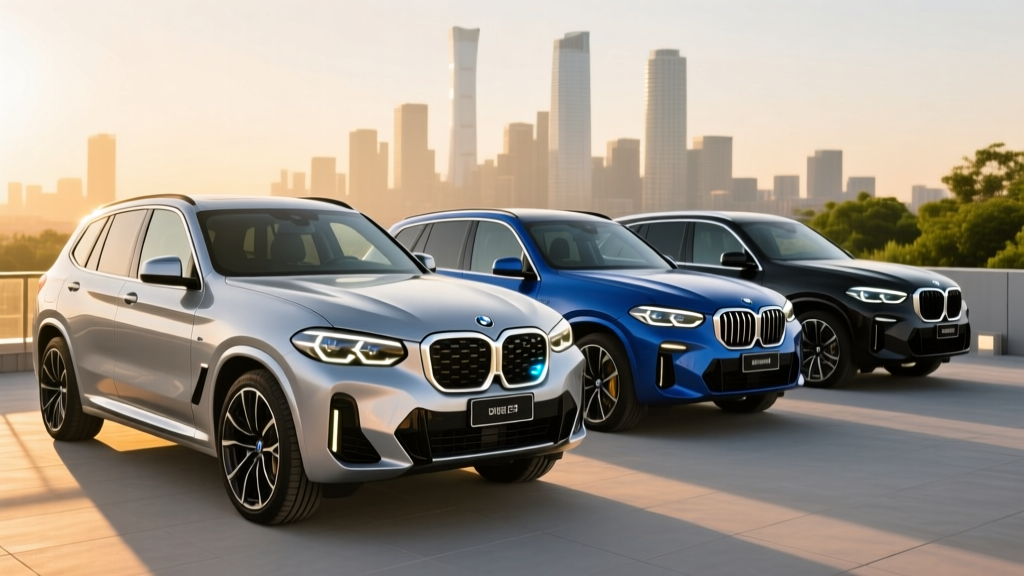
If you're researching a hybrid SUV BMW in 2026, the Bavarian automaker offers three distinct plug-in hybrid (PHEV) options spanning compact luxury to high-performance flagship. Unlike conventional hybrids that recharge solely through regenerative braking, every current BMW hybrid SUV is a plug-in — meaning you can charge from a wall outlet and drive meaningful distances on electricity alone before the gasoline engine engages. This guide breaks down the X3 xDrive50e, X5 xDrive50e, and XM with exact EPA figures, real-world expectations, battery longevity data, and federal tax credit eligibility so you can choose the right one.
BMW's 2026 Hybrid SUV Lineup at a Glance
BMW has fully committed to plug-in hybrid architecture across its SUV range. There is no conventional HEV (non-plug-in) option in the current BMW SUV lineup — every electrified BMW SUV is a PHEV or a full BEV (like the iX). This matters because PHEVs require access to charging to deliver their advertised efficiency; without regular plug-in charging, you're carrying dead battery weight and seeing MPG closer to a mild-hybrid gas car.
| Specification | X3 xDrive50e | X5 xDrive50e | XM |
|---|---|---|---|
| Powertrain | 2.0L turbo I4 + electric motor | 3.0L turbo I6 + electric motor | 4.4L twin-turbo V8 + electric motor |
| Combined Horsepower | 299 hp | 483 hp | 644 hp (738 hp Label Red) |
| Combined Torque | 332 lb-ft | 516 lb-ft | 590 lb-ft |
| 0-60 mph | 6.0 sec | 4.6 sec | 4.1 sec (3.7 Label Red) |
| Battery (gross / usable) | 19.7 kWh / ~16.5 kWh | 25.7 kWh / ~22.0 kWh | 25.7 kWh / ~22.0 kWh |
| Battery Chemistry | NMC (nickel manganese cobalt) | NMC | NMC |
| EPA Electric-Only Range | ~35 mi | ~38 mi | ~30 mi |
| EPA Combined MPGe (electric+gas) | ~75 MPGe | ~56 MPGe | ~46 MPGe |
| EPA MPG (gas only, battery depleted) | ~28 city / 33 hwy / 30 combined | ~22 city / 27 hwy / 24 combined | ~14 city / 18 hwy / 15 combined |
| Total Combined Range | ~430 mi | ~520 mi | ~380 mi |
| AC Charging (Level 2) | 7.4 kW (~2.5 hrs to full) | 7.4 kW (~3.5 hrs to full) | 7.4 kW (~3.5 hrs to full) |
| DC Fast Charging | Not available | Not available | Not available |
| Drivetrain | AWD (xDrive) | AWD (xDrive) | AWD (xDrive) |
| Starting MSRP | $58,675 | $74,775 | $160,775 |
HEV vs. PHEV: What BMW Buyers Need to Know
Conventional Hybrid (HEV) — Not Offered by BMW
A conventional hybrid like the Toyota RAV4 Hybrid uses a small battery recharged exclusively by regenerative braking and the gas engine. You never plug it in. EPA MPG is consistent regardless of driving habits. BMW does not currently sell an HEV SUV in the U.S.
Plug-In Hybrid (PHEV) — Every BMW Hybrid SUV
BMW's PHEVs carry a larger battery (19.7–25.7 kWh) that you charge via a plug — ideally at home overnight on a Level 2 (240V) charger. When the battery is full, you drive 30–38 miles on electricity alone. Once depleted, the gas engine takes over and the car operates like a conventional hybrid, though with lower MPG than a dedicated HEV due to the added battery weight.
The practical implication: If you can charge at home or work daily and your commute is under 35 miles round-trip, a BMW PHEV can operate almost entirely on electricity for daily driving — with the gas engine available for road trips. If you cannot charge regularly, a PHEV's advantage diminishes significantly, and you may be better served by a conventional hybrid from Toyota or Honda, or a full BEV if you want to eliminate gas entirely.
Real-World MPG vs. EPA Estimates
The EPA numbers above assume a mix of electric and gas driving. Real-world results depend heavily on your charging habits:
| Scenario | X3 xDrive50e | X5 xDrive50e | XM |
|---|---|---|---|
| Daily charging, 25-mi commute (mostly electric) | 80+ MPGe effective | 60+ MPGe effective | 50+ MPGe effective |
| Regular charging, mixed driving (EPA cycle) | ~75 MPGe / 30 MPG gas | ~56 MPGe / 24 MPG gas | ~46 MPGe / 15 MPG gas |
| Never charging, gas only | ~28–30 MPG combined | ~22–24 MPG combined | ~13–15 MPG combined |
| Cold weather (below 30°F), gas only | ~24–26 MPG combined | ~19–21 MPG combined | ~11–13 MPG combined |
BMW's turbocharged engines paired with the ZF 8-speed automatic and electric motor integration deliver smooth transitions between electric and gas modes. The X3 xDrive50e stands out for efficiency — its smaller 2.0L engine and lighter platform make it the most fuel-economical BMW hybrid SUV. The XM, by contrast, prioritizes performance: its twin-turbo V8 delivers supercar-rivaling acceleration but drinks fuel accordingly when the battery is depleted.
Electric-Only Range and Charging Details
Every BMW PHEV SUV uses a liquid-cooled NMC (nickel manganese cobalt) lithium-ion battery pack mounted beneath the floor. Electric-only range is modest compared to full EVs but sufficient for many daily commutes:
- X3 xDrive50e: ~35 miles electric-only. Adequate for short urban commutes. Expect ~28–30 miles in cold weather or at sustained highway speeds above 70 mph.
- X5 xDrive50e: ~38 miles electric-only. The largest usable battery in the lineup (~22 kWh usable). Real-world highway range drops to ~30–32 miles.
- XM: ~30 miles electric-only. Despite sharing the X5's battery capacity, the XM's heavier curb weight and aggressive tire compound reduce electric range. Expect ~22–25 miles in real-world mixed driving.
Charging speed is a key limitation: None of BMW's current PHEV SUVs support DC fast charging. You are limited to Level 1 (120V, ~1.4 kW, adding roughly 4–5 miles of range per hour) or Level 2 (240V, 7.4 kW, fully recharging in 2.5–3.5 hours depending on model). For most owners, overnight Level 2 home charging is the practical standard. A 240V / 32-amp home circuit is sufficient for the 7.4 kW onboard charger.
Battery Warranty and Replacement Cost
BMW covers its PHEV high-voltage battery for 8 years or 80,000 miles (whichever comes first) against defects and excessive capacity loss. BMW defines excessive degradation as falling below 70% of original capacity within the warranty period. In practice, BMW's NMC PHEV batteries have shown moderate degradation curves — expect approximately 85–90% state of health (SoH) after 5 years of regular use with typical charging patterns.
Out-of-warranty battery replacement costs are significant: approximately $12,000–$16,000 for the X3 and X5 packs, and up to $18,000+ for the XM, including parts and labor at a BMW dealership. Third-party hybrid battery specialists may offer refurbished packs for 30–40% less, though availability for newer BMW PHEV models remains limited.
Federal Tax Credit Eligibility for BMW PHEVs
Under the IRS §30D Clean Vehicle Credit, qualifying PHEVs are eligible for up to $7,500 in federal tax credits — but eligibility depends on battery component sourcing, critical mineral requirements, MSRP caps, and buyer income limits. Here's where BMW PHEVs stand in 2026:
- MSRP cap: SUVs must have an MSRP at or below $80,000. The X3 xDrive50e ($58,675) and X5 xDrive50e ($74,775) qualify on price. The XM ($160,775) exceeds the cap and is not eligible.
- Buyer income limits: Modified adjusted gross income must not exceed $300,000 (joint filers), $225,000 (head of household), or $150,000 (individual).
- Battery sourcing requirements: The credit splits into two halves — $3,750 for critical minerals and $3,750 for battery component manufacturing. BMW sources battery cells from CATL and Samsung SDI. As of 2026, the X3 and X5 PHEVs typically qualify for $3,750 (half credit) due to partial compliance with sourcing rules. Full $7,500 eligibility is unlikely for BMW PHEVs until battery supply chains further localize.
- Point-of-sale transfer: You can transfer the credit to the dealer at purchase, reducing your out-of-pocket cost immediately rather than waiting for a tax refund.
Always verify current eligibility on the fueleconomy.gov tax credit database before purchasing, as sourcing compliance can change with model-year updates. Consult a tax professional for your specific situation.
BMW Hybrid SUV vs. Full EV vs. Conventional Hybrid: Which Fits You?
Choose a BMW PHEV SUV if:
- You have home Level 2 charging and a daily commute under 35 miles round-trip
- You want electric daily driving but need gas flexibility for road trips or towing
- You value BMW's driving dynamics, interior quality, and dealer network
- You want to reduce fuel consumption without full EV range anxiety
Choose a full EV (like the BMW iX) if:
- You drive under 300 miles daily and have reliable home + destination charging
- You want zero tailpipe emissions and minimal maintenance (no oil changes, no gas engine)
- You want access to DC fast charging for road trips (the iX charges at up to 200 kW)
Choose a conventional HEV (Toyota RAV4 Hybrid, Honda CR-V Hybrid) if:
- You cannot plug in at home or work
- You want the simplest ownership experience with no charging infrastructure
- Your budget is under $40,000
The BMW PHEV sweet spot is the owner who charges nightly, commutes on electricity, and takes 4–6 road trips per year where the gasoline engine eliminates range planning. If you fall outside this pattern — either never charging or never needing gas — a full EV or conventional HEV, respectively, may serve you better at lower total cost.
Reliability, Ownership Costs, and What to Watch
BMW's PHEV powertrains add complexity: you're maintaining both a turbocharged gasoline engine and a high-voltage electric system. Based on owner reports and industry data from sources like IIHS and J.D. Power, BMW's current-generation PHEV systems (introduced for the 2024–2025 model years) have shown improved reliability over the earlier 2018–2022 generation, which had documented issues with battery management software and charging port electronics.
Key ownership considerations:
- Maintenance: BMW's PHEV SUVs require standard gas-engine maintenance (oil changes every 10,000 miles, coolant, spark plugs) in addition to high-voltage system monitoring. Budget $800–$1,200 annually after warranty.
- Insurance: PHEV premiums run 10–20% higher than equivalent gas models due to battery replacement cost. Get quotes before purchasing.
- Tires: The XM and X5 PHEV are heavy vehicles (5,500–6,000+ lbs). Expect tire replacement every 25,000–35,000 miles with OEM-spec rubber.
- Depreciation: BMW PHEVs depreciate faster than Toyota or Honda hybrids but hold value comparably to other luxury PHEVs. Expect ~45–55% value retention at 5 years for the X3 and X5.
Pros
- 30–38 miles of electric-only range covers most commutes
- Smooth, quiet electric driving with instant torque
- No range anxiety — gas engine for long trips
- Premium interior, strong build quality, excellent infotainment (iDrive 8.5)
- Eligible for partial federal tax credit (X3, X5)
- Strong acceleration, especially X5 and XM
Cons
- No DC fast charging on any BMW PHEV
- Electric range drops significantly in cold weather
- XM is extremely expensive and inefficient when battery is depleted
- Requires home charging to realize fuel savings
- Complex powertrain = higher long-term maintenance cost
- Battery replacement cost exceeds $12,000 out of warranty
Frequently Asked Questions
How many MPG does a BMW hybrid SUV get?
It depends on the model and whether you charge. The X3 xDrive50e achieves an EPA-estimated 30 MPG combined on gas alone (28 city / 33 highway). The X5 xDrive50e gets 24 MPG combined (22 city / 27 highway). The XM gets 15 MPG combined (14 city / 18 highway). When regularly charged, MPGe figures are much higher: 75 MPGe for the X3, 56 MPGe for the X5, and 46 MPGe for the XM.
How far can a BMW PHEV SUV go on electric only?
The X5 xDrive50e leads the lineup with approximately 38 miles of EPA-rated electric-only range. The X3 xDrive50e manages about 35 miles, and the XM about 30 miles. Real-world highway driving or cold weather (below 30°F) reduces these figures by 15–25%. Once the battery is depleted, the gasoline engine takes over seamlessly.
Does a BMW hybrid SUV qualify for a tax credit?
The X3 xDrive50e and X5 xDrive50e qualify for a partial federal tax credit — typically $3,750 under current §30D rules, due to battery sourcing requirements. The XM does not qualify because its MSRP exceeds the $80,000 SUV cap. Income limits apply: $300,000 for joint filers. Check IRS guidelines and fueleconomy.gov for the latest eligibility details.
Is a BMW hybrid SUV reliable?
Current-generation BMW PHEVs (2024+) show improved reliability over earlier models. The high-voltage battery is warranted for 8 years / 80,000 miles against defects and capacity loss below 70%. The gasoline powertrain uses proven BMW engine families (B48 4-cylinder, B58 6-cylinder, S68 V8) with established service histories. The main risk area is long-term electronics and charging-system components — budget for extended warranty coverage if you plan to own past the factory warranty period.
What does it cost to replace a BMW PHEV battery?
Out-of-warranty replacement runs $12,000–$16,000 for the X3 and X5, and $18,000+ for the XM, including parts and labor at a BMW dealer. This is comparable to other luxury PHEV battery replacements. The 8-year/80,000-mile warranty should cover premature degradation, and most owners report 85–90% battery health after 5 years of normal use.
Do I need to plug in a BMW PHEV, or does it charge itself?
You must plug in a BMW PHEV to realize its electric-only range and fuel savings. While regenerative braking and the gas engine do maintain a small buffer charge, they cannot fully recharge the high-voltage battery. Without plugging in, you'll operate in gas-only mode and see MPG figures in the 15–30 range depending on model. A home Level 2 (240V) charger is strongly recommended.
Hybrid vs. PHEV vs. full EV — which BMW SUV should I choose?
BMW does not offer a conventional hybrid (HEV) SUV. Your choice is between a PHEV (X3, X5, or XM — plug in for 30–38 electric miles, then gas) and a full EV (the iX — 300+ miles of range, no gas). Choose PHEV if you need long-trip flexibility and can charge at home. Choose the iX if you want zero gas use, DC fast charging, and lower maintenance. Choose a non-BMW conventional hybrid if you cannot plug in at all.