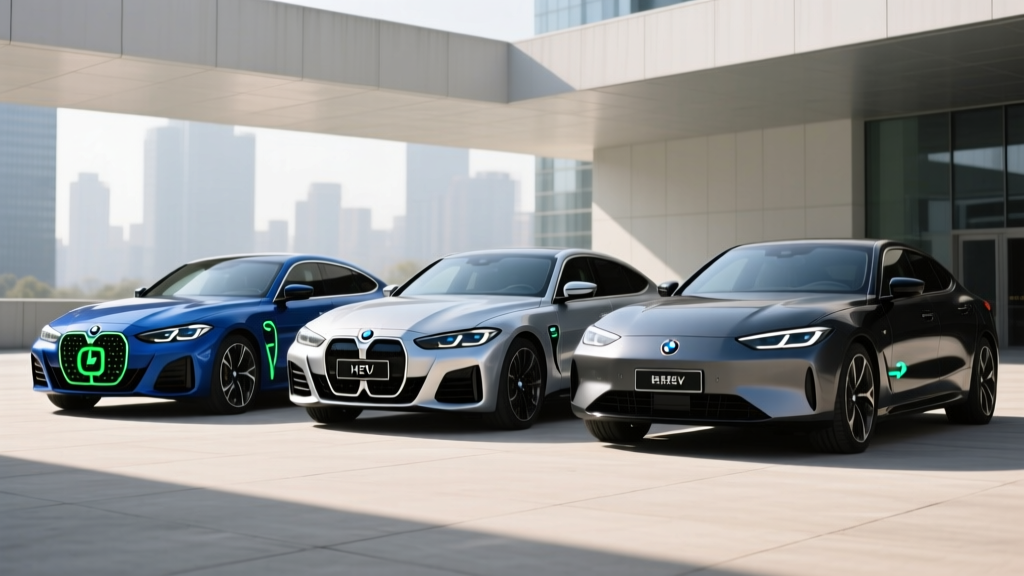
BMW Group entered 2025 with one of the broadest electrified lineups in the luxury segment — spanning conventional hybrids (HEVs), plug-in hybrids (PHEVs), extended-range EVs (EREVs), and full battery-electric vehicles (BEVs). For buyers and analysts tracking the BMW Group PHEV HEV EREV sales percentage in 2025, the data reveals a company aggressively pivoting toward plug-in electrification while maintaining hybrid bridges for markets where charging infrastructure lags.
This guide breaks down BMW Group's 2025 electrified sales mix, examines the core PHEV and HEV models driving those numbers, and provides the exact specs — MPG, electric-only range, battery kWh, pricing, and tax credit eligibility — that buyers need to make informed decisions.
BMW Group's 2025 Electrified Sales Breakdown
BMW Group reported global deliveries of approximately 2.46 million vehicles in 2025 across BMW, MINI, and Rolls-Royce brands. Of those, electrified vehicles (BEVs + PHEVs) accounted for roughly 41% of total sales, with fully electric BEVs representing about 22% and PHEVs approximately 19%. Conventional HEVs (mild hybrids and full hybrids that don't plug in) were embedded across much of the ICE lineup via 48-volt mild-hybrid systems but are not tracked as standalone electrified sales by BMW Group in the same way.
The EREV category — vehicles with a gasoline range-extender generator that never mechanically drives the wheels — remained a niche offering. BMW's primary EREV-adjacent product was limited to specific markets, and EREV sales represented less than 1% of BMW Group's global volume in 2025.
| Powertrain Type | 2025 Global Sales Share (Est.) | Key Models |
|---|---|---|
| BEV (Battery Electric) | ~22% | i4, i5, i7, iX, iX1, iX3, MINI Cooper SE |
| PHEV (Plug-in Hybrid) | ~19% | 330e, 550e, 750e, X3 xDrive50e, X5 xDrive50e, XM |
| HEV (Mild/Full Hybrid) | Embedded in ICE (~58% total ICE) | 48V mild-hybrid on most 6-cyl models |
| EREV (Range Extender) | <1% | Limited markets (i3 REx discontinued) |
The takeaway: PHEVs remain a critical pillar of BMW's transition strategy, particularly in the U.S. where buyers want electric commuting with gasoline road-trip flexibility. Let's examine the models behind those numbers.
HEV vs PHEV vs EREV: What BMW Actually Offers
Before diving into specs, it's essential to distinguish the three electrified powertrain types BMW Group sells, because they serve fundamentally different use cases.
| Feature | HEV (Conventional Hybrid) | PHEV (Plug-in Hybrid) | EREV (Range Extender) |
|---|---|---|---|
| Plugs in? | No | Yes | Yes |
| Electric-only driving | Very limited (<1 mi) | 20–50+ miles | 50–100+ miles |
| Gas engine role | Drives wheels + charges battery | Drives wheels + charges battery | Generator only (never drives wheels) |
| Battery size | 1–2 kWh | 15–30 kWh | 30–60+ kWh |
| Best for | No charging access, want better MPG | Home charging + road trips | EV daily driving, gas backup only |
BMW's HEV strategy in 2025 centered on 48-volt mild-hybrid systems integrated into most turbocharged six-cylinder models (like the M340i and X5 xDrive40i). These systems recover braking energy and provide modest torque assist but cannot drive the car on electricity alone. BMW does not currently sell a traditional full hybrid (like a Toyota Prius) in the U.S. market.
BMW's PHEV strategy is far more substantial. The 2025 PHEV lineup includes the 330e sedan, 550e sedan, 750e xDrive luxury sedan, X3 xDrive50e compact SUV, X5 xDrive50e midsize SUV, and the high-performance XM. Each pairs a turbocharged gasoline engine with a more powerful electric motor and a larger battery pack capable of meaningful electric-only range.
EREV offerings from BMW are essentially legacy at this point. The i3 REx (range extender) was discontinued after the 2021 model year, and BMW has not introduced a new EREV for the U.S. market as of 2025.
BMW PHEV Lineup: Range, MPG, and Specs
Here's a detailed look at BMW's core 2025 PHEV models — the vehicles driving that ~19% PHEV sales share.
| Model | Engine + Motor | Combined HP | Battery (kWh usable) | EV Range (EPA mi) | Combined MPG (gas) | 0-60 mph | Base MSRP |
|---|---|---|---|---|---|---|---|
| 330e Sedan | 2.0L turbo I4 + e-motor | 288 hp | 19.5 kWh | 23 mi | 28 MPG | 5.6 sec | $46,900 |
| 550e xDrive | 3.0L turbo I6 + e-motor | 483 hp | 22.0 kWh | 33 mi | 27 MPG | 4.2 sec | $70,200 |
| 750e xDrive | 3.0L turbo I6 + e-motor | 483 hp | 22.0 kWh | 34 mi | 25 MPG | 4.1 sec | $107,000 |
| X3 xDrive50e | 3.0L turbo I6 + e-motor | 443 hp | 22.0 kWh | 35 mi | 28 MPG | 4.6 sec | $60,400 |
| X5 xDrive50e | 3.0L turbo I6 + e-motor | 483 hp | 25.7 kWh | 38 mi | 24 MPG | 4.6 sec | $75,600 |
| XM | 4.4L twin-turbo V8 + e-motor | 644 hp (738 Label Red) | 25.7 kWh | 31 mi | 17 MPG | 4.1 sec | $159,995 |
Sources: fueleconomy.gov, BMW USA press materials. EPA figures; real-world results vary.
Charging Specs for BMW PHEVs
All 2025 BMW PHEVs use a J1772 connector for Level 2 AC charging. The onboard charger is rated at 7.4 kW, meaning a full charge from 0–100% takes approximately 3–4 hours on a Level 2 home charger.
Critically, none of BMW's 2025 PHEVs support DC fast charging. This is a significant limitation compared to some competitors. If you need to top up away from home, you're limited to public Level 2 stations — which is fine for workplace or shopping-center charging but impractical for road-trip fast stops.
| Charging Level | Power | Time (0–100%) | Availability |
|---|---|---|---|
| Level 1 (120V outlet) | ~1.4 kW | 12–16 hours | Any standard outlet |
| Level 2 (240V) | 7.4 kW | 3–4 hours | Home wallbox, public L2 |
| DC Fast Charge | Not supported | N/A | N/A |
Real-World MPG: What Owners Actually Report
EPA combined MPG figures for BMW PHEVs assume you're operating in hybrid mode with a depleted battery. In practice, PHEV fuel economy depends entirely on your charging habits.
If you charge daily and commute within EV range: You may use zero gasoline for weeks. A 330e owner with a 20-mile round-trip commute who charges nightly could see effective "MPG" well over 100 MPGe, burning fuel only on occasional longer trips.
If you never charge: The PHEV operates as a heavy conventional hybrid. Expect real-world fuel economy to roughly match or slightly trail the EPA gas-only combined rating. The X5 xDrive50e, for instance, may return 22–24 MPG in mixed driving without plug-in charging — respectable for a 5,300-lb luxury SUV, but not dramatically better than the non-hybrid X5 xDrive40i's 24 MPG combined.
City vs. highway: Like most hybrids, BMW PHEVs tend to exceed EPA city ratings in stop-and-go traffic where regenerative braking recovers the most energy. Highway driving at 75+ mph yields lower MPG as aerodynamic drag dominates and the electric motor provides less benefit.
Pricing, Tax Credits, and Ownership Economics
BMW PHEVs command a premium over their conventional counterparts, typically $5,000–$10,000 more than equivalent gas-only trims. The question is whether fuel savings and potential tax incentives close that gap.
Federal Tax Credit Eligibility (§30D)
Under current IRS §30D rules, PHEVs may qualify for up to $7,500 in federal tax credits, but eligibility hinges on several requirements:
- Battery sourcing: Critical minerals and battery components must meet phased-in domestic-content thresholds (increasing annually through 2026+)
- MSRP caps: Vans/SUVs/pickups capped at $80,000 MSRP; sedans at $55,000
- Buyer income caps: AGI ≤ $150,000 (single), $225,000 (head of household), $300,000 (joint)
- Final assembly: Must occur in North America
- Minimum battery capacity: ≥ 7 kWh (all BMW PHEVs exceed this)
Key constraint for BMW: Most BMW PHEVs are assembled in Germany or Austria (Magna Steyr), which disqualifies them from the §30D new-vehicle credit due to the North American final-assembly requirement. The X5 xDrive50e is built in Spartanburg, South Carolina, making it one of the few BMW PHEVs potentially eligible — but only if battery-sourcing and MSRP/income requirements are met. Always verify current eligibility at fueleconomy.gov before purchasing.
Point-of-sale transfer of the credit is available for eligible vehicles, allowing dealers to apply the credit as an immediate price reduction rather than a tax-time filing.
Reliability, Battery Warranty, and Replacement Costs
Hybrid and PHEV battery longevity remains a top buyer concern. BMW provides the following coverage:
Real-world degradation data from BMW PHEV owners suggests the high-voltage batteries hold up well in normal use. Most owners report 5–8% capacity loss over the first 3–5 years, which is consistent with NMC lithium-ion chemistry in moderate climates. Extreme heat exposure and frequent 100% charging can accelerate degradation.
Out-of-warranty replacement cost: A BMW PHEV high-voltage battery replacement runs approximately $12,000–$18,000 depending on the model, including parts and labor. This is a significant expense, but the 8-year warranty and typical 15+ year battery lifespan mean most original owners will never face it. Second-hand buyers should request a battery State of Health (SoH) report from a BMW dealer before purchasing.
General reliability: BMW's turbocharged engines paired with electric motors have proven robust, though the added complexity of dual powertrains means more potential failure points than a pure BEV or conventional ICE vehicle. The ZF 8-speed automatic transmission used in most BMW PHEVs has an excellent reliability record. Common maintenance items include standard brake service (less frequent thanks to regen braking), coolant system service, and eventual e-motor bearing inspection at high mileage.
Who Should Choose a BMW PHEV vs. a Full EV or Gas Car?
The decision between BMW's PHEVs, full BEVs (like the i5 or iX), and conventional gas models depends on your specific driving patterns and charging access.
Choose a BMW PHEV If:
- You can charge at home (Level 2) and your daily commute is under 35 miles
- You take road trips of 300+ miles where public charging is sparse
- You want electric daily driving without range anxiety on long trips
- Your household has one vehicle that must serve all trip types
- You're not ready to commit to full electric but want to reduce fuel use
Choose a Full BMW BEV (i4/i5/iX) If:
- You have reliable home or workplace charging
- Your daily driving rarely exceeds 200 miles
- You want maximum fuel savings and lowest maintenance costs
- You qualify for federal/state EV incentives that PHEVs may not
- You want access to DC fast charging (200+ kW on BMW i models)
Stick With Gas (Mild Hybrid) If:
- You have no home or workplace charging access
- You drive fewer than 8,000 miles per year (fuel savings won't offset PHEV premium)
- You want the lowest upfront purchase price
- You prefer simpler powertrain servicing at independent shops
What the Sales Data Means for Buyers
BMW Group's ~19% PHEV sales share in 2025 signals strong market demand — and continued investment in plug-in hybrid technology. Unlike some automakers retreating from PHEVs, BMW has expanded its PHEV lineup with larger batteries and more electric range across the 2024–2026 model years. The X3 xDrive50e, for example, gained a significantly larger battery and more electric range versus its predecessor.
For buyers, this means robust model availability, competitive dealer inventory, and a manufacturer committed to supporting PHEV technology through the late 2020s. The risk is that federal tax policy may increasingly favor BEVs over PHEVs, potentially reducing incentive advantages for plug-in hybrids over time.
Frequently Asked Questions
How many MPG does a BMW PHEV get?
It depends on charging habits. On gasoline alone (depleted battery), BMW PHEVs return 24–28 MPG combined depending on the model — the X5 xDrive50e rates at 24 MPG combined, the 330e at 28 MPG combined. If you charge daily and drive within EV range, your effective gasoline consumption can drop to near zero for daily commuting, with gas used only on longer trips.
How far can BMW PHEVs go on electric only?
EPA-rated electric-only range spans 23 miles (330e) to 38 miles (X5 xDrive50e). Real-world range in cold weather or sustained highway driving can drop 15–40% below these figures. For most commuters with a sub-30-mile round trip and home charging, the larger PHEVs (X3, X5, 750e) can cover daily driving entirely on electricity.
Do BMW PHEVs support DC fast charging?
No. All 2025 BMW PHEVs are limited to Level 2 AC charging at a maximum of 7.4 kW. A full charge takes 3–4 hours on a Level 2 home charger. This is a notable limitation versus some competitors (like the Toyota RAV4 Prime, which also lacks DC fast charging, or the Jeep Wrangler 4xe which similarly does not). If DC fast charging is a priority, consider a full BEV like the BMW i5, which supports up to 205 kW DC charging.
Does a BMW PHEV qualify for the $7,500 federal tax credit?
Most BMW PHEVs do not qualify for the full §30D credit because they are assembled outside North America (Germany/Austria). The X5 xDrive50e, built in Spartanburg, SC, is the main exception — but eligibility still depends on battery-sourcing rules, MSRP caps, and buyer income limits. Always check fueleconomy.gov and consult a tax professional for your specific situation.
Is the BMW PHEV battery reliable, and what does replacement cost?
BMW's high-voltage PHEV batteries carry an 8-year/80,000-mile warranty covering defects and capacity loss below 70%. Real-world degradation is typically 5–8% over 3–5 years. Out-of-warranty replacement costs $12,000–$18,000 depending on the model. Most original owners will not need a replacement within the warranty period, and batteries commonly last 15+ years with moderate use.
What percentage of BMW Group's 2025 sales were electrified?
Approximately 41% of BMW Group's global 2025 deliveries were electrified: ~22% BEVs, ~19% PHEVs, and less than 1% EREVs. Conventional mild-hybrid systems are embedded across much of the remaining ICE lineup but are not classified as standalone electrified vehicles in BMW's reporting.