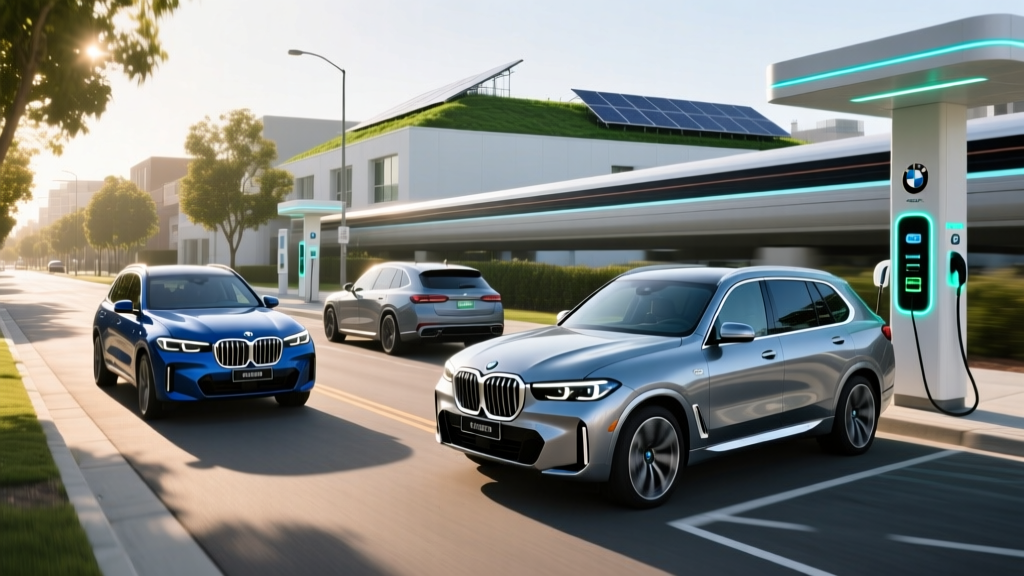
BMW's electrified lineup in 2026 leans heavily on plug-in hybrid (PHEV) technology rather than conventional hybrids. If you're researching a BMW car hybrid, you'll find that nearly every electrified BMW sold in the U.S. today is a plug-in hybrid — meaning it carries a larger battery you can charge from a wall outlet, delivers meaningful electric-only range, and then transitions seamlessly to a gas engine for longer trips. This guide breaks down the three core PHEV models — the 330e sedan, the 550e sedan, and the X5 xDrive50e SUV — with exact EPA numbers, real-world expectations, and ownership costs so you can decide which one fits your driving pattern.
HEV vs PHEV: Why BMW Went All-In on Plug-In Hybrids
A conventional hybrid (HEV) like a Toyota Prius uses a small battery charged only by regenerative braking and the gas engine. You never plug it in. A plug-in hybrid (PHEV) carries a much larger battery — typically 15 to 25 kWh in BMW's case — that you charge from a Level 2 home charger or public station. This gives you 30 to 40 miles of electric-only driving before the gas engine engages.
BMW discontinued its mild-hybrid-only U.S. offerings years ago. Every electrified BMW you can buy in 2026 is a PHEV. This matters for two reasons: you need access to a charging outlet (even a standard 120V household outlet works overnight), and PHEVs may qualify for federal tax credits that conventional hybrids do not.
2026 BMW PHEV Lineup: Side-by-Side Specs
| Specification | 330e Sedan | 550e xDrive Sedan | X5 xDrive50e SUV |
|---|---|---|---|
| Powertrain | 2.0L turbo I4 + electric motor | 3.0L turbo I6 + electric motor | 3.0L turbo I6 + electric motor |
| Combined Horsepower | 288 hp | 483 hp | 483 hp |
| Combined Torque | 310 lb-ft | 516 lb-ft | 516 lb-ft |
| Battery (usable kWh) | 19.5 kWh | 18.7 kWh | 25.7 kWh |
| EPA Electric-Only Range | ~22 mi | ~36 mi | ~38 mi |
| EPA Combined MPGe (EV mode) | 64 MPGe | 64 MPGe | 56 MPGe |
| EPA MPG (gas-only, combined) | 28 MPG | 27 MPG | 22 MPG |
| 0–60 mph | 5.6 sec | 4.1 sec | 4.6 sec |
| Drivetrain | RWD / xDrive (AWD) | xDrive (AWD) | xDrive (AWD) |
| DC Fast Charging | No | No | No |
| AC Level 2 Charge Rate | 3.7 kW | 7.4 kW | 7.4 kW |
| Level 2 Charge Time (0–100%) | ~5.3 hrs | ~2.5 hrs | ~3.5 hrs |
| Base MSRP | $47,875 | $72,575 | $74,575 |
Sources: fueleconomy.gov, BMW USA press materials. Specs reflect 2025/2026 model year EPA estimates. Real-world results will vary.
EPA MPG and Electric Range: The Numbers That Matter
The headline question for any BMW car hybrid buyer: how many MPG does it actually get? The answer depends on how you drive and how often you charge.
| Model | City MPG (gas) | Highway MPG (gas) | Combined MPG (gas) | Electric-Only Range | Total Range |
|---|---|---|---|---|---|
| 330e Sedan | 26 | 31 | 28 | 22 mi | ~420 mi |
| 550e xDrive | 25 | 29 | 27 | 36 mi | ~440 mi |
| X5 xDrive50e | 20 | 24 | 22 | 38 mi | ~460 mi |
Real-world MPG note: PHEVs reward city driving and frequent charging. If your commute is under 30 miles round-trip and you charge nightly, you may burn almost no gasoline for weeks. On a pure highway road trip with a depleted battery, expect the X5 xDrive50e to return roughly 20–22 MPG — comparable to a non-hybrid six-cylinder SUV. The 330e's lighter weight gives it a slight highway advantage at around 31 MPG gas-only.
Charging: Level 2 Only, No DC Fast Charging
None of BMW's 2026 PHEVs support DC fast charging. This is typical for the segment — the batteries are small enough that Level 2 AC charging fully replenishes them overnight or during a workday.
The 330e charges at a maximum of 3.7 kW on Level 2, which means a full 0–100% charge takes roughly 5.3 hours. The 550e and X5 xDrive50e both accept up to 7.4 kW, cutting full-charge times to 2.5 and 3.5 hours respectively. On a standard 120V household outlet (Level 1 at ~1.4 kW), expect a full charge to take 14–18 hours — feasible for overnight top-ups if your daily electric-only need is under 20 miles.
Practical tip: A 240V Level 2 home charger (like a BMW Wallbox or ChargePoint Home Flex on a 40-amp circuit) is the sweet spot. You'll arrive home, plug in, and wake up to a full battery every morning. Installation typically runs $500–$1,500 depending on your electrical panel's proximity to the garage.
Powertrain Deep Dive: What's Under the Hood
BMW pairs its turbocharged engines with an electric motor integrated directly into the ZF 8-speed automatic transmission. This means the electric motor drives the wheels through the same gearbox as the gas engine — no separate e-CVT or power-split device like you'd find in a Toyota hybrid.
330e: The 2.0-liter turbo four-cylinder produces 181 hp on its own. The electric motor adds 111 hp, for a combined system output of 288 hp and 310 lb-ft of torque. It's available in rear-wheel drive or xDrive all-wheel drive.
550e xDrive: The B58 3.0-liter turbocharged inline-six — one of the best engines BMW makes — contributes 312 hp. The electric motor adds 184 hp, bringing the combined total to 483 hp and 516 lb-ft. The result is a luxury sedan that hits 60 mph in 4.1 seconds while returning 36 miles of silent electric commuting.
X5 xDrive50e: Uses the same inline-six and motor combination as the 550e but tuned for the heavier SUV platform. The larger 25.7 kWh battery compensates for the X5's greater mass, preserving a 38-mile electric range. The 483 hp system output makes this one of the quickest midsize luxury SUVs on the market, despite its 5,400-pound curb weight.
Pricing, Tax Credits, and Total Cost
| Model | Base MSRP | Federal §30D Credit Eligibility | Est. After Credit |
|---|---|---|---|
| 330e Sedan | $47,875 | Up to $3,750 (partial credit — battery sourcing rules) | ~$44,125 |
| 550e xDrive | $72,575 | Up to $3,750 (sedan MSRP cap is $55,000 — 550e exceeds it; credit likely $0) | $72,575 |
| X5 xDrive50e | $74,575 | Up to $3,750 (SUV MSRP cap is $80,000 — qualifies on price) | ~$70,825 |
Federal tax credit caveats (IRS §30D, 2026 rules):
- The 330e sedan qualifies on MSRP (under the $55,000 sedan cap), but the credit amount depends on battery critical-mineral and component sourcing requirements. Many BMW PHEVs currently earn a partial $3,750 credit rather than the full $7,500.
- The 550e exceeds the $55,000 sedan MSRP cap and is therefore ineligible for the federal credit regardless of battery sourcing.
- The X5 xDrive50e falls under the $80,000 SUV/van/truck MSRP cap, making it eligible on price — but the same battery sourcing rules apply, limiting the credit to $3,750 in most cases.
- Buyer income caps apply: $150,000 single / $300,000 joint modified AGI.
- The credit can be transferred to the dealer at point of sale as an immediate purchase-price reduction.
- Always verify current eligibility at irs.gov before purchasing — rules change frequently.
Battery Warranty, Reliability, and Replacement Cost
BMW PHEV Battery Warranty: BMW covers the high-voltage battery for 8 years or 80,000 miles (whichever comes first), with a capacity-retention threshold of 70%. If the battery degrades below 70% of its original capacity within that window, BMW will repair or replace it at no cost.
Hybrid-specific component warranty: The electric motor, power electronics, and charging system are covered under the same 8-year/80,000-mile hybrid component warranty.
Out-of-warranty replacement cost: If you keep the vehicle beyond 8 years and the battery fails, a full high-voltage battery replacement for a BMW PHEV typically runs $8,000–$14,000 including parts and labor, depending on the model. Individual module replacement (BMW batteries are modular) can reduce this to $2,000–$5,000 if only one or two cells degrade.
On reliability, BMW's PHEV powertrains have proven durable in owner surveys. The B58 inline-six (in the 550e and X5) is widely regarded as one of the most reliable modern BMW engines. The electric motor and power electronics have fewer moving parts than a conventional transmission and rarely require service. Consumer Reports generally rates BMW PHEVs as average to above-average in predicted reliability, with most complaints centered on infotainment software rather than the hybrid system itself.
Who Should Buy a BMW PHEV — and Who Shouldn't
Choose a BMW PHEV if:
- You can charge at home (Level 2 preferred) and your daily commute is under 35 miles round-trip — you'll drive electric most days and use gas only for road trips.
- You want a luxury badge, sporty driving dynamics, and a premium interior without committing to full-EV range limitations.
- You frequently drive long distances or live in an area with sparse public charging infrastructure — the gas engine eliminates range anxiety entirely.
- You want to reduce fuel costs and emissions without changing your driving habits.
Choose a full EV (like the BMW iX or i4) instead if:
- You have reliable home charging and rarely drive more than 250 miles in a single day.
- You want zero tailpipe emissions and lower long-term maintenance (no oil changes, no spark plugs, fewer fluids).
- You want access to the full $7,500 federal tax credit (available on qualifying BEVs like the i4).
Choose a conventional gas car instead if:
- You cannot charge at home or at work and your daily driving exceeds 40 miles — a PHEV you never plug in is just a heavier, more expensive gas car.
- Upfront cost is your primary concern and you drive under 10,000 miles per year.
Pros
- 36–38 miles of electric range covers most commutes gas-free
- Seamless transition between electric and gas — no range anxiety
- Sporty driving dynamics and premium BMW interior
- X5 and 550e deliver 483 hp with inline-six smoothness
- 8-year/80,000-mile hybrid battery warranty
- X5 xDrive50e qualifies for partial federal tax credit
Cons
- No DC fast charging on any BMW PHEV
- 330e's 3.7 kW Level 2 rate is slow for the segment
- 550e sedan exceeds MSRP cap — no federal tax credit
- Electric range drops 20–30% in cold weather
- Cargo space reduced vs. non-hybrid variants (battery under rear seat/trunk)
- Out-of-warranty battery replacement can exceed $10,000
Frequently Asked Questions
How many MPG does a BMW hybrid get?
On gasoline alone (battery depleted), the 330e returns 28 MPG combined (26 city / 31 highway), the 550e returns 27 MPG combined, and the X5 xDrive50e returns 22 MPG combined. However, if you charge daily and commute under 35 miles, you may use little to no gasoline on most days, making your effective "MPG" far higher when measured over a month of mixed driving.
How far can a BMW PHEV go on electric only?
The 330e delivers about 22 miles of EPA-rated electric range, the 550e about 36 miles, and the X5 xDrive50e about 38 miles. In real-world conditions — especially in cold weather (below 40°F) or at sustained highway speeds above 70 mph — expect 20–30% less. That means the X5 might deliver 27–30 electric miles on a chilly winter morning.
Do BMW hybrids need to be plugged in?
Yes, to get the benefit. BMW's current U.S. lineup consists entirely of plug-in hybrids (PHEVs). You can drive them without ever plugging in — the gas engine and regenerative braking will keep the battery minimally charged — but you'll forfeit the electric-only range and essentially drive a heavier, more expensive conventional car. Plug in nightly to a Level 2 charger and you'll maximize fuel savings.
Does a BMW hybrid qualify for a tax credit?
It depends on the model and your income. Under current IRS §30D rules, the X5 xDrive50e (SUV, under $80,000 MSRP) qualifies for up to $3,750 in federal tax credit, subject to battery-sourcing requirements and buyer income limits ($150K single / $300K joint). The 330e sedan qualifies on price (under $55K cap) for a similar partial credit. The 550e sedan exceeds the sedan MSRP cap and is not eligible. Always confirm at irs.gov before purchasing.
Is the BMW hybrid battery reliable and what does replacement cost?
BMW's PHEV batteries are covered for 8 years or 80,000 miles against capacity loss below 70%. Real-world degradation data suggests these batteries retain 85–90% capacity after 5 years of normal use. Out-of-warranty replacement costs range from $8,000 to $14,000 for a full pack, but BMW's modular battery design allows individual module replacement for $2,000–$5,000 if only a portion degrades.
BMW PHEV vs. full EV — which should I choose?
If you have home charging and your daily driving stays under 250 miles, a full EV like the BMW i4 or iX offers lower running costs, less maintenance, and a larger federal tax credit. If you frequently take road trips exceeding 300 miles, live in an apartment without charging access, or simply want the safety net of a gas engine, a BMW PHEV is the pragmatic bridge between electric commuting and gasoline flexibility.