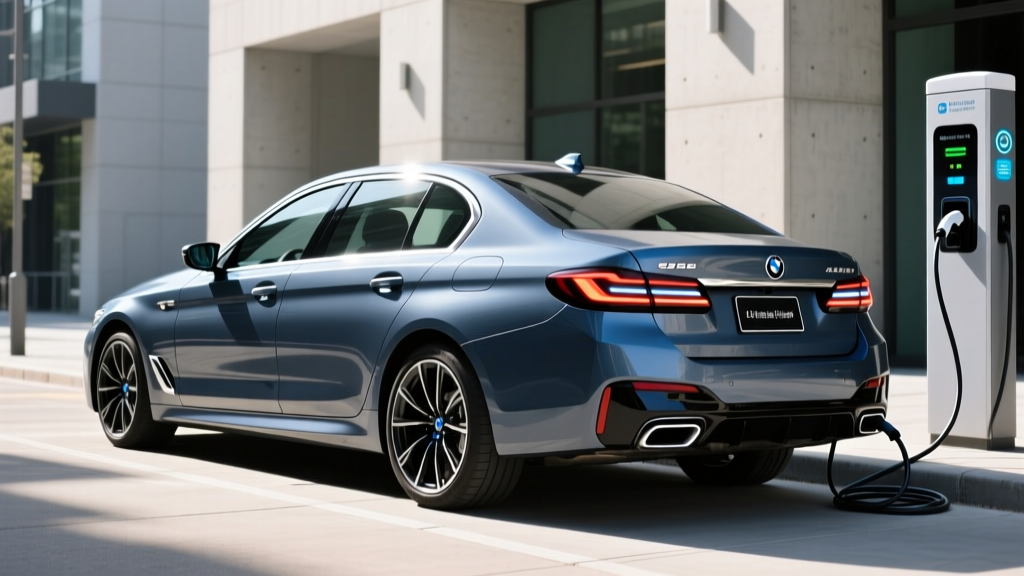
The BMW 5 Series has long been the benchmark executive sedan, and the 2026 BMW 550e xDrive plug-in hybrid (PHEV) tries to be two cars in one: a silent, zero-tailpipe-emission commuter for the daily grind, and a 483-horsepower sport sedan when you need it. For buyers searching for a BMW 5 plug-in hybrid, this sixth-generation G60 platform delivers meaningful electric-only range and genuine luxury — but with important caveats around charging speed, tax credit eligibility, and real-world efficiency that we'll break down with exact numbers.
This guide covers the 2026 BMW 550e xDrive PHEV specifically. BMW does not offer a conventional (non-plug-in) hybrid 5 Series in the US market for 2026 — the lineup is the gasoline 530i/540i, the fully electric i5, and the 550e plug-in hybrid. If you want hybrid efficiency without ever plugging in, you'll need to look at competitors like the Mercedes-Benz E 350 (which uses a mild-hybrid system, not a full HEV) or the Toyota Crown. For BMW buyers, the plug-in decision is the only hybrid path.
HEV vs PHEV vs EV: Where the BMW 550e Fits
Before diving into specs, let's establish what you're actually buying, because the terminology matters for ownership expectations:
| Feature | Conventional Hybrid (HEV) | Plug-in Hybrid (PHEV) | Battery Electric (BEV) |
|---|---|---|---|
| Plugs in? | No — self-charging via regen + engine | Yes — has a charge port | Yes — charge port only |
| Electric-only driving | Minimal (1-2 mi at low speed) | 20-40 mi typical | 250-400+ mi |
| Gas engine | Always available, seamlessly blends | Always available as backup | None |
| Tailpipe emissions | Reduced vs gas-only | Zero in EV mode; emits when engine runs | Zero at tailpipe |
| Range anxiety | None — gas station refuel | None — gas engine backs up | Requires route/charger planning on long trips |
| Example | Toyota Crown, Lexus ES 300h | BMW 550e xDrive | BMW i5 eDrive40 |
The BMW 550e is a PHEV. You get a usable battery you charge via a plug (Level 1 or Level 2 — no DC fast charging), plus a gasoline engine that kicks in when the battery depletes or when you demand full power. This means your 25-mile commute can be fully electric if you charge at home, while a 500-mile road trip proceeds exactly like any gas car — stop for fuel in five minutes and go.
Powertrain, Performance & Efficiency Specs
| Powertrain | 3.0L turbocharged inline-6 + electric motor (8-speed auto, AWD) |
| Combined Horsepower | 483 hp |
| Combined Torque | 516 lb-ft |
| 0-60 mph | 4.1 seconds (BMW est.) |
| Battery (gross / usable) | 19.5 kWh gross / ~16.3 kWh usable (NMC chemistry) |
| EPA Electric-Only Range | 29 miles |
| Total Combined Range (EV + gas) | ~380 miles |
| EPA MPGe (EV mode) | 64 MPGe combined |
| EPA MPG (charge-sustaining / gas only) | 27 city / 31 highway / 29 combined |
| Fuel Tank | 15.8 gallons (premium required) |
| Max AC Charge Rate (Level 2) | 7.4 kW |
| DC Fast Charging | Not available |
| Charge Time (Level 2, 0-100%) | ~2 hours 45 minutes |
| Charge Time (Level 1, 120V, 0-100%) | ~10-12 hours |
| Charge Port / Connector | J1772 (Level 2); no CCS/NACS (no DC capability) |
| Curb Weight | ~5,050 lbs |
| Cargo Volume | 17.5 cu ft (trunk; no frunk) |
| Base MSRP | $72,575 (including $995 destination) |
That inline-six paired with an electric motor integrated into the transmission produces a combined 483 horsepower — more than the gas-only 540i xDrive (375 hp) and approaching the old V8 M550i territory. The smoothness of the I-6 under electric assist is one of this car's defining characteristics. You get seamless torque fill from the electric motor at low RPM, and the engine only fires up when you push past roughly 50% throttle or when the battery depletes.
Electric-Only Range & Real-World Efficiency
EPA Electric Range: 29 miles
Real-World Expectation: 22-27 miles in mixed driving; as low as 18-20 miles in freezing weather or sustained highway speeds above 70 mph; up to 29-31 miles in mild-weather city driving under 45 mph.
The 29-mile EPA electric range is competitive among luxury PHEV sedans. The Mercedes-Benz E 350e (not sold in the US for 2026) would offer more, but in the American market, the BMW 550e competes most directly with the Volvo S90 Recharge (38 miles EV range) and the Lexus ES 300h (which is a conventional HEV with no plug-in capability).
Why does real-world electric range fall short of the EPA sticker? Three factors:
- Highway speeds: PHEVs are optimized for city driving. At 75 mph, aerodynamic drag consumes energy roughly 2.5x faster than at 45 mph, cutting your electric range to 20-22 miles.
- Cold weather: Below 40°F, the battery's internal resistance increases and cabin heating draws from the battery. Expect a 25-35% range reduction in winter, bringing electric-only range to 18-22 miles.
- Climate control: Running A/C or heat at maximum pulls 1-3 kW continuously, which meaningfully reduces a 16.3 kWh usable battery.
Once the battery depletes, the 3.0L inline-six operates as a conventional hybrid in "charge-sustaining" mode. The EPA rates this at 29 MPG combined (27 city / 31 highway). In real-world testing, PHEVs in charge-sustaining mode often match or slightly exceed their EPA highway rating on flat terrain but fall 1-3 MPG short in city driving when the engine must both propel the car and manage battery state of charge. Expect 26-30 MPG combined in gas-only operation — strong for a 5,000-lb luxury sedan, but not Toyota Prius territory.
| Mode | City | Highway | Combined |
|---|---|---|---|
| Electric Only (MPGe) | 71 MPGe | 58 MPGe | 64 MPGe |
| Gas Only (charge-sustaining, MPG) | 27 MPG | 31 MPG | 29 MPG |
Charging: What You Need to Know
The BMW 550e charges exclusively via AC power — there is no DC fast charging capability. This is a deliberate engineering choice: the 19.5 kWh battery is small enough that a Level 2 home charger replenishes it in under three hours, making DC fast charging infrastructure unnecessary for most owners.
| Level | Voltage | Max Power (kW) | 0-100% Time | Cost to Install |
|---|---|---|---|---|
| Level 1 (included cordset) | 120V | ~1.4 kW | 10-12 hours | $0 (standard outlet) |
| Level 2 (home wall connector) | 240V | 7.4 kW | ~2 hr 45 min | $500-$1,800 (equipment + electrician) |
| DC Fast Charge | N/A | N/A | N/A | Not supported |
For daily use, most owners will plug in overnight on a Level 2 home charger (BMW offers the Wallbox, or any J1772-compatible unit works) and wake up to a full battery every morning. At 7.4 kW, the onboard charger is adequate — you'll recover roughly 15 miles of electric range per hour of charging. If you only have access to a standard 120V outlet, Level 1 charging will fully replenish the battery overnight, which is sufficient for a 29-mile-range PHEV.
Key limitation: On road trips, you cannot top up the battery at DC fast chargers along the highway. Once the battery depletes, you're running on gasoline until you reach a destination with AC charging. This is the trade-off of a PHEV without DC capability — but given the small battery size and 380-mile total range, it rarely matters in practice.
Pricing, Trims & Federal Tax Credit Eligibility
The 2026 BMW 550e xDrive starts at $72,575 (including destination). There is effectively one trim level — BMW packages most features standard, with options for packages like the Premium Package, Executive Package, and M Sport Package that can push the price above $85,000.
§30D Federal Tax Credit Eligibility (2026 Rules):
- Maximum credit: Up to $7,500 ($3,750 for critical minerals + $3,750 for battery components)
- MSRP cap for sedans: $55,000 — the 550e at $72,575 EXCEEDS this cap and does NOT qualify for the new-vehicle §30D credit
- Buyer income limits: $150K single / $225K head of household / $300K joint (MAGI)
- Battery sourcing: Critical minerals and component sourcing requirements from US/FTA partners
- Point-of-sale transfer: Available for eligible vehicles — but inapplicable here due to MSRP cap
Source: IRS §30D Clean Vehicle Credit. Rules are subject to change; consult a tax professional for your specific situation.
This is the critical point many buyers miss: the §30D new-vehicle tax credit has a $55,000 MSRP cap for sedans (SUVs and trucks have an $80,000 cap). Because the BMW 550e is classified as a sedan and starts at $72,575, it does not qualify for the federal purchase credit regardless of your income or the battery's sourcing. Some state-level incentives (like those in California, Colorado, or New York) may still apply — check your state's energy office or AFDC incentive database for current local programs.
One potential workaround: the used EV tax credit (§25E) offers up to $4,000 (30% of sale price, capped) for qualifying pre-owned plug-in vehicles sold for $25,000 or less. However, a 550e is unlikely to depreciate to $25,000 within the foreseeable future, so this path is impractical for this model.
Reliability, Battery Warranty & Long-Term Costs
BMW PHEV Battery & Powertrain Warranty:
- High-voltage battery: 8 years / 80,000 miles (capacity retention threshold: 70% of original capacity)
- Powertrain (engine + transmission + motor): 4 years / 50,000 miles
- Limited vehicle warranty: 4 years / 50,000 miles
- Complimentary maintenance: 3 years / 36,000 miles
BMW's high-voltage battery warranty aligns with the federal minimum mandated by the EPA and CARB states — 8 years / 80,000 miles with coverage if capacity drops below 70%. In practice, BMW's NMC batteries in the current-generation PHEVs have shown moderate degradation of roughly 5-8% over the first 5 years / 60,000 miles based on owner fleet data, well within the warranty threshold.
Battery replacement cost: If the high-voltage battery requires replacement out of warranty, expect a cost between $8,000 and $14,000 (parts and labor) at a BMW dealership. This is significantly less than a full BEV battery replacement because the PHEV battery is roughly 19.5 kWh versus 80-100+ kWh in a full EV. Individual module replacement may be possible at lower cost if only specific cells degrade.
On reliability broadly: BMW's inline-six engines (the B58 family used in the 550e) are among the most reliable in the luxury segment, with a strong track record since their 2015 introduction. The ZF 8-speed automatic transmission is similarly well-proven. The primary risk areas for long-term ownership are the complexity of the combined powertrain — two power sources, additional cooling circuits, and power electronics — which means more potential failure points than a conventional gas car or a pure EV. Extended warranty coverage is worth considering if you plan to keep the vehicle past 60,000 miles.
Who Should Buy the BMW 550e PHEV?
Choose the BMW 550e PHEV if:
- Your daily commute is under 30 miles round-trip and you can charge at home — you'll drive electric most weekdays
- You take regular road trips (300+ miles) and don't want to plan around DC chargers
- You want luxury sedan refinement with serious passing power (483 hp)
- You live in an area with unreliable public charging infrastructure — the gas engine is your backup
- Your company offers a home-charging stipend or you have access to workplace Level 2 charging
Choose a full EV (like the BMW i5) instead if:
- You can charge at home and your longest regular trip is under 250 miles
- You want to eliminate gasoline purchases and oil changes entirely
- You want access to HOV lane stickers (available in many states for BEVs, sometimes restricted for PHEVs)
- You want lower per-mile "fuel" costs — electricity at $0.14/kWh costs roughly $0.04/mile vs. $0.15/mile for premium gas at 29 MPG
Choose a conventional hybrid (like the Lexus ES 300h) instead if:
- You cannot install a home charger (apartment, street parking, no garage)
- You want hybrid efficiency with zero behavioral change — no plugging in, no charge management
- Your budget is under $50,000
Pros
- 29-mile EV range covers most daily commutes emission-free
- 483 hp combined with I-6 smoothness — genuinely quick and refined
- No range anxiety — 380-mile total range with gas-station refueling
- Quiet electric city driving with regenerative braking
- Strong build quality, excellent infotainment (iDrive 8.5), premium materials
Cons
- $72,575 MSRP exceeds the §30D sedan cap — no federal tax credit
- No DC fast charging — battery tops up only via AC
- 29-mile EV range is less than some competitors (Volvo S90 Recharge: 38 mi)
- Premium gasoline required in charge-sustaining mode adds cost
- Heavier than gas-only 5 Series (~5,050 lbs) affects tire wear and braking
Frequently Asked Questions
How many MPG does the BMW 550e plug-in hybrid get?
The EPA rates the 2026 BMW 550e xDrive at 64 MPGe combined when operating in electric mode, and 29 MPG combined (27 city / 31 highway) when the battery is depleted and the gasoline engine is running. Real-world results depend heavily on how often you charge — if you plug in nightly and commute under 29 miles, your effective fuel economy can exceed 100 MPGe because you rarely use gasoline.
How far can the BMW 550e go on electric only?
The EPA-rated electric-only range is 29 miles. In real-world conditions, expect 22-27 miles in mixed driving, as low as 18-20 miles in freezing weather or at sustained highway speeds, and up to 31 miles in mild-weather city driving. Once depleted, the gasoline engine takes over seamlessly.
Does the BMW 550e qualify for the $7,500 federal tax credit?
No. The §30D federal clean vehicle credit has a $55,000 MSRP cap for sedans, and the 550e starts at $72,575. It does not qualify regardless of buyer income or battery sourcing. State-level incentives may still apply — check your state's energy office or the AFDC state incentive database.
Is the BMW 550e reliable, and what does battery replacement cost?
BMW's B58 inline-six is one of the most reliable engines in the luxury segment, and the high-voltage battery is warrantied for 8 years / 80,000 miles (70% capacity retention). Out-of-warranty battery replacement runs $8,000-$14,000. The main long-term concern is powertrain complexity — two power sources mean more potential failure points than a pure gas car or pure EV.
Can the BMW 550e use DC fast chargers?
No. The 550e supports only AC charging — Level 1 (120V, ~1.4 kW) and Level 2 (240V, up to 7.4 kW). A full charge on Level 2 takes approximately 2 hours 45 minutes. This is adequate for home and workplace charging but means you cannot top up the battery at highway DC fast-charging stations.
How does the BMW 550e compare to the fully electric BMW i5?
The EPA-rated BMW i5 eDrive40 offers 295 miles of range, 335 hp, and starts at $67,875. It qualifies for more of the tax credit discussion (though it too exceeds the $55K sedan cap). The i5 eliminates gasoline entirely but requires DC fast-charging access for road trips. The 550e offers more power (483 hp), shorter electric range (29 mi), and no road-trip charging anxiety. Choose the i5 if you charge at home and rarely drive 300+ miles in a day; choose the 550e if you need unlimited range flexibility.
Do I need to charge the BMW 550e every day?
You don't need to, but you should if you want to maximize electric driving. The 19.5 kWh battery fully replenishes in under 3 hours on a Level 2 charger, so nightly plug-in is effortless. If you skip charging, the car simply operates as a 29 MPG hybrid — you lose the efficiency and cost benefits of electric mode but the car functions normally.