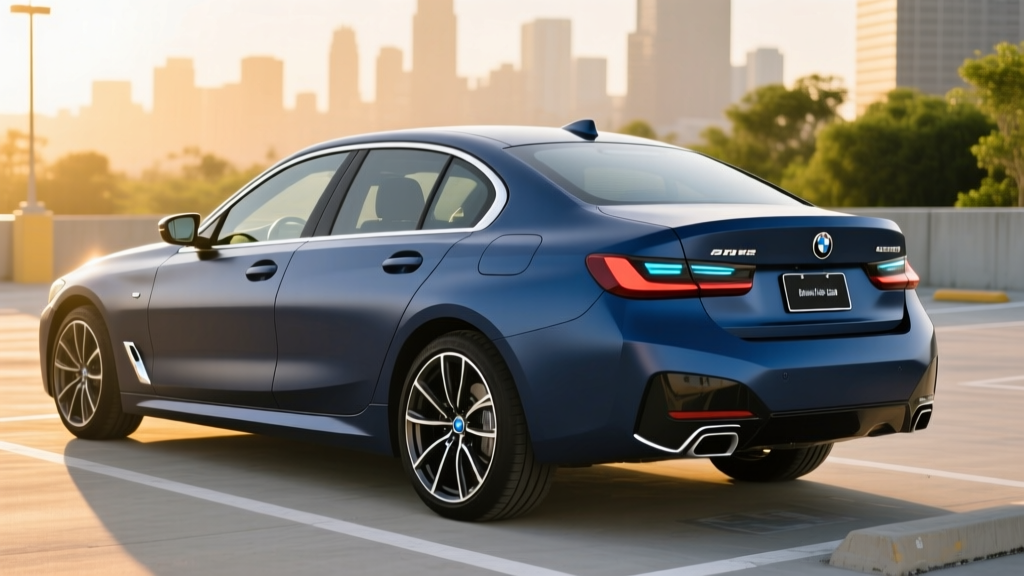
The BMW 330e PHEV at a Glance
The BMW 330e occupies a narrow lane in the luxury compact-sedan segment: a plug-in hybrid that lets you commute on electricity while retaining a turbocharged four-cylinder for road trips. For the 2026 model year, the 330e sedan pairs a 2.0-liter turbo engine with an electric motor integrated into the eight-speed automatic transmission, delivering a combined 292 horsepower and an EPA-estimated 22 miles of electric-only range.
If you're cross-shopping the BMW 330e sedan plug-in hybrid against the Tesla Model 3, the Toyota Prius Prime, or the conventional BMW 330i, this guide breaks down every number that matters — from real-world MPG to battery warranty to federal tax credit eligibility under current IRS §30D rules.
| Specification | 2026 BMW 330e Sedan (RWD) | 2026 BMW 330e xDrive Sedan |
|---|---|---|
| Combined Horsepower | 292 hp / 310 lb-ft | 292 hp / 310 lb-ft |
| Engine | 2.0L Turbo I4 (184 hp) + Electric Motor (113 hp) | 2.0L Turbo I4 + Electric Motor |
| Battery (Gross / Usable) | 19.5 kWh / ~17.1 kWh | 19.5 kWh / ~17.1 kWh |
| EPA Electric-Only Range | 22 miles | 20 miles |
| EPA MPGe (EV Mode) | 75 MPGe | 69 MPGe |
| EPA MPG (Gas, Combined) | 28 MPG (25 city / 33 hwy) | 27 MPG (24 city / 32 hwy) |
| Total Combined Range | ~420 miles | ~400 miles |
| 0–60 mph | 5.6 seconds | 5.4 seconds |
| Level 2 Charge Time (0–100%) | ~3.2 hours (at 3.7 kW) | ~3.2 hours |
| DC Fast Charging | Not available | Not available |
| Starting MSRP | $46,575 | $48,575 |
| Federal Tax Credit (§30D) | Up to $3,750 (see eligibility) | Up to $3,750 |
HEV vs PHEV: What's the Difference and Why It Matters
Before evaluating the 330e specifically, it's worth clarifying the hybrid landscape, because the distinction between a conventional hybrid (HEV) and a plug-in hybrid (PHEV) fundamentally changes how you own the car.
| Feature | Conventional Hybrid (HEV) | Plug-In Hybrid (PHEV) |
|---|---|---|
| Battery Size | ~1–2 kWh | ~10–25 kWh |
| Electric-Only Range | 0–1 mile at low speed | 15–45 miles typically |
| Plug In to Charge? | No — regenerates via braking/engine | Yes — plugs into Level 1 or Level 2 |
| Gas Engine | Always available | Always available after EV range depletes |
| Federal Tax Credit | None | Potentially up to $7,500 (§30D) |
| Example | Toyota Camry Hybrid | BMW 330e, Toyota RAV4 Prime |
The BMW 330e is a PHEV. You plug it in overnight, drive 20-ish miles on electricity alone, and then the gasoline engine takes over seamlessly. If you never plug it in, it still functions as a heavy hybrid — but you'll sacrifice the efficiency advantage and the whole point of the powertrain.
Electric-Only Range and Real-World Efficiency
The EPA rates the rear-wheel-drive 2026 BMW 330e at 22 miles of electric-only range. The xDrive all-wheel-drive variant drops to 20 miles due to additional drivetrain mass and friction.
For context, the 330e's 19.5 kWh gross battery (~17.1 kWh usable) is modest compared to PHEV SUVs like the RAV4 Prime (18.1 kWh usable, 42 miles of range). BMW prioritized packaging and weight distribution in the 3 Series chassis over maximizing EV range. If your commute is 15 miles or fewer each way, you'll rarely burn gasoline on weekdays.
How Many MPG Does the BMW 330e Get?
| Driving Mode | EPA Estimate | Real-World Expectation |
|---|---|---|
| Electric Only (MPGe) | 75 MPGe (RWD) / 69 MPGe (xDrive) | 60–80 MPGe depending on climate |
| Gas Only — City | 25 MPG | 26–30 MPG (hybrid regen helps in stop-and-go) |
| Gas Only — Highway | 33 MPG | 28–31 MPG at 70–80 mph |
| Gas Only — Combined | 28 MPG | 27–30 MPG mixed |
A key PHEV ownership insight: hybrids often exceed their EPA city MPG in real-world stop-and-go driving because regenerative braking recaptures energy that a gas car wastes as heat. On the highway, however, the 330e carries roughly 400 pounds of battery mass that works against efficiency once the electric range is depleted. Your blended MPG will vary dramatically based on how often you charge.
Charging: Level 1, Level 2, and the No-DC-Fast-Charge Reality
The 2026 BMW 330e supports Level 1 (120V household outlet) and Level 2 (240V) AC charging. It does not support DC fast charging — a deliberate engineering decision shared with most PHEVs in this class. The onboard charger maxes out at 3.7 kW.
| Charging Level | Power | 0–100% Time | Practical Notes |
|---|---|---|---|
| Level 1 (120V) | ~1.4 kW | ~12 hours | Emergency/trickle only; fine for overnight if battery is partially depleted |
| Level 2 (240V, 16A) | 3.7 kW | ~3.2 hours | Standard home wallbox or public Level 2; full charge while you work or sleep |
| DC Fast Charge | N/A | N/A | Not supported — PHEV battery too small to justify DC hardware cost/weight |
Because the battery is small (~17 kWh usable), a Level 2 home charger replenishes it in just over three hours. Most owners plug in overnight and wake up to a full charge every morning. The lack of DC fast charging is irrelevant for daily use — you'd only notice it on a road trip, where the gas engine handles long distances anyway.
Home charging setup: A 240V NEMA 14-50 outlet installation typically costs $300–$800 if your electrical panel has capacity. A hardwired Level 2 wallbox (like a ChargePoint Home Flex or BMW's own Wallbox) adds $400–$700 for the unit. For a PHEV with a 3.7 kW onboard charger, even a basic $300 Level 2 EVSE is sufficient.
Powertrain and Performance: 292 HP With Seamless Transitions
The 330e's powertrain is where BMW's engineering pedigree shows. The 2.0-liter turbocharged inline-four produces 184 horsepower on its own, while the electric motor — sandwiched between the engine and the ZF eight-speed automatic — contributes up to 113 horsepower. Combined system output is 292 horsepower and 310 lb-ft of torque, with an "XtraBoost" function that temporarily unlocks the motor's full output under hard acceleration.
The result is a 0–60 mph time of 5.6 seconds (RWD) or 5.4 seconds (xDrive) — roughly a full second quicker than the gas-only 330i. More importantly, the electric motor fills in the torque gap at low RPM before the turbo spools, making the 330e feel punchy and responsive in daily driving.
BMI's hybrid-specific driving modes include:
- Electric: Pure EV driving up to ~87 mph (forced engine start above that or under heavy throttle)
- Hybrid: Default mode — the car optimizes gas/electric blending based on navigation and driving conditions
- Battery Control: Sets a target state of charge (e.g., 80%) so the engine preserves battery for a planned zero-emission zone later in your route
The Battery Control feature is underrated: if you're driving 50 miles to a city with an emissions-restricted zone, you can tell the car to save its electric range for the final urban stretch. Few competitors offer this level of energy management granularity.
Pricing, Trims, and Federal Tax Credit Eligibility
The 2026 BMW 330e sedan starts at $46,575 (including destination) for the rear-wheel-drive model. The xDrive all-wheel-drive variant adds $2,000, bringing the entry point to $48,575. For comparison, the gas-only 330i starts at $44,450, making the PHEV premium roughly $2,125 before any incentives.
Popular option packages can push a well-equipped 330e past $55,000:
- Premium Package (heated seats, heated steering wheel, head-up display): ~$2,800
- Executive Package (parking assist, adaptive LED headlights): ~$1,900
- M Sport Package (sport suspension, aerodynamic kit, 19" wheels): ~$3,500
- Driving Assistance Professional (adaptive cruise, lane-keeping — Level 2 ADAS): ~$1,700
Does the BMW 330e Qualify for a Federal Tax Credit?
Federal §30D Clean Vehicle Credit — Current Rules (2026):
The BMW 330e is a plug-in hybrid, and PHEVs can qualify for a partial federal tax credit. Under current IRS §30D rules, the credit amount depends on battery capacity and critical-mineral/battery-component sourcing requirements. The 330e's 19.5 kWh battery typically qualifies for a credit of up to $3,750, not the full $7,500, because it meets some but not all sourcing thresholds.
- MSRP Cap: Sedans must have an MSRP at or below $55,000. A base 330e qualifies; a heavily optioned one may exceed the cap and lose eligibility entirely.
- Income Cap: Modified adjusted gross income must not exceed $150,000 (single), $225,000 (head of household), or $300,000 (married filing jointly).
- Point-of-Sale Transfer: As of 2024, you can transfer the credit to the dealer at purchase, reducing your out-of-pocket cost immediately rather than waiting for a tax refund.
- Assembly: The 330e sold in the U.S. is assembled in Germany, which does not disqualify it from §30D (the North American final-assembly requirement applies only to the separate commercial clean vehicle credit under §45W for leases — leased 330e vehicles may qualify under different rules).
Tax credit rules change frequently. Consult a tax professional and verify current eligibility on irs.gov before purchasing.
Battery Warranty, Reliability, and Replacement Cost
- High-Voltage Battery: 8 years / 80,000 miles (whichever comes first), covering defects and capacity loss below 70% of original capacity
- Powertrain (engine + electric motor + transmission): 4 years / 50,000 miles
- Limited Vehicle Warranty: 4 years / 50,000 miles
- Complimentary Maintenance: 3 years / 36,000 miles
Is the BMW 330e Reliable?
BMW's PHEV powertrain has been in production since the F30-generation 330e (2016), and the current G20-generation system is its second major iteration. The high-voltage battery uses NMC (nickel manganese cobalt) lithium-ion cells with active liquid thermal management — the same chemistry and cooling approach used in BMW's i4 and iX EVs. This thermal management is critical for longevity: it prevents the extreme heat and cold exposure that accelerates degradation.
Based on data from earlier-generation 330e models and BMW's broader PHEV fleet, high-voltage battery degradation is typically modest — around 5–10% capacity loss over the first 5 years / 60,000 miles. The 8-year/80,000-mile warranty with a 70% capacity retention threshold provides a solid backstop. If the battery does fall below that threshold within warranty, BMW replaces or reconditions it at no cost.
What Does a BMW 330e Battery Replacement Cost?
Out-of-warranty high-voltage battery replacement for the 330e is estimated at $8,000–$12,000 (parts and labor), based on BMW dealer pricing for the G20-generation pack. This is less expensive than a full EV battery replacement (often $15,000–$25,000) because the 330e's pack is much smaller. However, it's a cost to factor in if you plan to keep the car past the 8-year warranty window. Individual cell module replacement (rather than the full pack) may be possible and less costly, depending on the failure mode.
For reliability context, IIHS crash-test ratings and owner-survey data from sources like Consumer Reports should be consulted for the latest model-year scores, as BMW's reliability rankings have historically been mid-pack among luxury brands.
BMW 330e vs the Competition: Where It Fits
The 330e doesn't have many direct rivals in the luxury compact PHEV sedan space. Here's how it stacks up against the most common cross-shops:
| Vehicle | Type | EV Range | Combined MPG / MPGe | HP | Starting MSRP |
|---|---|---|---|---|---|
| BMW 330e (RWD) | PHEV | 22 mi | 28 MPG / 75 MPGe | 292 | $46,575 |
| Mercedes-Benz C 350e (if available) | PHEV | ~30 mi (est.) | ~30 MPG / ~80 MPGe | ~315 | ~$58,000 |
| Tesla Model 3 Long Range | BEV | 341 mi (EPA) | 132 MPGe | 346 | $42,630 |
| Toyota Prius Prime XSE | PHEV | 39 mi | 48 MPG / 114 MPGe | 220 | $36,695 |
| BMW 330i (gas) | Gas | 0 mi | 29 MPG | 255 | $44,450 |
The 330e trades electric range for driving dynamics. The Prius Prime offers nearly double the EV range at $10,000 less but can't match the BMW's chassis, materials, or badge. The Tesla Model 3 eliminates gasoline entirely with 341 miles of range but requires a lifestyle built around charging. The conventional 330i is cheaper and lighter but offers no electric commuting capability.
Pros
- 292 hp with instant electric torque — quicker than the 330i
- Silent, zero-emission commuting for 18–22 miles
- Class-leading driving dynamics and steering feel
- No range anxiety — gas engine covers long trips
- Battery Control mode for strategic energy management
- Partial federal tax credit (~$3,750)
- 8-year/80,000-mile high-voltage battery warranty
Cons
- Only 22 miles of EV range — less than most PHEV competitors
- No DC fast charging
- Trunk space reduced by ~4 cu ft due to battery placement
- MSRP cap risk: optioned above $55K, you lose the tax credit
- Heavier than the 330i (~400 lbs of battery/motor mass)
- Premium fuel recommended for the 2.0L turbo
- Out-of-warranty battery replacement: $8K–$12K
Who Should Buy the BMW 330e — and Who Shouldn't
Choose the BMW 330e PHEV if:
- Your round-trip commute is 20 miles or fewer and you can charge at home nightly
- You want a luxury sport sedan but need the flexibility for frequent road trips without charging-planning headaches
- You value BMW's driving dynamics and interior quality over maximum electric range
- You live in an area with limited DC fast-charging infrastructure
- You want to reduce your gasoline consumption without going fully electric
Choose a Full EV (Tesla Model 3, BMW i4) if:
- You have reliable home charging and your daily driving is under 250 miles
- You want zero tailpipe emissions and minimal maintenance (no oil changes, no spark plugs)
- You want access to the full $7,500 federal tax credit (subject to eligibility)
- You're ready to plan road trips around charging stops
Choose a Conventional Hybrid (HEV) or Gas Car if:
- You cannot charge at home or at work — a PHEV's advantage disappears without plugging in
- Your budget is tighter and you want lower upfront cost (consider a Toyota Camry Hybrid or the gas 330i)
- You prioritize trunk space and lower vehicle weight over electric commuting
Frequently Asked Questions
How far can the BMW 330e go on electric only?
The EPA rates the 2026 BMW 330e at 22 miles of electric-only range (RWD) or 20 miles (xDrive). In real-world conditions, expect 18–22 miles in mild weather and 13–17 miles in cold weather. The electric motor can propel the car up to approximately 87 mph before the engine is forced to engage.
How many MPG does the BMW 330e get on gasoline?
Once the battery is depleted, the EPA estimates 28 MPG combined (25 city / 33 highway) for the RWD model. In real-world city driving, regenerative braking often pushes actual city MPG to 26–30. Highway driving at sustained speeds typically yields 28–31 MPG.
Does the BMW 330e qualify for a federal tax credit?
Yes, partially. Under current IRS §30D rules, the 330e qualifies for up to $3,750 in federal tax credit, subject to buyer income caps ($150K single / $300K married) and the $55,000 MSRP cap for sedans. The credit can be transferred to the dealer at point of sale. Always verify eligibility with a tax professional before purchase, as sourcing requirements change.
Do I have to plug in the BMW 330e?
You don't have to, but you should. The 330e is a plug-in hybrid — it will operate as a conventional hybrid if you never charge it, but you'll miss the entire efficiency and cost-saving benefit. If you can't plug in at home or work, a conventional hybrid (HEV) like the BMW 330i with a mild-hybrid system or a Toyota Camry Hybrid is a better fit.
How long does the BMW 330e battery last?
BMW warranties the high-voltage battery for 8 years or 80,000 miles against defects and capacity loss below 70%. Based on data from BMW's PHEV fleet, most owners experience 5–10% degradation over the first 5 years. With proper thermal management (which the 330e has), the battery should remain functional well beyond the warranty period, though with gradually reduced EV range.
What is the total driving range of the BMW 330e?
With a full battery and a full tank of gasoline, the RWD 330e can travel approximately 420 miles total (22 miles electric + ~398 miles on gas). The xDrive variant achieves roughly 400 miles combined. This eliminates the range anxiety that some EV buyers experience on long road trips.
Can the BMW 330e use DC fast chargers?
No. The 330e only supports AC charging — Level 1 (120V, ~1.4 kW) and Level 2 (240V, up to 3.7 kW). A full Level 2 charge takes about 3.2 hours. This is standard for PHEVs; the small battery doesn't benefit from DC fast-charging hardware, which would add weight and cost.
Is the BMW 330e better than the Tesla Model 3?
They serve different needs. The Model 3 Long Range offers 341 miles of all-electric range, lower running costs, and access to the Supercharger network — but requires a charging-centric lifestyle. The 330e gives you 22 miles of electric commuting with the freedom of a gas engine for road trips, plus BMW's interior quality and driving dynamics. If you can charge at home and rarely drive over 250 miles in a day, the Model 3 is more economical. If you road-trip frequently or lack reliable charging, the 330e is the safer choice.
Sources: EPA fuel economy data via fueleconomy.gov, BMW USA official specifications, IRS §30D Clean Vehicle Credit guidelines. All specifications reflect 2026 model year data available at time of publication. Verify current pricing and tax credit eligibility before purchase.