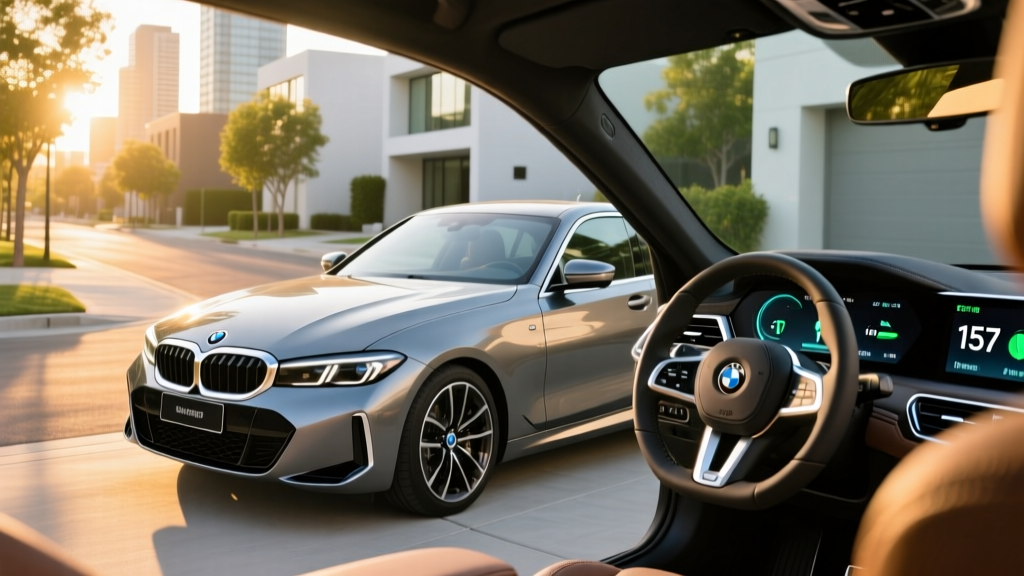
The BMW 3 Series has long been the benchmark sport sedan, and the plug-in hybrid variant — the BMW 330e — threads a specific needle: genuine electric-only commuting paired with a turbocharged gas engine for road trips, all wrapped in a chassis that actually rewards the driver. For 2026, the 330e sedan continues as BMW's most accessible entry into electrified luxury, competing against the Mercedes-Benz C 300e (not sold in the US) and positioned below the all-electric i4.
This guide covers the 2026 BMW 330e sedan hybrid in detail — its PHEV powertrain, real-world efficiency, charging practicality, ownership costs, and whether it's the right bridge for buyers not yet ready to go fully electric.
HEV vs PHEV: What the BMW 330e Actually Is
Before diving into specs, it's essential to distinguish the two hybrid categories, because the 330e sits firmly in one of them.
Conventional Hybrid (HEV)
A standard hybrid like the Toyota Prius uses a small battery (1–2 kWh) recharged solely by regenerative braking and the gas engine. You never plug it in. Electric-only driving is limited to very low speeds and short distances. The benefit is improved MPG with zero behavior change.
Plug-In Hybrid (PHEV) — The 330e
The BMW 330e is a plug-in hybrid. It carries a much larger battery pack (19.5 kWh gross, approximately 17.1 kWh usable) that you charge via a plug — either at home on a Level 2 charger or on a standard 120V outlet. This gives it a meaningful electric-only range (EPA-rated at 22 miles) before the 2.0-liter turbo four-cylinder engine engages. Once the battery depletes, it operates like a conventional hybrid.
The practical upshot: if your daily commute is under 20 miles round-trip and you can charge at home, you may burn almost no gasoline on weekdays. For weekend road trips, the gas engine eliminates any range anxiety — total combined range exceeds 350 miles.
Powertrain Specs and Performance
The 2026 BMW 330e pairs a 2.0-liter turbocharged inline-four with an electric motor integrated into the 8-speed Steptronic automatic transmission. Combined output is 288 horsepower and 310 lb-ft of torque, with a 0–60 mph time of 5.6 seconds — brisk enough to feel properly BMW-like when merging onto a freeway.
| Specification | Value |
|---|---|
| Powertrain | 2.0L turbo I4 + electric motor (PHEV) |
| Combined Horsepower | 288 hp |
| Combined Torque | 310 lb-ft |
| Transmission | 8-speed automatic (Steptronic) |
| Drivetrain | RWD (xDrive AWD available) |
| Battery (Gross / Usable) | 19.5 kWh / ~17.1 kWh |
| Battery Chemistry | NMC (nickel manganese cobalt) |
| EPA Electric-Only Range | 22 miles (RWD) |
| EPA Combined MPGe (EV mode) | 75 MPGe |
| EPA MPG (charge-sustaining / hybrid mode) | 28 city / 34 hwy / 30 combined |
| Total Combined Range | ~350 miles |
| 0–60 mph | 5.6 seconds |
| AC Charging (Level 2, max) | 3.7 kW |
| DC Fast Charging | Not available |
| Level 1 (120V) Charge Time | ~12 hours (0–100%) |
| Level 2 (240V) Charge Time | ~5 hours (0–100%) |
| Base MSRP (330e RWD) | $46,900 |
| Base MSRP (330e xDrive AWD) | $48,900 |
| Battery Warranty | 8 years / 80,000 miles |
One important note: the 330e does not support DC fast charging. This is typical for PHEVs in this class — the battery is small enough that Level 2 AC charging is considered sufficient for overnight replenishment. If you need rapid roadside charging, a full BEV like the BMW i4 is a better fit.
How Many MPG Does the BMW 330e Get?
The answer depends entirely on how you use it. The EPA publishes two separate efficiency figures for PHEVs, and both matter:
| Mode | City | Highway | Combined |
|---|---|---|---|
| Electric Mode (MPGe) | — | — | 75 MPGe |
| Hybrid / Charge-Sustaining (MPG) | 28 | 34 | 30 |
Real-world MPG vs. EPA: In our experience and aggregated owner data, PHEVs like the 330e frequently exceed their EPA city MPG rating in stop-and-go traffic because regenerative braking recaptures energy that a gas-only car wastes as heat. Drivers who charge nightly and commute under 20 miles report using very little fuel during the work week, effectively achieving 100+ MPGe over a month. Conversely, if you never plug in and drive the 330e as a conventional hybrid, expect approximately 28–32 MPG combined — respectable for a 288-hp sport sedan, but not Prius territory.
Highway driving at 75+ mph will reduce both electric range (expect ~16–18 miles instead of the rated 22) and hybrid-mode MPG (closer to 30–31 MPG). Cold weather (below 35°F) can reduce electric-only range by 15–25% due to cabin heating demands and reduced battery efficiency — a factor for Northern-climate owners.
Electric-Only Range and Charging Practicality
The EPA rates the 2026 BMW 330e at 22 miles of electric-only range (RWD model; the xDrive AWD variant is rated slightly lower at approximately 20 miles). That's enough for many daily commutes, school runs, and errands — but it's not generous by 2026 PHEV standards. For comparison, the Toyota RAV4 Prime delivers 42 miles electric, and the Jeep Wrangler 4xe manages 21 miles in a far less aerodynamic package.
EPA Electric Range: 22 miles (RWD)
Real-World Expectation: 17–20 miles in mixed driving; 14–16 miles in cold weather or sustained highway speeds above 70 mph. City driving at moderate temperatures can stretch to the full 22 miles.
Charging at home is straightforward. The 330e uses a standard J1772 connector (or NACS if equipped with an adapter on newer builds). On a Level 2 home charger (240V, 16A+), the 17.1 kWh usable battery replenishes in roughly 5 hours — easily done overnight. On a standard 120V household outlet (Level 1), plan for about 12 hours, which still works if you plug in every evening.
The 3.7 kW onboard charger is the bottleneck here. Even if your home charger can deliver 7.2 or 11.5 kW, the car will only accept 3.7 kW. This is a deliberate engineering choice — BMW sized the charger to match the small battery, since DC fast-charging infrastructure isn't needed for a pack this size. The trade-off: you can't top up quickly at a public charger during a lunch stop.
Pricing, Trims, and Federal Tax Credit Eligibility
The 2026 BMW 330e sedan starts at $46,900 MSRP for the rear-wheel-drive model and $48,900 for the xDrive all-wheel-drive variant. These prices exclude the $995 destination fee and any dealer-installed options. Well-equipped examples with the Premium Package, Driving Assistance Professional, and larger wheels can push past $56,000.
Federal Tax Credit (§30D) — Does the 330e Qualify?
Under current IRS rules for the §30D Clean Vehicle Credit, plug-in hybrids with at least 7 kWh of battery capacity can qualify for a federal tax credit of up to $7,500 — but eligibility is far from automatic. The 330e must meet several criteria:
- MSRP cap: Sedans must have an MSRP at or below $55,000. The base 330e qualifies; heavily optioned examples may not.
- Buyer income limits: Modified AGI must not exceed $150,000 (single), $225,000 (head of household), or $300,000 (married filing jointly).
- Battery sourcing: A percentage of critical minerals and battery components must be sourced from the US or free-trade-agreement countries. BMW's supply chain compliance varies by model year — verify current status on the IRS qualified vehicles list before purchasing.
- Point-of-sale transfer: As of 2024, buyers can transfer the credit to the dealer at purchase, reducing the purchase price directly rather than waiting for a tax refund. This applies in 2026.
Bottom line: A base 330e RWD at $46,900 can potentially qualify for the full $7,500 credit, bringing the effective price to approximately $39,400 — a compelling number for a 288-hp luxury PHEV. But battery-sourcing requirements are the wildcard. Always confirm eligibility on fueleconomy.gov or consult a tax professional before counting on the credit.
Battery Longevity, Warranty, and Replacement Cost
Battery Warranty: 8 years or 80,000 miles (whichever comes first), covering defects and capacity loss below a specified threshold (typically 70% of original capacity, consistent with CARB and federal PHEV warranty standards).
Expected Lifespan: BMW's NMC battery packs in the 330e are liquid-cooled and conservatively managed. Real-world data from earlier-generation 330e models (2016–2020) suggests minimal degradation — typically 5–10% over 100,000 miles — when owners avoid routinely charging to 100% and leaving the car at full charge in extreme heat.
Out-of-Warranty Replacement Cost: A full high-voltage battery replacement for the 330e is estimated at $8,000–$12,000 (parts and labor) at a BMW dealership. However, individual module replacement may be possible at lower cost if only a subset of cells degrades. Full pack replacement remains rare within the first decade of ownership.
BMW also maintains a robust high-voltage battery recycling program and, in many markets, offers refurbished replacement packs at reduced cost. For most owners who plan to keep the car 5–8 years, battery replacement is unlikely to be a personal expense.
Is the BMW 330e Reliable?
The 330e's powertrain is based on BMW's well-proven B48 2.0-liter turbo engine, which has been in production since 2015 and is widely regarded as one of the more reliable modern BMW engines. The electric motor and power electronics are similarly mature — BMW has been building PHEVs since the i3 and X5 xDrive40e era.
Where BMW has historically drawn criticism is in electronics, infotainment glitches, and build-quality inconsistencies — not powertrain failures. The iDrive 8.5 system in the 2026 330e is more stable than earlier iterations, but owners should budget for typical German-luxury maintenance costs: brake fluid flushes, cabin filters, and eventual control-arm bushings are not cheap at dealership rates.
According to NHTSA records and IIHS testing, the 3 Series sedan earns strong safety marks. The 330e's additional weight (approximately 450 lbs heavier than the gas 330i due to the battery) has not negatively impacted crash performance.
Who Should Choose the BMW 330e — and Who Shouldn't?
Choose the BMW 330e if:
- Your daily commute is under 25 miles and you can charge at home (Level 1 or 2).
- You want to drive electric most weekdays but need gas-engine range for road trips without planning around chargers.
- You value driving dynamics — the 330e's chassis tuning, steering feel, and 50/50-ish weight distribution are meaningfully better than most PHEV crossovers.
- You want a luxury badge with available features like the Driving Assistance Professional package (Level 2 ADAS), Harman Kardon audio, and a well-finished interior.
- The federal tax credit applies to your purchase, bringing the effective cost near $40K.
Choose a full EV (like the BMW i4) instead if:
- You have reliable home charging and your daily driving rarely exceeds 200 miles.
- You want zero engine maintenance — no oil changes, no spark plugs, no turbo-related concerns.
- You want DC fast charging for road trips (200+ kW capability).
- You want more electric range — the i4 offers up to 307 EPA miles.
Choose a conventional HEV (like the Lexus ES 300h) instead if:
- You cannot charge at home or at work — plugging in is not an option for your living situation.
- You want maximum MPG (44+ combined) without any plug-in behavior change.
- Lower purchase price and long-term maintenance cost matter more than performance.
Pros
- 288 hp with genuine sport-sedan dynamics
- 22 miles electric covers many daily commutes
- No range anxiety — gas engine for road trips
- Eligible for up to $7,500 federal tax credit (if sourcing rules met)
- Strong build quality and premium interior
- Available xDrive AWD for snow-belt states
Cons
- Only 22 miles electric — trails rivals like RAV4 Prime
- No DC fast charging — limited to 3.7 kW AC
- Trunk space reduced by battery (~13 cu ft vs 17 in gas 330i)
- Higher maintenance costs than Japanese/Korean PHEVs
- MSRP cap may disqualify optioned examples from tax credit
- Level 2 ADAS (Driving Assistant Pro) requires subscription for some features
Frequently Asked Questions
How far can the BMW 330e go on electric only?
The EPA rates the 2026 BMW 330e RWD at 22 miles of electric-only range. In real-world mixed driving, expect 17–20 miles; in cold weather or sustained highway driving, that drops to 14–16 miles. City driving at moderate temperatures can achieve the full 22 miles.
Does the BMW 330e need to be plugged in?
No — the 330e will operate as a conventional hybrid if you never plug it in, using regenerative braking and the gas engine to manage the battery. However, you'll forfeit the electric-only range and the efficiency gains that make the PHEV worthwhile. To get the most from the 330e, nightly home charging is strongly recommended.
How many MPG does the 330e get when the battery is depleted?
In charge-sustaining (hybrid) mode with a depleted battery, the EPA rates the 330e at 28 city / 34 highway / 30 combined MPG. Real-world reports cluster around 28–32 MPG combined depending on driving style and conditions.
Does the BMW 330e qualify for the $7,500 federal tax credit?
It can, but eligibility depends on MSRP (must be ≤$55,000 for sedans), buyer income limits, and battery-component/critical-mineral sourcing requirements. The base 330e RWD at $46,900 meets the MSRP cap. Verify current sourcing compliance on the IRS qualified vehicle list before purchase. The credit can be transferred to the dealer at point of sale as of 2024.
How long will the BMW 330e hybrid battery last?
BMW warranties the high-voltage battery for 8 years or 80,000 miles against defects and excessive capacity loss. Real-world data from prior-generation 330e models shows typical degradation of 5–10% over 100,000 miles with normal use. Full battery replacement is rare within the first decade but estimated at $8,000–$12,000 if needed out of warranty.
Can the BMW 330e DC fast charge?
No. The 330e is limited to AC charging at a maximum rate of 3.7 kW. A full charge on Level 2 (240V) takes approximately 5 hours; on Level 1 (120V), about 12 hours. DC fast charging is not offered on this model — a common limitation among PHEVs with smaller battery packs.
BMW 330e vs. a full EV like the BMW i4 — which should I buy?
If you can charge at home and rarely drive more than 200 miles in a day, the i4 (up to 307 miles EPA, DC fast charging, zero engine maintenance) is the more future-proof choice. If you regularly take long road trips, live in an area with sparse charging infrastructure, or want the flexibility of gas without planning, the 330e PHEV is the pragmatic bridge.