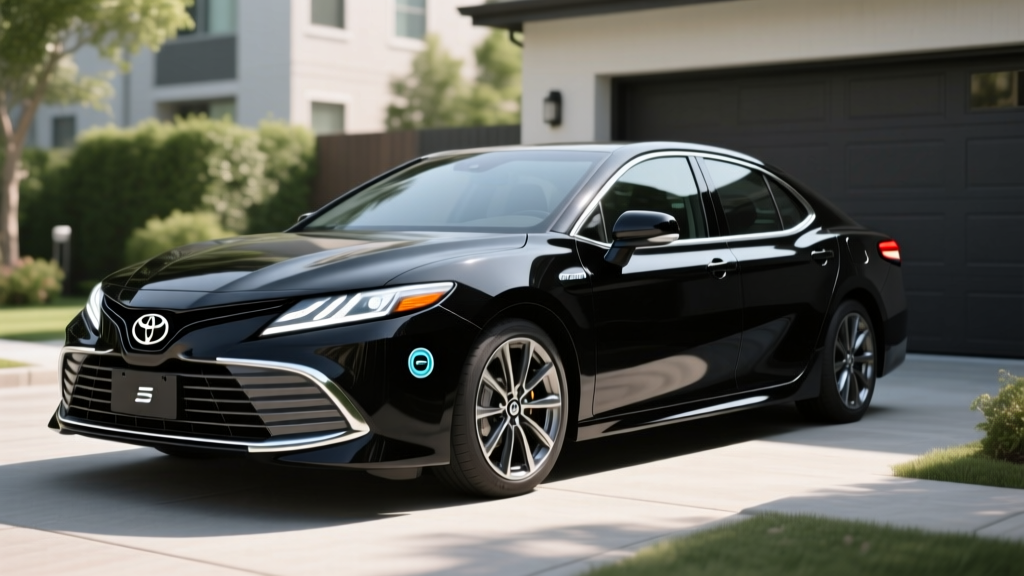
Search for a black Toyota Camry Hybrid at any dealership and you'll find one of the most popular midsize sedans in America — and for good reason. The current-generation Camry Hybrid pairs Toyota's fifth-generation hybrid system with a 2.5-liter four-cylinder engine and two electric motor-generators to deliver an EPA-estimated 51 MPG combined in front-wheel-drive form. Whether you're drawn to the Midnight Black Metallic or the deeper Cosmic Black Pearl finish, the real story is what's under the hood: a proven hybrid powertrain that requires no plug, no range anxiety, and no behavioral change from a conventional gas car.
This guide covers everything a Camry Hybrid buyer needs to know in 2026 — from exact EPA fuel economy figures across every trim to battery longevity, real-world MPG expectations, and how the Camry Hybrid stacks up against plug-in hybrids and full battery-electric vehicles.
2026 Camry Hybrid Powertrain: How It Works
The 2026 Toyota Camry Hybrid uses Toyota's Series-Parallel hybrid architecture. A 2.5-liter Dynamic Force four-cylinder engine (184 hp on its own) teams with a permanent-magnet synchronous electric motor integrated into the transaxle. Combined system output is 225 horsepower in front-wheel-drive trims and 232 horsepower with the electronic on-demand all-wheel-drive system (AWD-e), which adds a second 40 kW rear-mounted electric motor.
This is a conventional hybrid electric vehicle (HEV), not a plug-in hybrid. The 1.6 kWh nickel-metal hydride (NiMH) traction battery charges exclusively through regenerative braking and the gasoline engine. You never plug it in. You fuel it at any gas station with regular 87-octane unleaded. The hybrid system manages energy flow automatically — the electric motor assists during acceleration, captures energy during braking, and can propel the car at low speeds for brief distances on electric power alone.
| Specification | FWD Trims | AWD-e Trims |
|---|---|---|
| Combined Horsepower | 225 hp | 232 hp |
| Engine | 2.5L 4-cyl Dynamic Force (184 hp) | |
| Electric Motor (front) | 100 kW permanent-magnet synchronous | |
| Electric Motor (rear, AWD-e only) | N/A | 40 kW |
| Traction Battery | 1.6 kWh NiMH | |
| Transmission | eCVT (electronically controlled continuously variable) | |
| EPA MPG (city / hwy / combined) | 51 / 49 / 51 | 44 / 43 / 44 |
| Fuel Tank | 13.2 gallons (regular 87 octane) | |
| Total Driving Range (EPA est.) | ~673 miles | ~581 miles |
| 0–60 mph | ~7.2 sec | ~6.9 sec |
Fuel Economy: EPA Ratings and Real-World MPG
The Camry Hybrid's headline number — 51 MPG combined for FWD models — comes from the EPA's fueleconomy.gov testing. Here's the full breakdown by drivetrain:
| Drivetrain | City MPG | Highway MPG | Combined MPG |
|---|---|---|---|
| Front-Wheel Drive (LE, SE, XLE) | 51 | 49 | 51 |
| AWD-e (SE, XLE) | 44 | 43 | 44 |
Real-world expectations: Toyota's hybrid system excels in city driving, where frequent stops maximize regenerative braking and low-speed electric assist. Many owners report exceeding the EPA city figure — 53–56 MPG is common in stop-and-go traffic during moderate temperatures. Highway driving is the Camry Hybrid's relative weak point: at sustained 75–80 mph, expect 42–46 MPG for FWD models as aerodynamic drag dominates and the electric motor contributes less. In cold weather (below 30°F), the engine runs more frequently to maintain cabin heat, reducing city MPG by roughly 5–8 MPG until the powertrain reaches operating temperature.
For a driver covering 15,000 miles annually with a 55/45 city-highway split, the FWD Camry Hybrid will consume approximately 294 gallons of fuel per year — roughly $880 at $3.00/gallon. That's about $1,100 less than a comparable non-hybrid midsize sedan averaging 30 MPG combined.
HEV vs PHEV vs EV: Which Powertrain Fits You?
Toyota discontinued the Camry Hybrid plug-in variant in the U.S. market after the 2024 model year, so the 2026 Camry is available exclusively as a conventional HEV. If you're cross-shopping electrified sedans, here's how the three powertrain types compare:
| Factor | HEV (Camry Hybrid) | PHEV (e.g., Toyota Prius Prime) | BEV (e.g., Tesla Model 3) |
|---|---|---|---|
| Plug-in Required? | No | Yes (for EV range) | Yes (always) |
| Electric-Only Range | ~1 mi at low speed | 39–44 mi (Prius Prime) | 272–363 mi (Model 3) |
| Total Range | ~673 mi | ~510 mi combined | 272–363 mi |
| Home Charging Needed? | No | Recommended (120V or 240V) | Essential (240V Level 2) |
| Federal Tax Credit (§30D) | Not eligible | Up to $7,500* | Up to $7,500* |
| Upfront Cost Premium | Low (~$1,500 over gas) | Medium (~$4,000–$6,000) | High (~$10,000+) |
| Fuel Cost per Mile | ~$0.06 | ~$0.03 (EV mode) / $0.08 (gas) | ~$0.03–$0.05 |
| Maintenance Complexity | Low (standard hybrid) | Medium (two systems) | Lowest (no engine) |
*§30D credit eligibility depends on MSRP caps, buyer income limits, battery sourcing, and point-of-sale transfer rules. See IRS.gov for current requirements.
Choose the Camry Hybrid (HEV) if: You lack home charging access, want zero behavioral change from a gas car, drive 12,000–20,000 miles per year, and prioritize low upfront cost with excellent fuel economy.
Choose a PHEV (like the Prius Prime) if: You have home charging, your daily commute is under 40 miles, and you want electric-only driving for errands with gas-engine backup for road trips.
Choose a full EV (like the Model 3) if: You have reliable Level 2 home charging, your daily driving is under 250 miles, you want the lowest per-mile energy cost, and you're ready to plan around DC fast charging on road trips.
Pricing, Trims, and Tax Credit Eligibility
The 2026 Camry Hybrid is available across four trims. Both Midnight Black Metallic and Cosmic Black Pearl are available paint options across all trims, though availability varies by dealer allocation.
| Trim | Drivetrain | MSRP (incl. destination) |
|---|---|---|
| LE Hybrid | FWD | $30,490 |
| SE Hybrid | FWD | $32,090 |
| SE Hybrid | AWD-e | $33,490 |
| XLE Hybrid | FWD | $35,290 |
| XLE Hybrid | AWD-e | $36,690 |
Federal tax credit: The conventional Camry Hybrid does not qualify for the IRS §30D New Clean Vehicle Credit. That credit applies only to plug-in electric vehicles (PHEVs and BEVs) with a minimum 7 kWh battery capacity. The Camry Hybrid's 1.6 kWh battery falls well below that threshold. However, some states and municipalities offer rebates for conventional hybrids — check your state energy office or AFDC's state incentive database for local programs.
Hybrid Battery Warranty, Longevity, and Replacement Cost
Battery durability is the most common concern among first-time hybrid buyers. Toyota addresses this with one of the industry's strongest hybrid battery warranties:
Toyota Hybrid Battery Warranty: 10 years / 150,000 miles (whichever comes first) for 2020 and newer model years. This covers the hybrid traction battery against defects and abnormal capacity loss. The warranty is transferable to subsequent owners.
Hybrid System Warranty: 8 years / 100,000 miles covering the inverter, converter, and electric motor-generators.
Real-world longevity data: Toyota's NiMH hybrid batteries have demonstrated exceptional durability across millions of vehicles. It's common for Camry, Prius, and RAV4 Hybrid batteries to reach 200,000+ miles without replacement. The NiMH chemistry is less energy-dense than lithium-ion but is extremely tolerant of the shallow charge-discharge cycles that hybrids use (the system typically operates between 40% and 80% state of charge, avoiding the stress of deep cycling).
Replacement cost if out of warranty: A new OEM hybrid battery for the Camry Hybrid costs approximately $2,500–$3,500 installed at a dealership. Refurbished or aftermarket NiMH modules are available for $1,200–$2,000 installed at independent hybrid specialists. Given the 10-year/150,000-mile warranty and the battery's proven track record, most original owners will never pay for a hybrid battery replacement.
Driving Impressions and Practical Ownership
The 2026 Camry Hybrid drives like a competent midsize sedan — not like a fuel-economy science experiment. The eCVT eliminates shift shock, and the transition between electric and gasoline power is nearly imperceptible at part throttle. Floor it from a stoplight and the combined 225 hp delivers a confident 7.2-second 0–60 time (FWD), with the AWD-e model shaving about 0.3 seconds thanks to rear-motor traction off the line.
The SE trim adds sport-tuned suspension and paddle-shift-modeled sequential shift points for a firmer ride and slightly more engagement. The XLE prioritizes comfort with softer damping and additional sound insulation.
Cargo and practicality: The hybrid battery is packaged under the rear seat, preserving the full 15.1 cubic-foot trunk — identical to the (now-discontinued) gas-only Camry. The rear seats fold 60/40 for longer items.
Safety: Every 2026 Camry Hybrid includes Toyota Safety Sense 3.0 as standard: pre-collision braking with pedestrian detection, full-speed adaptive cruise control, lane-departure alert with steering assist, lane-tracing assist, and automatic high beams. The Camry has earned top marks from IIHS and NHTSA in recent model years.
Pros, Cons, and the Verdict on the Black Camry Hybrid
Pros
- 51 MPG combined (FWD) — among the best of any midsize sedan
- No plug-in required; zero infrastructure dependency
- 10-year / 150,000-mile hybrid battery warranty
- ~673-mile total range on a single tank
- Strong resale value and proven reliability record
- AWD-e available for snow-belt buyers
- Standard Toyota Safety Sense 3.0 across all trims
Cons
- Highway MPG drops to ~42–46 real-world at 75+ mph
- No federal tax credit (HEV, not PHEV/BEV)
- AWD-e costs ~7 MPG combined vs FWD
- eCVT can drone under hard acceleration
- Interior materials lag some competitors at this price point
- No plug-in hybrid variant currently offered in the U.S.
Verdict: The black Toyota Camry Hybrid remains the default recommendation for buyers who want maximum fuel economy without changing how they refuel. If you don't have access to home or workplace charging, a conventional hybrid is the smartest electrified option available — and the Camry Hybrid is the best-executed example in its class.
Frequently Asked Questions
How many MPG does the Toyota Camry Hybrid actually get?
The EPA rates the FWD Camry Hybrid at 51 city / 49 highway / 51 combined MPG. In real-world driving, expect 53–56 MPG in city traffic and 42–46 MPG on the highway at 75+ mph. Cold weather reduces city efficiency by roughly 5–8 MPG. The AWD-e model is rated at 44 combined MPG.
Does the Camry Hybrid need to be plugged in?
No. The Camry Hybrid is a conventional HEV, not a plug-in hybrid. Its 1.6 kWh battery charges through regenerative braking and the gasoline engine. You fuel it at any gas station with regular 87-octane fuel.
Does the Camry Hybrid qualify for any tax credit?
The Camry Hybrid does not qualify for the federal §30D New Clean Vehicle Credit, which requires a minimum 7 kWh battery and plug-in capability. Some states offer separate hybrid rebates — check your local programs. The credit is available for PHEVs and BEVs, not conventional HEVs.
How long will the Camry Hybrid battery last and what does replacement cost?
Toyota warrants the hybrid battery for 10 years or 150,000 miles. Real-world data shows these NiMH batteries commonly last 200,000+ miles. If replacement is needed out of warranty, expect $2,500–$3,500 for a new OEM battery installed, or $1,200–$2,000 for a refurbished unit.
Should I get the Camry Hybrid or a plug-in hybrid like the Prius Prime?
Choose the Camry Hybrid if you lack home charging or want a midsize sedan with maximum range and no plug-in routine. Choose the Prius Prime if you have home charging and want 39–44 miles of electric-only commuting with a gas backup for longer trips — and if you qualify for the up-to-$7,500 federal tax credit, the PHEV's effective price drops significantly.
Is AWD-e worth the fuel economy trade-off?
AWD-e reduces combined MPG from 51 to 44 — a 7 MPG penalty that costs roughly $120 more per year in fuel at 15,000 miles. If you regularly drive on snow or ice, the electronic rear motor provides meaningful traction benefits. If you live in a mild climate, FWD is the more efficient and economical choice.