BEV vs PHEV: Defining the Two Paths to Electrification
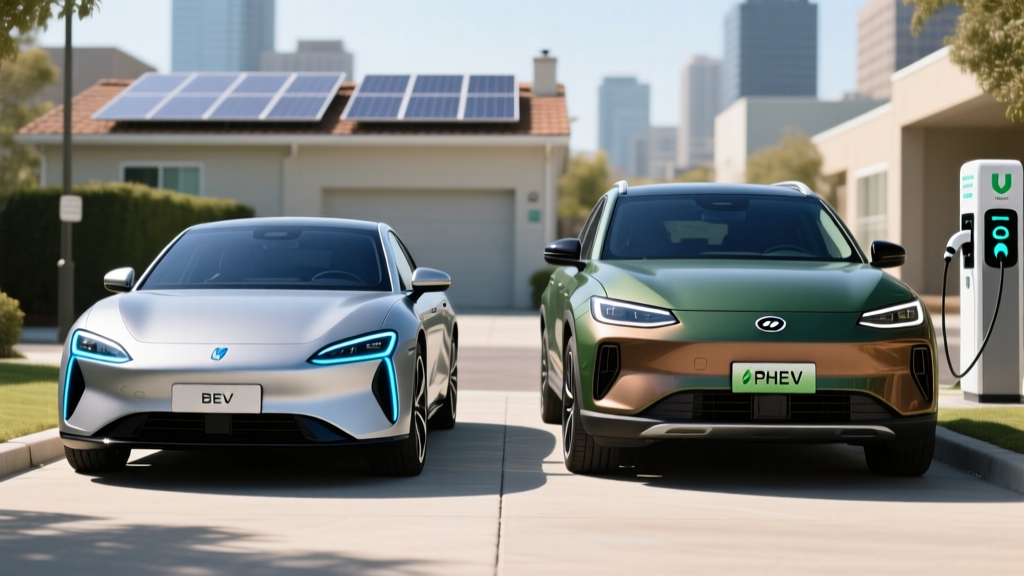
If you're shopping for an electrified vehicle in 2026, you're likely weighing a battery electric vehicle (BEV) against a plug-in hybrid electric vehicle (PHEV). The choice isn't about which is objectively better — it's about which fits your driving patterns, charging access, and budget. This guide breaks down the engineering, economics, and daily-life realities of each powertrain so you can decide with data, not marketing.
First, a Critical Distinction: HEV vs PHEV vs BEV
Conventional Hybrid (HEV): A small battery (typically 1–2 kWh) recharged solely by regenerative braking and the gasoline engine. You never plug it in. Examples: Toyota Prius, Honda CR-V Hybrid. Expect 45–57 MPG combined.
Plug-in Hybrid (PHEV): A larger battery (12–25+ kWh) you can plug in to charge. Delivers 25–50 miles of electric-only driving before the gasoline engine engages seamlessly. Examples: Toyota RAV4 Prime, Jeep Wrangler 4xe, BMW X5 xDrive50e.
Battery Electric Vehicle (BEV): No gasoline engine. A large battery (60–120+ kWh) provides all driving range — typically 250–400+ miles EPA. Examples: Tesla Model Y, Hyundai Ioniq 5, Ford Mustang Mach-E.
Fuel Economy and Efficiency: The Numbers Side by Side
Efficiency is where BEVs and PHEVs diverge most dramatically. A BEV has no tailpipe emissions and uses no gasoline; its efficiency is measured in MPGe (miles per gallon equivalent) and kWh per 100 miles. A PHEV splits its life between two modes: electric-only (measured in MPGe) and hybrid mode after the battery depletes (measured in standard MPG).
| Vehicle (2026 Models) | Powertrain | Electric Range | MPGe (EV Mode) | MPG (Hybrid/Gas Mode) | EPA Combined |
|---|---|---|---|---|---|
| Toyota RAV4 Prime | PHEV | 42 mi | 94 MPGe | 38 MPG | 94 MPGe / 38 MPG |
| Toyota Prius Prime | PHEV | 44 mi | 127 MPGe | 52 MPG | 127 MPGe / 52 MPG |
| BMW X5 xDrive50e | PHEV | 38 mi | 56 MPGe | 26 MPG | 56 MPGe / 26 MPG |
| Tesla Model Y (Long Range) | BEV | 320 mi | 123 MPGe | N/A | 123 MPGe (27 kWh/100mi) |
| Hyundai Ioniq 5 (LR RWD) | BEV | 303 mi | 132 MPGe | N/A | 132 MPGe (25 kWh/100mi) |
| Toyota Prius (HEV) | Hybrid | N/A | N/A | 57 MPG combined | 57 MPG |
Real-world MPG note: Conventional hybrids and PHEVs in hybrid mode often exceed their EPA highway estimates in city driving because regenerative braking recovers more energy in stop-and-go traffic. The Prius HEV's 57 MPG combined EPA rating can stretch to 60+ MPG in urban driving. Conversely, BEVs tend to lose 15–30% of their EPA range at sustained highway speeds above 70 mph and in cold weather below 30°F.
Electric-Only Range and Battery Capacity: PHEV Deep Dive
The electric-only range of a PHEV determines how much of your daily driving can be gasoline-free. Most 2026 PHEVs offer 25–50 miles of EV range, which covers the average American's round-trip commute (roughly 35 miles according to FHWA data).
| 2026 PHEV Model | Battery (kWh) | EV Range (EPA) | Total Range | Level 2 Charge Time | DC Fast Charge? |
|---|---|---|---|---|---|
| Toyota RAV4 Prime | 18.1 kWh | 42 mi | ~600 mi | ~2.5 hrs (240V) | No |
| Toyota Prius Prime | 13.6 kWh | 44 mi | ~620 mi | ~4 hrs (240V) | No |
| Chrysler Pacifica PHEV | 16.0 kWh | 32 mi | ~520 mi | ~2 hrs (240V) | No |
| BMW X5 xDrive50e | 25.7 kWh | 38 mi | ~540 mi | ~3.5 hrs (240V) | No |
| Jeep Wrangler 4xe | 17.3 kWh | 22 mi | ~370 mi | ~2.5 hrs (240V) | No |
The DC fast-charging gap: As of 2026, most PHEVs do not support DC fast charging. Their batteries are small enough that Level 2 (240V) charging fully replenishes them in 2–4 hours, which works for overnight home charging. However, if you lack home charging access, a PHEV's electric range becomes harder to utilize — you'd rely on the gasoline engine and lose much of the efficiency benefit. A few newer PHEVs (notably some Chinese-market models) are beginning to offer DC charging, but it remains rare in the US market.
Powertrain Specs: What's Under the Hood
PHEVs pair a gasoline engine with one or more electric motors for combined output that often exceeds their gas-only siblings. BEVs rely entirely on electric motors, delivering instant torque and simpler mechanical layouts.
PHEV Powertrain Example: 2026 Toyota RAV4 Prime
- Engine: 2.5L 4-cylinder Atkinson-cycle (177 hp)
- Front Electric Motor: 134 kW (180 hp)
- Rear Electric Motor: 40 kW (54 hp)
- Combined System Output: 302 hp
- 0–60 mph: 5.7 seconds
- Drivetrain: Electronic AWD (eAWD)
BEV Powertrain Example: 2026 Hyundai Ioniq 5 Long Range RWD
- Battery: 77.4 kWh usable (NMC chemistry)
- Motor: 168 kW (225 hp), rear-mounted
- Torque: 258 lb-ft
- 0–60 mph: 7.1 seconds
- Drivetrain: RWD (AWD available with dual motors, 325 hp)
The RAV4 Prime's 302 hp makes it the quickest RAV4 variant — a pattern across PHEVs. The electric motor fills the torque gap while the engine handles sustained highway cruising. BEVs like the Ioniq 5 AWD (325 hp, 0–60 in ~5.0 seconds) deliver comparable or greater performance without the mechanical complexity of a dual powertrain.
Charging Infrastructure and Daily Practicality
This is where the BEV vs PHEV decision often crystallizes. A PHEV can run on gasoline indefinitely — you'll never be stranded looking for a charger. A BEV requires reliable access to charging, whether at home or via public networks.
Home charging reality: Both BEVs and PHEVs benefit enormously from Level 2 home charging. For a PHEV, a standard 120V outlet (Level 1) can replenish a 13–18 kWh battery overnight in 8–14 hours — workable but slow. A BEV's 60–100 kWh battery would take 40–80+ hours on Level 1, making Level 2 (240V, 7–11 kW) installation practically mandatory. Expect to pay $500–$2,000 for a Level 2 home charger installation depending on your electrical panel's capacity, according to typical electrician estimates. If your home needs a panel upgrade (100A to 200A), add $1,500–$3,000.
Public charging: BEVs rely on DC fast-charging networks (Tesla Supercharger, Electrify America, EVgo) for road trips. A 2026 BEV with 800V architecture (Ioniq 5, Kia EV6, Porsche Taycan) can charge from 10–80% in roughly 18 minutes at a 350 kW charger, though sustained rates are lower than peak. PHEVs, lacking DC fast-charge capability in most cases, don't benefit from this infrastructure — they simply use gas on long trips.
Pricing, Tax Credits, and Total Cost of Ownership
Upfront pricing and available incentives significantly shift the BEV vs PHEV calculus.
| Vehicle | Starting MSRP (2026) | Federal Tax Credit (§30D) | Effective Price |
|---|---|---|---|
| Toyota Prius Prime SE | ~$33,445 | Up to $3,750* | ~$29,695 |
| Toyota RAV4 Prime SE | ~$43,690 | Not eligible (MSRP/income varies) | ~$43,690 |
| Tesla Model Y (Long Range) | ~$44,990 | Up to $7,500* | ~$37,490 |
| Hyundai Ioniq 5 (SEL RWD) | ~$42,600 | Up to $7,500* | ~$35,100 |
| BMW X5 xDrive50e | ~$74,900 | Not eligible (exceeds MSRP cap) | ~$74,900 |
*Federal tax credit caveats (2026 rules per IRS §30D): The credit ranges from $3,750 to $7,500 depending on battery-component and critical-mineral sourcing requirements. Eligibility depends on your modified adjusted gross income (AGI limits: $150K single / $300K joint), vehicle MSRP caps ($55K for cars, $80K for SUVs/trucks/vans), and North American final assembly. Many PHEVs receive only the $3,750 partial credit because their smaller batteries don't meet full sourcing thresholds. Always verify current eligibility on the IRS website and consult a tax professional — rules change, and point-of-sale transfer is available at participating dealers.
Battery Warranty and Replacement Cost
PHEV battery warranty: Federal law mandates that hybrid and PHEV battery packs carry a minimum warranty of 8 years / 100,000 miles (10 years / 150,000 miles in CARB states including California, New York, and others). Toyota, BMW, and Jeep all meet or exceed this baseline.
BEV battery warranty: Most BEVs also carry 8yr/100K-mile battery warranties covering defects and capacity loss below a threshold (typically 70% state-of-health). Hyundai offers an industry-leading 10yr/100K-mile warranty on the Ioniq 5.
Replacement cost: Out-of-warranty hybrid battery replacement typically runs $2,000–$5,000 for an HEV and $4,000–$8,000 for a PHEV. BEV battery replacement is far more expensive: $10,000–$20,000+ depending on capacity. However, data from Recurrent Auto and other battery-health trackers show that most modern EV batteries lose only 10–15% capacity over 100,000 miles — catastrophic failure is rare.
Hybrid vs PHEV vs BEV: The Decision Framework
Choose a PHEV If…
- Your daily commute is under 40 miles and you can charge at home
- You take frequent road trips and don't want to plan around charging stations
- Your household has one vehicle that must do everything
- You live in an apartment or area with limited public charging
- You want EV-like city driving with gas-car range security
Choose a BEV If…
- You have reliable home Level 2 charging (garage or driveway)
- Your daily driving is under 200 miles (well within any BEV's range)
- You want minimal maintenance (no oil changes, no engine, no transmission fluid)
- You want the lowest per-mile "fuel" cost (electricity at $0.13/kWh ≈ $0.04/mile vs gas at $3.50/gal ≈ $0.13/mile for a 27 MPG car)
- You're motivated by zero tailpipe emissions and a simpler drivetrain
Choose a Conventional HEV If…
- You cannot charge at home or at work
- You want maximum MPG without any behavioral change (no plugging in)
- You want the lowest upfront cost among electrified options
- You drive in heavy city traffic where regenerative braking maximizes efficiency
The real-world cost math: If you drive 12,000 miles/year and a PHEV covers 35 miles of your 33-mile daily commute on electricity, you might use only 200–300 gallons of gas annually (~$700–$1,050 at $3.50/gal) plus roughly $400 in electricity. A comparable gas-only SUV at 27 MPG would burn 444 gallons (~$1,554). A BEV would use roughly $520 in electricity. The PHEV splits the difference — you save substantially versus gas but not as much as a BEV, while retaining unlimited range flexibility.
Reliability: What the Data Shows
Conventional hybrids have two decades of proven reliability — the Toyota Prius has accumulated billions of real-world miles with battery packs routinely lasting 150,000–200,000+ miles. PHEVs add charging hardware and a larger battery but retain the proven hybrid architecture. Consumer Reports reliability surveys consistently rank Toyota and Lexus hybrids at the top.
BEVs have fewer moving parts (no engine, no transmission, no exhaust system) but their long-term reliability data is younger. Early BEVs showed issues with thermal management and battery degradation; 2026 models from major manufacturers have largely resolved these with improved cooling systems and LFP chemistry options (which degrade more slowly than NMC at the cost of lower energy density).
Key reliability concern for PHEVs: You're maintaining two complete powertrains — engine and electric. That means oil changes, spark plugs, and coolant service for the engine, plus the electrical systems. BEVs eliminate all engine-related maintenance. Over 10 years, a BEV's maintenance cost is typically 40–50% lower than a PHEV or gas car, according to DOE analysis.
Frequently Asked Questions
How many MPG does a PHEV get once the battery is depleted?
In hybrid mode (after the electric range is used), a PHEV operates like a conventional hybrid. The 2026 Toyota Prius Prime achieves 52 MPG combined in hybrid mode. The RAV4 Prime gets 38 MPG. These are real-world achievable numbers — city driving often yields slightly higher results due to regenerative braking.
How far can a PHEV go on electric only?
Most 2026 PHEVs deliver 22–50 miles of EPA-rated electric-only range. The Prius Prime leads at 44 miles; the RAV4 Prime manages 42 miles; the Wrangler 4xe is rated at 22 miles. Real-world EV range varies with temperature (expect 20–30% loss below freezing), terrain, and driving style — similar to BEV range variability.
Does a PHEV qualify for the federal tax credit?
Some do, but often at the partial $3,750 level rather than the full $7,500. Eligibility depends on battery-component sourcing, critical-mineral sourcing, MSRP caps ($80K for SUVs, $55K for cars), buyer income limits, and North American assembly. Check the current list at fueleconomy.gov and verify with your tax professional before purchasing.
Is a PHEV battery reliable, and what does replacement cost?
PHEV batteries are warranted for 8 years/100,000 miles (10yr/150K in CARB states). Real-world data shows hybrid and PHEV batteries routinely lasting 150,000+ miles with gradual capacity loss rather than sudden failure. Out-of-warranty replacement costs $4,000–$8,000 depending on the model — significant, but rarely needed within typical ownership periods.
Do I need to plug in a PHEV?
No — a PHEV will operate as a conventional hybrid if you never plug it in. However, you'll forfeit the electric-only range and the associated fuel savings. To maximize a PHEV's value, plan to charge it daily at home or work using a standard 120V outlet (slow but sufficient for 13–18 kWh batteries) or a 240V Level 2 charger.
BEV vs PHEV: which saves more money over 5 years?
A BEV typically saves more on fuel and maintenance if you have home charging. Over 5 years / 60,000 miles, a BEV might cost ~$2,600 in electricity and ~$1,500 in maintenance, versus a PHEV at ~$2,000–$4,000 in combined gas/electricity and ~$3,000 in maintenance. However, the PHEV's higher residual value and lower purchase price (for some models) can narrow or reverse the gap. Run the numbers for your specific commute, electricity rate, and gasoline price.