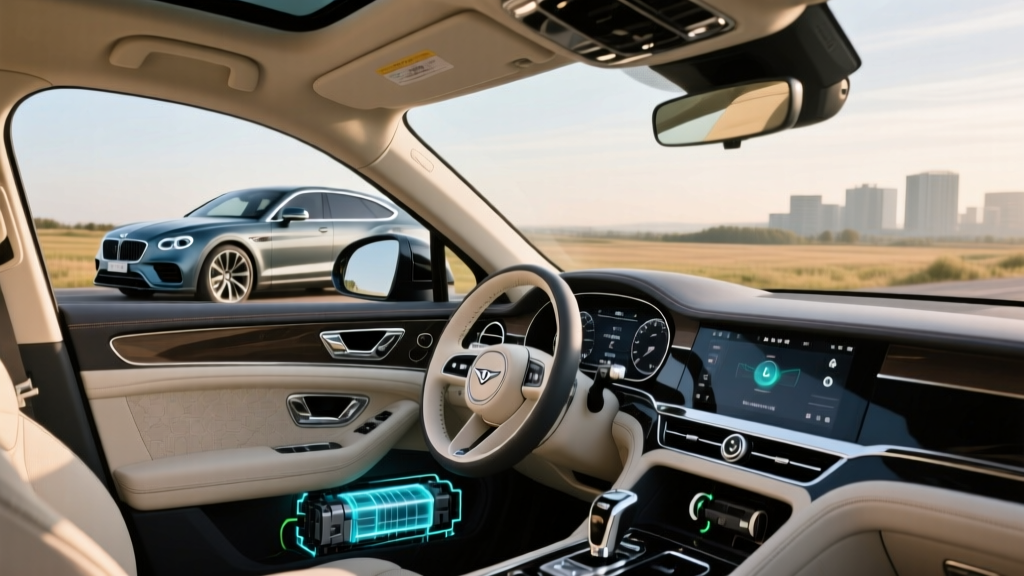
For buyers who associate Bentley with twelve-cylinder grand touring, the brand's pivot to electrification may seem improbable. Yet Bentley's plug-in hybrid lineup — the Flying Spur Hybrid and Bentayga Hybrid — represents a genuine engineering effort to blend luxury performance with everyday electric commuting. Both use a V6 engine paired with an electric motor and a plug-in battery, making them true PHEVs rather than conventional self-charging hybrids.
This guide breaks down the exact specs, real-world efficiency, charging requirements, and ownership economics of every Bentley hybrid currently in production. Whether you're cross-shopping a Bentayga Hybrid against a Porsche Cayenne E-Hybrid or deciding if a plug-in Bentley makes financial sense, the data below will ground your decision.
Bentley's Hybrid Lineup: What's Available in 2026
As of the 2026 model year, Bentley offers two plug-in hybrid (PHEV) vehicles in the U.S. market. It's critical to understand the distinction between hybrid types before evaluating these cars:
HEV vs. PHEV — What's the Difference?
- Conventional Hybrid (HEV): Uses a small battery recharged only by regenerative braking and the engine. Cannot plug in. Electric-only driving is limited to brief low-speed assists. Examples: Toyota Prius, Honda CR-V Hybrid.
- Plug-in Hybrid (PHEV): Carries a larger battery that charges via a plug (Level 1 or Level 2). Offers meaningful electric-only range (typically 20–50 miles) before the gasoline engine engages. Examples: Bentley Flying Spur Hybrid, Chrysler Pacifica PHEV.
Every current Bentley hybrid is a PHEV. Bentley does not sell a conventional HEV. Both models require plugging in to access their full electric range and efficiency benefits.
| Specification | Flying Spur Hybrid | Bentayga Hybrid |
|---|---|---|
| Powertrain | 2.9L twin-turbo V6 + electric motor | 3.0L turbo V6 + electric motor |
| Combined Horsepower | 536 hp | 443 hp |
| Combined Torque | 553 lb-ft | 516 lb-ft |
| Battery Capacity (usable) | ~14.1 kWh | ~17.3 kWh |
| EPA Electric-Only Range | ~21 miles | ~31 miles |
| Total Combined Range | ~430 miles | ~536 miles |
| 0–60 mph | 4.1 seconds | 5.0 seconds |
| AC Charging (Level 2) | 7.2 kW (~2.5 hrs to full) | 7.2 kW (~2.5 hrs to full) |
| DC Fast Charging | Not supported | Not supported |
| Starting MSRP | ~$214,000 | ~$203,000 |
Fuel Economy: EPA MPG and Real-World Efficiency
PHEV fuel economy is measured in two ways: MPGe (miles per gallon equivalent, capturing electric + gas operation when the battery is charged) and standard MPG (gas-only operation after the battery is depleted). Understanding both is essential to evaluating a Bentley hybrid honestly.
| Model | Combined MPGe | Gas-Only City MPG | Gas-Only Hwy MPG | Gas-Only Combined MPG |
|---|---|---|---|---|
| Flying Spur Hybrid | ~55 MPGe | ~17 MPG | ~24 MPG | ~19 MPG |
| Bentayga Hybrid | ~61 MPGe | ~18 MPG | ~24 MPG | ~20 MPG |
Real-world reality check: These MPGe figures assume you start every trip with a full battery and drive within the electric-only range. If you regularly exceed 20–30 miles before charging, your effective fuel economy drops to the gas-only column — a heavy, luxury vehicle's MPG. In practice, owners who charge nightly and commute under 20 miles will see dramatically lower fuel consumption than those who rarely plug in. A Bentley hybrid that isn't plugged in is simply a very thirsty luxury sedan or SUV.
Also worth noting: unlike conventional hybrids, which often exceed their EPA city rating due to regenerative braking in stop-and-go traffic, PHEVs in charge-depleted mode behave like their gas counterparts. Expect the gas-only figures above to be accurate within ±1 MPG for mixed driving.
Electric-Only Range and Charging: What to Expect
The Bentayga Hybrid's ~31-mile electric range and the Flying Spur Hybrid's ~21-mile range are modest by current PHEV standards. For context, the Toyota RAV4 Prime delivers 42 miles electric, and the Chrysler Pacifica PHEV manages 32 miles. Bentley's shorter electric ranges reflect a design priority on performance integration rather than maximum zero-emission commuting.
Charging specifications:
- Level 1 (120V household outlet): ~1.4 kW — a full charge takes approximately 10–12 hours. Practical only for overnight top-ups.
- Level 2 (240V home charger): 7.2 kW onboard charger — full charge in roughly 2.5 hours. This is the practical daily-charging solution.
- DC Fast Charging: Neither Bentley PHEV supports DC fast charging. You cannot use public CCS or NACS rapid chargers to replenish the traction battery. This is standard for most PHEVs — the battery is simply too small to benefit from DC charging infrastructure.
For home charging, a Level 2 wallbox (such as a ChargePoint Home Flex or Emporia Vue) is strongly recommended. A licensed electrician will typically charge $500–$2,000 for installation depending on panel proximity and local permit requirements. If your home's electrical panel is older (100-amp service), a panel upgrade to 200 amps may be needed, adding $1,500–$3,000.
Powertrain Deep Dive: V6 Meets Electric Motor
Bentley's PHEV powertrains share a common architecture philosophy: a turbocharged V6 engine mounted ahead of an electric motor integrated into the transmission, with the lithium-ion battery pack mounted beneath the rear floor. The result is full-time all-wheel drive with torque fill from the electric motor at low RPMs.
Flying Spur Hybrid: The 2.9-liter twin-turbo V6 produces 410 hp on its own, supplemented by a 134-hp electric motor for a combined system output of 536 hp and 553 lb-ft of torque. The eight-speed dual-clutch transmission routes power to all four wheels. The 0–60 mph time of 4.1 seconds is genuinely quick for a 5,500-pound luxury sedan, and the electric motor's instant torque eliminates the lag typically associated with large turbocharged engines.
Bentayga Hybrid: The 3.0-liter single-turbo V6 makes 335 hp, paired with a 126-hp electric motor for 443 hp combined and 516 lb-ft of torque. An eight-speed automatic handles gear changes. The 5.0-second 0–60 time is respectable for a luxury SUV of this mass, though it trails the V8 Bentayga by roughly a second.
In both vehicles, the driver can select from several modes: EV Drive (electric-only), Hybrid mode (system-managed blending), and Hold mode (preserves battery charge for later use, such as entering a zero-emission city zone). The Hold mode is particularly useful for highway-then-city commutes, letting you save electric range for stop-and-go traffic where it's most efficient.
Battery Warranty, Reliability, and Replacement Costs
Bentley PHEV Battery Warranty
- Coverage: 8 years or 100,000 miles (whichever comes first)
- Capacity threshold: Battery is covered if it falls below 70% of original capacity during the warranty period
- Powertrain warranty: 3 years or unlimited miles (Bentley's standard powertrain coverage)
- Replacement cost (out of warranty): Estimated $15,000–$25,000 including labor, based on comparable luxury PHEV battery replacements
Bentley's high-voltage battery warranty aligns with the industry standard for PHEVs — federal regulations effectively mandate 8 years/100,000 miles for emissions-related components in many states, and most manufacturers apply this to the hybrid battery as well.
Reliability outlook: Bentley as a brand consistently ranks near the bottom of J.D. Power and Consumer Reports reliability surveys, but this reflects the complexity of their hand-built luxury vehicles rather than specific hybrid-system failures. The PHEV powertrain itself — the V6, electric motor, and battery — uses proven technology shared with other Volkswagen Group vehicles (Porsche Panamera E-Hybrid, Audi A8 TFSI e). The hybrid components are generally more reliable than the bespoke interior electronics and air suspension systems that drive most Bentley warranty claims.
Battery degradation reality: PHEV batteries experience less degradation than full EV batteries because the system maintains a larger buffer — you're never using the full capacity. Most PHEV owners report less than 5% capacity loss over the first five years. The 70% threshold in Bentley's warranty is generous relative to typical degradation curves; reaching it within eight years would suggest a defect rather than normal wear.
Pricing, Tax Credits, and Ownership Economics
Bentley hybrids command premium pricing even within the luxury segment. Here's what buyers should budget for:
| Model | Base MSRP | Typical Well-Equipped Price | Federal Tax Credit (§30D) |
|---|---|---|---|
| Flying Spur Hybrid | ~$214,000 | $240,000–$280,000 | Not eligible (MSRP cap exceeded) |
| Bentayga Hybrid | ~$203,000 | $220,000–$260,000 | Not eligible (MSRP cap exceeded) |
Tax credit explanation: Under current IRS §30D Clean Vehicle Credit rules, the federal tax credit of up to $7,500 is subject to MSRP caps: $55,000 for sedans and $80,000 for SUVs/vans/pickups. Both Bentley hybrids far exceed these thresholds and are categorically ineligible for the federal credit. Buyer income caps and battery-sourcing requirements are moot — the price alone disqualifies them.
Some states offer additional incentives that may not carry MSRP caps. California's Clean Fuel Reward program, for example, has at times included higher-priced vehicles. Check your state's current incentive database or consult a tax professional for jurisdiction-specific guidance.
Total cost of ownership: Fuel savings from the PHEV system are real but modest relative to the purchase price. If you commute 20 miles daily on electric power and charge at home ($0.14/kWh national average), you might save $2,000–$3,500 annually on fuel versus a gas-only Bentayga or Flying Spur. Over five years, that's $10,000–$17,500 — meaningful, but a fraction of the vehicle's cost. Insurance premiums for Bentley hybrids are typically $4,000–$7,000 annually depending on coverage and driving record.
Pros
- Silent, smooth electric driving for short commutes
- Full performance available — no power sacrifice vs. gas models
- Handcrafted interior quality unmatched by mainstream PHEVs
- Reduced fuel cost for disciplined daily chargers
- Access to HOV/carpool lanes in many states
Cons
- Short electric range (21–31 mi) vs. competitors like RAV4 Prime (42 mi)
- No DC fast charging capability
- No federal tax credit eligibility due to MSRP cap
- High purchase price with steep depreciation
- Brand reliability reputation remains below average
- Gas-only MPG is poor if you don't plug in regularly
Bentley Hybrid vs. Full EV vs. Gas: Which Fits You?
Choose a Bentley PHEV if:
- You have reliable home charging (garage or dedicated driveway outlet)
- Your daily commute is under 30 miles round-trip
- You want electric commuting but need gas-engine range for long road trips
- You value Bentley's craftsmanship and aren't ready to switch to a full EV
Choose a full EV (e.g., Rolls-Royce Spectre, Mercedes EQS) if:
- You have home charging and rarely drive more than 300 miles without stopping
- You want zero tailpipe emissions and minimal maintenance
- You're comfortable with public DC fast charging on road trips
Choose the gas-only Bentley if:
- You lack home charging access entirely
- You prioritize the W12 or V8 engine experience
- You drive primarily long highway distances where PHEV advantages disappear
Bentley's Electric Future: Beyond the PHEV
Bentley's "Beyond100" strategy targets full electrification by 2030, with the brand's first dedicated battery-electric vehicle expected around 2026–2027 (as of this writing, specific models remain announced/preliminary). The current PHEVs are transitional products — engineered to bridge the gap between Bentley's combustion heritage and its electric future. Buyers investing in a Bentley hybrid today should expect these models to be the last generation of plug-in hybrids before the brand moves to full BEV architecture.
This has depreciation implications. PHEVs historically depreciate faster than both pure EVs and conventional vehicles, as the technology is seen as interim. A Bentley PHEV purchased today may face steeper resale-value decline as the market shifts toward longer-range full EVs with DC fast charging.
Frequently Asked Questions
How many MPG does the Bentley hybrid get?
The Flying Spur Hybrid achieves approximately 55 MPGe combined when regularly charged, dropping to 19 MPG combined in gas-only mode. The Bentayga Hybrid returns roughly 61 MPGe and 20 MPG gas-only. These figures are sourced from EPA fueleconomy.gov data. Real-world results depend heavily on charging discipline.
How far can the Bentley hybrid go on electric only?
The Flying Spur Hybrid delivers approximately 21 miles of EPA-rated electric-only range. The Bentayga Hybrid offers about 31 miles. In cold weather or at highway speeds, expect 15–25% less. These ranges are sufficient for short commutes but fall short of PHEV leaders like the Toyota RAV4 Prime (42 miles).
Does the Bentley hybrid qualify for a tax credit?
No. Under current IRS §30D rules, the federal EV tax credit has MSRP caps of $55,000 for sedans and $80,000 for SUVs. Both Bentley hybrids exceed $200,000 and are categorically ineligible. Some state incentives may apply — check your local programs.
Is the Bentley hybrid reliable, and what does a battery replacement cost?
Bentley's hybrid powertrain components share technology with other Volkswagen Group PHEVs and are generally reliable. The brand's overall reliability ratings are below average, but this reflects infotainment and suspension issues rather than hybrid-system failures. The high-voltage battery is warranted for 8 years/100,000 miles. Out-of-warranty replacement is estimated at $15,000–$25,000 based on comparable luxury PHEVs.
Can I DC fast charge a Bentley hybrid?
No. Neither the Flying Spur Hybrid nor the Bentayga Hybrid supports DC fast charging. They charge exclusively via AC — Level 1 (120V) or Level 2 (240V). At 7.2 kW on Level 2, a full charge takes approximately 2.5 hours. This is standard for most PHEVs; the battery packs are too small to justify DC fast-charge hardware.
Do I have to plug in a Bentley hybrid?
Yes. Both Bentley hybrids are plug-in hybrids (PHEVs), not conventional self-charging hybrids. You must plug them in to access their electric-only range and MPGe ratings. If you never plug in, they operate as heavy, inefficient gasoline vehicles. If you lack home or workplace charging access, a PHEV is not the right choice.
Specifications and pricing reflect 2025/2026 model-year data available at time of publication. EPA figures sourced from fueleconomy.gov. Tax credit rules are subject to change — consult the IRS or a qualified tax professional before making a purchase decision based on incentive eligibility.