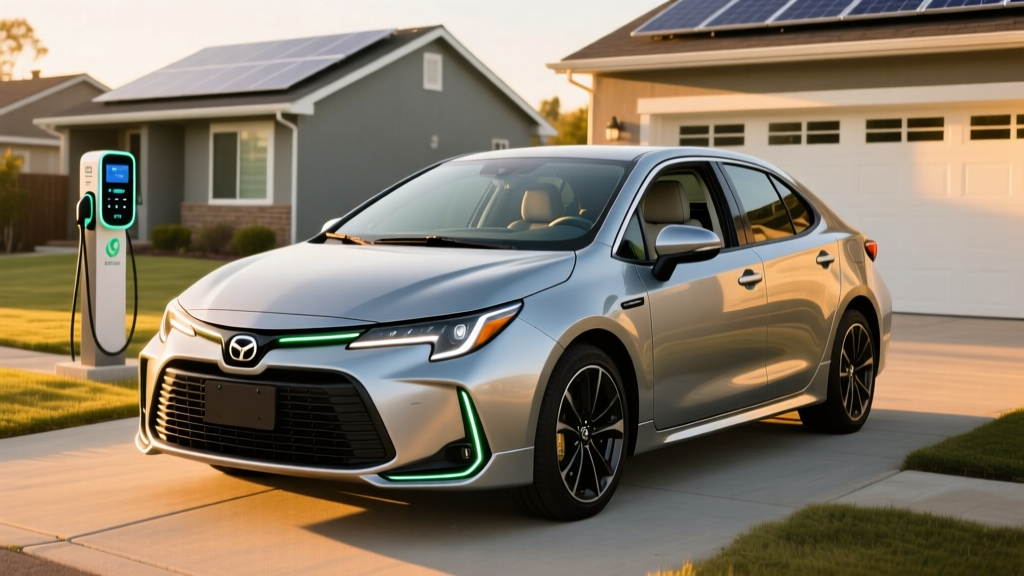
If you want all-weather traction without the fuel-economy penalty of a traditional AWD system, the 2026 Toyota Corolla Hybrid AWD occupies a narrow but compelling lane. It pairs Toyota's fifth-generation hybrid powertrain with an electronic rear axle motor, delivering all-wheel drive that activates on demand rather than dragging a mechanical drivetrain everywhere you go. The result: EPA ratings that rival front-wheel-drive compacts, with the grip to handle snow, rain, and gravel roads.
This guide covers everything a data-driven buyer needs — EPA and real-world MPG, powertrain specifics, trim pricing, battery longevity, and how the Corolla Hybrid AWD stacks up against plug-in hybrids and full EVs for different driving lifestyles.
Corolla Hybrid AWD Powertrain and Performance Specs
The 2026 Corolla Hybrid uses Toyota's latest hybrid synergy drive. A 1.8-liter four-cylinder Atkinson-cycle engine handles the bulk of cruising duties, while two front-mounted motor-generators and a separate rear-axle electric motor provide electric assist and all-wheel-drive traction. The rear motor engages automatically when the system detects front-wheel slip, low-trition launches, or cornering that benefits from torque redistribution.
| Specification | Value |
|---|---|
| Combined System Horsepower | 138 hp |
| Gas Engine | 1.8L 4-cyl Atkinson-cycle (97 hp, 105 lb-ft) |
| Front Electric Motors (MG1 + MG2) | 94 hp (MG2) |
| Rear Axle Electric Motor | |
| Transmission | Electronically controlled CVT (eCVT) |
| Drivetrain | Electronic On-Demand AWD |
| Hybrid Battery | ~1.3 kWh lithium-ion (sealed, self-charging HEV) |
| 0–60 mph (est.) | ~9.0 seconds |
| Curb Weight | ~3,100 lbs |
Unlike a plug-in hybrid, the Corolla Hybrid's small battery charges exclusively through regenerative braking and the gas engine. There is no charge port, no plug, and no electric-only driving range to manage. You simply fuel up and drive — the hybrid system optimizes the blend of gas and electric power in the background.
EPA Fuel Economy and Real-World MPG
Fuel economy is the headline reason buyers cross-shop the Corolla Hybrid against conventional gas compacts. The AWD variant carries a minimal penalty versus the FWD model — typically 1–2 MPG combined — because the rear motor only draws power when actively engaged.
| Trim | City MPG | Highway MPG | Combined MPG |
|---|---|---|---|
| LE AWD | 51 | 44 | 48 |
| SE AWD | 50 | 43 | 47 |
| XLE AWD | 50 | 43 | 47 |
Source: fueleconomy.gov, U.S. EPA
Toyota hybrids consistently overperform their EPA city ratings in stop-and-go traffic, where regenerative braking recaptures energy that a gas car wastes as heat. In urban and suburban driving, owners regularly report 52–55 MPG. Highway driving is the opposite story: sustained 75 mph cruising reduces regenerative opportunities and increases aerodynamic drag, yielding 40–43 MPG in real-world conditions. Cold weather (below 30°F) can drop combined economy by 5–8 MPG as the engine runs more frequently to maintain cabin heat and battery temperature. Expect a blended real-world average of 46–50 MPG combined for mixed driving in moderate climates.
HEV vs. PHEV vs. EV: Which Powertrain Fits You?
The Corolla Hybrid is a conventional hybrid electric vehicle (HEV). It cannot plug in and has no electric-only range. This distinction matters because buyers sometimes confuse it with plug-in hybrids like the Toyota Prius Prime or full battery-electric vehicles. Here is how the three powertrain types compare for different ownership situations:
| Factor | HEV (Corolla Hybrid) | PHEV (e.g., Prius Prime) | BEV (e.g., Tesla Model 3) |
|---|---|---|---|
| Plug-in Required? | No | Yes (for max benefit) | Yes |
| Electric-Only Range | None | ~35–44 mi | 250–360 mi |
| Home Charging Needed? | No | Recommended (Level 2) | Essential |
| Combined Efficiency | 47–48 MPG | 48 MPG + 114 MPGe (elec) | 120–132 MPGe |
| Annual Fuel Cost (15k mi) | ~$940 | ~$600–$900 | ~$480–$720 |
| Upfront Price (base) | ~$24,000 | ~$33,000 | ~$39,000 |
| Federal Tax Credit | None | Up to $3,750 (§30D)* | Up to $7,500 (§30D)* |
| Best For | No home charging, budget-first | Home charging, short commutes | Home charging, low-cost miles |
* Federal tax credit eligibility under IRS §30D depends on MSRP caps, buyer income limits, battery component sourcing, and critical mineral requirements. Verify current-year rules at irs.gov and consult a tax professional.
If you cannot install a home charger — apartment dwellers, street parkers, or those without a dedicated parking spot — the Corolla Hybrid AWD is the clear winner. You get hybrid-level fuel savings with zero infrastructure requirements and a starting price roughly $9,000–$15,000 below comparable PHEVs and EVs.
Pricing, Trims, and Tax Credit Eligibility
The 2026 Corolla Hybrid AWD is available in three trims. Pricing below reflects MSRP before destination charges:
| Trim | MSRP (est.) | Key Features |
|---|---|---|
| LE AWD | ~$24,050 | Toyota Safety Sense 3.0, 8" touchscreen, wireless CarPlay/Android Auto, LED headlights |
| SE AWD | ~$26,550 | Sport-tuned suspension, 18" alloy wheels, sport seats, paddle shifters |
| XLE AWD | ~$28,850 | SofTex seats, 10.5" display, heated front seats, wireless charging, ambient lighting |
The Corolla Hybrid is a conventional HEV, not a plug-in vehicle. It does not qualify for the federal §30D New Clean Vehicle Credit (up to $7,500) or the §25E Used Clean Vehicle Credit (up to $4,000). These credits are reserved for plug-in EVs and PHEVs meeting battery capacity, sourcing, MSRP, and buyer income thresholds. Some states offer separate hybrid incentives — check your state energy office or AFDC incentive database for local programs.
Battery Longevity, Warranty, and Replacement Cost
Hybrid battery anxiety is the most common concern we hear from first-time hybrid buyers. Here is what the data shows after two decades of Toyota hybrid deployments:
- Hybrid Battery Warranty: 10 years / 150,000 miles (whichever comes first)
- Hybrid System Components: 8 years / 100,000 miles
- Powertrain Warranty: 5 years / 60,000 miles
- Basic Bumper-to-Bumper: 3 years / 36,000 miles
Toyota's hybrid batteries are engineered for longevity. The 1.3 kWh lithium-ion pack in the Corolla Hybrid operates within a conservative state-of-charge window — it never fully charges or fully depletes — which dramatically reduces cell degradation. Real-world data from Toyota's hybrid fleet (over 20 million vehicles sold globally) shows most hybrid batteries last 150,000–200,000+ miles before needing replacement.
If a replacement is needed outside warranty, a refurbished Toyota hybrid battery costs roughly $2,000–$3,500 installed at a dealership, while a new OEM pack runs $3,500–$5,000. Independent hybrid specialists often offer refurbished units with 1–3 year warranties at the lower end of that range. Given the 10-year/150,000-mile warranty and typical ownership periods, most original owners will never face this cost.
Driving Impressions and AWD System Behavior
The Corolla Hybrid AWD is not a performance car — 138 hp and a ~9-second 0–60 time place it firmly in the "adequate commuter" category. But adequacy is the point. The eCVT delivers seamless, shift-free acceleration, and the hybrid system's electric torque fill masks the modest engine output in normal city driving.
The electronic AWD system is transparent in daily use. You will not feel the rear motor engage during dry-pavement driving. On wet roads, snow-covered intersections, or loose gravel, the system transfers torque rearward within milliseconds of detecting front-wheel slip. Unlike mechanical AWD systems in competitors like the Subaru Impreza, there is no center differential, no driveshaft, and no constant parasitic loss — the rear axle is entirely decoupled when not needed, which is why the fuel-economy penalty is so small.
One trade-off: the rear motor's ~40 hp output is designed for traction assist, not performance driving. In deep snow or steep, slippery grades, the Corolla Hybrid AWD provides confident starts and low-speed stability, but it does not match the continuous torque distribution of a full-time mechanical AWD system. For severe winter conditions, dedicated winter tires remain the single most impactful upgrade.
Pros, Cons, and the Bottom Line
Pros
- 47–48 MPG combined (AWD) — among the most efficient AWD vehicles sold
- No plug-in required — zero charging infrastructure needed
- Low starting price (~$24,050) undercuts PHEVs and EVs by $9K–$15K
- 10-year/150,000-mile hybrid battery warranty
- Toyota Safety Sense 3.0 standard on all trims
- Proven reliability track record (Corolla nameplate, 5th-gen hybrid system)
Cons
- Modest 138 hp — not quick by any measure
- No federal tax credit (HEV, not plug-in)
- AWD is traction-assist only, not a full-time system for off-road or deep snow
- Rear-seat and cargo space tighter than compact SUV hybrids
- Highway MPG drops noticeably at sustained 75+ mph
- Road noise and CVT drone under hard acceleration
Frequently Asked Questions
How many MPG does the AWD Corolla Hybrid get in real-world driving?
The EPA rates the 2026 Corolla Hybrid AWD LE at 51 city / 44 highway / 48 combined MPG. In real-world mixed driving, owners typically see 46–50 MPG combined. City driving often exceeds the EPA rating (52–55 MPG) thanks to regenerative braking, while sustained highway speeds above 70 mph reduce economy to 40–43 MPG. Cold weather can drop combined figures by 5–8 MPG.
Does the Corolla Hybrid AWD need to be plugged in?
No. The Corolla Hybrid is a conventional hybrid (HEV), not a plug-in hybrid (PHEV). It has no charge port. The hybrid battery recharges through regenerative braking and the gasoline engine. You fuel it at any gas station and drive normally.
Is the Corolla Hybrid reliable, and what does battery replacement cost?
Toyota's hybrid systems have an extensive reliability record spanning over two decades and 20+ million vehicles globally. The 2026 Corolla Hybrid's battery is covered by a 10-year/150,000-mile warranty. If replacement is needed out of warranty, expect to pay $2,000–$3,500 for a refurbished unit or $3,500–$5,000 for a new OEM pack. Most batteries last well beyond 150,000 miles.
Does the AWD Corolla Hybrid qualify for any tax credit?
The Corolla Hybrid does not qualify for the federal §30D New Clean Vehicle Credit because it is a conventional hybrid without plug-in capability. That credit (up to $7,500) is reserved for qualifying PHEVs and BEVs. Some states or municipalities may offer separate incentives for high-efficiency hybrids — check the Alternative Fuels Data Center for state-specific programs.
Corolla Hybrid AWD vs. a compact EV — which should I choose?
Choose the Corolla Hybrid AWD if you lack home charging access, need a sub-$25,000 vehicle, drive long highway routes frequently, or want zero lifestyle change from your current gas car. Choose a compact EV (like the Chevy Equinox EV or Hyundai Kona Electric) if you can charge at home, drive under 250 miles daily, want the lowest per-mile fuel cost (~$0.04/mi vs. ~$0.06/mi for the hybrid), and are willing to pay $10,000–$15,000 more upfront — potentially offset by the $7,500 federal tax credit.
How does the electronic AWD system work?
The Corolla Hybrid AWD uses a separate electric motor mounted on the rear axle. There is no mechanical connection (driveshaft or center differential) between the front and rear axles. The rear motor activates automatically when the system detects front-wheel slip during acceleration, cornering, or low-traction launches. When AWD is not needed, the rear motor disengages entirely, eliminating the drivetrain losses that reduce fuel economy in traditional mechanical AWD systems.