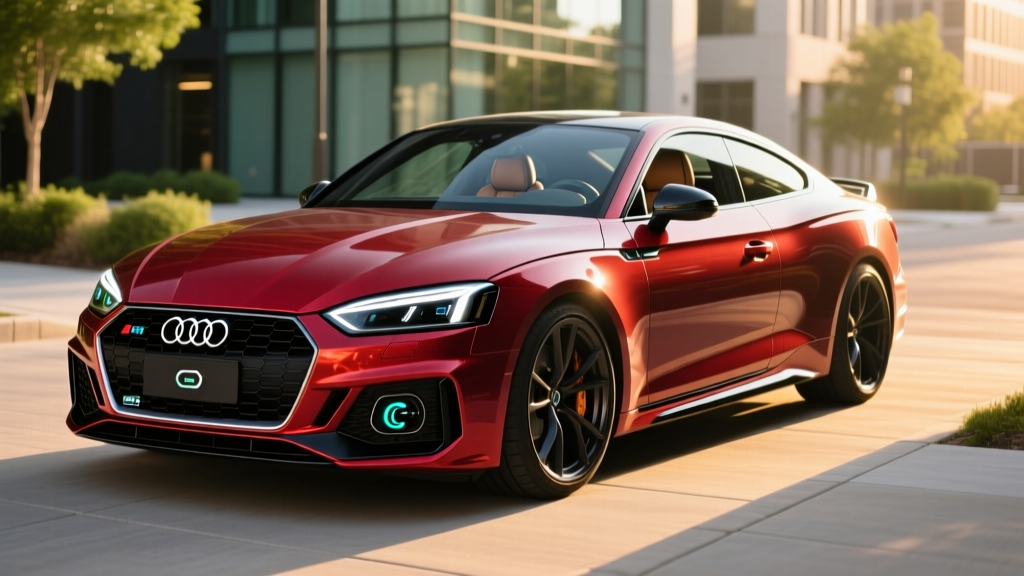
Audi's next-generation RS 5 is ditching the pure-combustion formula. The automaker has confirmed that the upcoming performance coupe and Avant will arrive as a plug-in hybrid electric vehicle (PHEV), pairing a turbocharged V6 with a powerful electric motor for what Audi promises will be its most potent RS 5 yet. While the production model hasn't officially launched as of early 2026, Audi teased the new RS 5 plug-in hybrid details through press briefings, prototype sightings, and executive statements — and the numbers point to a serious performance machine that can also handle daily commuting on electric power alone.
Here's everything we can piece together from confirmed reports, platform-sharing data with the similarly configured Porsche Panamera E-Hybrid and Audi RS 6 PHEV, and Audi's own disclosures. Because the vehicle is still pre-launch, all specifications are preliminary and estimated until Audi publishes final production figures.
What Audi Has Confirmed About the RS 5 PHEV Powertrain
The new RS 5 PHEV will ride on Audi's updated PPC (Premium Platform Combustion) architecture, which was engineered from the outset to accommodate electrified powertrains. At its core sits a 2.9-liter twin-turbo V6 — an evolution of the current RS 5's engine — mated to an electric motor integrated into the transmission housing. This is the same fundamental layout Audi has deployed in the RS 6 e-hybrid and that Porsche uses in the Panamera 4 E-Hybrid and Turbo E-Hybrid.
Based on the platform's known capabilities and Audi's own hints at a target output exceeding 500 horsepower, here is our best-estimated spec breakdown:
| Specification | Estimated Figure |
|---|---|
| Powertrain | 2.9L twin-turbo V6 + electric motor (PHEV) |
| Combined Horsepower | ~500–530 HP |
| Combined Torque | ~516–553 lb-ft |
| Transmission | 8-speed tiptronic automatic (quattro AWD) |
| Battery Capacity (estimated usable) | ~22–25 kWh (lithium-ion NMC) |
| Electric-Only Range (est. EPA) | ~25–30 miles |
| Total Combined Range (est.) | ~380–420 miles |
| AC Charging (Level 2) | 7.2 kW onboard charger (~3.5 hours 0–100%) |
| DC Fast Charging | Not expected (typical for PHEVs in this class) |
| 0–60 mph (est.) | ~3.4–3.7 seconds |
| Top Speed | Electronically limited ~155 mph (174 mph w/ RS package) |
| Body Styles | Coupe, Avant (wagon) |
| Estimated Starting MSRP | $85,000–$92,000 |
Note: These figures are estimates based on platform data and Audi's disclosures. Final EPA ratings and MSRP will be published closer to the on-sale date. Audi USA has not yet listed the RS 5 PHEV on its configurator.
Electric-Only Range and Battery: What PHEV Buyers Need to Know
For PHEV shoppers, the electric-only range is the number that determines daily usability. The RS 5 PHEV's estimated 22–25 kWh usable battery (total pack capacity is likely around 29–31 kWh, with a buffer to protect longevity) should deliver approximately 25–30 miles of zero-emission driving on the EPA cycle.
That aligns with the Porsche Panamera 4 E-Hybrid, which achieves 28 miles of EPA electric range from a similar 25.9 kWh (total) battery. In real-world use, expect the RS 5 PHEV to deliver:
- City/low-speed commuting: 28–33 miles (regenerative braking recovers energy at lower speeds)
- Highway driving at 70+ mph: 20–24 miles (aerodynamic drag and sustained speed reduce EV efficiency)
- Cold weather (below 32°F): 18–22 miles (battery chemistry is less efficient, and cabin heating draws from the pack)
The 7.2 kW onboard AC charger means a full recharge from a Level 2 home charger takes roughly 3.5 hours. Most PHEVs in this performance segment — including BMW's M-series PHEVs and Porsche's E-Hybrids — do not support DC fast charging, and all available evidence suggests the RS 5 PHEV will follow suit. This is a deliberate engineering trade-off: omitting DC hardware saves weight and packaging space in a performance-oriented chassis.
HEV vs PHEV vs Full EV: Where the RS 5 Fits
It's critical to understand that the RS 5 PHEV is a plug-in hybrid, not a conventional hybrid (HEV). Here's the distinction and how it shapes ownership:
| Factor | Conventional Hybrid (HEV) | Plug-in Hybrid (PHEV) — RS 5 | Full EV (BEV) |
|---|---|---|---|
| Plugs in? | No — self-charging via regen + engine | Yes — plug in for EV range | Yes — sole propulsion source |
| Electric-only range | 0–1 mile (assist only) | 25–30 miles (est.) | 250–400+ miles |
| Gas engine? | Yes — primary power | Yes — extends range after battery depletes | No |
| Home charging needed? | No | Recommended for daily EV mode | Essential |
| Fuel cost if never plugged in | Optimized MPG | Worse than HEV (carrying dead battery weight) | N/A |
| Best for | No charging access, want MPG gains | Home charging + longer road trips | Full charging access, no gas needed |
The RS 5 PHEV occupies a specific niche: performance buyers who want electric commuting capability without range anxiety on road trips. If you have Level 2 home charging and a commute under 30 miles, you could drive the RS 5 PHEV on electricity alone most weekdays, then use the V6 for weekend canyon carving or cross-country trips. If you lack home charging access, a PHEV becomes an expensive, heavy conventional hybrid — and you'd be better served by a full EV or a standard HEV.
Estimated Fuel Economy: MPG and MPGe Breakdown
Because the RS 5 PHEV hasn't received final EPA certification, official MPG figures aren't available yet. However, we can extrapolate from the closest comparable — the Porsche Panamera 4 E-Hybrid (which shares the same fundamental powertrain architecture) and Audi's own RS 6 e-hybrid:
| Vehicle | EV Range | Combined MPGe (EV mode) | Combined MPG (gas only, battery depleted) |
|---|---|---|---|
| Audi RS 5 PHEV (est.) | 25–30 mi | ~50–55 MPGe | ~22–25 MPG |
| Porsche Panamera 4 E-Hybrid (2025) | 28 mi | 52 MPGe | 22 MPG |
| BMW M340e xDrive (2025) | 33 mi | 60 MPGe | 28 MPG |
| Mercedes-AMG C63 S E Performance | 7 mi | N/A (limited EV range) | ~20 MPG |
A few things to note about real-world MPG with this type of PHEV:
- If you charge daily and commute under 30 miles: You may use little to no gasoline during the workweek. Your effective "MPG" is essentially infinite for those trips.
- If you never plug in: Expect roughly 22–25 MPG combined. The V6 is powerful but the added battery weight (~300–400 lbs) hurts efficiency versus a non-hybrid RS 5.
- Highway road trips: Once the battery is depleted, the car operates as a conventional hybrid. At sustained 75–80 mph, expect 20–23 MPG — typical for a twin-turbo V6 performance car with AWD.
- Real-world vs EPA: PHEVs often exceed their EPA MPGe in city driving where regenerative braking is most effective, but fall short on sustained highway runs.
Pricing and Tax Credit Eligibility
Audi has not announced official MSRP for the RS 5 PHEV. Based on the current RS 5's pricing trajectory, the positioning relative to the RS 6 e-hybrid, and the premium that PHEV powertrains command, we estimate:
- RS 5 PHEV Coupe (base): ~$85,000–$88,000
- RS 5 PHEV Avant: ~$88,000–$92,000
- Fully loaded (RS Design, Dynamic Plus packages): $100,000+
Does the RS 5 PHEV Qualify for the Federal §30D Tax Credit?
This is where it gets complicated — and where most PHEV buyers need to pay close attention. Under current IRS §30D rules, plug-in hybrids can qualify for up to $7,500 in federal tax credits, but several conditions must be met:
- MSRP Cap: The vehicle must have an MSRP at or below $55,000 for sedans/coupes or $80,000 for SUVs/trucks/vans. The RS 5 PHEV, as a coupe/Avant classified as a passenger car, almost certainly exceeds the $55,000 cap — meaning it would NOT qualify for the federal credit.
- Battery Capacity: Must have at least 7 kWh of battery capacity. The RS 5 PHEV clears this bar easily (~22–25 kWh usable).
- Buyer Income Limits: Modified adjusted gross income must not exceed $150,000 (single), $225,000 (head of household), or $300,000 (joint). Even if the MSRP qualified, many RS 5 buyers would be near or above these thresholds.
- Critical Minerals & Battery Sourcing: The battery components and critical minerals must meet phased-in domestic sourcing requirements that tighten annually through 2030. Audi's supply chain details for the RS 5 PHEV battery are not yet public.
- Point-of-Sale Transfer: If eligible, the credit can be transferred to the dealer at purchase for an immediate price reduction rather than claimed on your tax return.
Bottom line: The RS 5 PHEV will almost certainly be ineligible for the federal §30D credit due to its MSRP exceeding the $55,000 sedan/coupe cap. Some state-level incentives (such as those in California, Colorado, and New York) may still apply — check your state's energy office for current programs. Always consult a tax professional before making purchase decisions based on credit eligibility.
Who Should Buy the RS 5 PHEV — and Who Shouldn't
Pros
- 500+ HP performance with V6 soundtrack and instant electric torque
- 25–30 miles of silent, zero-emission commuting
- No range anxiety — gas engine covers long trips effortlessly
- quattro AWD standard for all-weather capability
- Avant body style offers practical cargo space (est. 25+ cu ft)
- 8-year/100,000-mile high-voltage battery warranty expected
Cons
- Estimated $85K+ MSRP puts it well above non-hybrid RS 5 pricing
- Likely ineligible for the $7,500 federal tax credit (MSRP cap)
- No DC fast charging — Level 2 only at 7.2 kW
- Added battery weight (~300–400 lbs) may affect handling dynamics vs. pure ICE RS 5
- If you never plug in, fuel economy is worse than a lighter non-hybrid
- PHEV complexity: two propulsion systems mean more potential service points long-term
Decision Framework: Is the RS 5 PHEV Right for You?
Choose the RS 5 PHEV if: You want a high-performance daily driver that can commute on electricity, you have Level 2 home charging, you take regular road trips where EV-only range would be limiting, and you value the Avant body style for practicality.
Choose a full EV (e.g., Audi e-tron GT, Porsche Taycan) if: You have reliable home and workplace charging, your daily driving rarely exceeds 250 miles, and you want zero maintenance on an internal combustion engine.
Choose a conventional hybrid or wait for a non-PHEV RS 5 if: You lack home charging access, you want the lightest possible performance car, or the $85K+ price tag is a stretch without the offset of a tax credit.
Reliability and Long-Term Battery Outlook
Audi's PHEV track record is relatively short but encouraging. The Volkswagen Group's PHEV systems — shared across Audi, Porsche, and Volkswagen — have been in production since 2019 (with the current-generation A7, A8, and Q5 TFSI e models). The high-voltage batteries use NMC (nickel-manganese-cobalt) chemistry, which offers strong energy density but requires careful thermal management to minimize degradation over time.
Based on data from existing VW Group PHEVs:
- Expected degradation: 8–12% capacity loss over 8 years / 100,000 miles under normal use — meaning a 25 kWh usable battery would retain roughly 22–23 kWh.
- Battery replacement cost: If out of warranty, a PHEV battery pack of this size typically costs $8,000–$14,000 for parts alone, plus 4–6 hours of labor. This is significantly less than a full EV battery replacement but still a material expense.
- Warranty protection: The 8-year/100,000-mile warranty with a 70% capacity retention threshold provides strong coverage through the typical first-ownership period.
For reliability context, IIHS and NHTSA ratings for the new RS 5 platform have not yet been published. The outgoing RS 5 earned strong marks, and the PPC platform is engineered with updated structural and safety systems. We'll update this section when crash-test data becomes available.
Frequently Asked Questions
How many MPG does the Audi RS 5 PHEV get?
Official EPA figures aren't available yet. Based on comparable Porsche Panamera E-Hybrid data, we estimate approximately 50–55 MPGe combined when operating in EV mode, and 22–25 MPG combined once the battery is depleted and the V6 operates as a conventional hybrid. Your actual mileage depends heavily on how often you charge — daily plug-in users may burn almost no gasoline during weekday commuting.
How far can the RS 5 PHEV go on electric only?
Estimated EPA electric-only range is 25–30 miles. Real-world range will vary: expect up to 33 miles in stop-and-go city driving with regenerative braking, 20–24 miles at sustained highway speeds, and 18–22 miles in freezing temperatures where the battery is less efficient and cabin heating draws power from the pack.
Does the Audi RS 5 PHEV qualify for a tax credit?
Almost certainly not at the federal level. The IRS §30D credit caps eligible sedans and coupes at $55,000 MSRP, and the RS 5 PHEV is estimated at $85,000+. State-level incentives may still apply depending on where you live. Always verify current rules at IRS.gov and consult a tax professional.
Is the RS 5 PHEV reliable, and what does battery replacement cost?
Audi's PHEV systems share components with Porsche's proven E-Hybrid lineup. The high-voltage battery is warrantied for 8 years / 100,000 miles with a 70% capacity retention guarantee. Out-of-warranty replacement is estimated at $8,000–$14,000 for the battery pack, plus labor. The dual powertrain (gas engine + electric motor) means two systems to maintain, but both are well-proven in other VW Group applications.
Can the RS 5 PHEV DC fast charge?
No — based on all available information, the RS 5 PHEV will only support AC Level 2 charging at up to 7.2 kW, taking approximately 3.5 hours for a full charge. This is standard for performance PHEVs in this class. DC fast charging hardware adds weight and complexity that Audi has chosen to omit in favor of performance optimization.
When will the Audi RS 5 PHEV go on sale?
Audi has not confirmed an exact on-sale date. Industry reporting suggests a late 2026 or early 2027 launch for European markets, with U.S. availability following shortly after. We will update this article when Audi publishes official specs, pricing, and timing.