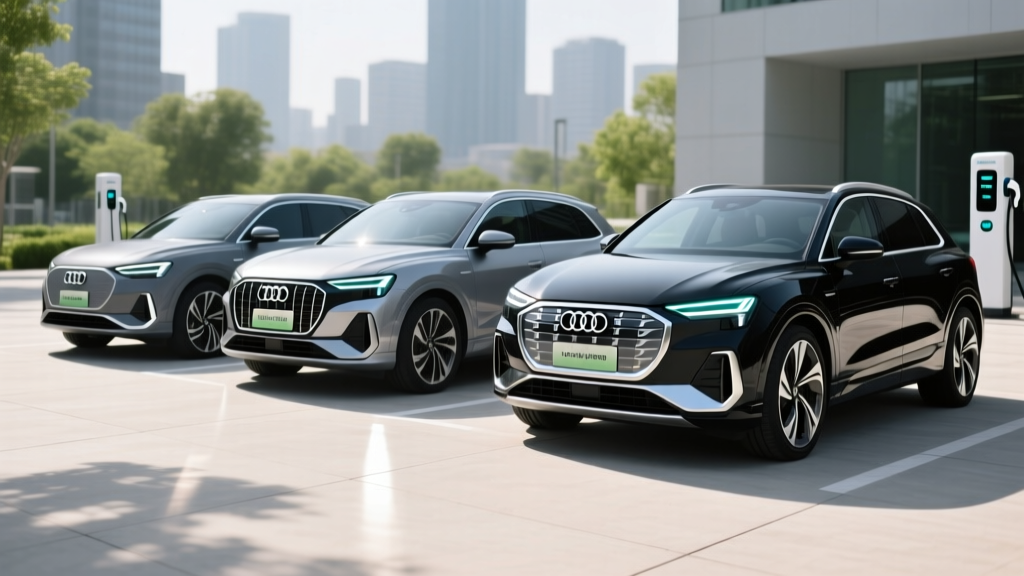
Audi's electrified SUV strategy in the US market centers on one key model: the Q5 55 TFSI e, a plug-in hybrid (PHEV) that bridges the gap between the conventional gas Q5 and the fully electric Q8 e-tron. If you've been searching for an Audi hybrid SUV 2025 model year, this is the vehicle you'll find in showrooms — and it's a compelling option for buyers who want electric-only commuting without range anxiety on longer trips.
But before you visit a dealer, you need the exact numbers: real-world MPG, electric-only range, charging logistics, federal tax credit eligibility under current IRS §30D rules, and long-term battery reliability. This guide covers all of it with data sourced from the EPA, Audi's official specifications, and IRS guidelines.
HEV vs PHEV: What Audi Actually Offers in 2025
Audi does not sell a conventional hybrid (HEV) SUV in the United States for the 2025 model year. Every other luxury competitor — BMW, Mercedes-Benz, Volvo — offers some form of electrification, but Audi's approach is specific: the Q5 55 TFSI e is a plug-in hybrid electric vehicle (PHEV). Understanding the difference is essential before you evaluate specs.
HEV vs PHEV — Key Differences
| Feature | Conventional Hybrid (HEV) | Plug-In Hybrid (PHEV) |
|---|---|---|
| Plugs in? | No — charges via regen & engine | Yes — external charging required for EV range |
| Electric-only range | 0–2 miles at low speed | 20–40 miles typically |
| Battery size | 1–2 kWh | 12–25 kWh |
| Federal tax credit | None (up to $2,500 for some) | Up to $7,500 (sourcing rules apply) |
| Best for | No home charging access | Home charging + short commute |
The Q5 55 TFSI e falls firmly in the PHEV column. If you cannot charge at home or at work, you'll still benefit from its hybrid-mode efficiency — but you'll be leaving its best feature on the table.
2025 Audi Q5 55 TFSI e: Full Powertrain Specs
The 2025 Q5 55 TFSI e pairs a turbocharged 2.0-liter four-cylinder engine with an electric motor integrated into the seven-speed S tronic dual-clutch transmission. Here are the exact figures:
| Specification | 2025 Audi Q5 55 TFSI e |
|---|---|
| Engine | 2.0L turbocharged I4 |
| Engine output | 261 hp / 273 lb-ft torque |
| Electric motor output | 141 hp / 258 lb-ft torque |
| Combined system output | 362 hp / 369 lb-ft torque |
| 0–60 mph | 5.7 seconds (Audi est.) |
| Battery capacity (gross / usable) | 17.9 kWh / ~14.8 kWh usable |
| Battery chemistry | NMC (nickel manganese cobalt) |
| Drivetrain | quattro AWD |
| Transmission | 7-speed S tronic dual-clutch |
| Towing capacity | 4,400 lbs |
| Base MSRP (Premium trim) | $58,995 (incl. destination) |
The combined 362 horsepower makes this the most powerful Q5 variant short of the SQ5, and the instant electric torque gives it a responsive feel around town that the gas-only Q5 45 TFSI (261 hp) can't match.
EPA Fuel Economy and Electric-Only Range
Fuel economy is where PHEV numbers get nuanced. The EPA rates the Q5 55 TFSI e in two modes — charge-depleting (electric + gas) and charge-sustaining (hybrid mode after battery is depleted). Here's the official breakdown from fueleconomy.gov:
| Metric | EPA Rating |
|---|---|
| Combined MPGe (charge-depleting) | 61 MPGe |
| Combined MPG (charge-sustaining / hybrid mode) | 26 MPG |
| City MPG (hybrid mode) | 25 MPG |
| Highway MPG (hybrid mode) | 27 MPG |
| Electric-only range | 23 miles |
| Total range (EV + gas) | ~380 miles |
| Fuel tank capacity | 13.2 gallons |
Real-World Range vs EPA Sticker
The EPA's 23-mile electric-only range is measured on a mixed cycle. In real-world driving, expect:
- City/low-speed commuting: 22–26 miles (regen braking helps extend range)
- Highway at 70+ mph: 16–19 miles (aerodynamic drag depletes battery faster)
- Cold weather (below 32°F): 14–18 miles (battery chemistry slows, cabin heating draws power)
In hybrid mode after the battery depletes, owners report 25–28 MPG in mixed driving — close to the EPA's 26 combined. City driving can push slightly higher thanks to regenerative braking recapturing energy at stops.
Charging the Q5 PHEV: What You Need to Know
The Q5 55 TFSI e uses a J1772 connector for AC charging. Here is the critical detail many buyers miss: this PHEV does not support DC fast charging. That's standard for most plug-in hybrids — the battery is too small to justify the hardware cost and weight of a DC inlet.
| Charging Method | Power (kW) | 0–100% Time |
|---|---|---|
| Level 1 (120V household outlet) | ~1.4 kW | ~12–14 hours |
| Level 2 (240V, home or public) | ~7.2 kW (onboard charger max) | ~2.5 hours |
| DC Fast Charging | Not supported | N/A |
A 240-volt Level 2 home charger is the practical choice. At 7.2 kW, a full charge takes about 2.5 hours — meaning you can easily recharge during the workday if your office has Level 2 stations, or top up overnight at home. The small 17.9 kWh battery means you're not spending hours tethered to a plug the way full-EV owners sometimes do on road trips.
Level 1 charging from a standard 120V outlet is viable if your daily electric-only driving is under 15 miles and the car sits parked for 10+ hours — but it's painfully slow for a full replenishment.
Pricing, Trims, and Federal Tax Credit Eligibility
The 2025 Audi Q5 55 TFSI e is offered in three trims:
- Premium: $58,995
- Premium Plus: $63,495
- Prestige: $68,195
All prices include the $1,195 destination charge. The Q5 PHEV slots below the fully electric Q8 e-tron ($74,400+) and above the gas-only Q5 45 TFSI ($46,595).
Federal Tax Credit: The §30D Question
Under current IRS §30D Clean Vehicle Credit rules, the Q5 55 TFSI e may qualify for a partial or full credit of up to $7,500, but eligibility depends on several factors that change periodically:
§30D Tax Credit Checklist for 2025
- MSRP cap: SUVs must be at or below $80,000 — all Q5 PHEV trims qualify ✓
- Buyer income cap: Modified AGI ≤ $300,000 (joint), ≤ $225,000 (head of household), ≤ $150,000 (individual)
- Battery sourcing: Critical minerals and battery components must meet phased-in percentage thresholds from US or FTA partners — verify current-year compliance on the IRS qualified vehicles list
- Point-of-sale transfer: As of 2024, eligible buyers can transfer the credit to the dealer for an upfront price reduction rather than waiting for a tax refund
- Final assembly: Must occur in North America — the Q5 is assembled in San José Chiapa, Mexico, which qualifies under USMCA provisions
Critical: Battery sourcing requirements tighten each year. A model that qualifies in early 2025 may lose eligibility if Audi's supply chain shifts. Always verify on the IRS qualified vehicle list before purchasing, and consult a tax professional for your specific situation.
Battery Warranty, Reliability, and Replacement Costs
Hybrid and PHEV battery longevity is consistently a top concern for buyers. Here's what Audi provides and what the data shows:
2025 Q5 55 TFSI e Battery & Powertrain Warranty
- High-voltage battery warranty: 8 years / 100,000 miles (whichever comes first)
- Capacity retention threshold: Warranty covers defects if battery falls below ~70% of original capacity
- Powertrain warranty: 4 years / 50,000 miles
- New vehicle limited warranty: 4 years / 50,000 miles
- Complimentary maintenance: 1 year / 10,000 miles
The 8-year/100,000-mile battery warranty is federally mandated for PHEVs and matches what BMW, Volvo, and Mercedes-Benz offer. In practice, NMC lithium-ion batteries in PHEVs tend to degrade slowly because the battery management system (BMS) maintains a generous buffer — you rarely use the full 17.9 kWh gross capacity. Real-world PHEV battery replacements before 100,000 miles are uncommon.
If you do need an out-of-warranty replacement, expect a PHEV battery pack to cost between $8,000 and $14,000 including labor, depending on the service center and parts availability. That's significantly less than a full-EV battery replacement ($15,000–$25,000+) because the pack is smaller.
Regarding broader reliability: Audi as a brand scores mid-pack in Consumer Reports reliability rankings, and the Q5 specifically has been an average-to-slightly-below-average performer. The PHEV powertrain adds complexity (two propulsion systems, high-voltage components) but removes some traditional wear items — the electric motor handles low-speed driving, reducing transmission and brake wear.
Who Should Buy the Audi Q5 PHEV — And Who Shouldn't
Decision Framework
Choose the Q5 55 TFSI e PHEV if:
- Your daily commute is under 25 miles and you can charge at home (Level 2)
- You want the Audi brand, interior quality, and quattro AWD without committing to full electric
- You take regular road trips where charging infrastructure is unreliable
- You want 362 hp performance without stepping up to the SQ5 ($58,000+ gas-only)
- You qualify for the §30D tax credit, effectively reducing the price by up to $7,500
Choose a full EV (Audi Q8 e-tron or competitor) if:
- You have reliable home and workplace charging
- Your daily driving is under 200 miles and road trips are infrequent
- You want zero tailpipe emissions and lower per-mile energy costs
- You want to avoid maintaining a gasoline engine entirely
Choose the gas-only Q5 45 TFSI if:
- You have no access to home or workplace charging whatsoever
- Your budget is closer to $46,000–$50,000
- Your annual mileage is low and fuel cost savings wouldn't offset the PHEV premium
Pros
- 23-mile EV range covers most commutes emission-free
- 362 hp with instant electric torque — genuinely quick
- quattro AWD standard, 4,400-lb towing
- No range anxiety — 380+ total miles
- Premium interior, strong build quality
- Potential $7,500 federal tax credit
Cons
- 23-mile EV range trails rivals (RAV4 Prime: 42 mi, Volvo XC60 Recharge: 35 mi)
- No DC fast charging capability
- Higher MSRP than gas Q5 by ~$12,400
- Hybrid-mode MPG (26 combined) is unremarkable
- Cargo space slightly reduced by battery placement
- Audi reliability ratings are mid-pack
Frequently Asked Questions
How many MPG does the 2025 Audi Q5 hybrid get?
The Q5 55 TFSI e gets 26 MPG combined (25 city / 27 highway) in hybrid mode after the battery is depleted. In charge-depleting mode with a full battery, the EPA rates it at 61 MPGe. Real-world hybrid-mode driving typically returns 25–28 MPG depending on conditions.
How far can the Audi Q5 PHEV go on electric only?
The EPA rates it at 23 miles electric-only. In real-world city driving with regenerative braking, you may see 22–26 miles. Highway driving at 70+ mph reduces this to roughly 16–19 miles, and cold weather can drop it further to 14–18 miles.
Does the 2025 Audi Q5 PHEV qualify for a federal tax credit?
It may qualify for up to $7,500 under IRS §30D, depending on your income, the vehicle's battery sourcing compliance at time of purchase, and current IRS qualified vehicle listings. The MSRP is below the $80,000 SUV cap. Always check the IRS Clean Vehicle Credit page before purchasing and consult a tax professional.
Is the Audi Q5 hybrid reliable, and what does battery replacement cost?
The Q5 PHEV carries an 8-year/100,000-mile high-voltage battery warranty. PHEV battery failures within the warranty period are uncommon. Out-of-warranty replacement typically costs $8,000–$14,000. Audi's overall brand reliability is average per Consumer Reports — the added PHEV complexity is offset by reduced wear on the engine and brakes during electric-mode driving.
Hybrid vs PHEV vs EV — which Audi SUV should I choose?
Audi only offers a PHEV (Q5 55 TFSI e) and a full EV (Q8 e-tron) in the US — there is no conventional HEV option. If you can charge at home and your commute is under 25 miles, the PHEV lets you drive electric daily while keeping gas for road trips. If you charge reliably and rarely exceed 250 miles, the Q8 e-tron offers 285 miles of EPA range and zero tailpipe emissions. If you have no charging access, consider the gas-only Q5 45 TFSI.
Can I charge the Q5 PHEV on a regular household outlet?
Yes, via a 120V Level 1 connection at ~1.4 kW, but a full charge takes 12–14 hours. For practical daily use, a 240V Level 2 home charger (~7.2 kW) is strongly recommended — it delivers a full charge in about 2.5 hours.
Does the Q5 PHEV battery reduce cargo space?
Yes, slightly. The high-voltage battery is mounted under the rear cargo floor, raising the load floor by approximately 1–2 inches compared to the gas-only Q5. You lose roughly 1.5 cubic feet of under-floor storage, though the main cargo area dimensions remain similar at approximately 25.1 cu ft behind the rear seats.