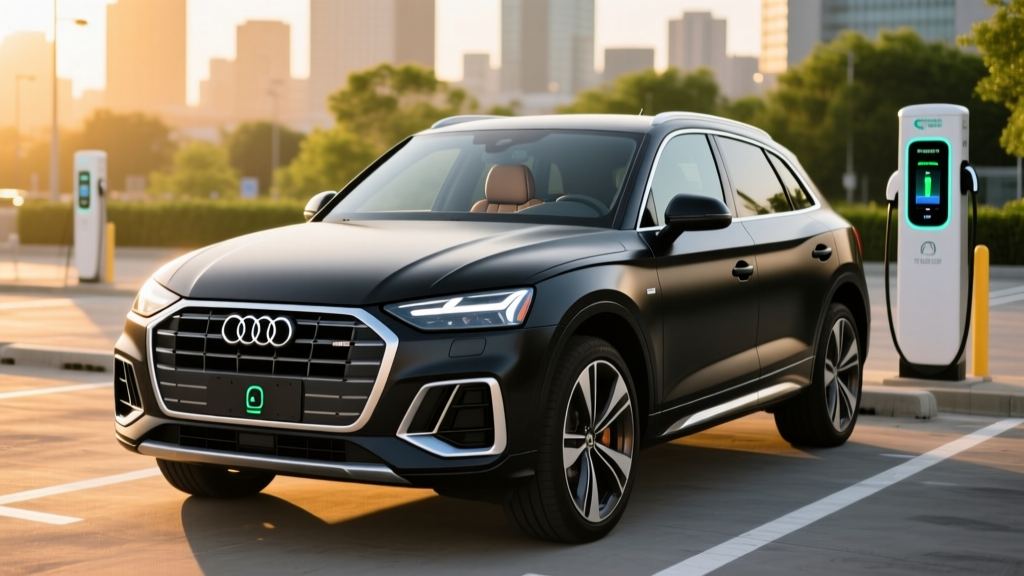
The 2026 Audi Q5 plug-in hybrid—badged the Q5 S line 55 TFSI e—occupies a specific niche: a luxury compact SUV that can handle a daily commute on electricity alone while retaining a turbocharged gas engine for road trips. For buyers searching for an Audi hybrid SUV Q5, understanding the PHEV powertrain, its real-world efficiency, and its ownership economics is essential before signing a lease or purchase agreement.
This guide covers the current-generation Q5 PHEV sold in the United States, with EPA data, charging specifics, warranty terms, and a clear framework for deciding whether this plug-in hybrid fits your driving pattern better than a conventional hybrid (HEV) or a full battery-electric vehicle (BEV).
HEV vs PHEV: What the Audi Q5 Actually Is
Before evaluating specs, it is critical to distinguish the two hybrid architectures, because Audi sells only one Q5 hybrid variant in the US market.
Conventional Hybrid (HEV)
A small battery (typically 1–2 kWh) recharged by regenerative braking and the gas engine. No plug required. The electric motor assists the engine but cannot drive the car on electricity alone for meaningful distances. Examples: Toyota RAV4 Hybrid, Honda CR-V Hybrid.
Plug-In Hybrid (PHEV) — The Audi Q5 55 TFSI e
A larger battery (17.9 kWh usable) that charges via a plug and powers an electric motor capable of 23 miles of zero-emission driving per EPA. Once the battery depletes, the 2.0L turbo engine takes over as a conventional hybrid. You plug in to unlock the PHEV advantage; without plugging in, you are simply driving a heavy, less-efficient gas car.
If you cannot charge at home or at work, a PHEV loses most of its value proposition. The Q5 55 TFSI e is designed for drivers with access to a Level 2 home charger or reliable workplace charging who also need the flexibility of a gas engine for longer trips.
Powertrain Specs: 362 Horsepower From Engine + Motor
| Specification | 2026 Audi Q5 55 TFSI e |
|---|---|
| Gas Engine | 2.0L turbocharged inline-4 (261 hp, 273 lb-ft) |
| Electric Motor | Permanent-magnet synchronous (integrated in transmission) |
| Combined System Output | 362 hp / 369 lb-ft torque |
| Battery (Usable) | 17.9 kWh lithium-ion (NMC chemistry) |
| Transmission | 7-speed S tronic dual-clutch automatic |
| Drivetrain | quattro all-wheel drive |
| 0–60 mph | 5.0 seconds (manufacturer) |
| EPA Electric-Only Range | 23 miles |
| EPA Combined Range (gas + electric) | 380 miles |
| Base MSRP | $58,200 (Premium trim) |
The combined 362 hp output makes the Q5 PHEV significantly quicker than its gas-only Q5 45 TFSI sibling (261 hp, 6.1 seconds to 60). The electric motor fills the torque gap at low RPM, giving the PHEV a responsive, effortless feel in city driving that a conventional turbo four cannot match on its own.
Fuel Economy: EPA MPG and Real-World Expectations
| Mode | City | Highway | Combined |
|---|---|---|---|
| Charge-Depleted (Hybrid Mode) | 25 MPG | 31 MPG | 28 MPG |
| Electric-Only (MPGe) | 78 MPGe | 74 MPGe | 76 MPGe |
Source: EPA fueleconomy.gov
How many MPG does the Audi Q5 hybrid get? Once the battery is depleted, the Q5 PHEV operates as a conventional hybrid returning 28 MPG combined. That is competitive with the gas-only Q5 45 TFSI (25 MPG combined) but not class-leading—the BMW X3 xDrive30e achieves similar figures, while non-hybrid luxury rivals like the base Mercedes GLC 300 manage around 26 MPG combined.
Real-world MPG vs EPA: Plug-in hybrids routinely exceed EPA city figures in real-world driving when the battery is charged, because electric motors are far more efficient in stop-and-go traffic. On a 15-mile urban commute with a full charge, you may burn zero gasoline. Conversely, highway road trips with a depleted battery will see numbers closer to 28–30 MPG—the turbo engine working at sustained load with the added weight of the battery pack (~4,900 lbs curb weight).
In cold weather (below 35°F), expect electric-only range to drop 15–25% due to cabin heating demands and reduced battery efficiency. That 23-mile EPA electric range may shrink to 17–19 miles in a January commute in Chicago or Boston.
Electric-Only Range and Charging Details
How far can the Audi Q5 PHEV go on electric only? The EPA rates the Q5 55 TFSI e at 23 miles of electric-only range. In favorable conditions (moderate temperatures, city speeds under 45 mph), owners report 25–27 miles. At sustained highway speeds of 70+ mph, expect 18–20 miles before the gas engine engages.
EPA Electric Range: 23 miles
Real-World Expectation: 18–27 miles depending on temperature, speed, and terrain. Highway driving and cold weather reduce range; mild city driving extends it.
The 23-mile electric range is adequate for short commutes and school runs but falls short of rivals like the BMW X3 xDrive30e (28 miles EPA) and the Lincoln Corsair Grand Touring (28 miles EPA). If your one-way commute exceeds 20 miles, the Q5 will rely on its gas engine for part of the trip even with a full charge.
Charging Speed and Connectors
The Q5 55 TFSI e accepts AC Level 2 charging at up to 7.2 kW via a J1772 connector (NACS adapter available from Audi for Tesla Supercharger/destination access in future model years, though the PHEV cannot use DC fast charging on Superchargers).
| Charging Level | Power | 0–100% Time | Notes |
|---|---|---|---|
| Level 1 (120V household) | ~1.4 kW | ~13 hours | Emergency/trickle only |
| Level 2 (240V home/public) | 7.2 kW | ~2.5 hours | Standard home charging |
| DC Fast Charge | Not supported | N/A | No CCS or CHAdeMO inlet |
DC fast charging is not available on the Q5 PHEV. This is standard for most plug-in hybrids in this segment—the battery is too small to justify the cost and weight of DC fast-charge hardware. A full Level 2 charge in approximately 2.5 hours means you can top off during a workday or between errands.
Pricing, Trims, and Federal Tax Credit Eligibility
The 2026 Audi Q5 55 TFSI e starts at $58,200 (Premium trim, including destination). The Premium Plus trim adds approximately $4,500, and the Prestige trim adds another $5,000 on top. Options like the S line exterior package, adaptive suspension, and upgraded leather can push a well-equipped Q5 PHEV past $70,000.
Does the Audi Q5 PHEV Qualify for a Federal Tax Credit?
Under IRS §30D New Clean Vehicle Credit rules, the Q5 55 TFSI e may qualify for a partial credit of up to $3,750, depending on battery component and critical-mineral sourcing requirements that shift annually. The credit is subject to:
- MSRP cap: SUVs must have an MSRP at or below $80,000 — the Q5 PHEV qualifies at base, but heavily optioned Prestige models may exceed the cap.
- Buyer income cap: Modified adjusted gross income must not exceed $150,000 (single), $225,000 (head of household), or $300,000 (joint filing).
- Battery sourcing: The $3,750 half-credit requires meeting critical-mineral sourcing thresholds; the full $7,500 additionally requires battery-component manufacturing thresholds. As of the 2026 model year, the Q5 PHEV typically qualifies for one half ($3,750) but verify with your dealer and a tax professional at point of purchase.
- Point-of-sale transfer: Eligible buyers can transfer the credit to the dealer at purchase, reducing the out-of-pocket price immediately rather than waiting for a tax refund.
Always confirm current eligibility on fueleconomy.gov and consult a tax professional. Credit rules and manufacturer sourcing compliance change frequently.
Battery Warranty, Reliability, and Replacement Cost
Hybrid/PHEV Battery Warranty: 8 years / 100,000 miles (whichever comes first), covering defects and capacity loss below a specified threshold (typically 70% of original capacity).
Powertrain Warranty: 4 years / 50,000 miles.
Limited Vehicle Warranty: 4 years / 50,000 miles.
Is the Audi Q5 hybrid reliable? Audi's PHEV powertrain has been in production since the 2020 model year, and major failures are uncommon based on available owner data. However, Audi as a brand consistently ranks mid-to-low in long-term reliability surveys from Consumer Reports and J.D. Power—typically below Lexus, Toyota, and Porsche, and roughly on par with BMW and Mercedes-Benz. The PHEV system adds complexity (two power sources, high-voltage components, additional cooling circuits) compared to a gas-only vehicle.
Battery replacement cost: If the high-voltage battery requires replacement outside of warranty, expect a cost in the range of $8,000–$12,000 including parts and labor at an Audi dealer. This is a significant figure, though it is rare for PHEV batteries to require full replacement within the first decade of ownership. Degradation in PHEVs is generally modest because the battery management system maintains a large buffer—the 17.9 kWh usable capacity sits within a larger gross capacity, protecting the cells from deep cycling stress.
For context, the 12V auxiliary battery (which powers electronics and starts the vehicle's systems) is a separate component that typically requires replacement every 4–6 years at a cost of $300–$500.
Who Should Choose the Q5 PHEV vs a Full EV or Gas SUV
Choose the Audi Q5 55 TFSI e (PHEV) if:
- Your daily round-trip commute is under 25 miles and you can charge at home overnight
- You take 4+ road trips per year exceeding 200 miles and want to avoid public charging dependency
- You want luxury-brand refinement, quattro AWD, and quick acceleration (5.0s 0–60)
- You are not ready to commit to a full EV but want to reduce daily fuel consumption
Choose a Full BEV (e.g., Audi Q4 e-tron, Tesla Model Y) if:
- You have reliable home Level 2 charging and your daily driving is under 250 miles
- You want to eliminate gasoline entirely and minimize maintenance (no oil changes, fewer moving parts)
- You want access to DC fast charging for road trips (200+ kW capability)
- Lower running costs are your top priority
Choose a Gas-Only Q5 45 TFSI if:
- You cannot charge at home or at work (apartment, street parking)
- You want the lowest purchase price ($46,000 base for the gas Q5)
- Your annual mileage is low and fuel savings would not offset the PHEV premium
The Q5 PHEV's $12,000+ premium over the gas-only Q5 45 TFSI is justified primarily by the electric commute capability and the 100-hp power advantage. If you never plug it in, the PHEV becomes a heavier, thirstier version of the gas car—defeating its purpose entirely.
Pros and Cons at a Glance
Pros
- 362 hp combined output; genuinely quick (5.0s 0–60)
- 23-mile electric range covers most short commutes zero-emission
- No range anxiety on road trips — gas engine provides 380+ mile total range
- Standard quattro AWD for all-weather confidence
- Luxury interior with latest MMI infotainment
- Eligible for partial §30D federal tax credit (up to $3,750)
Cons
- Electric-only range (23 mi) trails key rivals (BMW X3 PHEV: 28 mi)
- No DC fast charging — Level 2 only
- $58,200 starting price is steep; options push past $70K
- Mid-pack brand reliability ratings vs Japanese luxury competitors
- Cargo space slightly reduced vs gas Q5 due to battery placement
- Potential $8K–$12K battery replacement cost post-warranty
Frequently Asked Questions
How many MPG does the Audi Q5 hybrid get?
The 2026 Audi Q5 55 TFSI e achieves 28 MPG combined (25 city / 31 highway) once the battery is depleted and it operates as a conventional hybrid. When charged, the first 23 miles use no gasoline (76 MPGe). Real-world city driving with regular charging can result in weeks between fill-ups.
How far can the Audi Q5 PHEV go on electric only?
The EPA rates it at 23 miles electric-only. Real-world results range from about 18 miles (cold weather, highway speeds) to 27 miles (mild weather, city driving). For commutes under 20 miles round-trip, many owners rarely visit a gas station.
Hybrid vs PHEV vs EV — which fits my lifestyle?
A conventional hybrid (HEV) needs no plug and saves fuel automatically—ideal if you lack charging access. A PHEV like the Q5 gives you electric-only commuting when you plug in plus gas flexibility—best if you can charge at home but take long road trips. A full EV (BEV) eliminates gas entirely with the lowest running costs but requires charging infrastructure and route planning for trips beyond ~300 miles.
Is the Audi Q5 hybrid reliable, and what does battery replacement cost?
The PHEV powertrain has proven durable since its 2020 introduction, though Audi's overall brand reliability ranks mid-pack. The high-voltage battery is warranted for 8 years/100,000 miles. Out-of-warranty replacement costs approximately $8,000–$12,000—a figure to factor into long-term ownership plans beyond year eight.
Does the Audi Q5 PHEV qualify for a tax credit?
The Q5 55 TFSI e may qualify for up to $3,750 under the IRS §30D federal credit, subject to battery-sourcing requirements, buyer income limits ($150K single / $300K joint), and the $80,000 SUV MSRP cap. The credit can be transferred to the dealer at point of sale. Confirm current eligibility at irs.gov and with your tax advisor before purchasing.
Can I charge the Q5 PHEV at a Tesla Supercharger?
No. The Q5 PHEV uses a J1772 connector for Level 2 AC charging only and does not support DC fast charging of any kind. Tesla Superchargers provide DC fast charging, which the Q5 PHEV hardware cannot accept. You can charge at any public Level 2 station (ChargePoint, EVgo Level 2, Electrify America AC, etc.).
What happens if I never plug in the Q5 PHEV?
The vehicle will operate as a conventional hybrid using regenerative braking to maintain a small battery buffer. You will see approximately 28 MPG combined. However, you forfeit the primary benefit of the PHEV (electric-only driving), carry the added weight of the battery system, and pay a premium for capability you are not using. If you cannot plug in regularly, the gas-only Q5 45 TFSI is a more cost-effective choice.