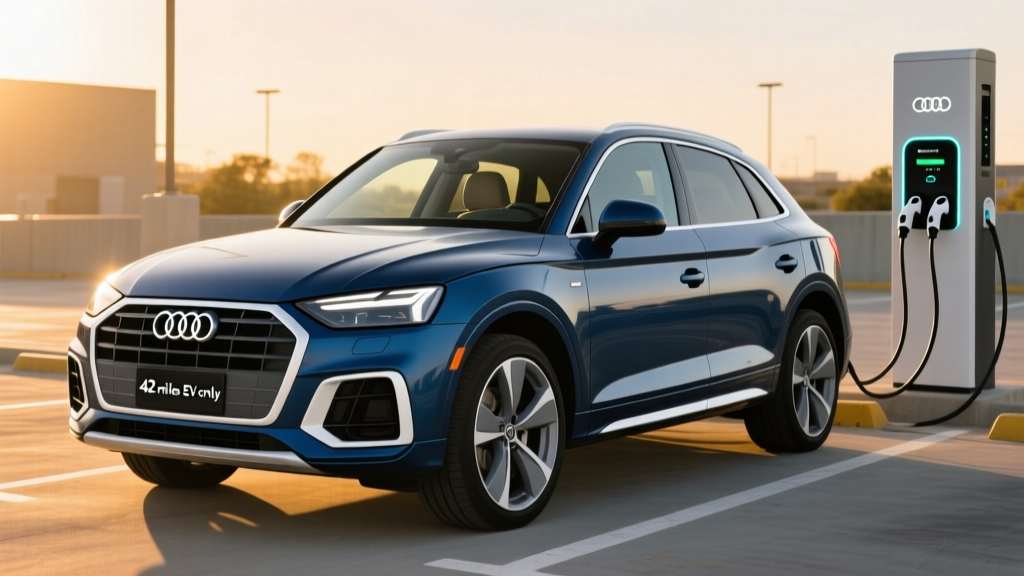
If you've been searching for Audi hybrid Q5 MPG figures, you've likely discovered that Audi's electrified Q5 lineup can be confusing. The brand has shifted its strategy significantly over the past few years, and for the 2026 model year, the Q5's electrification story centers on one primary offering: the Audi Q5 55 TFSI e plug-in hybrid (PHEV). Audi discontinued the conventional mild-hybrid-only Q5 variants in the U.S. market, meaning every new Q5 you can buy today pairs a turbocharged engine with electric assistance — but the degree of that assistance varies dramatically depending on whether you're looking at the standard mild-hybrid powertrain or the full plug-in variant.
This guide breaks down the exact MPG numbers, electric-only range, battery specs, charging requirements, pricing, and tax credit eligibility for the 2026 Audi Q5 hybrid lineup — with the real-world honesty you need to make an informed purchase decision.
Understanding the 2026 Audi Q5 Hybrid Lineup: HEV vs PHEV
Conventional Hybrid (HEV) vs Plug-In Hybrid (PHEV)
| Feature | Mild Hybrid (Q5 45 TFSI) | Plug-In Hybrid (Q5 55 TFSI e) |
|---|---|---|
| Plug-in charging? | No — self-charging via regen | Yes — plug in to access full EV range |
| Electric-only driving | No (electric assist only) | Yes — up to ~23 miles EPA |
| Battery size | ~0.6 kWh (48V system) | 17.9 kWh usable (lithium-ion) |
| Combined horsepower | 261 hp | 362 hp |
| Fuel economy (combined) | 25 MPG EPA | 25 MPG combined (gas) / 61 MPGe (EV+gas) |
| Tax credit eligible? | No | Eligibility varies — see §30D rules below |
The distinction matters enormously for your wallet and your daily driving. A conventional hybrid (HEV) like the Q5 45 TFSI's mild-hybrid system uses a small 48-volt battery and integrated starter-generator to smooth stop/start events and provide brief torque assist. You never plug it in, and it cannot drive on electric power alone. A plug-in hybrid (PHEV) like the Q5 55 TFSI e carries a much larger battery pack, a more powerful electric motor, and a charge port — giving you genuine electric-only commuting capability before the gas engine kicks in.
Audi Q5 Hybrid MPG: EPA City, Highway, and Combined
| Model | City MPG | Highway MPG | Combined MPG | MPGe (PHEV) |
|---|---|---|---|---|
| Q5 45 TFSI (Mild Hybrid) | 23 | 28 | 25 | N/A |
| Q5 55 TFSI e (PHEV — gas only) | 24 | 27 | 25 | 61 MPGe combined |
Source: EPA Fuel Economy
How Many MPG Does the Audi Q5 Hybrid Actually Get?
The headline number — 25 MPG combined for both the mild-hybrid 45 TFSI and the PHEV 55 TFSI e when running on gasoline — may seem underwhelming for a "hybrid." That's because the Q5 is a 4,500+ pound luxury SUV with standard quattro all-wheel drive, and Audi has tuned the PHEV powertrain for performance (362 hp, 0-60 in 5.0 seconds) rather than maximum efficiency.
Real-world MPG reality check: In mixed suburban and city driving where the PHEV's regenerative braking shines, owners frequently report 27-29 MPG on gasoline once the battery is depleted — slightly better than the EPA's combined estimate. On the highway at 75+ mph, expect 24-26 MPG, as aerodynamic drag dominates and the electric motor provides less benefit. In cold weather (below 30°F), the engine runs more frequently for cabin heating, and expect gas-mode efficiency to drop to 22-24 MPG combined.
The mild-hybrid 45 TFSI delivers its best efficiency on the highway, where the 48V system's coasting function can shut down the engine entirely during deceleration. In city driving, expect 21-23 MPG real-world — the mild system helps, but can't match the stop-start efficiency of a full hybrid system like Toyota's.
Q5 55 TFSI e Electric-Only Range and Total Range
Electric-Only Range: EPA vs Real World
EPA-rated electric range: 23 miles
Real-world expectation: 18-21 miles in moderate weather; 14-17 miles in cold weather (below 35°F) or at sustained highway speeds above 70 mph
Total combined range (EV + gas): Approximately 380-400 miles with a full tank and full battery
The 2026 Q5 55 TFSI e carries a 17.9 kWh usable battery (gross capacity is approximately 20.9 kWh, with a software buffer to protect longevity). That battery powers a 141-hp electric motor integrated into the 7-speed S tronic dual-clutch transmission. In EV mode, the Q5 PHEV can reach speeds up to 84 mph on electric power alone — sufficient for most suburban and highway merging scenarios.
How far can it go on electric only? The EPA's 23-mile estimate assumes a mix of city and suburban driving at moderate temperatures. In practice, if your commute is 15-18 miles round trip with moderate climate control use, you'll likely complete it entirely on electricity. Push it to 70 mph on the freeway with the A/C blasting, and you'll see that range contract to 16-18 miles.
Battery, Charging, and Powertrain Specifications
| Specification | Q5 45 TFSI (Mild Hybrid) | Q5 55 TFSI e (PHEV) |
|---|---|---|
| Engine | 2.0L turbo I4 | 2.0L turbo I4 |
| Electric motor | 48V belt-driven starter-generator | 141 hp permanent-magnet synchronous motor |
| Combined output | 261 hp / 273 lb-ft | 362 hp / 369 lb-ft |
| Transmission | 7-speed S tronic dual-clutch | 7-speed S tronic dual-clutch |
| Drivetrain | quattro AWD | quattro AWD (electric rear axle assist) |
| Battery capacity | ~0.6 kWh (48V) | 17.9 kWh usable (li-ion NMC) |
| Level 1 charging (120V) | N/A | ~8 hours (0-100%) |
| Level 2 charging (240V) | N/A | ~2.5 hours at 7.7 kW (0-100%) |
| DC fast charging | N/A | Not available |
| Charge port | None | CCS/J1772 (right rear quarter panel) |
| 0-60 mph | 5.7 seconds | 5.0 seconds |
| Cargo volume (rear seats up) | 25.8 cu ft | 23.7 cu ft (battery reduces space) |
Charging the Q5 PHEV: What You Need to Know
The Q5 55 TFSI e accepts a maximum of 7.7 kW on Level 2 (240V) AC charging. This is adequate for overnight replenishment but means you cannot take advantage of faster public AC chargers rated at 11 or 22 kW. Critically, the Q5 PHEV does not support DC fast charging — a limitation common to most PHEVs in this segment (the BMW X5 xDrive50e and Volvo XC60 Recharge also lack DC fast charging). This means the battery can only be replenished via Level 1 or Level 2 AC power.
For most PHEV owners, this is perfectly fine: you plug in at home overnight, wake up to a full battery, and cover your daily commute on electricity. The 2.5-hour Level 2 charge time means you could also top up during a workday if your office offers Level 2 charging.
Pricing, Tax Credits, and Ownership Costs
2026 Audi Q5 Hybrid MSRP by Trim
| Model / Trim | Base MSRP | Est. Price After Federal Credit |
|---|---|---|
| Q5 45 TFSI Premium (Mild Hybrid) | $46,495 | N/A — no federal EV/PHEV credit |
| Q5 55 TFSI e Premium (PHEV) | $58,995 | Varies — see §30D eligibility below |
| Q5 55 TFSI e Premium Plus (PHEV) | $63,495 | Varies |
| Q5 55 TFSI e Prestige (PHEV) | $68,195 | Varies |
Does the Audi Q5 PHEV Qualify for a Federal Tax Credit?
Federal §30D Tax Credit Eligibility Checklist (2026 Rules)
- Vehicle MSRP cap: SUVs must be under $80,000 — all Q5 55 TFSI e trims qualify ✓
- Buyer income cap: Modified AGI must not exceed $150,000 (single) / $300,000 (joint) — verify your situation
- Battery sourcing requirements: Critical minerals and battery component rules have tightened annually since 2024. Audi's PHEV battery sourcing has been inconsistent with §30D requirements. As of early 2026, the Q5 55 TFSI e's credit eligibility is partial or unavailable depending on the specific battery supply chain certification for the current production batch.
- Point-of-sale transfer: If eligible, you can transfer the credit to the dealer at purchase for an immediate price reduction rather than waiting for tax filing
- Credit amount: Up to $3,750 (critical minerals) + up to $3,750 (battery components) = maximum $7,500 — but partial eligibility is common for European-manufactured PHEVs
Always verify current eligibility at fueleconomy.gov and consult a tax professional. Rules change frequently — IRS.gov §30D guidance is the definitive source.
This is the single biggest variable in the Q5 PHEV's value equation. Unlike domestically assembled competitors (the Jeep Grand Cherokee 4xe qualifies more consistently), the Q5's German manufacturing and battery supply chain have made full §30D credit eligibility uncertain. Some buyers may qualify for $3,750, some for the full $7,500, and some for nothing — depending on the production date and current IRS sourcing certifications. Check the VIN-specific eligibility tool on fueleconomy.gov before committing to a purchase.
Battery Warranty, Reliability, and Replacement Costs
Audi Q5 55 TFSI e Battery Warranty
High-voltage battery warranty: 8 years / 100,000 miles (whichever comes first)
Coverage threshold: Battery must retain at least 70% of original capacity during the warranty period
Powertrain warranty: 4 years / 50,000 miles
Estimated out-of-warranty battery replacement: $8,000 - $14,000 (based on current Audi PHEV battery pricing; expected to decline as battery costs fall)
Is the Audi Q5 Hybrid Reliable?
Audi's PHEV powertrain in the Q5 has been in production since the 2020 model year, giving it a solid track record. The 2.0L TFSI engine is one of Volkswagen Group's most widely deployed powerplants, and the electric motor and power electronics have proven durable. The main reliability concerns reported by owners center on:
- Charging system software glitches: Occasional communication errors between the vehicle and Level 2 chargers, typically resolved via OTA updates or dealer reflashes
- 12V battery drain: Like many modern Audis, the 12V auxiliary battery can drain if the vehicle sits unplugged for extended periods — the high-voltage system does not automatically maintain the 12V battery when parked
- Coolant system complexity: The PHEV has separate cooling circuits for the engine, battery, and power electronics — more potential failure points than a conventional vehicle, though failures have been infrequent
The high-voltage battery uses NMC (nickel manganese cobalt) chemistry, which offers high energy density but is more sensitive to heat degradation than LFP. Audi's thermal management system actively cools the pack, and the software buffer (roughly 3 kWh held in reserve above and below the usable window) protects against deep cycling damage. Expect 5-8% capacity loss over the first 5 years based on owner-reported data from 2020-2024 models — well within the 70% warranty threshold.
As for battery replacement cost: if you need a new high-voltage pack outside of warranty, expect $8,000 to $14,000 including labor at an Audi dealer. However, individual cell module replacement (if only one section has degraded) can cost significantly less — approximately $2,000-$4,000. Battery costs continue to decline, and by the time a 2026 model exits its warranty period in 2034, aftermarket and refurbished options will likely be available at lower prices.
Real-World Efficiency: What Owners Actually Report
EPA numbers tell only part of the story. Here's what 2024-2025 Q5 55 TFSI e owners consistently report on forums and tracking apps like Fuelly:
| Driving Scenario | Observed Efficiency |
|---|---|
| City commute, battery charged daily | 60-80 MPGe (majority of miles on electricity) |
| Suburban mixed driving, battery charged daily | 45-55 MPGe |
| Highway road trip (battery depleted) | 24-26 MPG gas-only |
| Winter city driving (below 30°F) | 18-20 MPG gas-only (EV range drops to ~15 mi) |
| Never charging (gas-only operation) | 22-25 MPG combined |
The critical insight: a PHEV's efficiency is entirely dependent on how often you charge it. If you plug in every night and your commute is under 20 miles, you may use 2-3 gallons of gasoline per month. If you never plug in, you're carrying 400+ pounds of battery and electric motor hardware you're not using — and getting worse fuel economy than the lighter mild-hybrid Q5 45 TFSI. The PHEV only makes financial and environmental sense if you have reliable access to charging.
Who Should Choose the Q5 Hybrid vs a Full EV or Gas SUV?
Decision Framework: Which Q5 Powertrain Fits You?
Choose the Q5 45 TFSI (mild hybrid) if:
- You cannot charge at home or work (apartment, street parking, no electrical access)
- You want the lowest purchase price and simplest ownership experience
- You drive primarily highway miles where hybrid benefits are minimal
- You prefer not to think about charging or battery management
Choose the Q5 55 TFSI e (PHEV) if:
- You have Level 2 charging at home and a commute under 25 miles round trip
- You want electric daily driving but need gas flexibility for road trips and towing
- You value the 362 hp combined output — the PHEV is the quickest Q5 variant
- You live in a state with HOV lane access for PHEVs (check your local rules)
Choose a full EV (e.g., Audi Q4 e-tron, Tesla Model Y, BMW iX3) if:
- You have home charging and rarely drive more than 250 miles in a single day
- You want to eliminate gasoline entirely and minimize maintenance
- Your state offers additional EV purchase incentives beyond federal credits
- You want the lowest per-mile fuel cost (electricity at $0.13/kWh ≈ $0.04/mile vs gasoline at $3.50/gal ≈ $0.14/mile)
Q5 55 TFSI e Pros
- Genuine electric-only commuting (18-23 mi real-world)
- 362 hp with seamless electric torque fill — quickest Q5
- No range anxiety — gas engine covers long trips
- Premium interior, ride quality, and quattro AWD
- Eligible for partial or full §30D credit (VIN-dependent)
Q5 55 TFSI e Cons
- No DC fast charging — AC only at 7.7 kW max
- Reduced cargo space vs gas Q5 (23.7 vs 25.8 cu ft)
- Gas-only MPG (25 combined) is unremarkable for a hybrid
- Premium fuel recommended for best performance
- Tax credit eligibility uncertain due to battery sourcing rules
Frequently Asked Questions
How many MPG does the Audi Q5 hybrid get?
The 2026 Audi Q5 55 TFSI e PHEV achieves 25 MPG combined (24 city / 27 highway) when running on gasoline, and 61 MPGe when combining electric and gas operation. The mild-hybrid Q5 45 TFSI gets 25 MPG combined (23 city / 28 highway). Real-world results vary: expect 27-29 MPG in suburban driving for the PHEV and 21-23 MPG city for the mild hybrid.
How far can the Audi Q5 PHEV go on electric only?
The EPA rates the Q5 55 TFSI e at 23 miles of electric-only range. In real-world conditions, expect 18-21 miles in moderate weather and 14-17 miles in cold weather or at sustained highway speeds. This is sufficient for most daily commutes under 20 miles round trip.
Does the Audi Q5 hybrid need to be plugged in?
It depends on the model. The Q5 45 TFSI mild hybrid never needs to be plugged in — it charges its small 48V battery through regenerative braking and engine power. The Q5 55 TFSI e PHEV should be plugged in regularly (ideally nightly) to take advantage of its 23-mile electric range. Without plugging in, the PHEV operates as a heavy gas-only vehicle with mediocre fuel economy.
Is the Audi Q5 hybrid reliable, and what does battery replacement cost?
The Q5 PHEV powertrain has proven reliable since its 2020 introduction, with the main concerns being software-related rather than mechanical. The high-voltage battery is covered by an 8-year/100,000-mile warranty with a 70% capacity retention guarantee. Out-of-warranty battery replacement costs approximately $8,000-$14,000, though individual module replacement is cheaper. Battery costs are expected to decline over the coming decade.
Does the Audi Q5 PHEV qualify for the federal tax credit?
Eligibility for the §30D federal clean vehicle credit is VIN-specific and depends on the battery's critical mineral and component sourcing, which has been inconsistent for the German-built Q5 PHEV. The MSRP is under the $80,000 SUV cap, but you must check your specific vehicle's eligibility on fueleconomy.gov and verify your income falls under the $150,000 (single) / $300,000 (joint) cap. Some buyers may qualify for $3,750, some for the full $7,500, and some for no credit at all. Consult a tax professional for your situation.
Hybrid vs PHEV vs full EV — which should I choose?
If you have home charging and a short commute, the PHEV gives you electric daily driving with gas backup for road trips — the best of both worlds. If you can't charge at home, the mild hybrid requires no behavior change but offers modest efficiency gains. If you have home charging and rarely exceed 250 miles in a day, a full EV like the Audi Q4 e-tron or Tesla Model Y will offer lower running costs, less maintenance, and a smoother driving experience — but you'll need to plan for longer trips around DC fast charging.