The 2026 Audi Q5 e hybrid quattro occupies a specific niche: a luxury compact SUV that lets you drive short commutes on electricity alone while keeping a gas engine for longer trips. It's a plug-in hybrid (PHEV), not a conventional hybrid, and that distinction drives everything from daily fuel costs to federal tax credit eligibility. Below is a data-driven breakdown of what this powertrain actually delivers on the road — and whether it makes sense versus a full EV or a standard Q5.
HEV vs PHEV: Where the Q5 e Fits
Conventional Hybrid (HEV): Regenerates energy through braking and the engine to charge a small battery (~1-2 kWh). You never plug it in. Example: Toyota RAV4 Hybrid. EPA-rated around 40 MPG combined.
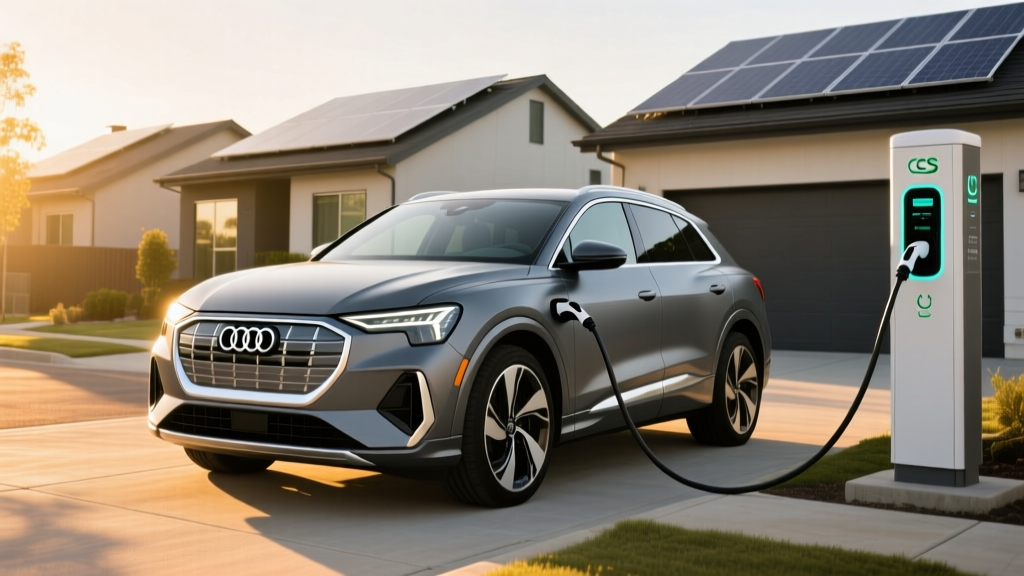
Plug-in Hybrid (PHEV): Carries a larger battery you charge via a wall outlet or public charger. Delivers 20-30+ miles of electric-only driving before the gas engine kicks in. Example: this Audi Q5 e. You can drive it without plugging in, but you lose most of the efficiency and cost benefit.
The Q5 e is firmly a PHEV. If you charge it nightly at home, your weekday commute may burn zero gasoline. If you never plug it in, you're hauling 500+ lbs of dead battery weight and getting worse fuel economy than a conventional hybrid — defeating the purpose entirely.
Powertrain and Performance Specs
| Specification | 2026 Audi Q5 S Line 55 TFSI e |
|---|---|
| Engine | 2.0L turbocharged 4-cylinder (261 hp) |
| Electric Motor | 141 hp, integrated into 7-speed S tronic |
| Combined System Output | 362 hp / 369 lb-ft torque |
| 0-60 mph | 5.0 seconds |
| Drivetrain | quattro all-wheel drive |
| Battery (gross / usable) | 17.9 kWh / ~14.1 kWh |
| Battery Chemistry | NMC (nickel manganese cobalt) |
| Transmission | 7-speed dual-clutch automatic |
| Towing Capacity | 4,400 lbs |
The dual-powertrain layout gives the Q5 e genuine passing power — 362 hp in a compact luxury SUV is brisk. The electric motor fills in torque at low RPMs where the turbo four has slight lag, making city driving feel responsive. Quattro AWD is standard, with the rear axle driven mechanically through the transmission (not a separate rear motor, unlike some competitors).
Electric-Only Range and Total Range
EPA Electric-Only Range: 23 miles
Real-World Expectation: 18-21 miles in mixed driving; 15-17 miles at sustained highway speeds or in cold weather (below 40°F). The electric motor is adequate for neighborhood and suburban speeds but works harder — and drains faster — above 65 mph.
Total Combined Range (electric + gas): ~420 miles on a full charge and full 18.5-gallon tank.
Twenty-three EPA-rated electric miles covers many commutes. According to fueleconomy.gov, the average American one-way commute is roughly 16 miles. If yours falls under 20 miles round-trip and you charge at home, you'll rarely visit a gas station on weekdays. For longer weekend trips, the gas engine takes over seamlessly — no range anxiety, no charging-station planning required.
Fuel Economy: EPA vs Real-World MPG
| Mode | City | Highway | Combined |
|---|---|---|---|
| Charge-Depleting (EV mode) | 23 miles electric, then hybrid mode | ||
| Hybrid Mode (battery depleted) | 25 MPG | 28 MPG | 26 MPG |
| MPGe (electric + gas combined) | 61 MPGe | ||
Real-world MPG notes: Once the battery is depleted, expect 24-27 MPG combined in mixed driving. Highway cruising at 75+ mph may dip to 23-24 MPG due to aerodynamic drag and the vehicle's 4,600-lb curb weight. City driving with frequent regenerative braking opportunities can push toward 28-29 MPG on a depleted battery. These figures assume you're not regularly recharging between drives — if you are, your effective fuel consumption drops dramatically.
Compared to a gas-only 2026 Q5 45 TFSI (EPA 25 MPG combined), the PHEV saves meaningful fuel only if you actually plug in. Without charging, the efficiency gap narrows to just 1-2 MPG.
Charging: Level 1, Level 2, and the No-DC-Fast-Charge Limitation
| Charging Level | Power | 0-100% Time | Availability |
|---|---|---|---|
| Level 1 (120V household) | ~1.4 kW | ~12 hours | Any standard outlet |
| Level 2 (240V home/public) | 7.7 kW | ~2.5 hours | Home wallbox, public AC stations |
| DC Fast Charging | NOT SUPPORTED — no CCS DC inlet | ||
This is a critical limitation for some buyers: the Q5 e cannot DC fast charge. The J1772/Type 1 AC inlet is the only charge port. That means no topping up at Electrify America or Tesla Supercharger stations on road trips. For a PHEV with 23 miles of range and a 2.5-hour Level 2 charge time, this is less painful than it would be on a full EV — but if you were hoping to charge quickly during a grocery stop, that's not an option here.
Home charging recommendation: A Level 2 home charger (240V, 32-amp circuit) is essentially mandatory to make this PHEV practical. Budget $500-$1,200 for a quality Level 2 unit (ChargePoint Home Flex, Emporia Level 2) and $800-$2,500 for professional installation depending on your panel capacity and run length, per Department of Energy guidance. Total: $1,300-$3,700 for a reliable home setup.
Pricing, Trims, and Federal Tax Credit Eligibility
| Trim | Base MSRP | Est. After Federal Credit |
|---|---|---|
| Q5 S Line 55 TFSI e Premium | $58,200 | $54,450* |
| Q5 S Line 55 TFSI e Premium Plus | $62,800 | $59,050* |
| Q5 S Line 55 TFSI e Prestige | $67,400 | $63,650* |
*Tax credit estimates assume full eligibility. Actual credit varies.
Federal §30D PHEV Credit Requirements (2026 rules per IRS.gov):
- Credit amount: Up to $3,750 for the Q5 e (based on battery capacity ≥16 kWh; critical mineral and battery component sourcing requirements may reduce this from $7,500)
- MSRP cap: SUVs must be under $80,000 — all Q5 e trims qualify
- Buyer income cap: AGI ≤ $150,000 (single) / $300,000 (joint) / $225,000 (head of household)
- Battery sourcing: Critical minerals and battery components must meet phased-in domestic/free-trade sourcing thresholds — Audi's supply chain compliance varies by build date
- Point-of-sale transfer: Eligible buyers can transfer the credit to the dealer at purchase, reducing the sale price directly
Important: Consult a tax professional before purchase. Sourcing rules tighten annually, and a vehicle that qualifies in January may not in December. Verify current eligibility on the IRS clean vehicle credit page before signing.
Battery Warranty, Reliability, and Replacement Cost
High-Voltage Battery Warranty: 8 years / 100,000 miles (whichever comes first), covering defects and capacity loss below ~70% of original capacity.
Powertrain Warranty: 4 years / 50,000 miles (Audi's standard new-vehicle coverage).
Battery Replacement Cost (out of warranty): Estimated $12,000-$16,000 for the PHEV battery pack, plus $1,500-$3,000 labor. Significantly cheaper than a full-EV battery replacement but still a meaningful expense in years 10+.
PHEV batteries are smaller and experience shallower charge cycles than full-EV packs, which generally translates to slower degradation. Audi's 8-year/100,000-mile warranty is industry-standard and federally mandated for emissions-related components (which includes the hybrid battery under EPA regulations). Real-world data from earlier-generation Audi PHEVs (A7, A8 TFSI e) suggests 5-8% capacity loss over 5 years / 60,000 miles — well within warranty thresholds.
The more common reliability concern with the Q5 e isn't the battery — it's the complexity of managing two powertrains. Turbo engine maintenance (oil, coolant, spark plugs) continues alongside electric motor and power electronics service. Historical Audi reliability data from owner surveys places the brand mid-pack among luxury manufacturers, with PHEV-specific issues being rare but expensive when they occur.
Q5 e vs Full EV vs Gas Q5: Decision Framework
Choose the Q5 e PHEV if:
- Your daily round-trip commute is under 25 miles and you can charge at home
- You take 4+ road trips per year over 200 miles and don't want to plan around DC chargers
- You want quattro AWD and luxury features without full-EV pricing
- You're in a region with unreliable public charging infrastructure
Choose a full EV (e.g., Audi Q8 e-tron, Tesla Model Y) if:
- You have reliable home Level 2 charging and your trips rarely exceed 250 miles
- You want near-zero routine maintenance (no oil changes, no spark plugs)
- You want access to DC fast charging for road trips
- You want the maximum federal tax credit ($7,500 for qualifying EVs)
Choose the gas Q5 45 TFSI if:
- You cannot charge at home (apartment, street parking, no garage)
- Your budget is under $50,000 and you don't qualify for tax credits
- You drive over 20,000 miles/year mostly on highways where PHEV electric range is irrelevant
Pros and Cons at a Glance
Pros
- 23 miles electric covers most commutes gas-free
- 362 hp combined delivers genuine acceleration (5.0s 0-60)
- No range anxiety — 420+ miles total range
- Quattro AWD standard, 4,400-lb towing
- Eligible for partial federal tax credit (up to $3,750)
- Quiet, smooth EV-mode city driving
Cons
- No DC fast charging — AC only
- $58,200+ starting price is steep for a compact SUV
- 26 MPG on depleted battery is only marginally better than gas Q5
- Requires home Level 2 charger investment ($1,300-$3,700)
- Cargo space slightly reduced vs gas Q5 (battery under floor)
- Two powertrains mean double the maintenance systems
Frequently Asked Questions
How many MPG does the Audi Q5 e hybrid get?
Once the battery is depleted, the Q5 e returns EPA-rated 25 city / 28 highway / 26 combined MPG. If you charge daily and commute under 23 miles, you may use little to no gasoline on weekdays. The combined MPGe rating (accounting for electric driving) is 61 MPGe.
How far can the Q5 e go on electric only?
The EPA rates it at 23 miles electric-only. Expect 18-21 miles in real-world mixed driving, and as little as 15-17 miles at sustained highway speeds or in freezing temperatures. The electric motor is best suited for speeds under 65 mph.
Does the Audi Q5 e qualify for a tax credit?
It may qualify for a partial federal §30D credit — up to $3,750 depending on battery sourcing compliance, buyer income, and MSRP (all trims are under the $80,000 SUV cap). Eligibility changes as sourcing rules tighten. Verify on IRS.gov before purchase.
Can I charge the Q5 e at a public fast-charging station?
No. The Q5 e only accepts AC charging (Level 1 and Level 2) via a J1772 connector. It has no DC fast-charge capability. Plan to charge at home overnight or at Level 2 public stations (grocery stores, workplaces, parking garages).
Is the Q5 PHEV reliable, and what does a battery replacement cost?
The high-voltage battery is warrantied for 8 years / 100,000 miles. Out-of-warranty replacement is estimated at $12,000-$16,000 plus labor. PHEV batteries generally degrade slower than full-EV packs due to smaller capacity and shallower cycles. The main reliability consideration is the added complexity of two powertrains requiring separate maintenance schedules.
Do I have to plug it in, or does it charge itself?
The Q5 e is a plug-in hybrid. While regenerative braking and the engine do maintain some charge, you must plug in to access the full 23-mile electric range and the efficiency/cost benefits. Without plugging in, you're carrying heavy battery weight for minimal gain — a conventional hybrid would serve you better.
How does the Q5 e compare to the BMW X3 xDrive30e or Mercedes GLC 350e?
The BMW X3 PHEV offers similar electric range (~22 miles EPA) with slightly lower starting pricing. The Mercedes GLC 350e is a newer redesign with competitive range. The Audi differentiates with standard S Line sport styling, a more powerful combined output (362 hp vs competitors' ~288-312 hp), and Audi's virtual cockpit/dual-screen interior. All three lack DC fast charging.