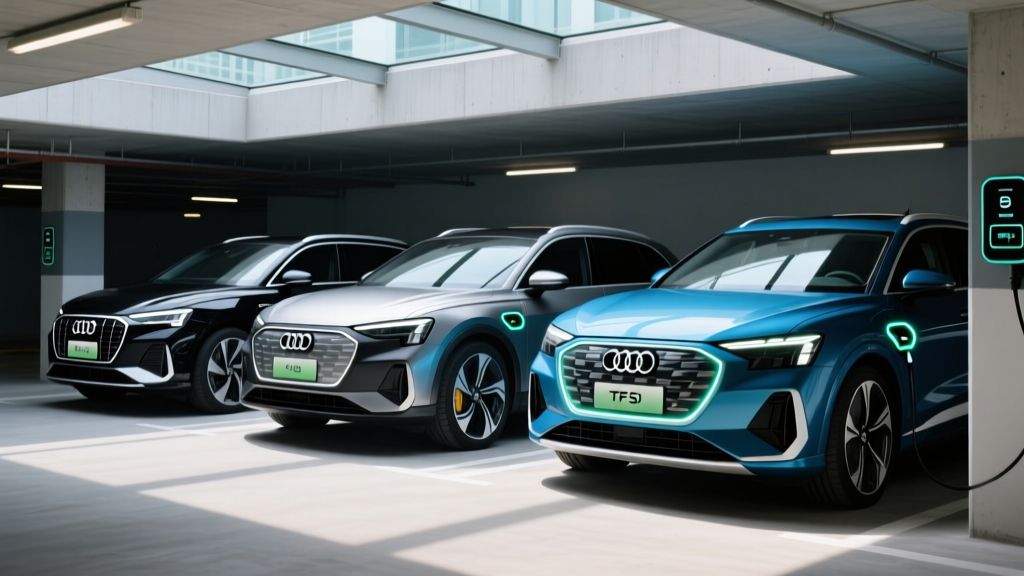
If you're researching an Audi hybrid plug in option, you're likely weighing the appeal of electric-only commuting against the flexibility of a gas engine for longer road trips. Audi's current plug-in hybrid electric vehicle (PHEV) lineup, badged as TFSI e, spans from the compact Q5 to the flagship Q8 SUV. These vehicles pair turbocharged gasoline engines with electric motors and medium-capacity battery packs, offering 20–30 miles of zero-tailpipe-emission driving before seamlessly switching to hybrid mode.
This guide breaks down every current Audi PHEV with exact EPA figures, real-world expectations, battery specs, charging requirements, and the federal tax credit rules that could save you thousands — or disqualify you entirely.
HEV vs PHEV: What Audi Actually Sells
Conventional Hybrid (HEV)
A conventional hybrid uses a small battery recharged by the engine and regenerative braking. You never plug it in. Audi currently does not sell a traditional HEV in the US market. If you see older Audi "mild hybrid" (MHEV) badges, those use a 12V or 48V system for slight efficiency gains — they cannot drive on electric power alone.
Plug-In Hybrid (PHEV)
A plug-in hybrid carries a much larger battery (14–25 kWh usable) that you charge via a plug — at home on a Level 2 charger or on public AC infrastructure. It can drive 20–30+ miles on electricity alone before the gas engine engages. All current Audi electrified models in the US are PHEVs.
This distinction matters: when you search for an Audi hybrid plug in, you're looking at a PHEV that requires charging access to unlock its full value. Without plugging in, you're simply carrying extra battery weight and getting marginally better fuel economy than a gas-only Audi.
2026 Audi TFSI e Lineup: Specs at a Glance
| Model | Battery (kWh usable) | EV Range (EPA) | Combined HP | 0–60 mph | MPGe (combined) | Gas MPG (combined) | Starting MSRP |
|---|---|---|---|---|---|---|---|
| Q5 55 TFSI e | 17.9 kWh | 23 mi | 362 hp | 5.0 sec | 61 MPGe | 26 MPG | $58,200 |
| Q8 55 TFSI e | 17.9 kWh | 24 mi | 375 hp | 5.6 sec | 56 MPGe | 22 MPG | $79,600 |
| A7 55 TFSI e | 14.1 kWh | 21 mi | 362 hp | 5.1 sec | 58 MPGe | 25 MPG | $74,900 |
Source: fueleconomy.gov and Audi USA official specifications. Figures reflect 2025/2026 model year EPA estimates. Real-world results vary with temperature, terrain, and driving style.
Electric-Only Range: Real-World vs EPA Sticker
EPA Electric Range: 21–24 miles depending on model
Real-World Expectation: 17–22 miles in mixed driving; as low as 13–16 miles in freezing weather with cabin heat on; up to 25 miles in mild city driving under 45 mph.
Audi's TFSI e models use NMC (nickel-manganese-cobalt) lithium-ion battery chemistry, chosen for its high energy density in a compact package. The usable capacity is intentionally buffered — Audi locks out a portion of the gross capacity to protect long-term battery health, meaning you'll never see a true 0% or 100% on the dash.
In practice, the Q5 55 TFSI e delivers enough electric range for most daily commutes. According to the US Bureau of Transportation Statistics, the average one-way commute is roughly 16 miles. If you can charge at home overnight, you may go weeks without the gasoline engine engaging — until you take a road trip and appreciate the 400+ mile total range.
Total combined range (electric + gas): approximately 380–430 miles depending on model and driving conditions.
Charging: Level 2 Only, No DC Fast Charging
Every current Audi TFSI e PHEV charges via a J1772 connector (the North American standard for AC charging). Here's what you need to know about charging speeds:
| Charging Level | Power (kW) | Time to Full (0–100%) | Miles of EV Range per Hour |
|---|---|---|---|
| Level 1 (120V household outlet) | 1.4 kW | 12–14 hours | ~2–3 mi/hr |
| Level 2 (240V, home or public AC) | 7.2 kW (onboard charger max) | 2.5–3.5 hours | ~8–10 mi/hr |
| DC Fast Charging | Not supported. Audi PHEVs do not have CCS or NACS DC fast-charge capability. | ||
This is a critical limitation to understand: Audi's PHEVs cannot use DC fast chargers (the 50–350 kW stations you see along highways). The onboard AC charger maxes out at 7.2 kW, meaning even at a public Level 2 ChargePoint or Electrify America AC station, you're looking at roughly 2.5 hours for a full charge.
For most PHEV owners, this isn't a dealbreaker. The strategy is simple: plug in at home overnight on a Level 2 wallbox, wake up to a full battery every morning, and use gas for longer trips. If you lack home charging access, a PHEV becomes far less compelling — you'd rely on the less efficient hybrid mode and miss the core value proposition.
Home charging setup: A 240V / 32A Level 2 wallbox (such as a ChargePoint Home Flex or Emporia Vue) costs $500–$800 for the unit, plus $500–$2,000 for professional electrician installation depending on your panel capacity and wiring run. See our home charging installation guide for a full cost breakdown.
Fuel Economy: EPA MPG and Real-World Results
| Model | EV Mode (MPGe) | Gas-Only City | Gas-Only Highway | Gas-Only Combined |
|---|---|---|---|---|
| Q5 55 TFSI e | 61 MPGe | 25 MPG | 27 MPG | 26 MPG |
| Q8 55 TFSI e | 56 MPGe | 20 MPG | 24 MPG | 22 MPG |
| A7 55 TFSI e | 58 MPGe | 24 MPG | 27 MPG | 25 MPG |
Real-world MPG note: Once the battery depletes, PHEVs operate as conventional hybrids. Unlike Toyota's hybrid system (which excels at city efficiency through aggressive regen), Audi's PHEV powertrain prioritizes performance — the turbocharged 2.0L engine and electric motor together produce up to 375 hp. Expect real-world gas-only MPG to land within 1–2 MPG of the EPA estimate in mixed driving. Highway-heavy routes at 75+ mph may drop 2–3 MPG below the sticker, particularly in the heavier Q8.
If you charge daily and commute within the electric range, your effective fuel consumption could drop to near zero for weekday driving. On a 300-mile road trip, however, you'll average the gas-only combined figure once the battery depletes — typically within the first 25 miles.
Powertrain Deep Dive: Engine + Electric Motor
All current Audi TFSI e models share a common architecture:
- Engine: 2.0-liter turbocharged inline-4 (TFSI), producing 261 hp and 273 lb-ft of torque
- Electric motor: Integrated into the transmission housing, producing 141 hp (105 kW) and 258 lb-ft
- Combined output: 362–375 hp depending on model tuning and boost mode
- Transmission: 7-speed S tronic dual-clutch automatic
- Drivetrain: quattro all-wheel drive (standard on all TFSI e models)
The electric motor provides instant torque from 0 rpm, which makes these PHEVs feel considerably quicker than their gas-only siblings off the line. The Q5 55 TFSI e hits 60 mph in 5.0 seconds — nearly a full second quicker than the gas-only Q5 45 TFSI.
Audi offers selectable drive modes: EV mode (electric-only up to ~84 mph), Hybrid mode (system decides optimal blend), Battery Hold (preserves charge for later — useful when entering a city center after highway driving), and Battery Charge (uses the engine to recharge the battery while driving, at the cost of fuel economy).
Federal Tax Credit Eligibility (§30D) and Pricing
Federal tax credit rules for PHEVs fall under IRS §30D, the same Clean Vehicle Credit that applies to full EVs. However, qualifying for the credit involves multiple hurdles that eliminate many Audi PHEVs:
§30D Credit Requirements for PHEVs:
- Battery capacity: Must be at least 7 kWh (all Audi TFSI e models qualify)
- MSRP cap: SUVs/vans/pickups ≤ $80,000; sedans ≤ $55,000
- Buyer income cap: AGI ≤ $150,000 (single), $225,000 (head of household), $300,000 (joint)
- Final assembly: Must be assembled in North America
- Battery sourcing: Critical minerals and battery components must meet phased-in domestic/free-trade sourcing thresholds (increasingly strict through 2026)
- Point-of-sale transfer: Eligible buyers can apply the credit as an instant dealer discount rather than waiting for tax filing
Current eligibility reality for Audi PHEVs (2026):
- Q5 55 TFSI e ($58,200 MSRP): Falls under the $80,000 SUV cap. Final assembly for the Q5 occurs in San José Chiapa, Mexico (a USMCA free-trade partner). Battery sourcing compliance depends on the specific build month — check the IRS eligible vehicle list for your exact VIN before purchase. If eligible, the credit can reach up to $7,500.
- Q8 55 TFSI e ($79,600 MSRP): Just under the $80,000 SUV cap, but battery component sourcing rules may reduce or eliminate the credit. Verify with your dealer and the IRS list.
- A7 55 TFSI e ($74,900 MSRP): As a sedan, the A7 falls under the stricter $55,000 MSRP cap — it does not qualify for the §30D credit at its current price.
Always verify current eligibility at irs.gov and consult a tax professional. Rules and sourcing requirements change frequently.
Battery Longevity, Warranty, and Replacement Cost
Audi PHEV High-Voltage Battery Warranty
Coverage: 8 years or 100,000 miles (whichever comes first)
Capacity threshold: Audi warrants that the high-voltage battery will retain at least 70% of its original capacity during the warranty period. If it degrades below this threshold, Audi will repair or replace it at no cost.
12V battery: Covered under the standard 4-year/50,000-mile new vehicle warranty — separate from the traction battery.
How long will it actually last? PHEV batteries experience more charge cycles than full EVs because the usable window is smaller and you're cycling through it more frequently. However, Audi's NMC chemistry with active thermal management (liquid cooling) has proven durable. Real-world data from European TFSI e fleets shows typical degradation of 8–12% over 5 years / 60,000 miles — well within the 70% warranty threshold.
Out-of-warranty replacement cost: If the high-voltage battery requires replacement after the warranty expires, expect a dealer quote in the range of $8,000–$14,000 including parts and labor. This is significantly less than a full EV battery replacement (often $15,000–$25,000+) because the PHEV pack is physically smaller. Third-party hybrid battery refurbishment shops may offer repairs for $3,000–$6,000 by replacing individual modules rather than the entire pack.
Maximizing battery life: Avoid routinely charging to 100% and leaving the car sitting at full charge for days. Audi's battery management system includes a buffer, but setting your charge limit to 80–90% for daily use and reserving 100% for planned long electric-only trips will extend longevity. Use the Audi MMI system or myAudi app to schedule charging during off-peak hours and precondition the cabin while plugged in — this reduces battery strain from thermal management duties.
Who Should Buy an Audi PHEV vs a Full EV or Gas Car
Choose an Audi TFSI e PHEV if:
- Your daily commute is under 25 miles round-trip and you have home Level 2 charging
- You take road trips 4+ times per year and don't want to plan around DC fast-charging stops
- You want Audi's quattro AWD, premium interior, and build quality with reduced daily fuel costs
- Your household has one vehicle that must serve both commuting and long-distance roles
Choose a full EV (like the Audi Q8 e-tron) if:
- You have reliable home charging and your longest regular trip is under 250 miles
- You want zero tailpipe emissions, lower maintenance costs (no oil changes, no spark plugs), and DC fast-charging capability for road trips
- You want to maximize the §30D federal tax credit (full EVs from qualifying manufacturers more reliably hit the $7,500 max)
Choose a gas-only Audi if:
- You have no access to home or workplace charging (apartment, street parking)
- You drive 30,000+ miles per year, mostly highway — the PHEV premium won't pay back through fuel savings
- You want the lowest purchase price and don't care about electric-only driving
Audi TFSI e Pros
- Seamless electric-to-gas transition with no range anxiety
- 362–375 hp combined output — performance-oriented powertrain
- Premium Audi interior, virtual cockpit, and MMI technology
- quattro AWD standard across all PHEV trims
- Daily electric commuting eliminates most fuel stops
Audi TFSI e Cons
- No DC fast-charging capability — AC Level 2 only at 7.2 kW
- EV range (21–24 mi) trails competitors like the BMW X5 xDrive50e (38 mi)
- Premium pricing; A7 TFSI e exceeds the §30D sedan MSRP cap
- Cargo space reduced vs gas-only models due to battery placement
- Gas-only MPG is unremarkable once the battery depletes
Frequently Asked Questions
How many MPG does the Audi Q5 plug-in hybrid get?
The 2026 Audi Q5 55 TFSI e achieves an EPA-estimated 61 MPGe when operating in electric mode and 26 MPG combined (25 city / 27 highway) once the battery is depleted and the vehicle runs on gasoline alone. Real-world gas-only MPG typically falls within 1–2 MPG of the EPA estimate in mixed driving.
How far can the Audi plug-in hybrid go on electric only?
The Q5 55 TFSI e is EPA-rated at 23 miles of electric-only range; the Q8 55 TFSI e at 24 miles; and the A7 55 TFSI e at 21 miles. In real-world conditions, expect 17–22 miles in mixed driving, potentially dropping to 13–16 miles in sub-freezing temperatures with cabin heating active.
Does the Audi plug-in hybrid qualify for a tax credit?
Eligibility depends on the specific model, your income, and battery sourcing compliance. The Q5 55 TFSI e (MSRP under the $80,000 SUV cap) may qualify for up to $7,500 under IRS §30D if your AGI is within limits and battery sourcing requirements are met. The A7 TFSI e does not qualify because its MSRP exceeds the $55,000 sedan cap. Always verify on the IRS eligible vehicle list.
Is the Audi plug-in hybrid reliable? What does a battery replacement cost?
Audi's TFSI e powertrain has proven reliable in European and US service data, with the high-voltage battery covered by an 8-year/100,000-mile warranty (70% capacity retention threshold). Out-of-warranty battery replacement runs $8,000–$14,000 at a dealer, or $3,000–$6,000 through a third-party hybrid specialist doing module-level repair.
Can I charge an Audi PHEV at a Tesla Supercharger or DC fast charger?
No. Audi's TFSI e plug-in hybrids only support AC charging via the J1772 connector, at a maximum rate of 7.2 kW. They do not have CCS, NACS, or any DC fast-charging hardware. You can charge at home on a Level 2 wallbox or at public Level 2 stations, but highway DC fast chargers are not compatible.
Hybrid vs PHEV vs full EV — which Audi should I choose?
Audi does not currently sell a conventional (non-plug-in) hybrid in the US. Your choice is between a TFSI e PHEV (electric commute + gas road trips, no range anxiety, no DC fast charging) or a full EV like the Q8 e-tron (250+ mile range, DC fast charging, lower maintenance, but requires charging planning for road trips). If you have home charging and a short commute but take frequent long trips, the PHEV is the pragmatic middle ground.
How much does it cost to charge the Audi Q5 TFSI e at home?
Filling the Q5's 17.9 kWh usable battery from empty on a home Level 2 charger costs roughly $2.15–$3.60 depending on your electricity rate ($0.12–$0.20/kWh). That's about $0.09–$0.16 per electric mile — roughly one-third the per-mile cost of gasoline at $3.50/gallon and 26 MPG.
Sources: EPA Fuel Economy, Audi USA, IRS §30D Eligible Vehicles.