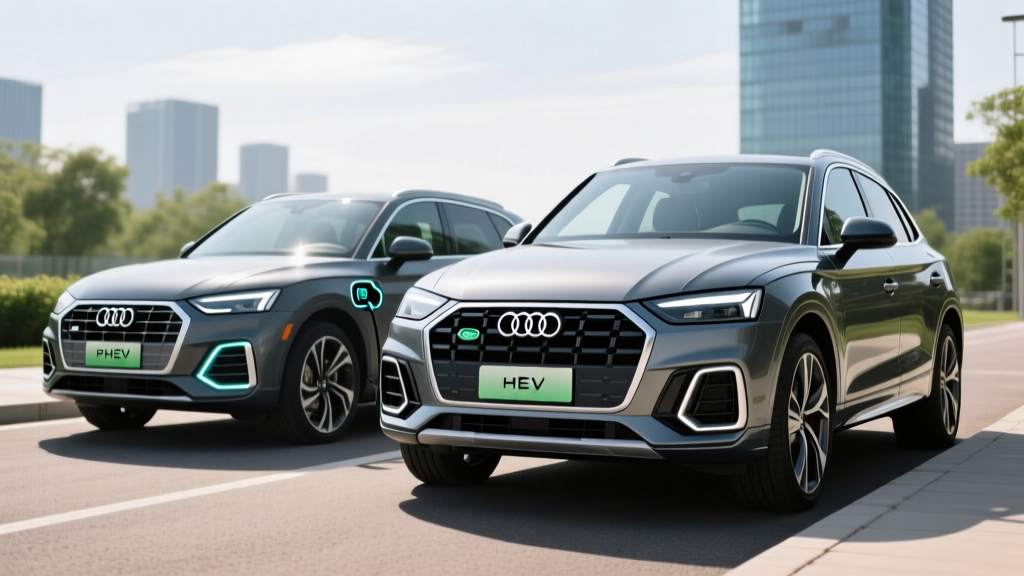
If you've been asking does Audi make a hybrid SUV, the answer is yes — but with important nuance. For the 2026 model year, Audi's hybrid SUV strategy centers on the Q5 plug-in hybrid (PHEV), sold as the Q5 55 TFSI e. Audi does not currently offer a conventional hybrid (HEV) SUV in the U.S. market — no self-charging hybrid Q3, Q5, or Q7 exists in the showroom. If you want hybrid efficiency from Audi, you're looking at a plug-in.
That distinction matters enormously for your wallet, your daily commute, and your tax-credit eligibility. This guide breaks down the 2026 Audi Q5 PHEV in full: real-world MPG, electric-only range, battery specs, charging logistics, pricing, and whether a PHEV, full EV, or gas model is the right call for your garage.
Audi's Hybrid SUV Lineup: What's Actually Available
Audi's U.S. electrified SUV lineup for 2026 includes the Q5 55 TFSI e as the sole plug-in hybrid offering. The larger Q7 and Q8 remain available with mild-hybrid (MHEV) 48-volt systems, but these are not true hybrids — they cannot drive on electric power alone and deliver negligible fuel-economy gains. The all-electric Q8 e-tron and Q4 e-tron round out the electrified range but are battery-electric vehicles (BEVs), not hybrids.
HEV vs PHEV vs MHEV — What Audi Actually Sells
| Type | Plug In? | Electric-Only Driving? | Audi SUV Example (2026) |
|---|---|---|---|
| HEV (Conventional Hybrid) | No | Brief, low-speed only | Not offered in U.S. |
| PHEV (Plug-In Hybrid) | Yes | Yes — ~23 miles | Q5 55 TFSI e |
| MHEV (Mild Hybrid) | No | No | Q7, Q8 (48V system) |
| BEV (Battery Electric) | Yes | Yes — full range | Q4 e-tron, Q8 e-tron |
Bottom line: when someone asks "does Audi make a hybrid SUV," the practical answer is the Q5 PHEV.
2026 Audi Q5 55 TFSI e: Full Powertrain & Efficiency Specs
The Q5 55 TFSI e pairs a 2.0-liter turbocharged four-cylinder engine with an electric motor integrated into the 7-speed S tronic dual-clutch transmission. Here's the complete spec breakdown:
| Spec | 2026 Audi Q5 55 TFSI e |
|---|---|
| Combined Horsepower | 362 hp |
| Combined Torque | 369 lb-ft |
| Gas Engine | 2.0L turbo I4 (261 hp) |
| Electric Motor | 141 hp, integrated in transmission |
| Battery (usable) | 17.9 kWh (NMC lithium-ion) |
| EPA Electric-Only Range | 23 miles |
| EPA MPGe (electric + gas) | 65 MPGe combined |
| EPA MPG (gas only, charge-depleted) | 27 city / 28 hwy / 27 combined |
| Total Combined Range | ~420 miles |
| 0–60 mph | 5.5 seconds |
| Drivetrain | quattro AWD |
| Level 2 Charge Rate | 7.7 kW (0–100% in ~2.5 hrs) |
| DC Fast Charging | Not available |
| Base MSRP | $59,895 (Premium trim) |
MPG Breakdown: EPA Sticker vs Real-World Driving
The Q5 PHEV's fuel economy story depends entirely on how you use it. MPGe (miles per gallon equivalent) measures efficiency when the battery is charged and you're blending electric and gas driving. Once the battery depletes, you're running a 27 MPG combined gas-only hybrid — respectable for a luxury SUV, but not class-leading.
| Mode | City | Highway | Combined |
|---|---|---|---|
| EPA (charge-depleted, gas only) | 27 | 28 | 27 |
| Real-world (gas only, mixed driving) | 25–28 | 26–29 | 25–27 |
| With daily charging (short commutes) | Often 50–80+ MPG equivalent; many trips use zero gas | ||
Real-world insight: If your daily commute is under 20 miles round-trip and you charge every night, you may visit a gas station only on road trips. Owners who never plug in, however, are essentially driving a 27 MPG gas SUV that weighs 500 lbs more than the standard Q5 — the PHEV premium becomes dead weight. This is the single biggest ownership mistake with any plug-in hybrid.
For reference, the EPA's fueleconomy.gov listing confirms the 65 MPGe combined and 27 MPG gas-only figures.
Electric-Only Range & Charging: The Daily-Commute Equation
The Q5 55 TFSI e's 23-mile EPA electric-only range is modest by PHEV standards. Competitors like the Toyota RAV4 Prime (42 mi) and the Jeep Wrangler 4xe (22 mi) bracket it. For context, the average American one-way commute is roughly 16 miles, per Census Bureau data — so 23 miles covers a round-trip commute for many drivers, but not all.
Charging logistics:
- Level 1 (120V household outlet): ~8 hours for a full charge — viable for overnight top-ups if you drive less than 20 miles daily.
- Level 2 (240V, 7.7 kW): ~2.5 hours from empty to full. A home Level 2 charger is strongly recommended for PHEV ownership.
- DC fast charging: Not supported. The Q5 PHEV's 17.9 kWh battery is too small to justify DC fast-charge hardware, and the added weight/cost would negate the efficiency gains.
The charge connector is a standard J1772 (AC charging), compatible with every Level 2 home charger and public AC station in the U.S.
Pricing, Trims & Tax-Credit Eligibility
The 2026 Q5 55 TFSI e starts at $59,895 for the Premium trim, stepping up to roughly $64,000 for Premium Plus and $69,000+ for Prestige. These prices represent a $7,000–$9,000 premium over the equivalent gas-only Q5 45 TFSI trims.
For 2026, the Q5 55 TFSI e may qualify for up to $3,750 of the federal plug-in hybrid tax credit, not the full $7,500. The credit amount depends on battery sourcing and critical-mineral requirements under current IRS §30D rules.
- MSRP cap: SUVs must be under $80,000 — the Q5 PHEV qualifies on all trims.
- Income cap: Adjusted gross income must not exceed $150,000 (single) / $300,000 (joint).
- Battery sourcing: The credit splits into two $3,750 halves — one for battery components, one for critical minerals. PHEV eligibility varies by model year and supply chain. Check the IRS clean vehicle credit list before purchasing.
- Point-of-sale transfer: You can transfer the credit to the dealer at purchase to reduce your out-of-pocket cost, rather than waiting for tax-time.
Always consult a tax professional and verify current eligibility on irs.gov before relying on credit amounts.
Battery Warranty, Reliability & Replacement Costs
Hybrid battery longevity is the number-one concern for buyers moving from gas to electrified powertrains. Here's what Audi provides:
Audi Q5 PHEV Battery Warranty
- High-voltage battery warranty: 8 years / 100,000 miles (whichever comes first)
- Capacity retention threshold: Warranty covers defects and capacity loss below 70% of original capacity
- Powertrain warranty: 4 years / 50,000 miles
- Limited vehicle warranty: 4 years / 50,000 miles
Real-world battery outlook: The Q5 PHEV's 17.9 kWh NMC battery is liquid-cooled and relatively small, meaning it cycles more frequently than a large BEV pack. However, PHEV batteries in general have proven durable — Toyota's RAV4 Prime and the BMW X5 xDrive50e have shown minimal degradation in early owner reports. Expect 10–15% capacity loss over 8–10 years under normal use.
Replacement cost: If the battery fails outside warranty, a PHEV battery replacement typically runs $8,000–$12,000 including labor. This is significantly less than a full BEV battery swap ($15,000–$25,000) because the pack is smaller. That said, out-of-warranty PHEV battery failures remain rare based on industry data.
Reliability context: Audi's brand-wide reliability ratings from IIHS and owner surveys place it mid-pack among luxury brands. The PHEV powertrain adds complexity (two power sources, additional cooling circuits, more software) compared to a pure gas or pure electric drivetrain. Maintenance costs are typically higher than either a BEV or a conventional HEV.
Q5 PHEV vs Gas Q5 vs Q4 e-tron: Which Fits Your Life?
Deciding between Audi's options comes down to your charging access, daily mileage, and tolerance for complexity.
Decision Framework: Which Audi SUV Is Right for You?
Choose the Q5 55 TFSI e (PHEV) if:
- You can charge at home (Level 2 preferred) every night
- Your daily driving is under 30 miles round-trip
- You want electric commuting but need gas flexibility for road trips
- You want 362 hp and don't mind the PHEV price premium
Choose the gas Q5 45 TFSI if:
- You cannot charge at home or at work
- Your daily mileage regularly exceeds 40+ miles
- You want the lowest purchase price and simplest maintenance
Choose the Q4 e-tron (full EV) if:
- You have reliable home charging and your daily driving is under 200 miles
- You want the lowest per-mile fuel cost and zero tailpipe emissions
- You want to maximize federal tax credit eligibility (up to $7,500 for qualifying BEVs)
Q5 PHEV Pros
- 23 mi electric-only covers most commutes gas-free
- 362 hp with smooth electric torque fill
- quattro AWD standard
- No range anxiety — gas engine for long trips
- Premium luxury interior and tech
Q5 PHEV Cons
- Only 23 mi electric range — less than RAV4 Prime
- No DC fast charging
- $8K+ premium over gas Q5
- Partial tax credit only (~$3,750 vs $7,500)
- More complex powertrain than BEV or gas
- Cargo space slightly reduced vs gas Q5
Frequently Asked Questions
How many MPG does the Audi Q5 hybrid get?
With the battery charged, the 2026 Q5 55 TFSI e achieves 65 MPGe combined. Once the battery is depleted, it operates as a conventional hybrid at 27 MPG combined (27 city / 28 highway). Real-world gas-only mileage ranges from 25–28 MPG depending on driving style and conditions.
How far can the Audi Q5 PHEV go on electric only?
The EPA-rated electric-only range is 23 miles. In real-world conditions — cold weather, highway speeds, or hilly terrain — expect 18–20 miles. In mild city driving, 22–24 miles is realistic.
Does the Audi Q5 hybrid qualify for a tax credit?
It may qualify for up to $3,750 of the federal §30D plug-in vehicle credit, depending on battery sourcing requirements. The full $7,500 credit is unlikely for this model. Income caps ($150K single / $300K joint) and the $80K SUV MSRP cap apply. Verify current eligibility at irs.gov before purchasing.
Is the Audi Q5 PHEV reliable? What about battery replacement?
The high-voltage battery is warrantied for 8 years / 100,000 miles with a 70% capacity-retention threshold. Out-of-warranty replacement runs approximately $8,000–$12,000. PHEV powertrains are more complex than pure gas or pure electric systems, so expect slightly higher maintenance costs over the vehicle's life.
Can I charge the Q5 PHEV at a DC fast charger?
No. The Q5 55 TFSI e supports AC charging only — Level 1 (120V, ~8 hrs) and Level 2 (240V at 7.7 kW, ~2.5 hrs). It uses a standard J1772 connector. DC fast charging is not available on this model.
Does Audi make a conventional (non-plug-in) hybrid SUV?
Not in the U.S. market for 2026. The Q7 and Q8 use a 48-volt mild-hybrid system that provides minor efficiency assistance but cannot drive on electric power alone. If you want true hybrid efficiency from Audi, the Q5 PHEV is the only option.