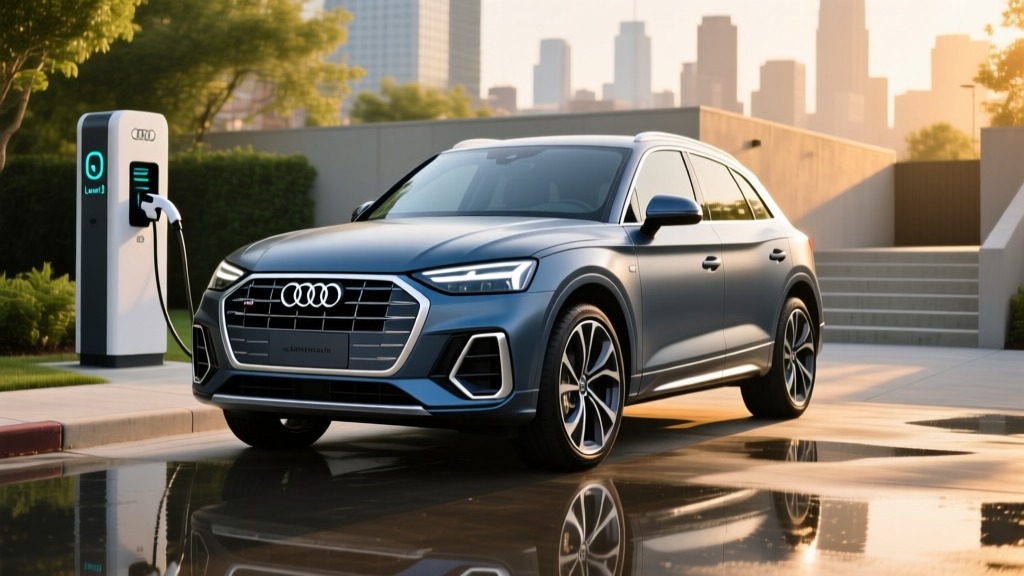
If you want Audi luxury and all-wheel-drive capability but aren't ready to commit to a full battery-electric vehicle, the Audi Q5 plug-in hybrid — officially the Q5 55 TFSI e quattro — sits at a compelling crossroads. It pairs a turbocharged 2.0-liter four-cylinder with an electric motor and a modest battery pack, delivering short electric-only commutes and seamless gas-engine backup for road trips. For 2026, Audi continues the PHEV variant alongside the conventional Q5 (no self-charging hybrid is offered in the US lineup), making this the only electrified Q5 you can plug in.
This guide breaks down everything you need to know about the Audi hybrid Q5: real-world and EPA fuel economy, electric-only range, charging logistics, powertrain output, pricing, federal tax credit eligibility, and whether a PHEV is the right bridge to full electrification for your household.
HEV vs PHEV: What Audi Actually Offers in the Q5
Before diving into specs, it's essential to distinguish between the two hybrid architectures buyers encounter:
| Feature | Conventional Hybrid (HEV) | Plug-In Hybrid (PHEV) |
|---|---|---|
| Battery size | Small (~1–2 kWh) | Larger (14–25 kWh typical) |
| Electric-only range | 0–2 miles at low speed | 15–50 miles (EPA rated) |
| Plug-in charging | No — recharges via regen & engine | Yes — Level 1 or Level 2 |
| Gas engine | Always available, seamlessly blends | Always available, seamlessly blends |
| Tax credit eligible | No | Potentially (§30D, varies) |
| Audi Q5 availability (US) | Not offered | Q5 55 TFSI e quattro |
The Q5 sold in the United States comes in three powertrain flavors: the standard Q5 45 TFSI (mild-hybrid gas engine), the performance SQ5 (also mild-hybrid gas), and the plug-in hybrid Q5 55 TFSI e quattro. Audi does not sell a conventional (non-plug-in) hybrid Q5 in the US market. If you're searching for an "Audi hybrid Q5," the 55 TFSI e is the vehicle you're looking for.
Audi Q5 PHEV Powertrain and Performance Specs
| Specification | 2026 Audi Q5 55 TFSI e quattro |
|---|---|
| Engine | 2.0L turbocharged inline-4 |
| Electric motor | Integrated in transmission (141 HP / 258 lb-ft) |
| Combined system output | 362 HP / 369 lb-ft torque |
| Battery (gross / usable) | 17.9 kWh gross / ~14.4 kWh usable |
| Battery chemistry | NMC (nickel manganese cobalt) |
| Drivetrain | quattro all-wheel drive |
| Transmission | 7-speed S tronic dual-clutch automatic |
| 0–60 mph | 5.0 seconds |
| EPA electric-only range | 23 miles |
| EPA MPGe (combined) | 61 MPGe |
| EPA MPG (gas-only, combined) | 25 MPG combined |
| Total range (est.) | ~400 miles (gas + electric) |
| Max AC charge rate | 7.4 kW (Level 2) |
| DC fast charging | Not supported |
| Charge time (Level 2, 0–100%) | ~2.5 hours |
| Charge time (Level 1, 120V) | ~7–8 hours |
| Base MSRP (Premium trim) | ~$58,200 |
The combined 362 horsepower makes the Q5 55 TFSI e noticeably quicker than the standard Q5 45 TFSI (261 HP). The electric motor fills in torque at low RPMs, giving strong off-the-line acceleration. In EV mode, the powertrain is quiet and refined — adequate for neighborhood driving and highway merging up to about 84 mph before the gas engine engages.
Fuel Economy: EPA Numbers vs Real-World MPG
| Driving Scenario | EPA Estimate | Real-World Expectation |
|---|---|---|
| Combined MPGe (electric + gas) | 61 MPGe | 55–65 MPGe (varies with plug-in frequency) |
| Gas-only combined MPG | 25 MPG | 23–27 MPG |
| City MPG (gas-only) | 24 MPG | 22–26 MPG (regen helps in stop-and-go) |
| Highway MPG (gas-only) | 27 MPG | 25–28 MPG (steady cruising is efficient) |
The MPGe figure of 61 assumes you're regularly plugging in and driving within the 23-mile electric window for a significant portion of your trips. If you rarely charge, expect fuel economy to settle around the gas-only figure of roughly 25 MPG combined. That's respectable for a 4,500-pound luxury AWD SUV, but it's not dramatically better than a well-tuned gas-only Q5 45 TFSI (which returns about 25 MPG combined per fueleconomy.gov).
The key insight for PHEV ownership: the fuel savings are almost entirely a function of how often you plug in. A Q5 PHEV owner who charges nightly and commutes 18 miles round-trip may use gas only on weekends. An owner who never plugs in is simply carrying 400+ pounds of dead battery weight and paying a premium for it.
Charging the Q5 PHEV: What You Need at Home
The Q5 55 TFSI e uses a standard J1772 connector (or NACS with an adapter, as Audi has begun transitioning its EV lineup). It accepts Level 1 (120V) and Level 2 (240V) AC charging only. There is no DC fast charging capability — a limitation shared by most PHEVs due to their smaller battery packs.
| Charging Level | Power | Time (0–100%) | Practical Use |
|---|---|---|---|
| Level 1 (120V household outlet) | ~1.4 kW | ~7–8 hours | Overnight top-up if no Level 2 available |
| Level 2 (240V home charger) | 7.4 kW | ~2.5 hours | Ideal daily charging; full recharge in evening |
For most PHEV owners, a Level 2 home charger is the sweet spot. A 240V outlet or dedicated hardwired charger (like a ChargePoint Home Flex or Emporia Level 2) refills the Q5's pack in about 2.5 hours — fast enough that you can recharge between an evening commute and a morning departure. Installation costs typically range from $500 to $2,000 depending on your electrical panel capacity and the distance from panel to charger location. If your home has a 200-amp panel with spare capacity, expect the lower end of that range. A panel upgrade to 200A can add $1,500–$3,000.
Public Level 2 chargers (grocery stores, workplaces, parking garages) are also viable for topping up during the day, but public DC fast chargers won't help — the Q5 PHEV cannot accept a DC fast charge even if you plug one in.
Pricing, Trims, and Federal Tax Credit Eligibility
The 2026 Audi Q5 55 TFSI e quattro starts at approximately $58,200 (Premium trim, including destination). The Premium Plus trim adds roughly $4,500, and the Prestige trim pushes the MSRP to around $68,000+ with options.
Does the Audi Q5 PHEV Qualify for the Federal Tax Credit?
This is where PHEV buyers need to pay close attention. Under current IRS §30D Clean Vehicle Credit rules, plug-in hybrids may qualify for up to $7,500 — but eligibility depends on multiple overlapping requirements:
- Battery capacity: Must be at least 7 kWh — the Q5 PHEV's 17.9 kWh pack clears this easily.
- MSRP cap: SUVs must be under $80,000 MSRP. The Q5 PHEV qualifies on base trims; a fully loaded Prestige with options could approach or exceed the cap.
- Buyer income cap: Modified adjusted gross income must not exceed $150,000 (single), $225,000 (head of household), or $300,000 (joint).
- Critical minerals & battery component sourcing: A percentage of critical minerals must be sourced from the US or free-trade-agreement countries, and battery components must be manufactured or assembled in North America. These thresholds tighten annually. This is where many PHEVs lose partial or full credit eligibility.
- Final assembly: Must occur in North America. The Q5 for the US market is assembled in San José Chiapa, Mexico — which qualifies under USMCA but verify current-year IRS guidance.
As of the 2026 tax year, the sourcing requirements have become stringent enough that the Q5 PHEV may qualify for $3,750 (partial credit) or the full $7,500, depending on Audi's supply chain adjustments. The point-of-sale transfer option allows you to apply the credit as a down-payment reduction at the dealer rather than waiting until tax filing. Always verify eligibility on the IRS website and with your tax professional before purchasing — the rules shift and manufacturer compliance lists update periodically.
Battery Warranty, Lifespan, and Replacement Cost
PHEV battery degradation is generally less severe than full EV degradation for a simple reason: the battery is smaller and the vehicle's software keeps it within a conservative state-of-charge window. You're rarely charging to true 100% or draining to true 0% — the onboard management system maintains a buffer. In practice, most PHEV owners report minimal noticeable degradation over 5–7 years of ownership.
If you need an out-of-warranty battery replacement, expect a cost in the range of $8,000–$14,000 for the high-voltage pack, including labor. This is a significant expense, but it's rare for PHEV batteries to require full replacement within the first decade. The conventional 12V auxiliary battery is a separate, standard maintenance item ($200–$400 replacement).
Regarding reliability: Audi's PHEV powertrain adds complexity (two power sources, additional cooling circuits, power electronics) compared to a pure gas or pure EV setup. Historical reliability data for Audi PHEVs is mixed — some owners report no issues, while others note software glitches or charging-system faults. The NHTSA recalls database is worth checking for any open campaigns on the specific model year you're considering.
Who Should Buy the Audi Q5 Hybrid — and Who Shouldn't
- Your daily commute is under 20 miles round-trip and you can charge at home nightly
- You want a luxury compact SUV with strong acceleration (362 HP, 5.0s 0–60)
- You take road trips where charging infrastructure is sparse or unreliable
- You want to reduce gas consumption without range anxiety
- You value quattro AWD for snow or inclement weather
- Your daily driving exceeds 23 miles regularly and you want zero gas use
- You have reliable Level 2 home charging and access to DC fast chargers for road trips
- You want lower long-term maintenance costs (no oil changes, fewer moving parts)
- You want to maximize federal tax credit benefits (full EVs have broader credit eligibility)
- You cannot charge at home (apartment, no garage, no outlet access)
- Your daily commute is long (40+ miles) where the PHEV advantage disappears
- You want a lower purchase price (the Q5 45 TFSI starts ~$8,000 less)
- You prefer simplicity — one powertrain, proven reliability
- 362 HP combined — quickest standard Q5 variant
- 23-mile electric range covers most short commutes
- No range anxiety — gas engine for long trips
- quattro AWD standard
- Level 2 charging in ~2.5 hours is convenient
- Premium interior with latest MMI infotainment
- 23-mile electric range is modest vs some PHEV rivals (Toyota RAV4 Prime: 42 mi)
- No DC fast charging
- High MSRP — $58,200+ before options
- Tax credit eligibility uncertain due to sourcing rules
- Cargo space slightly reduced vs gas Q5 (battery under floor)
- Complex powertrain = more potential failure points long-term
Frequently Asked Questions
How many MPG does the Audi Q5 hybrid get?
The EPA rates the Q5 55 TFSI e at 61 MPGe combined when using both electric and gas power. On gasoline alone (battery depleted), it returns 25 MPG combined (24 city / 27 highway). Real-world results vary: owners who charge daily and drive short distances may see effective economy well above 61 MPGe, while those who rarely plug in will hover around 23–27 MPG.
How far can the Audi Q5 PHEV go on electric only?
The EPA rates it at 23 miles of electric-only range. In mild city driving, expect 20–24 miles. Highway driving at 70+ mph reduces that to 15–18 miles. In freezing winter conditions, plan for 13–17 miles. The gas engine engages seamlessly when the battery depletes — there's no interruption in driving.
Does the Audi Q5 PHEV qualify for a federal tax credit?
It may qualify for up to $7,500 under IRS §30D rules, but eligibility depends on your income, the MSRP of your specific trim, and Audi's battery component and critical-mineral sourcing compliance for the 2026 tax year. The partial credit of $3,750 is more likely given current sourcing thresholds. Verify on fueleconomy.gov and with a tax professional before purchasing. The credit can be transferred to the dealer at point of sale as a price reduction.
Is the Audi Q5 hybrid reliable and what does battery replacement cost?
Audi covers the high-voltage battery for 8 years / 100,000 miles with a 70% capacity retention guarantee. Out-of-warranty replacement runs $8,000–$14,000. PHEV batteries experience modest degradation thanks to conservative charge-window management. The dual powertrain adds complexity — some owners report software or charging-system issues, but catastrophic battery failures within the first decade are uncommon.
Can I DC fast charge the Audi Q5 PHEV?
No. The Q5 55 TFSI e only accepts AC charging: Level 1 (120V, ~7–8 hours for a full charge) or Level 2 (240V, ~2.5 hours). DC fast charging is not supported, which is typical for plug-in hybrids with smaller battery packs. This means the Q5 PHEV is best suited for home and workplace charging, not highway fast-charging stops.
Hybrid vs PHEV vs full EV — which is right for me?
A conventional hybrid (HEV) requires no plug-in and improves fuel economy modestly — but Audi doesn't offer one in the US Q5 lineup. A PHEV like the Q5 55 TFSI e is ideal if you can charge at home and want short electric commutes with gas-engine flexibility for road trips. A full EV (like the Q8 e-tron) makes sense if you want zero gas use, lower maintenance, and have reliable charging access. If you can't charge at home at all, the PHEV's advantage largely disappears — consider the gas-only Q5 45 TFSI instead.