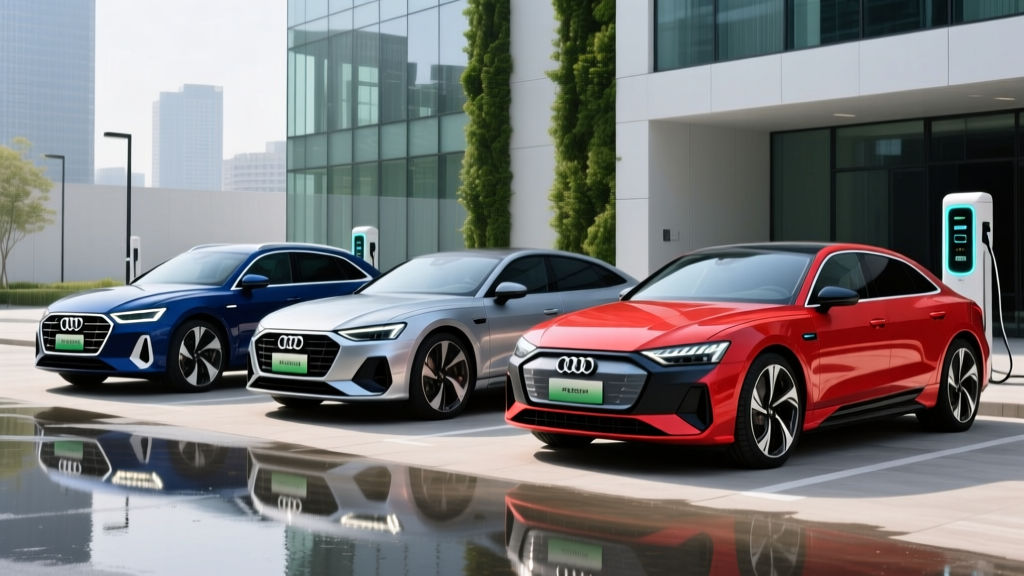
If you've been searching whether Audi offers a hybrid, the short answer is yes — but with an important caveat. As of the 2026 model year, Audi's U.S. lineup consists exclusively of plug-in hybrids (PHEVs), not conventional self-charging hybrids (HEVs) like a Toyota Prius. That distinction matters enormously for how you'll use the car, what you'll spend on fuel, and whether you qualify for federal tax incentives.
Audi's current electrified strategy skips the middle ground. You either get a full battery-electric vehicle (BEV) like the Q8 e-tron, or a plug-in hybrid with roughly 20–35 miles of electric-only driving before the gasoline engine takes over. If you were hoping for a traditional hybrid that never needs plugging in, Audi doesn't currently sell one in the United States.
Understanding Audi's Hybrid Strategy: PHEV Only
Audi has deliberately positioned its hybrid offerings as plug-in hybrids rather than conventional hybrids. Here's what that means in practice:
Conventional Hybrid (HEV)
How it works: A small battery recharges via regenerative braking and the gas engine. You never plug it in.
Electric-only range: Typically 0–2 miles at low speeds.
Example: Toyota RAV4 Hybrid, Honda CR-V Hybrid.
Audi offers this? No — not in the U.S. market.
Plug-in Hybrid (PHEV)
How it works: A larger battery (typically 14–26 kWh) charges via a plug or regenerative braking. You get meaningful electric-only range before the gas engine engages.
Electric-only range: 20–35+ miles depending on model.
Example: Audi Q5 TFSI e, Audi A7 TFSI e.
Audi offers this? Yes — this is Audi's hybrid path.
The practical implication: if you want Audi-badged hybrid efficiency without ever plugging in, you won't find it in the current lineup. But if you can charge at home or at work, a PHEV can function as a daily electric commuter that transforms into a gas-powered road-tripper on weekends.
2026 Audi Plug-in Hybrid Lineup: Models and Specs
Audi's U.S. PHEV lineup centers on a handful of nameplates wearing the "TFSI e" badge. Here's a comprehensive breakdown of the models available or announced for the 2026 model year:
| Model | Powertrain | Combined HP | Battery (kWh) | EPA Electric Range | EPA Combined MPG (hybrid mode) | 0–60 mph | Starting MSRP |
|---|---|---|---|---|---|---|---|
| 2026 Audi Q5 TFSI e | 2.0L turbo I4 + electric motor | 362 hp | ~17.9 kWh (usable) | ~23 mi | ~26 MPG (gas only) | 5.0 sec | ~$58,200 |
| 2026 Audi Q5 Sportback TFSI e | 2.0L turbo I4 + electric motor | 362 hp | ~17.9 kWh (usable) | ~22 mi | ~25 MPG (gas only) | 5.1 sec | ~$60,500 |
| 2026 Audi A7 TFSI e (announced) | 2.0L turbo I4 + electric motor | 362 hp (est.) | ~17.9 kWh (est.) | ~25 mi (est.) | ~27 MPG (est.) | ~5.5 sec | TBD |
Note: Specs reflect EPA estimates and manufacturer data where available. The A7 TFSI e is announced but not yet on sale — specs are preliminary. Always verify current figures at fueleconomy.gov.
Electric-Only Range: Can an Audi PHEV Replace Your Commute?
The headline number for any PHEV is its electric-only range — the distance you can travel on battery power alone before the gasoline engine fires up. For the 2026 Audi Q5 TFSI e, that figure sits at approximately 23 miles per EPA estimates.
Real-World Electric Range Expectations
EPA sticker: ~23 miles electric-only (Q5 TFSI e)
Real-world mild weather, city driving: 22–26 miles — regenerative braking in stop-and-go traffic can extend range slightly beyond the EPA estimate.
Highway driving at 70+ mph: 16–19 miles — aerodynamic drag and higher speeds drain the battery faster.
Cold weather (below 32°F): 14–18 miles — battery chemistry becomes less efficient, and cabin heating draws significant energy unless preconditioned.
For commuters with a round trip under 20 miles and access to home charging, the Q5 TFSI e can function as a de facto EV on most weekdays. Charge overnight on a Level 2 home charger, and you'll start each morning with a full battery. But if your commute is 40+ miles each way, the electric range serves more as a fuel-economy booster than a gas replacement.
Total Combined Range
Once the battery depletes, the 2.0L turbocharged engine and regenerative braking take over. With a full tank of gas and a full battery, total combined range exceeds 400 miles — eliminating the range anxiety that still concerns some prospective BEV buyers.
Fuel Economy: EPA MPG and Real-World Results
PHEV fuel economy is inherently dual-natured. You'll see two distinct figures depending on whether the battery is charged:
| Model | MPGe (electric + gas combined) | MPG (gas-only, battery depleted) | EPA City (gas-only) | EPA Highway (gas-only) |
|---|---|---|---|---|
| 2026 Audi Q5 TFSI e | ~61 MPGe | ~26 MPG | ~25 MPG | ~27 MPG |
| 2026 Audi Q5 Sportback TFSI e | ~60 MPGe | ~25 MPG | ~24 MPG | ~26 MPG |
MPGe explained: MPGe (miles per gallon equivalent) converts the energy in electricity to a gasoline-equivalent figure so you can compare across powertrains. The ~61 MPGe figure applies when you're using both battery and gas — essentially, when you charge regularly and drive within or near the electric range.
Real-world MPG vs. EPA: In gas-only mode (battery depleted), expect the EPA numbers to hold fairly true on the highway. In city driving with a depleted battery, regenerative braking can push real-world MPG 1–3 MPG above the EPA city estimate. However, if you never plug in, the Q5 TFSI e effectively becomes a heavy luxury SUV with middling fuel economy — around 24–27 MPG combined. That's worse than a conventional hybrid like the Lexus RX 350h (36 MPG combined) because the PHEV carries extra battery weight without the benefit of electric propulsion.
The economics only work if you charge regularly. Skip the plug, and you're paying a premium for battery mass you're not using.
Charging: Speed, Time, and What You Need at Home
One area where Audi's PHEVs draw criticism is charging speed. Unlike full EVs with DC fast-charging capability, most Audi PHEVs are limited to Level 2 AC charging.
| Charging Level | Power (kW) | Time for Full Charge (0–100%) | Miles of Electric Range per Hour |
|---|---|---|---|
| Level 1 (120V household outlet) | ~1.4 kW | ~12–14 hours | ~2 mi/hr |
| Level 2 (240V home/public charger) | ~7.7 kW (max onboard) | ~2.5–3 hours | ~8–9 mi/hr |
| DC Fast Charge | Not supported (most trims) | N/A | N/A |
kW vs. kWh — the critical distinction: kW (kilowatts) measures the rate of charging — how fast electricity flows into the battery. kWh (kilowatt-hours) measures the battery's total energy capacity — how much it can store. The Q5 TFSI e has a ~17.9 kWh battery and accepts up to ~7.7 kW of charging power. Think of it like filling a 17.9-gallon tank through a hose rated at 7.7 gallons per minute.
Home charging setup: A standard Level 2 home charger (240V, 32–40 amp circuit) will fully replenish the Q5 TFSI e battery in roughly 2.5 hours. Most owners simply plug in when they get home and wake up to a full charge. Installation costs for a Level 2 home charger typically run $500–$1,500 for the hardware plus $800–$2,500 for professional electrical work, depending on your panel capacity and run length. A licensed electrician should evaluate your electrical panel before installation.
The lack of DC fast charging means road trips won't offer quick battery top-ups at highway rest stops. Once the battery is depleted on a long drive, you're running on gas until you reach a destination where you can plug in for a few hours.
Powertrain Performance: More Than Just Efficiency
Audi doesn't sell PHEVs purely for fuel savings — the TFSI e powertrains deliver genuine performance. The Q5 TFSI e pairs a 2.0-liter turbocharged four-cylinder engine with an electric motor integrated into the transmission housing, sending power to all four wheels via quattro all-wheel drive.
- Engine output: 261 hp / 273 lb-ft torque (2.0L TFSI)
- Electric motor output: ~141 hp / 258 lb-ft torque
- Combined system output: 362 hp / 369 lb-ft torque
- 0–60 mph: 5.0 seconds
- Drivetrain: quattro AWD (standard)
- Transmission: 7-speed S tronic dual-clutch automatic
For comparison, the gas-only 2026 Audi Q5 45 TFSI produces 261 hp and hits 60 mph in about 5.7 seconds. The PHEV variant is meaningfully quicker, thanks to the electric motor's instant torque delivery at low speeds. It's a noticeable difference in daily driving — merging onto highways and pulling away from stoplights feels punchier than the gas model.
Driving modes let you prioritize electric-only propulsion, hold battery charge for later use (useful when entering a city center after a highway stretch), or combine both for maximum performance. The "Battery Hold" mode is particularly clever for road trips: save your electric miles for stop-and-go city traffic where regenerative braking maximizes their value.
Pricing, Tax Credits, and Total Cost of Ownership
The 2026 Audi Q5 TFSI e starts at approximately $58,200 (including destination charge), positioning it roughly $4,000–$6,000 above the equivalent gas-only Q5 45 TFSI. The Q5 Sportback TFSI e starts around $60,500.
Federal Tax Credit Eligibility (§30D)
Here's where PHEV buyers need to pay close attention. The federal EV tax credit under IRS §30D can provide up to $7,500, but eligibility is far from guaranteed and depends on multiple factors:
- MSRP cap: SUVs must have an MSRP at or below $80,000; sedans at or below $55,000. The Q5 TFSI e qualifies under the SUV cap.
- Buyer income cap: Adjusted gross income must not exceed $150,000 (single), $225,000 (head of household), or $300,000 (married filing jointly).
- Battery sourcing requirements: Increasing percentages of critical minerals and battery components must be sourced from the U.S. or free-trade-agreement countries. These thresholds tighten annually and may affect eligibility.
- Point-of-sale transfer: As of 2024, eligible buyers can transfer the credit to the dealer at purchase, reducing the out-of-pocket price immediately rather than waiting for a tax refund.
- Minimum battery capacity: The vehicle must have at least 7 kWh of battery capacity — all current Audi PHEVs meet this threshold.
Critical caveat: Battery-sourcing and critical-mineral requirements have disqualified several PHEVs in recent years. Always verify current eligibility on the official fueleconomy.gov tax credit page and consult a tax professional before relying on the credit in your purchase decision. Rules are subject to change under current IRS guidance.
5-Year Ownership Cost Snapshot
Assuming regular charging, moderate annual mileage (12,000 miles/year), and current national-average electricity and fuel prices, a Q5 TFSI e can save approximately $1,500–$2,500 in fuel costs over five years compared to the gas-only Q5 45 TFSI. However, the PHEV's higher purchase price partially offsets those savings unless the full tax credit applies. Insurance premiums for PHEVs tend to run 5–12% higher than their gas counterparts due to the dual powertrain complexity.
Reliability, Battery Warranty, and Replacement Costs
Hybrid and PHEV battery longevity remains a top concern for buyers. Audi covers the high-voltage battery with a warranty that meets or exceeds federal requirements:
Audi PHEV Battery Warranty
Coverage: 8 years / 100,000 miles (whichever comes first)
Capacity retention threshold: Battery is considered defective if it falls below approximately 70% of original capacity during the warranty period.
What's covered: Defects in materials, workmanship, and excessive capacity loss.
What's not covered: Normal gradual degradation, damage from accidents, improper charging equipment, or unauthorized modifications.
Real-world degradation data: PHEV batteries generally experience slower degradation than full EV batteries because they operate in a narrower state-of-charge window (the system rarely lets the battery reach true 0% or 100%). Based on industry data from similar Volkswagen Group PHEV platforms, expect approximately 8–12% capacity loss over the first 5 years under normal use.
Out-of-warranty replacement cost: If the high-voltage battery needs replacement after the warranty expires, expect a cost in the range of $8,000–$14,000 including parts and labor. This figure is an estimate based on comparable VW Group PHEV battery packs; exact Audi pricing may vary. As battery manufacturing costs continue to decline, replacement costs are expected to trend lower over time.
General reliability: Audi's PHEV powertrains share architecture with other Volkswagen Group vehicles that have been on the road for several years. Common reported issues in earlier model years included software glitches in the energy-management system and occasional onboard charger faults — problems typically addressed under warranty. The mechanical components (turbo engine, dual-clutch transmission) are well-proven across Audi's lineup. Independent reliability data from sources like Consumer Reports and J.D. Power should be consulted for the latest model-year scores.
Audi PHEV vs. Full EV vs. Gas: Which Should You Choose?
The decision between an Audi PHEV, a full electric vehicle, or a conventional gas car depends on your specific driving patterns, charging access, and priorities:
Choose the Audi Q5 TFSI e (PHEV) if:
- Your daily commute is under 25 miles round-trip and you can charge at home overnight.
- You take regular road trips (200+ miles) and don't want to plan around charging infrastructure.
- You want Audi's luxury, quattro AWD, and performance with some electric efficiency.
- You live in an area with limited public DC fast-charging stations.
Choose a Full EV (like the Audi Q8 e-tron or competing BEV) if:
- You have reliable home Level 2 charging and your daily driving stays under 200 miles.
- You want zero tailpipe emissions and minimal maintenance (no oil changes, fewer moving parts).
- You're eligible for the full $7,500 federal tax credit on a qualifying BEV.
- You want to eliminate gasoline costs entirely for daily driving.
Choose a Conventional Gas Car (or a competitor's HEV) if:
- You have no access to home or workplace charging whatsoever.
- Your budget prioritizes the lowest upfront purchase price.
- You want the simplicity of a single powertrain with no plug-in requirements.
- You prefer a conventional hybrid (like a Lexus RX 350h) that delivers strong MPG without ever plugging in.
Pros and Cons of Audi's Plug-in Hybrid Approach
Pros
- Electric-only commuting eliminates gas use for short daily trips
- 362 hp combined output delivers strong acceleration (5.0 sec 0–60)
- No range anxiety — gas engine provides 400+ total miles
- quattro AWD standard for all-weather confidence
- Luxury interior, technology, and build quality
- Potential $7,500 federal tax credit (verify eligibility)
- Battery Hold mode for strategic electric-range deployment
Cons
- No conventional (non-plug-in) hybrid option in Audi's U.S. lineup
- Electric-only range (~23 mi) is modest vs. competitors like the Toyota RAV4 Prime (42 mi)
- No DC fast-charging capability — road trips run on gas only
- Gas-only MPG (~25–26 combined) is unimpressive if you never plug in
- $4,000–$6,000 premium over the gas-only Q5
- Higher insurance premiums vs. gas-only equivalent
- Battery replacement cost ($8,000–$14,000) after warranty expiration
Frequently Asked Questions
Does Audi have a conventional hybrid that doesn't need plugging in?
No. As of the 2026 model year, Audi does not sell a conventional hybrid (HEV) in the United States. All Audi hybrid offerings are plug-in hybrids (PHEVs) that benefit from being plugged in to charge the battery. If you want a luxury-brand conventional hybrid, competitors like Lexus (RX 350h, NX 350h) and BMW (X5 xDrive50e operates as a PHEV, but BMW also offers mild-hybrid systems) provide alternatives.
How many MPG does the Audi Q5 hybrid get?
The 2026 Audi Q5 TFSI e achieves approximately 61 MPGe when combining electric and gas operation, and about 26 MPG combined when running on gasoline alone with a depleted battery. City gas-only MPG is around 25; highway is approximately 27. These figures assume a depleted battery — regular charging will yield significantly lower fuel consumption on short trips.
How far can the Audi Q5 TFSI e go on electric only?
The EPA rates the Q5 TFSI e at approximately 23 miles of electric-only range. In real-world city driving with regenerative braking, some owners report 24–26 miles. Highway driving at 70+ mph reduces this to roughly 16–19 miles, and cold weather (below freezing) can drop it further to 14–18 miles.
Does the Audi Q5 TFSI e qualify for a tax credit?
It may qualify for up to $7,500 under the federal §30D clean vehicle credit, but eligibility depends on your income (must be below $150K/$225K/$300K depending on filing status), the vehicle's MSRP (must be at or below $80,000 for SUVs), and battery-sourcing requirements that change annually. Check the current eligibility list at fueleconomy.gov and consult a tax professional before purchasing.
Is the Audi PHEV battery reliable and what does replacement cost?
Audi covers the PHEV battery for 8 years or 100,000 miles, warranting it against defects and excessive capacity loss (below ~70%). Real-world degradation for similar VW Group PHEV packs is approximately 8–12% over 5 years. Out-of-warranty replacement is estimated at $8,000–$14,000 including parts and labor. The narrower charge window of a PHEV (vs. a full EV) generally results in slower degradation.
Can I charge the Audi Q5 TFSI e at a DC fast charger?
No. The Q5 TFSI e supports Level 1 (120V) and Level 2 (240V) AC charging only, with a maximum onboard charge rate of approximately 7.7 kW. DC fast charging is not available on current Audi PHEVs. A full Level 2 charge takes roughly 2.5–3 hours.
What happens if I never plug in the Audi PHEV?
The car will operate as a conventional gasoline vehicle, but with worse fuel economy than a purpose-built hybrid. Expect approximately 24–27 MPG combined — the extra weight of the battery and electric motor adds mass that the gas engine must move. You'll also miss the performance benefit of electric-motor torque and the potential fuel savings that justify the PHEV price premium.
Hybrid vs PHEV vs EV — which Audi is right for me?
Audi doesn't offer a conventional hybrid, so your choices are PHEV (Q5 TFSI e) or full EV (Q8 e-tron). Choose the PHEV if you need road-trip flexibility, have short daily commutes, and can charge at home. Choose the EV if you want zero tailpipe emissions, have reliable home charging, and rarely drive more than 200 miles in a day. If you want a no-plug-in luxury hybrid, you'll need to look outside Audi to brands like Lexus.
Sources: EPA fuel economy data via fueleconomy.gov; Audi USA official specifications; IRS §30D clean vehicle credit rules via irs.gov. All pricing and specifications reflect 2026 model year data available at time of publication and are subject to change. Verify current tax credit eligibility before purchasing.