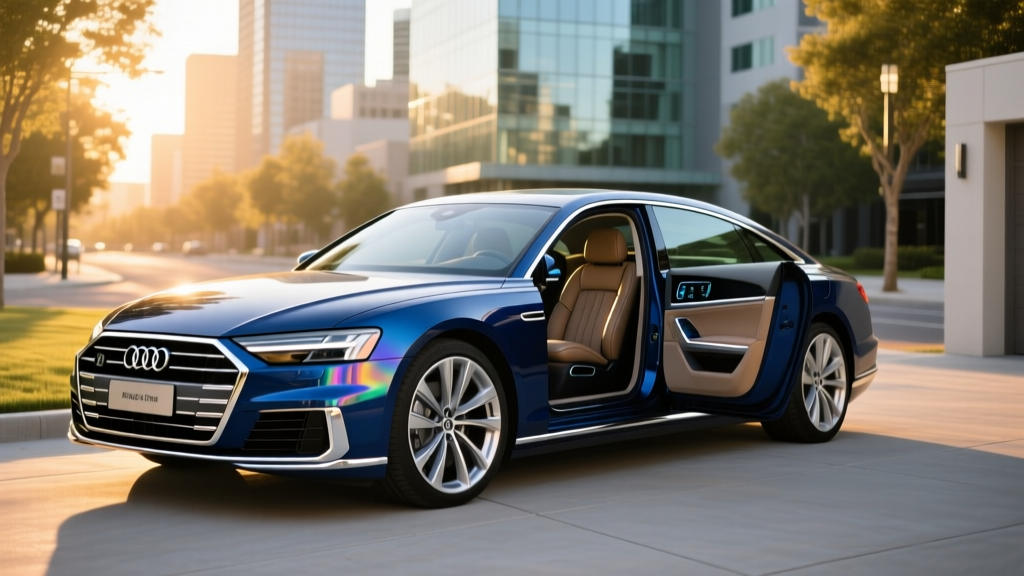
Finding an Audi A8 plug-in hybrid for sale means you're looking at one of the most refined luxury PHEVs on the market: the Audi A8 L 60 TFSI e. It pairs a turbocharged V6 with a plug-in electric drivetrain, delivering limousine-level comfort with the ability to handle most daily commutes on electricity alone. But before you sign the paperwork, you need to understand exactly what this PHEV delivers in range, efficiency, charging behavior, and ownership cost — not just what the brochure says.
This guide covers the 2026 Audi A8 L 60 TFSI e with precise, data-backed specs so you can decide whether it's the right electrified luxury sedan for your garage.
HEV vs PHEV: What the Audi A8 L 60 TFSI e Actually Is
Before we get into specs, let's clear up a common source of confusion. The automotive market offers two types of hybrid systems:
Conventional Hybrid (HEV)
A self-charging system that uses a small battery (typically 1–2 kWh) recharged by regenerative braking and the gas engine. You never plug it in. Think Toyota Prius. It improves MPG but cannot drive on electricity alone for meaningful distances.
Plug-In Hybrid (PHEV)
A larger battery (15–25+ kWh) that you can plug in to recharge. It provides a genuine electric-only range — typically 20–40 miles — before the gas engine takes over. The Audi A8 L 60 TFSI e is a PHEV. Once the battery is depleted, it operates like a conventional hybrid.
This distinction matters enormously for your daily routine. If you can charge at home or work, a PHEV lets you commute emission-free while keeping a gas engine for road trips. If you can't charge regularly, you're carrying dead battery weight and paying a premium for capability you don't use.
Audi A8 L 60 TFSI e: Powertrain and Performance Specs
The 2026 A8 L 60 TFSI e combines a 3.0-liter turbocharged V6 with an electric motor integrated into the transmission housing. Here's the full spec breakdown:
| Specification | Value |
|---|---|
| Engine | 3.0L Turbo V6 (335 hp / 369 lb-ft) |
| Electric Motor | 134 hp (100 kW) / 258 lb-ft |
| Combined System Output | 456 hp / 516 lb-ft |
| Transmission | 8-speed Tiptronic automatic w/ integrated motor |
| Drivetrain | quattro AWD |
| Battery (Gross / Usable) | 17.9 kWh gross / ~14.4 kWh usable |
| Battery Chemistry | NMC (Nickel Manganese Cobalt) |
| EV Range (EPA Est.) | 29 miles |
| Total Combined Range | ~380 miles |
| 0–60 mph | 5.6 seconds |
| Top Speed (EV mode) | 84 mph |
| Base MSRP | $107,900 (destination included) |
With 456 combined horsepower and quattro all-wheel drive, this is a heavy luxury sedan that moves with genuine urgency. The 0–60 time of 5.6 seconds is brisk for a vehicle weighing over 5,000 pounds. In EV mode, the 134-hp electric motor provides smooth, silent acceleration suitable for city and suburban driving up to 84 mph.
MPG, MPGe, and Real-World Efficiency
The EPA rates the A8 L 60 TFSI e across three metrics — electric-mode efficiency (MPGe), charge-depleted hybrid-mode MPG, and combined gasoline-only operation. Here's the official breakdown:
| Mode | City | Highway | Combined |
|---|---|---|---|
| EV Mode (MPGe) | 53 MPGe | 54 MPGe | 53 MPGe |
| Hybrid Mode (MPG) | 21 MPG | 29 MPG | 24 MPG |
| Gasoline-Only (no charge) | 19 MPG | 27 MPG | 22 MPG |
Source: EPA Fuel Economy
Real-World MPG vs. EPA Estimates
The EPA's 24 MPG combined hybrid-mode figure assumes a mix of city and highway driving with periodic plug-in charging. In practice:
- City-heavy commuting with nightly charging: You may use almost zero gasoline for weeks, achieving 80+ MPGe equivalent.
- Highway road trips (battery depleted): Expect 25–27 MPG at 70 mph — slightly better than EPA highway because hybrids benefit from steady-state cruising.
- Short trips in cold weather without charging: Efficiency drops to 18–20 MPG as the engine runs to heat the cabin and the battery is less effective.
The key insight: a PHEV's efficiency is directly tied to how often you charge. An A8 L 60 TFSI e that's never plugged in is just a heavy, slightly less efficient A8.
Electric-Only Range: 29 EPA Miles in Practice
The EPA rates the A8 L 60 TFSI e at 29 miles of electric-only range on a full charge. That's enough for most commutes, school runs, and local errands — but real-world results vary:
- Ideal conditions (65°F, flat terrain, 45 mph): 28–32 miles achievable
- Highway driving (70 mph, 80°F): 22–25 miles before engine kicks in
- Cold weather (30°F, cabin heat on): 18–22 miles — a 25–35% reduction
- Hilly terrain or aggressive acceleration: 20–24 miles
The ~14.4 kWh usable battery capacity (from a 17.9 kWh gross pack) reflects the buffer Audi engineers in to protect long-term battery health. The vehicle's thermal management system actively conditions the battery, which helps preserve range and longevity but consumes some energy in extreme temperatures.
Charging: Level 2 Only, No DC Fast Charging
Here's where PHEV buyers need to manage expectations. The A8 L 60 TFSI e supports Level 2 AC charging at 7.2 kW via its onboard charger. It does not support DC fast charging — this is standard for nearly all PHEVs, which have smaller batteries that don't warrant the cost and weight of DC hardware.
| Charging Level | Power | Time (0–100%) | Connector |
|---|---|---|---|
| Level 1 (120V household) | ~1.4 kW | ~10–11 hours | J1772 |
| Level 2 (240V home/public) | 7.2 kW (max) | ~2.5 hours | J1772 |
| DC Fast Charge | Not supported | N/A | N/A |
For most owners, overnight Level 2 charging is the sweet spot. A 240V home charger (such as a ChargePoint Home Flex or Audi-branded wall unit) replenishes the battery in about 2.5 hours — meaning you can top up during the evening and start every morning with a full 29-mile EV range.
Level 1 charging from a standard 120V outlet works but takes 10+ hours, which is only practical if you park for extended periods. It's a viable backup, not a daily solution.
Pricing, Tax Credits, and Total Cost
The 2026 Audi A8 L 60 TFSI e starts at $107,900 including destination. That positions it against the BMW 750e xDrive ($107,395) and Mercedes-Benz S 580e ($115,850).
Federal Tax Credit Eligibility (§30D)
Under current IRS §30D rules, the A8 L 60 TFSI e faces significant hurdles for the full $7,500 federal credit:
- MSRP cap: Sedans must be under $55,000 — the A8 at $107,900 exceeds this cap. This alone disqualifies it from the new-vehicle credit.
- Battery sourcing: Even if the price qualified, critical-mineral and battery-component sourcing requirements apply.
- Buyer income limits: $150K single / $300K joint AGI caps apply to all §30D claims.
- Point-of-sale transfer: Available for qualifying vehicles, but moot if the MSRP cap isn't met.
Bottom line: The new A8 L 60 TFSI e does not qualify for the $7,500 federal EV tax credit due to the MSRP cap on sedans. However, if you're considering a used A8 PHEV (model year 2022 or earlier, under $25,000), the §25E used clean vehicle credit of up to $4,000 may apply — subject to different income limits and dealer reporting requirements.
Some states offer additional PHEV incentives (California's CVRP, Colorado's innovative motor vehicle credit, etc.) that may not have the same MSRP caps. Check your state's energy office or Alternative Fuels Data Center for current local programs.
Battery Warranty, Reliability, and Replacement Cost
Audi PHEV Battery Warranty
Audi covers the A8 L 60 TFSI e's high-voltage battery with an 8-year / 100,000-mile warranty (whichever comes first). The warranty guarantees the battery will retain at least 70% of its original capacity during the coverage period. If degradation exceeds 30%, Audi will repair or replace the battery at no cost.
This aligns with the federal mandate for PHEV/EV battery warranties and is consistent with BMW, Mercedes, and Lexus coverage.
Long-Term Reliability Outlook
PHEV powertrains add complexity — you have both a full internal combustion system and a full electric drivetrain. That said, the A8's 3.0T V6 is a well-proven engine in Audi's lineup, and the electric motor/generator integrated into the ZF 8-speed transmission is a mature design shared across the Volkswagen Group's PHEV fleet.
Key reliability considerations:
- Battery degradation: NMC chemistry in a thermally managed PHEV pack typically loses 8–15% capacity over 8 years. With the 70% warranty floor, you're protected against abnormal degradation.
- Out-of-warranty replacement: A full high-voltage battery replacement runs $8,000–$14,000 depending on labor rates and whether individual modules can be serviced vs. a full pack swap.
- Maintenance: PHEVs require standard ICE maintenance (oil changes, coolant, spark plugs) plus EV-system checks. Budget $800–$1,200/year for scheduled maintenance at an Audi dealer.
Audi's overall brand reliability has improved in recent J.D. Power and Consumer Reports rankings, but the A8's complexity (air suspension, 48-volt mild-hybrid subsystem, advanced driver-assist sensors) means you should plan for higher-than-average maintenance costs after the warranty period.
Who Should Buy the A8 PHEV vs. a Full EV or Gas A8?
Choose the A8 L 60 TFSI e (PHEV) if:
- Your daily commute is under 25 miles and you can charge at home nightly
- You want a full-size luxury sedan but need 380+ miles of total range for frequent road trips
- You live in a region with sparse DC fast-charging infrastructure
- You value silent, electric around-town driving but don't want to plan charging stops on long drives
- Tax-credit ineligibility doesn't change your purchase calculus at this price point
Choose a Full EV (e.g., BMW i7, Mercedes EQS, Lucid Air) if:
- You want 300+ miles of range with no gasoline engine to maintain
- You have reliable home Level 2 charging and access to DC fast chargers for road trips
- You want to eliminate oil changes, spark plugs, and emissions testing entirely
- Lower per-mile "fuel" cost is a priority (electricity at $0.14/kWh ≈ $4.00 per 29-mile charge vs. ~$6.50 in premium gas)
Choose the Gas-Only A8 L 55 TFSI if:
- You cannot charge at home or work
- Your driving is predominantly highway road trips where PHEV advantages disappear
- You want a lower purchase price (~$89,000 base) and simpler powertrain
Pros
- 29 miles of silent, zero-emission electric driving covers most commutes
- 456 hp combined with quattro AWD — confident performance in all conditions
- 380+ mile total range eliminates road-trip charging anxiety
- Flagship luxury: massage seats, executive rear package, Matrix LED headlights
- Level 2 charging at 7.2 kW is fast for a PHEV — 2.5 hours to full
Cons
- $107,900 MSRP disqualifies it from the $7,500 federal tax credit
- No DC fast charging — public charging limited to Level 2 speed
- 29-mile EV range is shorter than BMW 750e xDrive (~34 mi) and newer PHEVs
- Dual powertrain = dual maintenance obligations long-term
- Cold weather cuts EV range to ~18–22 miles
Frequently Asked Questions
How many MPG does the Audi A8 plug-in hybrid get?
The EPA rates the 2026 A8 L 60 TFSI e at 24 MPG combined in hybrid mode (21 city / 29 highway) once the battery is depleted. In EV mode, it achieves 53 MPGe combined. Real-world results depend heavily on charging frequency — plug in nightly and you may use little gasoline for weeks.
How far can the Audi A8 PHEV go on electric only?
The EPA rates it at 29 miles of electric-only range. In real-world driving, expect 22–32 miles depending on temperature, speed, and terrain. Cold weather (below 40°F) typically reduces EV range by 25–35%.
Hybrid vs PHEV vs EV — which fits my lifestyle?
If you drive under 30 miles daily and can charge at home, the A8 PHEV gives you electric commuting with gas-engine flexibility for long trips. A conventional HEV (like a Lexus LS 500h) doesn't plug in and offers modest MPG gains without EV range. A full EV (BMW i7, Lucid Air) eliminates gasoline entirely but requires charging infrastructure for road trips.
Is the Audi A8 plug-in hybrid reliable, and what does battery replacement cost?
The powertrain uses proven VW Group components, and the battery is warrantied for 8 years/100,000 miles at 70% minimum capacity. Out-of-warranty battery replacement costs $8,000–$14,000. Overall A8 reliability is average for the luxury segment — expect higher maintenance costs than a Lexus after the warranty period.
Does the Audi A8 plug-in hybrid qualify for any tax credit?
The new A8 L 60 TFSI e does not qualify for the federal §30D clean vehicle credit because its $107,900 MSRP exceeds the $55,000 sedan cap. Some state incentives may still apply. A qualifying used A8 PHEV (under $25,000) may be eligible for the §25E used-vehicle credit of up to $4,000.
Can the Audi A8 PHEV charge at a Tesla Supercharger or DC fast charger?
No. The A8 L 60 TFSI e only supports AC Level 2 charging (7.2 kW max) via a J1772 connector. It cannot use DC fast chargers including Tesla Superchargers, Electrify America, or EVgo DC stations. This is standard for PHEVs with smaller battery packs.
How long does it take to charge the A8 PHEV at home?
On a 240V Level 2 charger at 7.2 kW, a full 0–100% charge takes approximately 2.5 hours. On a standard 120V outlet (Level 1), expect 10–11 hours. Most owners charge overnight on Level 2 and start each day with a full battery.