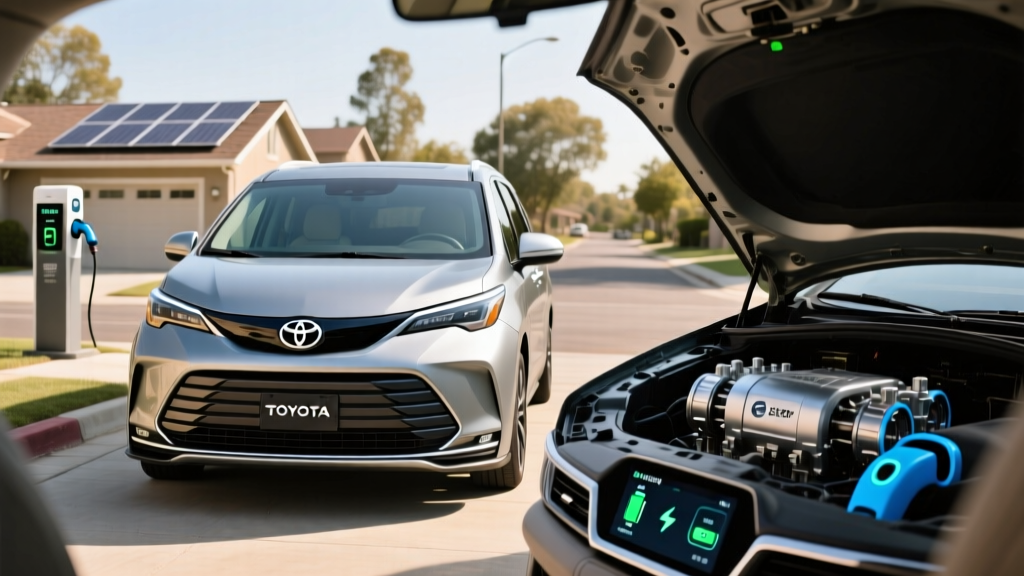
If you've been shopping for a family minivan and keep hearing that the Toyota Sienna ditched its V6, you're not imagining things. Since the 2021 redesign, every single Toyota Sienna sold in the United States has been a conventional hybrid electric vehicle (HEV). There is no gasoline-only version, no plug-in hybrid (PHEV) variant, and no fully electric Sienna. For 2026, that hybrid-only strategy continues across all trims.
This guide breaks down exactly what that means for your fuel bill, how the powertrain works, what the real-world MPG looks like versus the EPA sticker, and whether the Sienna's hybrid system — or a PHEV or full EV minivan — is the right call for your family.
Yes, Every 2026 Toyota Sienna Is a Hybrid — Here's What That Means
Toyota made a bold move with the fourth-generation Sienna: it eliminated the traditional 3.5-liter V6 and replaced it with a 2.5-liter four-cylinder hybrid powertrain across the entire lineup. Whether you choose the base LE, the XLE, the Limited, or the Platinum trim, you're getting the same Toyota Hybrid System (THS II). There is no non-hybrid Sienna available new from any U.S. dealer.
Before we go further, it's critical to understand the difference between the two main types of electrified powertrains, because buyers frequently confuse them:
HEV vs. PHEV — Know the Difference
| Feature | Conventional Hybrid (HEV) | Plug-In Hybrid (PHEV) |
|---|---|---|
| Plug-in charging? | No — refuels with gas only | Yes — plugs in for electric-only miles |
| Battery size | ~1.0–1.6 kWh (small) | ~10–20+ kWh (larger) |
| Electric-only range | Less than 1 mile at low speed | Typically 20–45 miles |
| Primary fuel | Gasoline (motor assists efficiency) | Electricity first, then gasoline |
| Federal tax credit? | No (§30D requires plug-in capability) | Up to $7,500 (subject to sourcing/income rules) |
The Toyota Sienna is a conventional HEV. You never plug it in. You simply fill it with gasoline, and the hybrid system handles the rest automatically.
2026 Toyota Sienna MPG: EPA Ratings and Real-World Efficiency
The headline number for the Sienna hybrid is its fuel economy, and it's the reason Toyota committed to a hybrid-only strategy. Here are the official EPA figures according to fueleconomy.gov:
| Drivetrain | City MPG | Highway MPG | Combined MPG |
|---|---|---|---|
| FWD (LE, XLE) | 36 | 36 | 36 |
| AWD (LE, XLE, Limited, Platinum, Woodland) | 35 | 36 | 35 |
Those numbers are remarkable for a vehicle with up to eight seats and available all-wheel drive. For comparison, the previous-generation V6 Sienna managed around 19 city / 27 highway — roughly a 40% improvement in city driving.
Real-World MPG: What Owners Actually See
Hybrids tend to perform as well as or better than their EPA estimates in city driving, where regenerative braking and electric-motor assist do the most work. Many Sienna owners report 37–40 MPG in mixed suburban driving with frequent stops. On sustained highway trips at 70–75 mph, expect the number to dip to roughly 30–33 MPG, as the gasoline engine carries more of the load at higher speeds and the aerodynamic profile of a minivan works against efficiency.
In cold weather (below 30°F), expect a 5–10% reduction as the engine runs more frequently to provide cabin heat and the battery operates less efficiently. This is modest compared to the 20–30% range loss a full EV experiences in freezing temperatures, because the Sienna's engine waste heat is actually useful here.
Powertrain Specs: How the Sienna Hybrid System Works
The 2026 Sienna uses Toyota's fourth-generation THS II hybrid system. Here's what's under the hood:
| Specification | Detail |
|---|---|
| Engine | 2.5L inline-4 (Atkinson cycle) |
| Engine horsepower | 189 hp @ 6,000 rpm |
| Front electric motor | 134 hp (100 kW) |
| Rear electric motor (AWD only) | 54 hp (40 kW) |
| Net combined system output | 245 hp (FWD & AWD) |
| Transmission | Electronic CVT (eCVT) |
| Hybrid battery | ~1.6 kWh nickel-metal hydride (NiMH) |
| 0–60 mph | ~7.1 seconds (FWD) |
| Towing capacity | 3,500 lbs (max, properly equipped) |
| Fuel tank | 14.5 gallons |
| Total driving range (est.) | ~522 miles (FWD combined) |
The eCVT is not a traditional belt-and-pulley CVT — it's a planetary gearset that seamlessly blends engine and motor power. There are no rubber bands, no slippage, and no drone. Acceleration is linear and adequate for merging and passing, though the Sienna is not a performance vehicle. The 245 combined horsepower is sufficient for a loaded minivan but won't win any drag races against the turbocharged Honda Odyssey or the now-discontinued Chrysler Pacifica V6.
Battery Warranty, Lifespan, and Replacement Cost
This is the number-one concern for hybrid buyers, and it deserves a direct answer.
Toyota Hybrid Battery Warranty — 2026 Sienna
- Hybrid battery coverage: 10 years / 150,000 miles (whichever comes first)
- Hybrid system components: 8 years / 100,000 miles
- Applies to: Original owner and all subsequent owners (transferable)
- Capacity threshold: Toyota covers the battery if it fails or falls below functional performance standards — unlike EV warranties, there is no published percentage-retention threshold for HEVs
Note: In states that follow California Air Resources Board (CARB) emissions standards (CA, CT, ME, MD, MA, NJ, NY, OR, RI, VT, WA, and others adopting CARB rules), hybrid battery warranty may extend further. Check with your dealer for state-specific coverage.
How Long Do Toyota Hybrid Batteries Actually Last?
Toyota's hybrid battery track record is among the best in the industry. The Prius — which shares the same fundamental THS architecture — has demonstrated hybrid battery longevity of 150,000 to 200,000+ miles with routine maintenance. The Sienna's NiMH battery is managed conservatively: the system never fully charges or fully depletes it, keeping it in a narrow state-of-charge window (roughly 40–80%) that minimizes degradation.
Real-world data from fleet operators and long-term owners suggests that Sienna hybrid batteries routinely exceed 150,000 miles without significant issues. Many first-generation Prius taxis surpassed 300,000 miles on the original battery.
Replacement Cost If the Battery Fails
If you do need a replacement outside of warranty, expect to pay between $3,000 and $5,000 for a new OEM hybrid battery pack, including labor. Refurbished or aftermarket options are available for $1,500–$2,500. This is dramatically less than a full EV battery replacement, which can run $10,000–$20,000+, because the Sienna's hybrid battery is only ~1.6 kWh.
Pricing, Trims, and Tax Credit Eligibility
For 2026, the Toyota Sienna lineup starts at approximately $39,000 MSRP for the LE FWD and climbs to around $55,000 for the Platinum AWD with premium packages. Here's a trim-by-trim overview:
| Trim | Drivetrain | Approx. MSRP | Key Features |
|---|---|---|---|
| LE | FWD / AWD | $39,000 / $40,000 | 8-passenger, Toyota Safety Sense 3.0, 8" touchscreen |
| XLE | FWD / AWD | $43,500 / $44,500 | Power sliding doors, SofTex seats, 10.1" screen |
| XSE | FWD / AWD | $45,000 / $46,000 | Sport-tuned suspension, 7-passenger, black exterior accents |
| Limited | FWD / AWD | $49,000 / $50,000 | Leather, dual sunroofs, JBL audio, 12.3" screen |
| Platinum | AWD | $53,000+ | Head-up display, 360° camera, heated/ventilated 2nd row |
| Woodland Edition | AWD | $48,000 | Rugged styling, raised ride height, roof rails |
Does the Sienna Qualify for Any Tax Credit?
No. The Toyota Sienna does not qualify for the federal §30D Clean Vehicle Credit. That credit applies exclusively to plug-in electric vehicles (PHEVs and BEVs) with a minimum battery capacity of 7 kWh and external charging capability. Since the Sienna is a conventional HEV with a ~1.6 kWh battery and no plug, it is ineligible regardless of buyer income or MSRP.
Some states and local utilities offer modest rebates for conventional hybrids (typically $250–$1,000), but these vary widely and change frequently. Check your state's energy office or utility provider for current programs. The Alternative Fuels Data Center maintains a state-by-state incentive database.
Sienna Hybrid vs. PHEV Minivan vs. Full EV — Which Fits Your Family?
The minivan segment has limited electrified options. Here's how the Sienna stacks up against the two main alternatives:
Choose the Toyota Sienna Hybrid (HEV) If:
- You want the simplest ownership experience — no plug, no charging, no range planning
- You drive a mix of city and highway and want 35–36 MPG everywhere
- You need AWD (Sienna offers electronic AWD with a rear motor)
- You want Toyota's long-proven hybrid reliability and 10-year battery warranty
- You lack access to home or workplace charging
- You regularly take long road trips and don't want to plan charging stops
Consider a PHEV or Full EV If:
- You can charge at home (Level 2) and most daily trips are under 30 miles (PHEV advantage)
- You want to drive on electricity for school runs and errands, saving gas for longer trips (PHEV)
- You want to eliminate gasoline entirely and have reliable home charging (full EV)
- You qualify for the §30D federal tax credit (up to $7,500 for eligible PHEVs/BEVs — see IRS guidelines)
- You want lower per-mile fuel costs (electricity is typically $0.04–$0.06/mile vs. $0.12–$0.16/mile for gas in the Sienna)
As of 2026, the Chrysler Pacifica PHEV remains the only plug-in hybrid minivan on the market, offering approximately 32 miles of electric-only range and a combined 30 MPG once the battery is depleted. It qualifies for partial federal tax credit depending on your income and the vehicle's battery sourcing compliance. The Kia Carnival is available as a conventional hybrid for 2026, rated at around 34 MPG combined, offering direct competition to the Sienna.
There is currently no fully electric minivan sold in the U.S. market. If a battery-electric family hauler is a must-have, you'll need to look at three-row SUVs like the Kia EV9 or the Rivian R1S instead.
Ownership Costs: What You'll Actually Spend
Let's put real numbers on five-year ownership for the Sienna hybrid versus a hypothetical gas-only minivan rated at 22 MPG combined:
| Cost Factor | Sienna Hybrid (36 MPG) | Gas Minivan (22 MPG) |
|---|---|---|
| Annual mileage | 15,000 miles | 15,000 miles |
| Fuel price assumption | $3.50/gal | $3.50/gal |
| Annual fuel cost | ~$1,458 | ~$2,386 |
| 5-year fuel cost | ~$7,292 | ~$11,932 |
| 5-year fuel savings | ~$4,640 saved with the Sienna hybrid | |
That $4,640 savings over five years doesn't include the potential for higher fuel prices, which would widen the gap further. It also doesn't account for the Sienna's typically higher resale value — Toyota hybrids historically hold their value well, which narrows the total cost of ownership advantage even more.
On the maintenance side, the Sienna hybrid actually costs less to maintain than a conventional minivan. The regenerative braking system reduces wear on the friction brakes (many owners report 80,000+ miles on original brake pads), and there is no traditional starter motor or alternator to replace. Toyota's eCVT has no belts or clutches to wear out.
FAQ: Common Questions About the Toyota Sienna Hybrid
Are all Toyota Siennas hybrid?
Yes. Since the 2021 model year redesign, every Toyota Sienna sold in the United States has been a conventional hybrid (HEV). There is no gasoline-only version, no PHEV, and no fully electric Sienna. For 2026, this hybrid-only approach continues across all trims: LE, XLE, XSE, Limited, Platinum, and Woodland Edition.
How many MPG does the Sienna hybrid get?
The EPA rates the 2026 Sienna FWD at 36 city / 36 highway / 36 combined. AWD models are rated at 35 city / 36 highway / 35 combined. In real-world city and suburban driving, many owners report 37–40 MPG. Sustained highway driving at 75+ mph typically yields 30–33 MPG.
Do I need to plug in the Toyota Sienna?
No. The Sienna is a conventional hybrid (HEV), not a plug-in hybrid (PHEV). It charges its small hybrid battery internally through regenerative braking and the gasoline engine. You simply fill it with regular unleaded gasoline at any gas station.
How long will the Sienna hybrid battery last?
Toyota's hybrid batteries have a strong track record of lasting 150,000–200,000+ miles. The hybrid battery is warranted for 10 years or 150,000 miles. If replacement is ever needed outside of warranty, expect to pay $3,000–$5,000 for a new OEM battery — far less than a full EV battery replacement.
Does the Toyota Sienna qualify for a federal tax credit?
No. The federal §30D Clean Vehicle Credit requires a vehicle to be a plug-in electric vehicle (PHEV or BEV) with at least 7 kWh of battery capacity. The Sienna's ~1.6 kWh NiMH battery and lack of plug-in capability make it ineligible. Some states or utilities may offer small hybrid rebates — check your local programs.
Is the Sienna hybrid underpowered compared to the old V6?
The hybrid system produces 245 combined horsepower versus the old V6's 296 hp. The Sienna hybrid is about 1.5 seconds slower to 60 mph (~7.1 sec vs. ~5.6 sec for the V6). In daily driving, the difference is modest — the electric motor provides instant torque for low-speed acceleration and merging. You'll notice the gap most during high-speed passing maneuvers or when fully loaded going uphill.
Hybrid vs. PHEV vs. EV — which minivan should I buy?
If you can't charge at home or take frequent long road trips, the Sienna HEV is the most practical choice — zero behavior change required, excellent MPG. If you have home charging and most daily trips are under 30 miles, the Chrysler Pacifica PHEV lets you do school runs and errands on electricity while keeping gas for road trips. There is no full-electric minivan currently available in the U.S. market as of 2026.
Does the Sienna hybrid require premium fuel?
No. The 2026 Sienna hybrid runs on regular unleaded gasoline (87 octane). This keeps operating costs lower compared to vehicles that require premium fuel.
The Toyota Sienna's hybrid-only strategy was controversial when it launched, but the results speak for themselves: class-leading fuel economy, proven reliability, and a total ownership experience that requires zero adaptation from the driver. If you want an electrified minivan without the complexity of plug-in charging or the range planning of a full EV, the Sienna remains the default recommendation for 2026.