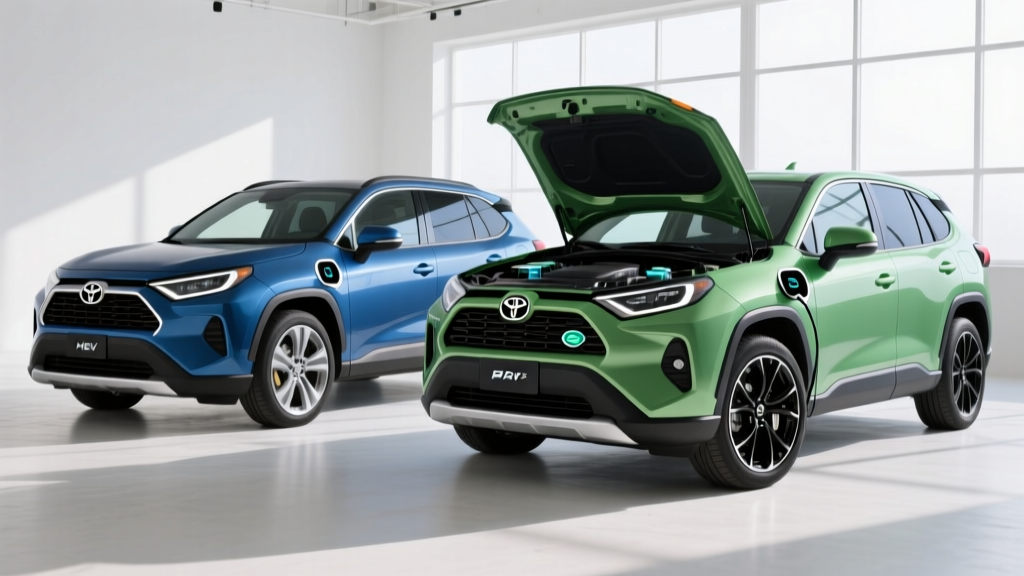
If you've browsed Toyota's SUV lineup lately, you've likely asked: are all RAV4 hybrids the same? The short answer is no. Toyota sells two fundamentally different electrified RAV4 models for 2026 — the conventional RAV4 Hybrid (HEV) and the plug-in RAV4 Prime (PHEV). They share a badge and a body shell, but their powertrains, batteries, fuel economy, pricing, and tax-credit eligibility diverge sharply.
This guide breaks down exactly what separates them so you can pick the right one for your commute, your garage, and your budget.
HEV vs PHEV: What's the Difference Under the Hood?
Before comparing specs, it's essential to understand the core distinction, because it affects everything from how you fuel the vehicle to whether you'll ever see a charging station.
RAV4 Hybrid (HEV)
A conventional hybrid. It pairs a 2.5-liter four-cylinder engine with electric motors and a small (~1.6 kWh) battery. You never plug it in. The battery recharges through regenerative braking and the gas engine. It operates seamlessly — you drive it exactly like a gas car, and it simply uses less fuel.
RAV4 Prime (PHEV)
A plug-in hybrid. It uses a much larger 18.1 kWh lithium-ion battery paired with a more powerful electric motor system and the same 2.5L engine. You plug it in to unlock ~42 miles of pure electric driving. Once the battery depletes, it reverts to hybrid mode and operates like the standard HEV.
Neither is "better" universally — the right choice depends on your daily mileage, home charging access, and budget. We'll get to that framework shortly.
EPA Fuel Economy: How Many MPG Does Each RAV4 Hybrid Get?
Fuel economy is where both models shine compared to the gas-only RAV4, but they achieve efficiency differently.
| Model | City MPG | Highway MPG | Combined MPG | MPGe (PHEV EV Mode) |
|---|---|---|---|---|
| 2026 RAV4 Hybrid (HEV) AWD | 41 | 38 | 39 | N/A |
| 2026 RAV4 Prime (PHEV) AWD — Hybrid Mode | 40 | 36 | 38 | N/A |
| 2026 RAV4 Prime (PHEV) AWD — EV Mode | 42 miles electric-only range | 94 MPGe | ||
| Gas RAV4 AWD (baseline) | 27 | 34 | 30 | N/A |
Source: EPA fueleconomy.gov
Real-World MPG: What Owners Actually Report
Toyota's hybrid system excels in stop-and-go city driving, where the electric motor handles low-speed propulsion and the engine kicks in for higher loads. Many RAV4 Hybrid owners report exceeding the 41 MPG city EPA estimate in warm-weather urban commuting — figures of 43–45 MPG are common on forums and owner surveys.
Highway driving is the opposite story. At sustained 70–80 mph speeds, the engine does most of the work and aerodynamic drag dominates. Expect 34–36 MPG highway in real-world conditions, slightly below the EPA sticker. In cold weather (below 30°F), plan for a 5–10% reduction across the board as the engine runs more frequently to provide cabin heat.
For the RAV4 Prime in hybrid mode (battery depleted), real-world numbers track closely with the HEV — around 36–38 MPG combined. The magic is in EV mode: if your commute is under 42 miles round-trip and you charge at home nightly, you may use gasoline only on weekend road trips.
RAV4 Prime Electric Range, Battery, and Charging Specs
The RAV4 Prime's 18.1 kWh battery pack is the centerpiece of its value proposition. Here's the precise breakdown:
| Specification | RAV4 Prime (PHEV) |
|---|---|
| Battery Capacity (gross / usable) | 18.1 kWh / ~14.5 kWh usable |
| EPA Electric-Only Range | 42 miles |
| Total Range (EV + Gas) | ~600 miles |
| Level 1 Charging (120V, 12A) | ~12 hours (0–100%) |
| Level 2 Charging (240V, 32A) | ~2.5 hours (0–100%) |
| DC Fast Charging | Not available |
| Charge Port | J1772 (Level 1 & 2) |
| Electric-Only Top Speed | ~84 mph |
No DC fast charging. This is a common buyer surprise. The RAV4 Prime charges exclusively via AC (Level 1 or Level 2). That means public DC fast chargers — the 50–350 kW stations along highways — are useless to this vehicle. For a PHEV with an 18.1 kWh battery, this isn't a practical limitation. A Level 2 home charger tops it off in about 2.5 hours, which is all you need for overnight charging.
If you don't have access to home or workplace Level 2 charging, the Prime's EV range advantage diminishes significantly. Level 1 (standard 120V outlet) technically works, but 12 hours for a full charge means you'll rarely get a complete battery unless you're parked overnight.
Powertrain and Performance: Horsepower, 0–60, and Drivetrain
Both RAV4 hybrids use Toyota's 2.5-liter Dynamic Force four-cylinder engine combined with electric motors, but the Prime's system is substantially more powerful.
| Specification | RAV4 Hybrid (HEV) | RAV4 Prime (PHEV) |
|---|---|---|
| Engine | 2.5L I4 + 2 electric motors | 2.5L I4 + 2 electric motors (higher output) |
| Combined System Horsepower | 219 hp | 302 hp |
| 0–60 mph | 7.4 seconds | 5.7 seconds |
| Drivetrain | AWD (eAWD with rear motor) | AWD (eAWD with rear motor) |
| Towing Capacity | 1,750 lbs | 2,500 lbs |
The Prime's 302 hp makes it one of the quickest vehicles in Toyota's mainstream lineup — faster than a V6 Camry, and the 5.7-second 0–60 time genuinely surprises drivers at merge lanes. The HEV's 219 hp is adequate for daily driving but won't win any stoplight sprints.
Both use Toyota's electronic AWD system, where a dedicated rear-axle electric motor provides all-wheel drive without a mechanical driveshaft. This is seamless in rain and light snow, though it's not a substitute for a dedicated off-road system.
Pricing, Trims, and Tax Credit Eligibility
Price is where the HEV vs PHEV decision becomes stark. The Prime commands a significant premium — but tax incentives can partially close the gap.
| Model / Trim | 2026 MSRP (est.) |
|---|---|
| RAV4 Hybrid LE | ~$33,500 |
| RAV4 Hybrid XLE | ~$35,500 |
| RAV4 Hybrid Woodland Edition | ~$37,500 |
| RAV4 Hybrid Limited | ~$40,000 |
| RAV4 Prime SE | ~$45,500 |
| RAV4 Prime XSE | ~$49,000 |
Does the RAV4 Hybrid or Prime Qualify for a Federal Tax Credit?
Here's the nuance that trips up many buyers:
- RAV4 Hybrid (HEV): Does not qualify for the federal §30D clean vehicle credit. Conventional hybrids are excluded — the credit applies only to plug-in vehicles with a battery capacity of at least 7 kWh.
- RAV4 Prime (PHEV): Historically eligible for up to $7,500 under §30D, but eligibility depends on current-year battery sourcing requirements, buyer income caps, and MSRP limits. As of 2026, the battery component and critical minerals sourcing rules under the Inflation Reduction Act have tightened significantly. The RAV4 Prime is assembled in Japan, and its battery supply chain may not meet the domestic-content thresholds required for the full credit.
§30D Federal Credit Checklist for RAV4 Prime (2026)
- ✔ MSRP under $80,000 (SUV cap) — Prime qualifies
- ✔ Buyer AGI: ≤ $150K single / $300K joint — must verify
- ⚠ Battery component manufacturing: must meet North American assembly threshold
- ⚠ Critical minerals sourcing: must meet approved-trade-partner threshold
- ✔ Plug-in with ≥ 7 kWh battery — Prime qualifies (18.1 kWh)
- ✔ Point-of-sale transfer available if all requirements met
Bottom line: Do not assume the RAV4 Prime qualifies for the full $7,500 credit. Check the latest eligibility list at IRS.gov before purchasing, and consult a tax professional. Some buyers may qualify for $3,750 (half credit if one sourcing requirement is met) or nothing at all depending on model-year sourcing changes. State incentives may also apply — check your state energy office.
Battery Reliability, Warranty, and Replacement Cost
This is the #1 concern among first-time hybrid buyers. Let's address it with data.
Toyota Hybrid Battery Warranty
RAV4 Hybrid (HEV): 10 years / 150,000 miles (whichever comes first), transferable to subsequent owners.
RAV4 Prime (PHEV): 10 years / 150,000 miles on the hybrid battery, plus 8 years / 100,000 miles on PHEV-specific components.
Covers battery capacity below a defined threshold (typically 60–70% of original capacity).
How Long Do Toyota Hybrid Batteries Actually Last?
Toyota has over two decades of real-world hybrid battery data, starting with the original Prius in 2001. The track record is strong:
- Most Toyota hybrid batteries last 150,000–200,000+ miles before meaningful degradation.
- Many Prius and Camry Hybrid owners report original batteries exceeding 250,000 miles with less than 15% capacity loss.
- The HEV's small 1.6 kWh battery cycles shallowly (never fully depletes or charges), which dramatically extends cell life.
- The Prime's 18.1 kWh pack has a larger buffer and more robust thermal management, though it undergoes deeper cycles.
What Does a Replacement Cost?
If you're buying used or plan to keep the vehicle past warranty:
- RAV4 Hybrid (HEV) battery replacement: $2,000–$4,000 (refurbished or new from Toyota).
- RAV4 Prime (PHEV) battery replacement: $8,000–$12,000 (larger pack, more complex).
For context, these costs are comparable to a major transmission repair or engine overhaul on a conventional vehicle — and they're far less likely to be needed within typical ownership periods. The 10-year / 150,000-mile warranty covers the vast majority of ownership timelines.
Real-World Ownership: Who Should Choose Which?
Choose the RAV4 Hybrid (HEV) If:
- You don't have access to home or workplace charging
- Your budget is under $40,000
- You want zero behavior change — just fill up less often
- You drive 200+ miles daily and don't want to think about battery range
- You want the lowest total cost of ownership without charging infrastructure investment
Choose the RAV4 Prime (PHEV) If:
- Your daily commute is under 40 miles round-trip
- You have a garage or driveway where you can install a Level 2 charger
- You want EV-like daily driving with gas-car road-trip freedom
- You value the 302 hp performance upgrade
- You can verify federal/state tax credit eligibility to offset the premium
Choose a Full EV (e.g., Tesla Model Y, Hyundai Ioniq 5) If:
- You want zero gasoline use and zero oil changes
- You have reliable home charging and access to DC fast-charging corridors
- Your daily driving is under 250 miles and you road-trip infrequently
- You want the lowest per-mile fuel cost (electricity vs. gasoline)
Pros and Cons at a Glance
RAV4 Hybrid (HEV) — Pros
- 41/38/39 MPG city/hwy/combined — no plug needed
- Lower starting price (~$33,500)
- No charging infrastructure required
- Proven, ultra-reliable Toyota hybrid system
- Real-world city MPG often exceeds EPA
RAV4 Hybrid (HEV) — Cons
- No federal tax credit
- 219 hp — adequate but not exciting
- 1,750-lb towing capacity
- Still burns gasoline for every mile
RAV4 Prime (PHEV) — Pros
- 42 miles electric-only — gas-free commuting
- 302 hp / 5.7-sec 0–60 — genuinely quick
- 94 MPGe in EV mode
- 2,500-lb towing capacity
- Potential federal + state tax credits
RAV4 Prime (PHEV) — Cons
- ~$12,000 premium over HEV LE
- No DC fast charging
- Requires Level 2 home charging to maximize value
- Tax credit eligibility uncertain under 2026 sourcing rules
- Higher battery replacement cost ($8K–$12K)
Frequently Asked Questions
Are all RAV4 hybrids plug-in vehicles?
No. The standard RAV4 Hybrid is a conventional hybrid (HEV) that never plugs in. Only the RAV4 Prime is a plug-in hybrid (PHEV). They are mechanically and financially very different vehicles.
How many MPG does the RAV4 Hybrid get in real driving?
The EPA rates it at 41 city / 38 highway / 39 combined. In real-world city driving, many owners see 42–45 MPG. Highway driving typically yields 34–36 MPG, especially at speeds above 70 mph or in cold weather.
How far can the RAV4 Prime go on electricity alone?
The EPA rates it at 42 miles of electric-only range. In mild weather at moderate speeds, some owners squeeze out 44–46 miles. In cold weather or at highway speeds, expect 35–38 miles before the gas engine engages.
Is the RAV4 Hybrid reliable long-term?
Toyota's hybrid system is among the most reliable powertrains in the industry. The hybrid battery carries a 10-year/150,000-mile warranty, and real-world data shows most batteries last well beyond 150,000 miles. The RAV4 Hybrid consistently earns top reliability scores from Consumer Reports and J.D. Power.
Does the RAV4 Hybrid qualify for any tax credits?
The conventional RAV4 Hybrid (HEV) does not qualify for the federal §30D clean vehicle credit — it applies only to plug-in vehicles. The RAV4 Prime (PHEV) may qualify for up to $7,500, but eligibility depends on 2026 battery-sourcing rules, buyer income, and MSRP caps. Verify at IRS.gov before purchasing.
Can I charge the RAV4 Prime at a public DC fast charger?
No. The RAV4 Prime accepts only AC charging (Level 1 at 120V or Level 2 at 240V). It has no DC fast-charge port. For a PHEV with 42 miles of range, overnight Level 2 charging at home is the intended use case.
What is the hybrid battery replacement cost?
The RAV4 Hybrid (HEV) battery costs approximately $2,000–$4,000 to replace. The RAV4 Prime (PHEV) battery runs $8,000–$12,000 due to its larger capacity. Both are covered under Toyota's 10-year/150,000-mile hybrid battery warranty.
Should I get the RAV4 Hybrid or a full EV?
If you can charge at home, drive under 250 miles daily, and have access to DC fast-charging routes for road trips, a full EV (like the Tesla Model Y or Hyundai Ioniq 5) offers lower per-mile fuel costs and zero tailpipe emissions. If you lack home charging, frequently drive 300+ miles, or want zero behavior change, the RAV4 Hybrid is the pragmatic choice.