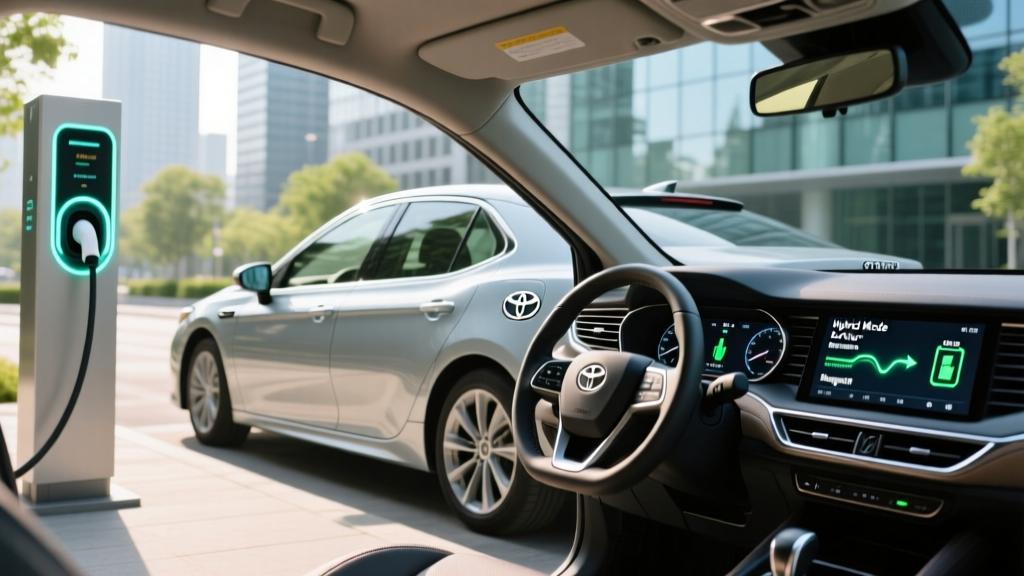
If you've shopped for a midsize sedan recently, you've likely noticed a major shift at Toyota dealerships: the traditional four-cylinder and V6 Camry engines are gone. That raises a common question among buyers: are all Camrys hybrid now? The short answer is yes. Starting with the 2025 model year and continuing into the 2026 Toyota Camry, every trim level comes exclusively with Toyota's fifth-generation hybrid powertrain. There is no gas-only Camry available new.
This wasn't a gradual phase-out — Toyota made a clean break. The 2026 Camry lineup is built entirely around a 2.5-liter four-cylinder engine paired with electric motors and a lithium-ion battery pack. But "hybrid" doesn't mean one-size-fits-all. The 2026 Camry is available in front-wheel drive (FWD) and all-wheel drive (AWD) configurations, with meaningful differences in horsepower, fuel economy, and pricing across trims.
Below, we break down exactly what this all-hybrid strategy means for your wallet, your commute, and your next car purchase — with real EPA data, ownership costs, and a clear-eyed look at who should (and shouldn't) choose the Camry hybrid over a plug-in hybrid or full EV.
The 2026 Camry Powertrain: What Replaced the Gas Engine
The 2026 Camry uses Toyota's fifth-generation hybrid system, which pairs a 2.5-liter Dynamic Force four-cylinder engine with one or two electric motors depending on drivetrain. Here's the spec breakdown:
| Specification | FWD Models | AWD Models |
|---|---|---|
| Engine | 2.5L 4-cylinder + 1 electric motor | 2.5L 4-cylinder + 2 electric motors |
| Combined Horsepower | 225 hp | 232 hp |
| Drivetrain | Front-wheel drive | Electronic on-demand AWD |
| Transmission | eCVT (electronically controlled) | eCVT |
| Hybrid Battery | Lithium-ion (under rear seat) | Lithium-ion (under rear seat) |
| 0-60 mph (est.) | ~7.2 seconds | ~6.9 seconds |
The AWD system adds a rear-mounted electric motor (40 hp) that engages automatically when the car detects slip — it's not a mechanical driveshaft system. This means the AWD Camry doesn't sacrifice cargo space or add significant weight penalty compared to the FWD model.
Notably, Toyota dropped the V6 entirely after the 2024 model year. The old 3.5L V6 produced 301 hp but returned just 26 MPG combined. The current hybrid four-cylinder sacrifices some peak power but more than doubles the city fuel economy, which is where most Camry buyers actually drive.
MPG Breakdown: How Efficient Is the 2026 Camry Hybrid?
Fuel economy is the headline reason Toyota went all-hybrid, and the numbers are substantial. Here's the EPA-rated data by configuration:
| Configuration | City MPG | Highway MPG | Combined MPG |
|---|---|---|---|
| FWD (LE trim) | 53 | 50 | 52 |
| FWD (SE/XSE trims) | 48 | 47 | 47 |
| AWD (SE/XSE trims) | 51 | 49 | 50 |
Source: fueleconomy.gov — EPA estimates. Your mileage will vary with driving conditions, tire pressure, and climate control use.
The LE trim achieves its higher numbers partly through lighter-weight wheels and low-rolling-resistance tires. If you step up to the sport-tuned SE or XSE, you trade a few MPG for sharper handling and larger alloy wheels — a reasonable compromise for many buyers.
Real-World MPG: Expect to Beat the EPA Sticker in the City
One of the most consistent findings with Toyota's hybrid system is that real-world city driving often exceeds the EPA city estimate. This is because the EPA city test cycle doesn't fully capture how aggressively the hybrid system recovers energy through regenerative braking in stop-and-go traffic. Owners on forums and fuel-tracking apps like Fuelly frequently report 54-58 MPG in urban commuting on the LE trim.
Highway driving is a different story. At sustained speeds above 70 mph, the electric motor contributes less and the gasoline engine carries more of the load. Expect highway fuel economy to land closer to — or slightly below — the EPA number, particularly in winter or with roof cargo. On a 300-mile highway trip at 75 mph, plan for roughly 44-48 MPG in a FWD LE, which still translates to over 600 miles of total range from the 13.2-gallon tank.
HEV vs. PHEV vs. EV: Which Powertrain Fits You?
The Camry is a conventional hybrid (HEV), meaning it generates its own electricity through the gasoline engine and regenerative braking. You never plug it in. This is a critical distinction from plug-in hybrids (PHEVs) and battery-electric vehicles (BEVs).
Conventional Hybrid (HEV) — Like the Camry
- No plug required — refuel at any gas station
- Electric-only driving: Very short distances at low speed (~1 mile or less)
- Best for: Drivers without home charging access, high-mileage commuters, those who want zero behavior change
- Trade-off: Still uses gasoline for all long trips; no electric-only commute
Plug-in Hybrid (PHEV) — Like the Toyota RAV4 Prime
- Plug in to charge — Level 1 (120V) or Level 2 (240V)
- Electric-only range: Typically 25-45 miles depending on model
- Best for: Drivers with home charging who want electric commutes but gas flexibility for road trips
- Trade-off: Higher purchase price; heavier; requires charging infrastructure to realize benefits
Battery Electric (BEV) — Like the Tesla Model 3 or Hyundai Ioniq 6
- Plug in to charge — Level 2 home + DC fast charging for trips
- Electric-only range: 250-400+ miles depending on model
- Best for: Drivers with reliable home/work charging, lower fuel costs, zero tailpipe emissions
- Trade-off: Higher upfront cost; charging time on road trips; range reduced in cold weather
The Camry HEV sits in a specific sweet spot: it dramatically reduces fuel consumption without requiring any change in refueling behavior. If you can't install a charger at home or your apartment complex doesn't offer EV charging, the Camry hybrid is arguably the most practical electrified sedan on the market.
2026 Camry Pricing: Trims, MSRP, and Tax Credit Eligibility
| Trim | Drivetrain | MSRP (approx.) |
|---|---|---|
| LE | FWD | $29,495 |
| LE | AWD | $30,995 |
| SE | FWD | $31,995 |
| SE | AWD | $33,495 |
| XSE | FWD | $34,495 |
| XSE | AWD | $35,995 |
Pricing is approximate based on manufacturer data and may vary by dealer. Destination charges additional.
Does the Camry Hybrid Qualify for a Federal Tax Credit?
No. The conventional Camry Hybrid (HEV) does not qualify for the federal §30D Clean Vehicle Credit. That credit — up to $7,500 — is reserved for plug-in electric vehicles (BEVs and PHEVs) that meet specific battery sourcing, critical mineral, MSRP cap, and buyer income requirements as outlined by the IRS.
Since the Camry HEV cannot be plugged in and has a battery too small to meet the §30D minimum capacity threshold (7 kWh for the credit's battery component), it is ineligible. However, the Camry's relatively low starting price and exceptional fuel economy mean the total cost of ownership is competitive even without a credit.
Some states offer their own incentives for hybrid purchases, though these are less common than EV incentives. Check your state's energy or environmental agency for current programs.
Reliability, Battery Lifespan, and Warranty Coverage
Toyota's hybrid system has one of the longest track records in the industry — the Prius has been on U.S. roads since 2000, and the hybrid Camry since 2007. The fifth-generation system in the 2026 Camry uses a lithium-ion battery pack (replacing the older nickel-metal hydride units), which is lighter, more energy-dense, and better managed thermally.
2026 Camry Hybrid Battery Warranty
- Hybrid Battery: 10 years / 150,000 miles (whichever comes first)
- Hybrid System Components: 8 years / 100,000 miles
- Basic Vehicle Warranty: 3 years / 36,000 miles
- Powertrain Warranty: 5 years / 60,000 miles
Toyota extended the hybrid battery warranty from 8 years/100,000 miles to 10 years/150,000 miles starting with 2020 model-year vehicles, and this carries forward to 2026.
Battery Replacement Cost: What to Expect
If the hybrid battery does eventually need replacement — typically well beyond the warranty period, often at 150,000-200,000+ miles — expect to pay between $2,000 and $4,000 for a refurbished or new battery pack plus labor at a dealership. Independent hybrid specialists can often perform the swap for less. This is a fraction of the cost of replacing a BEV traction battery, which can exceed $10,000-$20,000.
Real-world data from high-mileage Prius and Camry hybrid owners suggests that modern lithium-ion hybrid batteries retain functional capacity well past 200,000 miles in normal use. The battery is relatively small (roughly 1.0-1.6 kWh), so it isn't subjected to the deep discharge cycles that stress larger EV batteries. Degradation is gradual, and the car's computer manages the battery's state of charge within a narrow, protective window — typically between 40% and 80% — to maximize longevity.
Who Should Buy the Camry Hybrid — And Who Shouldn't
Pros
- Best-in-class city fuel economy (53 MPG EPA)
- No plug-in charging required — zero behavior change
- 600+ mile total driving range per tank
- 10-year / 150,000-mile hybrid battery warranty
- AWD available for snow-belt buyers
- Strong resale value (Toyota brand strength)
- Competitive starting price under $30,000
Cons
- No electric-only commuting capability
- No federal tax credit eligibility
- eCVT can feel unengaging for enthusiast drivers
- AWD only available on SE/XSE trims (not LE)
- Rear-seat space slightly reduced vs. prior gas generation
- Not as quick as turbocharged or V6 competitors
Choose the Camry Hybrid If:
- You commute in stop-and-go city traffic and want to minimize fuel costs without plugging in
- You live in an apartment or lack access to home/work EV charging
- You regularly take long road trips and don't want to plan around charging stops
- You want proven reliability with a long battery warranty
- Your budget is in the $29,000-$36,000 range for a midsize sedan
Look Elsewhere If:
- You want an electric-only daily commute — consider a PHEV like the Toyota Prius Prime (44 miles electric-only) or a BEV
- You qualify for the $7,500 federal EV credit and want to maximize incentives — a BEV or PHEV will net a lower effective price
- You prioritize acceleration and driving dynamics — the Honda Accord Hybrid or a BEV sedan will feel more responsive
- You need more than 16 cubic feet of trunk space — the hybrid battery does eat slightly into cargo volume
Camry Hybrid vs. Competitors: Quick Comparison
| Vehicle | Combined MPG (EPA) | Horsepower | Starting MSRP | AWD Available? |
|---|---|---|---|---|
| Toyota Camry Hybrid (LE FWD) | 52 | 225 hp | ~$29,495 | Yes (SE/XSE) |
| Honda Accord Hybrid | 48 | 204 hp | ~$33,990 | No |
| Hyundai Sonata Hybrid | 47 | 192 hp | ~$31,250 | No |
| Toyota Prius (HEV) | 57 | 196 hp | ~$28,350 | Yes (AWD-e) |
The Camry occupies a strong middle ground: it offers better fuel economy than the Accord and Sonata, more power than the Prius, and available AWD that the Accord and Sonata lack. The Prius beats it on pure MPG and starts slightly lower, but the Camry offers more rear-seat room and a quieter highway ride.
Ownership Cost: 5-Year Fuel Savings Estimate
To put the fuel savings in perspective, compare the Camry Hybrid LE (52 MPG combined) to the last gas-only Camry (2.5L 4-cylinder, ~32 MPG combined) over 5 years and 75,000 miles of driving:
- Gas Camry (32 MPG): ~2,344 gallons needed → ~$7,031 at $3.00/gal
- Camry Hybrid (52 MPG): ~1,442 gallons needed → ~$4,327 at $3.00/gal
- 5-year fuel savings: ~$2,704
That's roughly $540 per year in fuel savings, and more if gas prices rise. The hybrid also reduces annual CO₂ emissions by approximately 2.5 metric tons based on average U.S. driving patterns.
Frequently Asked Questions
Are all 2026 Toyota Camrys hybrid?
Yes. Every 2026 Camry — from the base LE to the top XSE — uses Toyota's fifth-generation hybrid powertrain. There is no gas-only option available. Toyota eliminated the conventional four-cylinder and V6 engines starting with the 2025 model-year redesign.
Do I need to plug in the Camry Hybrid?
No. The Camry is a conventional hybrid (HEV), not a plug-in hybrid. It charges its small battery through the gasoline engine and regenerative braking during deceleration. You refuel it at any gas station, just like a traditional car.
How many MPG does the Camry Hybrid actually get in real driving?
The EPA rates the FWD LE at 53 city / 50 highway / 52 combined. In real-world city commuting with frequent stops, many owners report 54-58 MPG thanks to aggressive regenerative braking. Highway driving at 75+ mph tends to return 44-48 MPG. Cold weather and aggressive acceleration reduce these figures.
Is the Camry Hybrid battery expensive to replace?
Hybrid battery replacement typically costs $2,000-$4,000 including labor, but this is rarely needed within the first 150,000+ miles. Toyota's hybrid battery warranty covers 10 years or 150,000 miles, and real-world data shows these batteries often last well beyond 200,000 miles due to conservative charge management.
Does the 2026 Camry Hybrid qualify for any federal tax credit?
No. The federal §30D Clean Vehicle Credit applies only to plug-in vehicles (BEVs and PHEVs) with battery packs meeting minimum capacity and domestic sourcing requirements. The Camry HEV's battery is too small and it cannot be plugged in, so it does not qualify. Check with your state environmental agency for possible state-level hybrid incentives.
Should I buy the Camry Hybrid or a full EV?
If you have reliable home charging, drive under 300 miles between charges, and qualify for the $7,500 federal tax credit, a BEV like the Tesla Model 3 or Hyundai Ioniq 6 can offer lower operating costs and stronger performance. If you lack home charging, frequently drive long distances, or want a lower purchase price with no charging logistics, the Camry Hybrid is the more practical choice.
Is the AWD system on the Camry Hybrid worth it?
If you regularly drive in snow, rain, or on loose surfaces, the electronic AWD (available on SE and XSE trims) adds meaningful traction for a ~$1,500 premium. It uses a rear electric motor rather than a mechanical driveshaft, so there's no cargo-space penalty. For dry-climate commuters, the FWD model saves money and returns slightly better fuel economy.