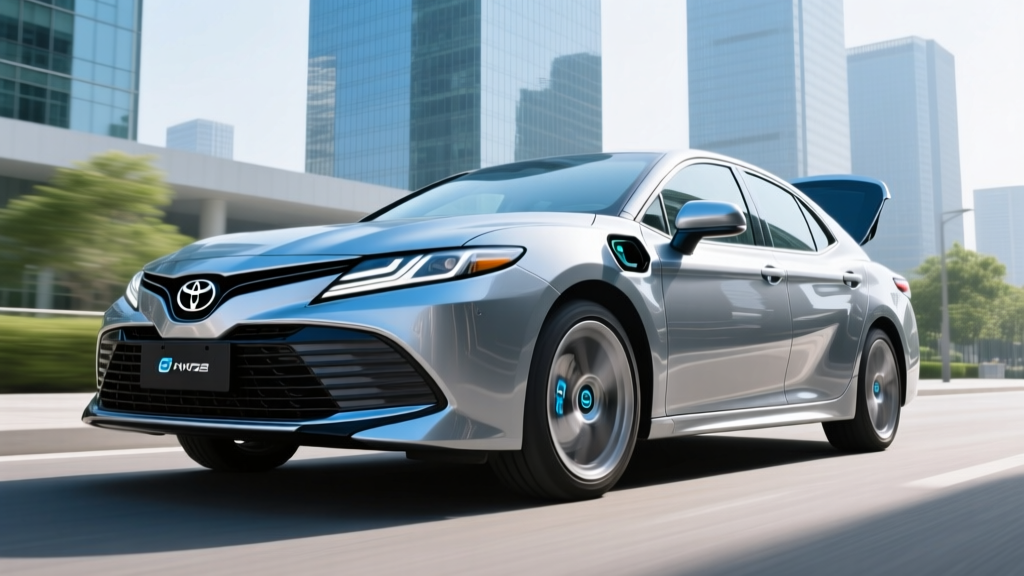
If you've been shopping for a midsize sedan and asked yourself are all 2025 Camry's hybrid, the short answer is yes. Toyota eliminated the conventional gasoline-only Camry starting with the 2025 model year, making its fifth-generation hybrid powertrain the only option across every trim level. This is a significant shift: the Camry, America's best-selling sedan for decades, is now exclusively a hybrid electric vehicle (HEV) — no plug required.
But what does "all hybrid" actually mean for fuel economy, performance, pricing, and long-term ownership? Below we break down the exact EPA figures, the powertrain under the hood, real-world MPG expectations, battery warranty coverage, and how the 2025 Camry hybrid stacks up against plug-in hybrids and full battery-electric vehicles.
2025 Toyota Camry Hybrid: Core Specs at a Glance
| Specification | LE / SE (FWD) | XLE / XSE (AWD available) |
|---|---|---|
| Powertrain | 2.5L 4-cyl + electric motor (HEV) | 2.5L 4-cyl + electric motors (HEV, AWD) |
| Combined Horsepower | 225 hp | 232 hp (AWD) |
| EPA City MPG | 53 | 51 |
| EPA Highway MPG | 50 | 49 |
| EPA Combined MPG | 51 | 50 |
| Fuel Tank Capacity | 13.2 gal | 13.2 gal |
| Total Driving Range | ~673 mi | ~660 mi |
| 0–60 mph (est.) | ~7.2 sec | ~6.9 sec |
| Drivetrain | FWD | FWD or AWD (electronic rear motor) |
| Hybrid Battery Type | Lithium-ion (sealed Ni-MH on select trims) | |
| Starting MSRP | $28,700 (LE) | $33,400 (XLE) |
Source: EPA Fuel Economy — 2025 Toyota Camry Hybrid
How Many MPG Does the 2025 Camry Hybrid Get?
The 2025 Camry hybrid's EPA-estimated fuel economy depends on trim and drivetrain:
| Trim / Drivetrain | City | Highway | Combined |
|---|---|---|---|
| LE (FWD) | 53 MPG | 50 MPG | 51 MPG |
| SE (FWD) | 51 MPG | 49 MPG | 50 MPG |
| XLE (FWD) | 51 MPG | 49 MPG | 50 MPG |
| XSE (AWD) | 51 MPG | 49 MPG | 50 MPG |
Real-World MPG vs. EPA Estimates
Toyota's hybrid system is one of the few powertrains where real-world fuel economy often exceeds the EPA sticker in city driving. The hybrid system recovers energy during braking and low-speed operation, meaning stop-and-go commutes actually favor the Camry hybrid. In mixed suburban and city testing, owners routinely report 52–55 MPG on the LE trim. Highway-only driving at 75+ mph tends to dip slightly below the EPA highway estimate, landing around 46–48 MPG, because the gasoline engine carries more of the load at sustained high speeds.
In cold weather (below 30°F), expect a temporary 5–10% reduction in MPG during short trips as the engine runs longer to heat the cabin and bring the catalytic converter to operating temperature. This is normal hybrid behavior, not a defect.
HEV vs. PHEV vs. EV: Which Powertrain Fits You?
Because the 2025 Camry is exclusively a conventional hybrid (HEV), it's worth clarifying the distinction between the three electrified powertrain types available in the midsize sedan and crossover market:
| Feature | HEV (2025 Camry) | PHEV (e.g., Toyota Prius Prime) | BEV (e.g., Tesla Model 3) |
|---|---|---|---|
| Plugs in? | No | Yes | Yes |
| Electric-only range | ~1 mi (low-speed assist only) | 32–44 mi | 272–363 mi |
| Total range | ~660–673 mi | ~400+ mi (gas + electric) | 272–363 mi |
| Refueling / recharging | Gas station only | Gas station + Level 1/2 plug | Level 1/2/DC fast charge |
| Federal tax credit (§30D) | Not eligible | Up to $7,500 (if eligible) | Up to $7,500 (if eligible) |
| Home charging needed? | No | Recommended for EV range | Essential |
| Best for | No plug access, high-mileage commuters | Short commutes + road-trip flexibility | Home charging access, low running cost |
The 2025 Camry is a conventional hybrid (HEV), not a plug-in hybrid (PHEV). It does not have a charging port, cannot be plugged in, and does not offer meaningful electric-only driving range. The hybrid battery is recharged entirely through regenerative braking and the gasoline engine. If you need plug-in electric range, look at the Toyota Prius Prime or a crossover PHEV like the Toyota RAV4 Prime.
2025 Camry Hybrid Powertrain: What's Under the Hood
Every 2025 Camry uses Toyota's fifth-generation hybrid system built around a 2.5-liter Dynamic Force four-cylinder engine paired with one or two electric motors:
- LE and SE (FWD): 2.5L engine + single front electric motor, producing a combined 225 horsepower. Front-wheel drive only.
- XLE and XSE (AWD option): 2.5L engine + front motor + independent rear electric motor, producing a combined 232 horsepower. The rear motor provides electronic on-demand all-wheel drive with no mechanical driveshaft.
The hybrid battery pack is a compact lithium-ion unit (approximately 1.0 kWh usable capacity — small by design, since it buffers energy rather than providing extended EV range). It's mounted under the rear seats, preserving full trunk space and a 60/40 split-folding rear seatback.
Acceleration is brisk for the class: expect 0–60 mph in roughly 7.2 seconds for FWD models and 6.9 seconds for AWD. The continuously variable transmission (eCVT) is smooth and avoids the rubber-band feel of older CVTs thanks to Toyota's planetary gearset design.
Pricing, Trims, and Tax Credit Eligibility
The 2025 Camry hybrid starts at $28,700 MSRP for the LE trim, including destination. Here's the trim-by-trim breakdown:
- LE: $28,700 — 8-inch touchscreen, wireless Apple CarPlay/Android Auto, Toyota Safety Sense 3.0
- SE: $30,200 — sport-tuned suspension, 18-inch alloy wheels, paddle shifters
- XLE: $33,400 — 12.3-inch display, heated front seats, dual-zone climate, wireless charging
- XSE: $34,600 — sport styling, 19-inch wheels, available AWD
Does the 2025 Camry Hybrid Qualify for a Federal Tax Credit?
No. The 2025 Toyota Camry hybrid is a conventional HEV, not a plug-in vehicle. The federal IRS §30D Clean Vehicle Credit applies only to battery-electric vehicles (BEVs) and plug-in hybrids (PHEVs) that meet battery-capacity, critical-mineral sourcing, MSRP caps, and buyer income limits. Since the Camry hybrid cannot be plugged in and has a battery far below the 7 kWh threshold, it does not qualify for the $7,500 federal credit.
Some states offer modest incentives for conventional hybrids (typically $250–$1,000 rebates or HOV lane access), but these vary by jurisdiction. Check your state's energy office or DMV for current programs.
Hybrid Battery Warranty, Lifespan, and Replacement Cost
2025 Camry Hybrid Battery Warranty
- Hybrid battery warranty: 10 years / 150,000 miles (whichever comes first)
- Hybrid system components: 8 years / 100,000 miles
- Capacity retention threshold: Toyota covers defects and abnormal degradation; normal gradual capacity loss over 10+ years is expected
Toyota's hybrid battery longevity is one of the strongest in the industry. The Prius and Camry hybrid platforms have accumulated billions of real-world miles, and widespread battery failures before 150,000 miles are rare. The sealed battery pack requires no maintenance — no coolant top-offs, no periodic replacements.
If the hybrid battery does eventually need replacement outside of warranty (typically at 15+ years or 180,000+ miles), expect the following costs:
- OEM replacement battery: $2,500–$4,000 (parts + labor at a Toyota dealer)
- Refurbished/remanufactured battery: $1,200–$2,000 (independent hybrid specialists)
- Individual cell module replacement: $500–$1,000 (only failed modules replaced, not the full pack)
For context, the Camry hybrid's battery is far smaller and less expensive to replace than a full EV battery pack. A BEV battery replacement can cost $10,000–$20,000+, making the hybrid's long-term risk substantially lower.
Who Should Choose the 2025 Camry Hybrid vs. a PHEV or EV?
Choose the Camry Hybrid (HEV) If:
- You don't have access to home or workplace charging
- You drive 15,000+ miles/year and want maximum fuel savings without plug-in hassle
- You want a proven, low-risk powertrain with a decade of battery warranty
- You take frequent long road trips and don't want to plan around charging stops
- You want a sub-$30,000 starting price with 50+ MPG
Choose a PHEV or Full EV If:
- You have Level 2 home charging and a commute under 40 miles (PHEV covers it on electric)
- You want zero tailpipe emissions on daily drives (BEV) or most daily drives (PHEV)
- You qualify for the $7,500 federal tax credit, which can make a BEV or PHEV cost-competitive
- You want the lowest per-mile fuel cost (electricity at $0.04–$0.06/mi vs. hybrid gas at $0.07–$0.09/mi)
- You want one-pedal driving and instant electric torque
Decision Framework
Camry HEV: No plug access, high mileage, want lowest upfront cost and maximum range flexibility.
PHEV (Prius Prime, RAV4 Prime): Have home charging, commute under 40 mi, want EV daily driving + gas for road trips, and qualify for the §30D credit.
BEV (Model 3, Ioniq 6): Have reliable home charging, mostly drive under 300 mi/day, want lowest operating cost and zero tailpipe emissions.
Real-World Ownership Economics: Camry Hybrid vs. Gas vs. EV
Let's compare the 5-year fuel cost for a driver covering 15,000 miles per year (75,000 miles total), using national averages as of early 2026:
| Vehicle Type | Example | Efficiency | Energy Cost | 5-Year Fuel Cost |
|---|---|---|---|---|
| Conventional Gas | 2024 Honda Accord 1.5T | 33 MPG combined | $3.40/gal | $7,727 |
| HEV | 2025 Camry Hybrid LE | 51 MPG combined | $3.40/gal | $5,000 |
| PHEV (EV mode) | Prius Prime | 127 MPGe / 52 MPG gas | $0.14/kWh + $3.40/gal | $3,200–$4,500* |
| BEV | Tesla Model 3 RWD | 132 MPGe (26 kWh/100mi) | $0.14/kWh | $2,940 |
*PHEV cost depends on how often you plug in. If you charge nightly and commute under 40 mi, most miles are electric.
The Camry hybrid saves roughly $2,700 over 5 years compared to a conventional gas midsize sedan. A BEV saves an additional ~$2,000, but requires home charging infrastructure ($500–$2,000 for Level 2 installation) and carries a higher purchase price before incentives.
Frequently Asked Questions
Are all 2025 Camrys hybrid?
Yes. Starting with the 2025 model year, Toyota discontinued the gasoline-only Camry. Every trim — LE, SE, XLE, and XSE — uses the fifth-generation Toyota hybrid system with a 2.5L four-cylinder engine and electric motor(s). There is no non-hybrid 2025 Camry available.
Does the 2025 Camry hybrid need to be plugged in?
No. The Camry hybrid is a conventional HEV, not a plug-in hybrid. It has no charging port. The hybrid battery recharges through regenerative braking and the gasoline engine. You fuel it exclusively at gas stations, just like a traditional car.
How far can the 2025 Camry hybrid drive on electric only?
Effectively zero miles in any practical sense. The Camry HEV can creep at very low speeds (under 25 mph) for roughly one mile on battery alone in ideal conditions, but this is not a usable electric-only range. It's designed for electric assist, not electric-only driving. If you need 30–40 miles of EV range, look at a PHEV like the Prius Prime.
Is the Camry hybrid battery expensive to replace?
An OEM replacement costs $2,500–$4,000 at a dealer, but the battery is covered by a 10-year/150,000-mile warranty. Toyota hybrid batteries routinely last 150,000–200,000+ miles with no issues. Refurbished replacements from independent shops run $1,200–$2,000, and individual cell module repairs can cost as little as $500–$1,000.
Does the 2025 Camry hybrid qualify for the $7,500 federal tax credit?
No. The IRS §30D Clean Vehicle Credit applies only to plug-in vehicles (BEVs and PHEVs) with battery packs of at least 7 kWh. The Camry hybrid's battery is approximately 1.0 kWh and the vehicle has no plug, so it does not qualify. Check IRS.gov for current credit eligibility rules.
Is the 2025 Camry hybrid reliable?
Toyota's hybrid system is among the most proven in the automotive industry, with over 25 years of real-world data from the Prius, Camry, RAV4, and Highlander hybrid lineups. The eCVT transmission has no traditional clutch packs or bands to wear out. The hybrid battery warranty (10 years/150,000 miles) reflects Toyota's confidence. NHTSA and IIHS crash-test ratings for the Camry have historically been top-tier; check IIHS.org and NHTSA.gov for the latest 2025 results once published.
How does the Camry hybrid compare to the Honda Accord hybrid?
The 2025 Accord hybrid (51/44/48 MPG city/highway/combined for the Sport trim) is the Camry's closest rival. The Camry LE edges ahead on EPA combined MPG (51 vs. 48) and offers available AWD, which the Accord does not. The Accord hybrid starts at a similar price point (~$32,000 for the base hybrid trim). Both are excellent; the Camry wins slightly on efficiency and drivetrain options, while the Accord offers a marginally roomier rear seat and a more engaging steering feel.