Quick Verdict: A Performance Wagon With a Plug-In Secret
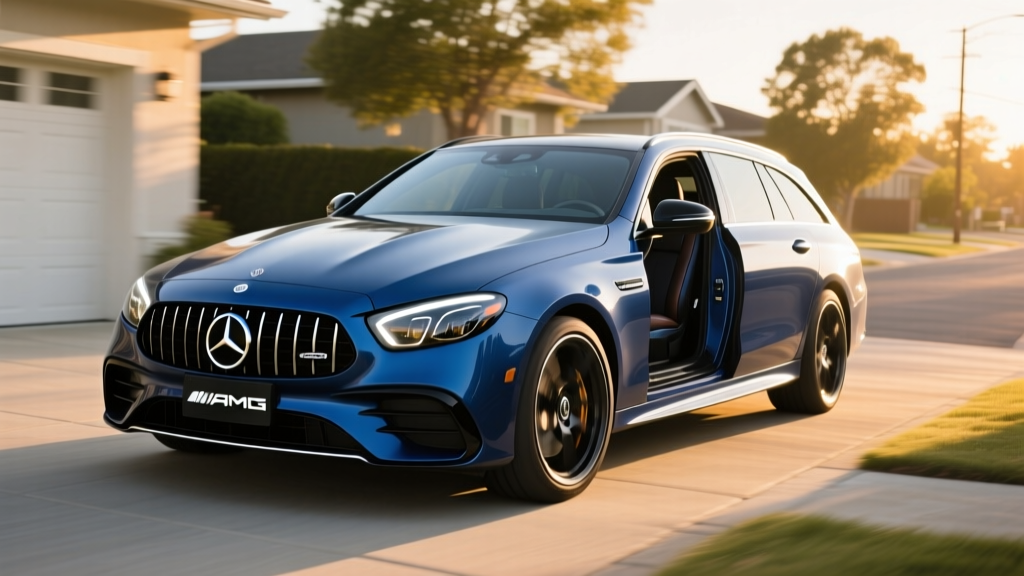
The 2026 Mercedes-AMG E 53 Hybrid Wagon occupies a rare niche: a plug-in hybrid (PHEV) estate that delivers genuine AMG performance while offering a usable electric-only commute range. With 469 combined horsepower from its turbocharged inline-six and electric motor, 0-60 mph in 3.7 seconds, and an EPA-estimated 25 miles of pure electric driving, it targets buyers who want wagon practicality, three-row utility, and daily electric commuting without full EV commitment.
But at a starting MSRP of approximately $82,900 (before destination), the E 53 Hybrid Wagon demands scrutiny on its efficiency claims, real-world electric range, and whether its PHEV powertrain actually saves fuel versus a conventional hybrid or full BEV alternative. Here's every number that matters.
HEV vs PHEV: What the E 53 Hybrid Wagon Actually Is
Before examining specs, the distinction matters because Mercedes markets several "hybrid" E-Class variants globally:
| Feature | Conventional Hybrid (HEV) | Plug-In Hybrid (PHEV) — E 53 |
|---|---|---|
| Plugs in to charge? | No — charges via regen and engine | Yes — 21.2 kWh battery, external charging |
| Electric-only range | 1-2 miles at low speed | EPA est. 25 miles |
| Battery size | ~1-2 kWh | 21.2 kWh (gross), ~18.5 kWh usable |
| Fuel savings mechanism | Engine assist, regen braking | Full EV mode for short trips + engine for long hauls |
| Tax credit eligible? | No | Potentially — up to $7,500 under §30D (see below) |
The 2026 AMG E 53 Hybrid Wagon is a PHEV. It has a charge port (behind the rear bumper on the driver's side in LHD markets), a substantially larger battery than any HEV, and the ability to drive 25 miles without the engine firing. If you never plug it in, it functions as a heavy, less-efficient conventional hybrid — defeating the purpose of the powertrain.
Powertrain Specs: 469 HP From Inline-Six + Electric Motor
| Specification | 2026 AMG E 53 Hybrid Wagon |
|---|---|
| Engine | 3.0L turbocharged inline-6 (M256M) |
| Engine output | 443 hp / 413 lb-ft |
| Electric motor | Permanently excited synchronous, integrated in 9G-Tronic transmission |
| Motor output | 161 hp / 354 lb-ft (peak, time-limited) |
| Combined system output | 469 hp / 516 lb-ft (with RACE START) |
| Transmission | AMG SPEEDSHIFT TCT 9-speed automatic |
| Drivetrain | AMG Performance 4MATIC+ AWD |
| 0-60 mph | 3.7 seconds (manufacturer) |
| Top speed | 155 mph (electronically limited) |
| Battery (gross / usable) | 21.2 kWh / ~18.5 kWh |
| Battery chemistry | NMC (nickel manganese cobalt) |
| Cargo volume (behind 2nd row) | ~33.1 cu ft (est., wagon) |
| Base MSRP | $82,900 (est., before destination & options) |
The inline-six carries over AMG's mild-hybrid EQ Boost architecture but pairs it with a significantly more powerful electric motor integrated into the transmission housing. Unlike the non-AMG E 350e PHEV (which uses a four-cylinder), the E 53's six-cylinder provides seamless power delivery and a character that four-cylinder PHEVs cannot match. The motor fills torque gaps during shifts and enables silent EV-mode launches.
Electric-Only Range and Charging: 25 Miles EPA, But What's Real?
EPA-estimated electric-only range: 25 miles
Real-world expectation: 20-23 miles in mixed driving; 17-19 miles at sustained highway speeds (65-75 mph); 24-27 miles in stop-and-go city traffic with moderate climate use.
Cold weather (below 32°F): Expect 15-18 miles due to cabin heating demand and reduced battery efficiency.
The 21.2 kWh gross battery (approximately 18.5 kWh usable, as Mercedes reserves a buffer to protect long-term State of Health) provides enough energy for most commutes under 20 miles round-trip. This is the sweet spot for PHEV utility: you drive electric Monday through Friday and use the inline-six for weekend road trips without range anxiety.
Charging Speeds and Connectors
| Charging Level | Power (kW) | Connector | 0-100% Time | Miles Added per Hour |
|---|---|---|---|---|
| Level 1 (120V household) | ~1.4 kW | J1772 | ~13-14 hours | ~2 miles/hr |
| Level 2 (240V home/public) | Up to 7.4 kW (onboard charger limit) | J1772 (NACS with adapter) | ~2.5-3 hours | ~8-10 miles/hr |
| DC Fast Charging | Not available | N/A | N/A | N/A |
Critical note: The E 53 Hybrid Wagon does not support DC fast charging. The 7.4 kW onboard AC charger is the maximum input. This is standard for most PHEVs — the battery is simply too small to justify DCFC hardware weight and cost. Plan to charge overnight at home on a Level 2 circuit. A 240V/32A circuit (7.7 kW supply) will fully replenish the battery in under 3 hours.
For 2026, Mercedes provides a J1772 inlet. If you charge at Tesla Supercharger or NACS-equipped public stations, you'll need a J1772-to-NACS adapter (widely available, ~$100-$200). Tesla's Level 2 Destination Chargers use NACS connectors natively, so the adapter matters for those as well.
Fuel Economy: EPA MPG and Real-World Efficiency
| Driving Mode | City | Highway | Combined |
|---|---|---|---|
| Charge-sustaining (hybrid mode, battery depleted) | 24 MPG | 30 MPG | 26 MPG |
| MPGe (electric + gas combined, EPA methodology) | 54 MPGe (est., first 25 miles) | ||
| Electric-only energy consumption | ~36 kWh/100 mi (est.) | ||
How to read these numbers: The EPA's MPGe figure (miles per gallon equivalent) blends electric and gasoline operation over the first portion of a drive cycle, assuming you start with a full charge. It's useful for comparing PHEVs to BEVs and HEVs on a single scale, but it's misleading if you never plug in.
The charge-sustaining MPG (26 combined) is what you'll see on road trips after the battery depletes. For a 4,800+ lb AWD performance wagon with 469 hp, 26 MPG is respectable — comparable to a four-cylinder midsize sedan from a decade ago. But it won't match a Toyota Prius (57 combined) or even a non-AMG E 350 mild-hybrid (27 combined).
Real-World MPG: Where PHEVs Surprise
In daily use with regular plug-in charging, many E 53 Hybrid Wagon owners will use zero gasoline on commutes under 25 miles. Over a month of weekday commuting (say, 15 miles each way, 22 workdays), you'd burn roughly 0 gallons if you charge nightly. Weekend trips of 200+ miles would return 24-28 MPG depending on speed and terrain.
Conversely, if you never plug in and drive it like a conventional hybrid, expect 22-25 MPG combined — the extra 400+ lbs of battery mass penalizes efficiency when the motor can't contribute meaningfully. The PHEV only saves fuel if you actually plug it in.
Pricing, Trims, and Federal Tax Credit Eligibility
The 2026 AMG E 53 Hybrid Wagon carries an estimated base MSRP of $82,900 (destination charge approximately $1,150 additional). Typical options — AMG Night Package, MBUX Hyperscreen, Executive Rear Seat package, carbon fiber trim — can push a well-equipped example to $95,000-$105,000.
Does It Qualify for the §30D Federal Tax Credit?
IRS §30D New Clean Vehicle Credit requirements (2026):
- MSRP cap: Vans, SUVs, and pickup trucks — $80,000. Sedans and wagons — $55,000. The E 53 Wagon is classified as a wagon, and at $82,900 MSRP, it exceeds the $55,000 cap.
- Buyer income cap: $150,000 single / $225,000 head of household / $300,000 joint (MAGI).
- Battery sourcing: Critical minerals and battery components must meet phased-in domestic/F TA-sourced thresholds.
- Point-of-sale transfer: Eligible buyers can transfer the credit to the dealer for an immediate price reduction.
Verdict: The E 53 Hybrid Wagon almost certainly does not qualify for the §30D federal tax credit due to its MSRP exceeding the $55,000 wagon cap. Always confirm with a tax professional and check the latest IRS guidance before purchasing.
Some states offer additional PHEV rebates (California's CVRP, for example, has varying eligibility thresholds), but federal credit is effectively off the table at this price point.
Battery Warranty, Reliability, and Replacement Cost
High-voltage battery warranty: 6 years / 62,000 miles (Mercedes-Benz standard for PHEV/EV batteries in the US, whichever comes first). Some states with California Air Resources Board (CARB) emissions warranties may extend coverage to 10 years / 150,000 miles for partial zero-emission vehicle (PZEV) components — check your state registration.
Capacity retention guarantee: Mercedes warrants the battery against defects and excessive capacity loss, typically defined as falling below 70% of original capacity during the warranty period.
How Long Will the Battery Last?
NMC chemistry in a PHEV application experiences moderate stress: daily charge-discharge cycles (unlike a BEV that might sit at 80% SoC for days) mean roughly 300-400 full equivalent cycles per year if charged nightly. At 18.5 kWh usable, that's manageable. Real-world data from earlier Mercedes PHEVs (GLE 350e, S 580e) suggests 8-12% degradation over 5 years / 60,000 miles is typical — meaning your 25-mile EV range might become 22-23 miles by year five.
Battery Replacement Cost
Out-of-warranty high-voltage battery replacement for a 21.2 kWh Mercedes PHEV pack is estimated at $8,000-$12,000 (parts and labor) based on current dealer pricing for comparable PHEV modules. Individual module replacement (if only one cell group fails) can reduce this to $2,000-$4,000, but availability depends on dealer diagnostic capability.
The inline-six engine and 9-speed transmission carry Mercedes' standard 4-year/50,000-mile new vehicle warranty. AMG-specific components (sport differential, performance exhaust, adaptive dampers) are covered under the same terms. For reliability data, consult NHTSA for recalls and IIHS for crash-test ratings as they become available for the 2026 wagon variant.
Who Should Buy the E 53 Hybrid Wagon — And Who Shouldn't
Choose the AMG E 53 Hybrid Wagon if:
- Your commute is under 25 miles round-trip and you can charge at home nightly
- You want a performance wagon with AWD, 469 hp, and sub-4-second 0-60 capability
- You take regular road trips where BEV charging infrastructure is sparse or inconvenient
- You need cargo capacity (33+ cu ft) that sedans can't provide
- You accept $82,900+ pricing without expecting a federal tax credit offset
Choose a full BEV (like the Mercedes EQE SUV or Tesla Model X) if:
- Your daily driving exceeds 40 miles and you want zero gasoline use
- You want lower maintenance costs (no oil changes, no spark plugs, fewer moving parts)
- You want access to DC fast charging for road trips (150-250 kW capability)
- You qualify for the §30D credit on a BEV under the MSRP cap
Choose a conventional hybrid (like the Volvo V90 Recharge T8, if available, or a non-plug-in hybrid wagon) if:
- You cannot install a Level 2 charger at home (apartment, street parking)
- You want hybrid efficiency without the complexity of plug-in management
- Your budget is under $60,000
Pros and Cons at a Glance
Pros
- 469 hp with 3.7-second 0-60 — genuine AMG performance
- 25-mile EV range covers most commutes emissions-free
- Wagon cargo practicality with AWD all-weather capability
- No range anxiety on long trips — the inline-six takes over seamlessly
- MBUX tech suite with latest driver-assistance (Level 2 SAE)
- Quiet, refined EV-mode driving around town
Cons
- $82,900+ MSRP exceeds §30D federal tax credit cap for wagons
- No DC fast charging — Level 2 only (7.4 kW max)
- 26 MPG combined in charge-sustaining mode is unremarkable for a hybrid
- Battery mass (~4,800+ lbs curb weight) affects handling vs non-hybrid AMG wagons
- 6-year/62,000-mile battery warranty is shorter than some competitors (BMW offers 8 yr/80k)
- Rear cargo floor slightly elevated due to battery packaging
Frequently Asked Questions
How many MPG does the AMG E 53 Hybrid Wagon get?
In charge-sustaining (hybrid) mode after the battery is depleted, the EPA estimates 24 city / 30 highway / 26 combined MPG. When regularly charged and driven within its 25-mile EV range, effective fuel consumption can approach zero for daily commuting. The MPGe rating (blending electric and gas operation) is estimated at 54 MPGe.
How far can the E 53 Hybrid Wagon go on electric only?
The EPA-estimated electric-only range is 25 miles from a full charge. In real-world conditions, expect 20-23 miles in mixed driving, 17-19 miles at sustained highway speeds, and up to 27 miles in low-speed city traffic. Cold weather (below freezing) reduces this to approximately 15-18 miles due to cabin heating demand and battery chemistry limitations.
Hybrid vs PHEV vs EV — which fits my lifestyle?
If you have home charging access and a commute under 25 miles, the E 53 PHEV lets you drive electric daily while keeping gasoline flexibility for road trips. A conventional hybrid (HEV) makes sense if you can't plug in at home. A full BEV (battery electric vehicle) is ideal if you want zero tailpipe emissions, lower maintenance, and DC fast charging — but requires planning for longer trips. The E 53 is specifically a PHEV; it requires plug-in charging to realize its efficiency benefits.
Is the AMG E 53 Hybrid Wagon reliable, and what does a battery replacement cost?
Mercedes' PHEV powertrains have shown moderate reliability in early model years, with most issues related to software and charging systems rather than battery cell failure. The high-voltage battery is warranted for 6 years/62,000 miles (longer in CARB states). Out-of-warranty replacement is estimated at $8,000-$12,000 for a complete pack, or $2,000-$4,000 for individual module replacement. The inline-six engine and 9-speed transmission are proven, well-understood components.
Does the E 53 Hybrid Wagon qualify for any tax credit?
Under 2026 IRS §30D rules, the E 53 Hybrid Wagon almost certainly does not qualify for the federal new clean vehicle credit. The MSRP cap for wagons is $55,000, and the E 53 starts at approximately $82,900. State-level incentives may still apply depending on your jurisdiction — check your state's energy office or DMV for current PHEV rebate programs. Consult a tax professional for personalized guidance.
Can I charge the E 53 Hybrid Wagon at a Tesla Supercharger?
Not directly for DC fast charging, as the E 53 does not support DCFC. However, at Tesla Level 2 Destination Chargers (which use NACS connectors), you can charge using a J1772-to-NACS adapter at up to the car's 7.4 kW onboard charger limit. Tesla Superchargers (DC fast) are incompatible regardless of adapter because the vehicle lacks DC charge hardware.
What is the total driving range combining electric and gasoline?
With a full battery and a full tank of premium gasoline (approximately 17.4 gallons), the E 53 Hybrid Wagon can travel roughly 470-490 miles total: 25 miles on electricity plus approximately 445-465 miles on the gasoline engine at 26 MPG combined. Highway-only range may extend slightly due to the 30 MPG highway figure.