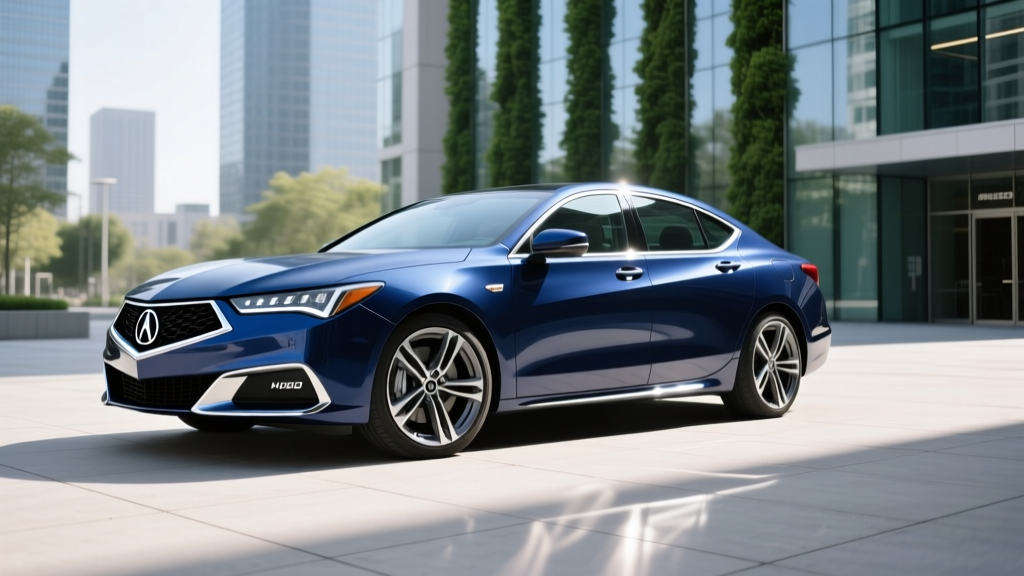
If you've been searching for an Acura TLX hybrid, you've likely noticed a frustrating gap: as of the 2026 model year, Acura does not offer a hybrid or plug-in hybrid version of its compact luxury sport sedan. The TLX lineup remains exclusively powered by turbocharged gasoline engines. But with Honda's aggressive hybrid rollout across its mainstream and luxury divisions, the question isn't whether an electrified TLX will arrive — it's when, and in what form.
This guide examines the current TLX powertrain lineup, Honda's hybrid strategy heading into 2026, the most likely hybrid configuration Acura would adopt, and whether you should wait for a hybrid TLX or consider the alternatives available right now.
Why There's No Acura TLX Hybrid Yet
The current-generation Acura TLX (introduced for 2021) was engineered on a platform that prioritized structural rigidity and chassis dynamics over electrification flexibility. Unlike Toyota's TNGA architecture, which was designed from the outset to accommodate hybrid and plug-in hybrid powertrains, Honda's midsize sedan platform was optimized primarily for conventional internal combustion engines.
That said, Honda has been rapidly expanding its hybrid offerings. The Accord Hybrid, CR-V Hybrid, and Civic Hybrid all use variants of Honda's two-motor e:HEV system. Acura's Integra — mechanically related to the Civic — has been widely rumored to receive a hybrid variant. The TLX, sharing its platform DNA with the Accord, is the logical next candidate.
Honda's stated goal is to electrify 100% of its vehicle sales by 2040, with a near-term target of hybrid and EV models comprising a significant majority by 2030. Acura, as Honda's luxury arm, is expected to follow this trajectory closely.
Current 2026 Acura TLX Powertrain Lineup
Before speculating about a hybrid, it's essential to understand what Acura currently offers. The 2026 TLX is available with two gasoline-only powertrains:
| Spec | TLX / TLX A-Spec | TLX Type S |
|---|---|---|
| Engine | 2.0L Turbo I-4 | 3.0L Turbo V-6 |
| Horsepower | 272 hp | 355 hp |
| Torque | 280 lb-ft | 354 lb-ft |
| Transmission | 10-speed automatic | 10-speed automatic |
| Drivetrain | FWD or SH-AWD | SH-AWD standard |
| EPA MPG (City/Hwy/Combined) | 22 / 31 / 25 (FWD) | 19 / 28 / 22 |
| 0–60 mph | ~5.9 sec | ~5.1 sec |
| Starting MSRP | ~$39,500 | ~$55,700 |
For context, these MPG figures place the TLX behind key competitors that already offer hybrid or electrified options. The EPA's fueleconomy.gov database confirms these ratings for the current model year.
What an Acura TLX Hybrid Would Likely Look Like
Based on Honda's current hybrid architecture and the Accord Hybrid's proven powertrain, we can project with reasonable confidence what a TLX hybrid would entail. There are two distinct possibilities: a conventional hybrid (HEV) and a plug-in hybrid (PHEV).
HEV vs. PHEV: Key Distinction
Conventional Hybrid (HEV): Charges its small battery (~1.1–1.5 kWh) through regenerative braking and the gasoline engine. You never plug it in. It improves fuel economy by 30–50% over a gas-only model.
Plug-in Hybrid (PHEV): Carries a larger battery (~15–18 kWh) that you charge via a wall outlet or Level 2 charger. It provides 25–40 miles of electric-only driving before the gasoline engine kicks in. Once the battery depletes, it operates as a conventional hybrid.
Projected TLX Hybrid (HEV) Configuration
| Spec | Projected TLX HEV |
|---|---|
| Powertrain | 2.0L Atkinson-cycle I-4 + two electric motors |
| Combined Horsepower | ~204–212 hp |
| Hybrid Battery | ~1.3 kWh lithium-ion (not plug-in) |
| Projected EPA MPG | ~44 city / 41 hwy / 43 combined |
| Drivetrain | FWD or SH-AWD (rear motor variant) |
| Plug-In Required? | No — self-charging via regen and engine |
Projected TLX PHEV Configuration
| Spec | Projected TLX PHEV |
|---|---|
| Powertrain | 2.0L turbo I-4 + electric motor |
| Combined Horsepower | ~270–302 hp |
| Battery Capacity | ~17 kWh lithium-ion (NMC chemistry) |
| Electric-Only Range | ~30–38 miles (EPA est.) |
| Total Combined Range | ~400–450 miles |
| Level 2 Charge Time (0–100%) | ~2.5 hours at 7.2 kW |
| DC Fast Charging | Unlikely (most PHEVs lack DC capability) |
| Plug-In Required? | Yes — to access electric-only range |
Honda's e:HEV two-motor system, as used in the Accord Hybrid, is the most probable candidate for a TLX HEV. For a PHEV, Honda would likely adapt the architecture used in the Clarity Plug-in Hybrid (now discontinued) or the newer systems found in the CR-V e:PHEV sold in international markets.
Fuel Economy: How a TLX Hybrid Would Compare
The fuel economy case for a TLX hybrid is compelling. Here's how the current gasoline TLX stacks up against existing hybrid luxury sedans and what a hybrid TLX would need to achieve to be competitive:
| Vehicle | Type | EPA Combined MPG / MPGe | Electric Range |
|---|---|---|---|
| Acura TLX 2.0T (current) | Gas | 25 MPG | N/A |
| Lexus ES 300h | HEV | 44 MPG | N/A |
| BMW 330e xDrive | PHEV | 28 MPG + 75 MPGe | 22 mi |
| Mercedes C 300e | PHEV | 27 MPG + 68 MPGe | ~25 mi |
| Projected TLX HEV | HEV | ~43 MPG | N/A |
| Projected TLX PHEV | PHEV | ~28 MPG + ~72 MPGe | ~34 mi |
The Lexus ES 300h sets the bar for luxury hybrid sedans with 44 MPG combined. A TLX hybrid using the Accord's proven two-motor system could match or come within 1–2 MPG of that figure. For PHEV buyers, the BMW 330e and Mercedes C 300e offer electric-only commutes in the 22–25 mile range; a TLX PHEV with a larger battery could exceed those figures.
Real-World MPG Expectations
One advantage conventional hybrids hold: they often exceed their EPA city rating in real-world stop-and-go driving, because regenerative braking recaptures energy that gasoline cars waste as heat. On the highway, hybrid advantages narrow because the electric motor assists less at sustained high speeds. Expect a TLX HEV to deliver 45–48 MPG in city commuting and 38–41 MPG on highway cruises — the inverse of the gas TLX's profile.
For PHEV owners, real-world electric range depends heavily on temperature and driving style. In mild weather (55–75°F), expect to match or slightly exceed EPA electric range. In freezing conditions, battery efficiency drops 20–30%, reducing a 34-mile EPA rating to roughly 24–27 miles of actual electric driving.
Pricing and Tax Credit Eligibility
Pricing for a future TLX hybrid would carry a premium over the current gasoline models, as is typical across the industry. Based on hybrid premiums seen in the Accord lineup ($1,500–$2,000 over gas trims) and luxury-segment norms, we can estimate:
- TLX Hybrid (HEV): ~$41,000–$43,000 starting MSRP (roughly $2,000–$3,500 over the current base TLX)
- TLX PHEV: ~$47,000–$52,000 starting MSRP (reflecting the larger battery and charging hardware)
Federal Tax Credit: §30D Eligibility for PHEVs
If Acura releases a TLX PHEV, it could qualify for the federal §30D Clean Vehicle Credit of up to $7,500 — but eligibility is far from guaranteed. Current 2026 rules require:
- Battery capacity of at least 7 kWh (a TLX PHEV would meet this)
- MSRP under $55,000 for sedans (tight for a loaded PHEV trim)
- Buyer modified adjusted gross income under $150,000 (single) / $300,000 (joint)
- Critical minerals and battery components sourced from the U.S. or FTA partners — a requirement that has disqualified many vehicles
- Final assembly in North America
Conventional hybrids (HEVs) do not qualify for the §30D credit. Always verify current eligibility on IRS.gov and consult a tax professional before basing a purchase decision on incentive assumptions.
Battery Warranty, Reliability, and Replacement Costs
Hybrid battery longevity is consistently the top concern for buyers considering their first electrified vehicle. Here's what the data shows:
Hybrid Battery Warranty & Lifespan
Federal mandate: All hybrid and EV batteries must carry a minimum warranty of 8 years / 100,000 miles (10 years / 150,000 miles in CARB states including California, New York, and others).
Expected lifespan: Honda's hybrid batteries in the Accord Hybrid and CR-V Hybrid have demonstrated excellent longevity. Real-world data from high-mileage owners and fleet operators shows most Honda hybrid batteries retain 85–90%+ capacity at 150,000 miles. Complete failures before 200,000 miles are uncommon.
Replacement cost: If a hybrid battery does require replacement out of warranty, expect $2,500–$4,500 for a conventional HEV battery pack and $6,000–$9,000 for a PHEV pack (due to the larger kWh capacity). Refurbished and third-party replacement options can reduce these costs by 30–50%.
Honda's hybrid systems have built a strong reliability track record. The two-motor e:HEV architecture eliminates the traditional transmission entirely — there are no gears to shift, no torque converter, and fewer mechanical wear points. IIHS crash-test ratings for hybrid variants are typically identical to their gasoline counterparts, as the battery pack is mounted low in the chassis and protected by structural reinforcements.
Hybrid vs. PHEV vs. Full EV: Which Fits Your Driving Life?
Whether you should wait for a TLX hybrid, buy a competing hybrid now, or leap to a full battery-electric vehicle depends on your specific circumstances:
Choose a Conventional Hybrid (HEV) If:
- You don't have access to home or workplace charging
- You want maximum fuel savings with zero behavior change
- Your commute is long and mixed (city + highway)
- You plan to keep the car 8–12 years
Choose a Plug-in Hybrid (PHEV) If:
- You can charge at home (Level 1 or 2) and your commute is under 35 miles
- You want electric daily driving but gas flexibility for road trips
- You want to qualify for potential tax credits
- You're not ready for full EV range planning
Choose a Full EV (BEV) If:
- You have reliable home Level 2 charging
- Your daily driving is under 250 miles
- You want the lowest per-mile fuel cost and minimal maintenance
- You qualify for the full $7,500 federal credit on an eligible model
For TLX intenders who need a car now and want hybrid efficiency, the most direct alternatives are the Lexus ES 300h (44 MPG combined, ~$44,000), the BMW 330e (PHEV, 22 miles electric, ~$46,000), or the Acura Integra A-Spec with the available hybrid powertrain if Acura introduces one before the TLX gets its own system.
Should You Wait for the Acura TLX Hybrid?
If you're loyal to the Acura brand and the TLX's specific blend of SH-AWD dynamics, interior quality, and value pricing, waiting is defensible — particularly if Honda's hybrid rollout timeline accelerates. Industry reports suggest Honda will introduce hybrid powertrains across most of its core lineup by 2027–2028, and the TLX is too important a model to be left out.
However, if fuel economy is your primary motivation and you're open to cross-shopping, the Lexus ES 300h and BMW 330e are proven, available, and competitive right now. The ES 300h in particular delivers the kind of 44 MPG real-world efficiency that a future TLX hybrid would target, wrapped in a comparably luxurious cabin.
For buyers ready to fully electrify, the EPA-rated Tesla Model 3, Hyundai Ioniq 6, and BMW i4 offer 300+ miles of range and dramatically lower operating costs — though they sacrifice the specific driving character and dealership experience that Acura buyers value.
Frequently Asked Questions
Does Acura make a TLX hybrid for 2026?
No. As of the 2026 model year, the Acura TLX is only available with gasoline turbocharged engines (2.0L I-4 or 3.0L V-6). Acura has not officially announced a hybrid or plug-in hybrid TLX, though Honda's broader electrification strategy strongly suggests one is in development.
How many MPG would an Acura TLX hybrid get?
Based on Honda's e:HEV system used in the Accord Hybrid, a conventional TLX HEV would likely achieve approximately 43–44 MPG combined (with higher city than highway figures). A PHEV variant would deliver roughly 28 MPG combined once the battery is depleted, plus an estimated 30–38 miles of electric-only driving rated at approximately 72 MPGe.
Would a TLX PHEV qualify for the $7,500 federal tax credit?
Possibly, but it's not guaranteed. The §30D credit requires battery sourcing from approved supply chains, an MSRP under $55,000 for sedans, buyer income below IRS thresholds, and North American final assembly. Many PHEVs have failed the battery-sourcing requirement. Always check current eligibility at IRS.gov and consult a tax professional.
How reliable are Honda/Acura hybrid systems?
Honda's two-motor hybrid systems have demonstrated strong reliability across the Accord Hybrid, CR-V Hybrid, and Civic Hybrid lineups. The hybrid battery carries a federally mandated warranty of 8 years/100,000 miles (10 years/150,000 miles in CARB states). Real-world data shows most Honda hybrid batteries retain strong capacity well past 150,000 miles, and out-of-warranty replacement costs for a conventional HEV battery range from $2,500–$4,500.
Is a conventional hybrid or plug-in hybrid better for daily commuting?
If your commute is under 35 miles and you can charge at home, a PHEV lets you drive on electricity daily while retaining gas flexibility for longer trips — often using zero gasoline on weekdays. If you lack home charging access or your commute is longer, a conventional HEV delivers strong fuel savings (40+ MPG) without any plugging in. Both are more efficient than the current gas-only TLX's 25 MPG combined.