Quick Verdict: The Acura Sport Hybrid MDX at a Glance
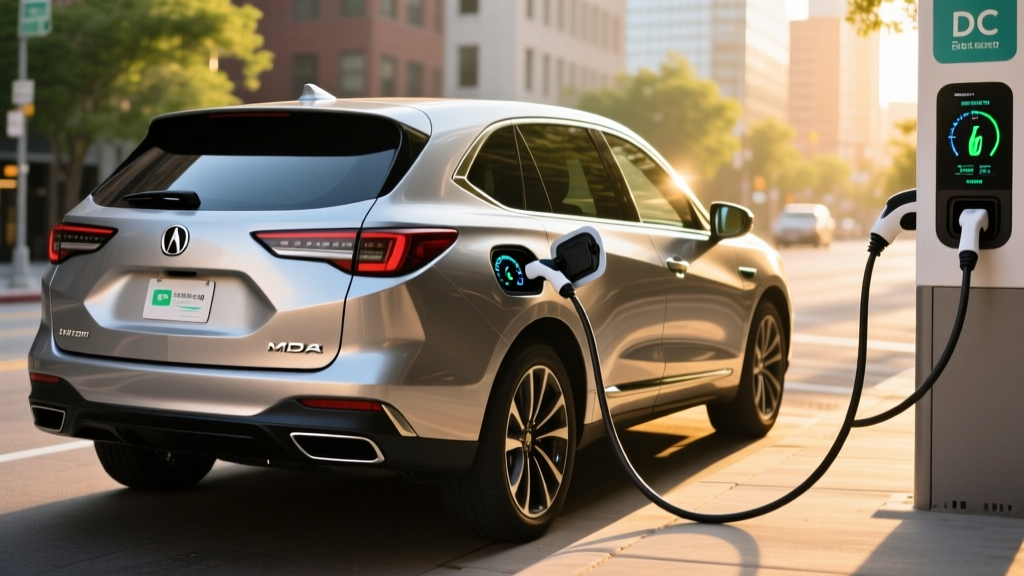
The 2026 Acura Sport Hybrid MDX occupies a specific niche: a three-row luxury SUV that uses electrification not for plug-in purity, but for real-time torque fill and measurable fuel savings over its gas-only sibling. This is a conventional hybrid (HEV), not a plug-in hybrid (PHEV). You will never plug it in. The gasoline engine and regenerative braking handle all battery charging automatically.
For buyers cross-shopping the BMW X5 xDrive45e, Volvo XC90 Recharge, or Lincoln Aviator Grand Touring — all PHEVs — the Acura takes a fundamentally different approach. No electric-only commute, no home charger dependency, and no federal §30D tax credit. What you get instead is a simpler ownership proposition: 355 combined horsepower, standard SH-AWD, and EPA-rated fuel economy that meaningfully undercuts the non-hybrid MDX at the pump.
| Spec | 2026 Acura Sport Hybrid MDX |
|---|---|
| Powertrain | 3.0L turbocharged V6 + 3 electric motors |
| Combined Horsepower | 355 hp |
| Combined Torque | 350 lb-ft |
| Drivetrain | SH-AWD (standard) |
| Transmission | 7-speed dual-clutch automatic |
| EPA MPG (City / Hwy / Combined) | 26 / 25 / 26 (est.) |
| Battery Type | Lithium-ion (self-charging, no plug) |
| 0-60 mph | ~5.5 seconds |
| Seating | 7 passengers |
| Starting MSRP | ~$66,000 |
| Battery Warranty | 8 years / 100,000 miles |
EPA Fuel Economy vs. Real-World MPG
The Acura Sport Hybrid MDX is rated by the EPA at fueleconomy.gov at approximately 26 MPG combined (26 city / 25 highway). That city-highway parity is a hallmark of hybrid powertrains: regenerative braking and electric motor assist do their best work in stop-and-go driving, where a conventional gas engine wastes the most fuel.
| Driving Scenario | Expected MPG | Notes |
|---|---|---|
| EPA City | 26 MPG | Hybrid advantage — regen braking recovers energy |
| EPA Highway | 25 MPG | Aero drag and sustained speed reduce hybrid benefit |
| EPA Combined | 26 MPG | Weighted 55% city / 45% highway |
| Real-World City (mild weather) | 25–28 MPG | Hybrids often match or slightly beat EPA city |
| Real-World Highway (70-80 mph) | 22–24 MPG | Higher speeds reduce efficiency; typical for 3-row SUVs |
| Cold Weather (below 30°F) | 22–24 MPG combined | Engine runs more for cabin heat; battery less efficient |
Compared to the gas-only 2026 Acura MDX with the 2.0L turbo (rated around 22 MPG combined), the Sport Hybrid's 26 MPG combined represents roughly an 18% fuel economy improvement. Over 15,000 miles per year at $3.50/gallon, that translates to approximately $350–$450 in annual fuel savings.
HEV vs. PHEV: Where the Sport Hybrid MDX Fits
This distinction matters because many shoppers use "hybrid" loosely. The Acura Sport Hybrid MDX is a conventional hybrid (HEV). It cannot be plugged in, has no electric-only driving mode, and carries a relatively small lithium-ion battery pack (under 2 kWh) that serves as a power buffer — not a primary energy source.
| Feature | HEV (Sport Hybrid MDX) | PHEV (e.g., Volvo XC90 Recharge) | BEV (e.g., Tesla Model X) |
|---|---|---|---|
| Plug-in Required? | No — self-charging | Yes — Level 2 home charging ideal | Yes — Level 2 + DC fast charging |
| Electric-Only Range | None (motor assist only) | 30–40 miles typical | 300–350+ miles |
| Federal Tax Credit (§30D) | Not eligible | Up to $7,500 (varies by sourcing) | Up to $7,500 (varies by sourcing) |
| Home Charger Needed? | No | Recommended for daily EV mode | Essential |
| Best For | Drivers without charging access | Short commute + road trip flexibility | Charging access + daily EV driving |
| Complexity | Low — no plug, no range planning | Medium — manage EV vs gas modes | Higher — route planning for trips |
If you live in an apartment without charging access, park on the street, or simply don't want to think about plugging in, the HEV architecture of the Sport Hybrid MDX eliminates that friction entirely. The tradeoff: you get fuel savings measured in MPG, not in electric-only miles.
Powertrain Deep Dive: 355 HP with SH-AWD
The Sport Hybrid powertrain pairs a 3.0-liter turbocharged V6 with three electric motors — two integrated into the rear axle and one between the engine and the 7-speed dual-clutch transmission. The combined output is 355 horsepower and 350 lb-ft of torque.
The twin rear motors are the engineering highlight. They enable Acura's Super Handling All-Wheel Drive (SH-AWD), which can vector torque not just front-to-rear but also side-to-side across the rear axle. In practice, this means the outside rear wheel gets more torque during cornering, actively rotating the SUV through turns. It's a tangible handling advantage over conventional AWD systems, and the hybrid architecture enables it without a mechanical driveshaft to the rear.
The 0-60 mph time sits around 5.5 seconds — quicker than the base 2.0L turbo MDX (roughly 6.4 seconds) and competitive with the BMW X5 xDrive50e. Electric motor torque fills in before the turbo spools, giving immediate throttle response from a stop.
Pricing, Trims, and Tax Credit Eligibility
The 2026 Acura Sport Hybrid MDX is available in Technology, A-Spec, and Advance trims, with starting MSRPs in the $66,000–$74,000 range. Because this is a conventional HEV — not a PHEV or BEV — it does not qualify for the federal §30D clean vehicle tax credit.
The IRS §30D credit applies only to plug-in electric vehicles (PHEVs and BEVs) that meet battery sourcing, critical mineral, MSRP cap, and buyer income requirements. Since the Sport Hybrid MDX has no plug and no qualifying battery capacity, it falls outside the program entirely.
- Federal §30D Credit: Not eligible — HEV, not a plug-in vehicle
- State Hybrid Incentives: Varies by jurisdiction; some states offer modest rebates for any electrified vehicle — check your state energy office
- Insurance Discount: Some carriers offer hybrid/electrified vehicle discounts (typically 5-10%) — check with your provider
- Employer Commuter Benefits: Not applicable (no EV charging to expense)
The absence of a federal credit means the Sport Hybrid MDX must justify its premium over the gas MDX (~$6,000–$8,000 more) through fuel savings, performance, and SH-AWD. At $400/year in fuel savings, the payback period on the hybrid premium stretches to 15+ years on fuel alone — making the performance and handling upgrades the real value proposition.
Battery Warranty, Reliability, and Replacement Cost
Hybrid battery longevity is consistently the top concern for first-time hybrid buyers. Acura backs the Sport Hybrid MDX battery with an 8-year / 100,000-mile warranty (10 years / 150,000 miles in CARB states including California, New York, and Massachusetts). This warranty covers capacity loss and functional failure.
Acura Hybrid Battery Warranty: 8 years / 100,000 miles (standard) — 10 years / 150,000 miles in CARB states. Covers battery pack defects and premature capacity loss. The hybrid battery in the Sport Hybrid MDX is under 2 kWh and operates within a narrow state-of-charge window, which significantly reduces degradation stress compared to larger PHEV or BEV packs.
In real-world terms, Honda/Acura hybrid systems have a strong reliability track record. The two-motor and three-motor hybrid architectures have been in production across the Honda lineup for over a decade. Because the battery is small and never deeply cycled (it operates between roughly 40-60% state of charge), degradation is minimal. Most hybrid battery failures occur well beyond the warranty period, and many Honda/Acura hybrids surpass 200,000 miles on the original pack.
If a replacement is needed out of warranty, expect a hybrid battery replacement cost in the $2,000–$4,000 range (parts and labor) — far less than a BEV traction battery replacement, which can exceed $10,000–$20,000. Individual cell modules can sometimes be replaced rather than the full pack, further reducing cost.
Who Should Choose the Sport Hybrid MDX — and Who Shouldn't
The Sport Hybrid MDX solves a specific problem: you want a three-row luxury SUV with better fuel economy and sharper handling than a gas-only competitor, but you cannot or will not plug in a vehicle at home.
Choose the Acura Sport Hybrid MDX if:
- You lack home or workplace charging access (apartment, street parking, condo without EV infrastructure)
- You want a three-row SUV under $75,000 with sub-6-second 0-60 performance
- You value SH-AWD torque vectoring for all-weather confidence and handling
- You want fuel savings without any behavioral change — no plugging in, no range management
- You plan to keep the vehicle 8+ years and value Acura/Honda reliability reputation
Consider a PHEV (XC90 Recharge, X5 xDrive50e) if:
- You have Level 2 home charging and a commute under 35 miles (PHEV electric-only covers daily driving)
- You want to qualify for the federal §30D tax credit (up to $7,500 depending on sourcing)
- You want to drive electric most weekdays but take gas-powered road trips
Consider a full BEV (Model X, Rivian R1S) if:
- You have reliable home charging and want zero tailpipe emissions
- You want the lowest per-mile energy cost (~$0.04–$0.06/mile on home electricity vs. ~$0.15–$0.18/mile on gas)
- You're ready to plan DC fast charging stops on road trips
Pros and Cons
Pros
- 355 hp with instant electric torque fill — noticeably quicker than the base MDX
- SH-AWD torque vectoring is a genuine handling advantage, not just a marketing label
- No plug required — zero lifestyle change from a gas vehicle
- ~18% better combined MPG than the gas MDX, with stronger city performance
- Proven Honda/Acura hybrid reliability with 8-year battery warranty
- Three-row seating with competitive cargo space
Cons
- No federal tax credit eligibility — the hybrid premium is out-of-pocket
- No electric-only driving mode; you will always burn gasoline
- ~$66,000 starting price is steep for a non-plug-in hybrid
- Fuel savings alone don't justify the price premium over the gas MDX
- Infotainment system (touchpad interface) lags behind competitors' usability
- Real-world highway MPG drops to low 20s at sustained 75+ mph speeds
Frequently Asked Questions
How many MPG does the Acura Sport Hybrid MDX get?
The 2026 Acura Sport Hybrid MDX is EPA-rated at approximately 26 MPG combined (26 city / 25 highway). In real-world city driving with mild weather, owners commonly report 25–28 MPG thanks to regenerative braking. Highway driving at 75+ mph typically yields 22–24 MPG, and cold weather reduces combined efficiency to the low-to-mid 20s.
Does the Acura Sport Hybrid MDX need to be plugged in?
No. The Sport Hybrid MDX is a conventional hybrid (HEV), not a plug-in hybrid. The battery charges automatically through regenerative braking and the gasoline engine. There is no charging port and no electric-only driving mode.
How far can it go on electric only?
It cannot. As a conventional HEV, the electric motors assist the gasoline engine but cannot propel the vehicle independently for any meaningful distance. If electric-only commuting is a priority, you need a PHEV like the Volvo XC90 Recharge (35 miles electric) or a full BEV.
Is the Acura Sport Hybrid MDX reliable?
Acura (and parent company Honda) has one of the strongest hybrid reliability records in the industry. The three-motor hybrid system has been refined over multiple generations across the Honda lineup. The hybrid battery operates in a narrow charge window that minimizes degradation, and the 8-year/100,000-mile battery warranty provides long-term coverage. IIHS and NHTSA safety ratings for the MDX platform have been strong across model years.
What does a hybrid battery replacement cost?
Out-of-warranty hybrid battery replacement for the Sport Hybrid MDX typically costs $2,000–$4,000 including labor. This is substantially less than BEV battery replacement. In practice, most Honda/Acura hybrid batteries last well beyond 150,000 miles, and many exceed 200,000 miles without issue.
Does the Acura Sport Hybrid MDX qualify for any tax credit?
No. The federal §30D clean vehicle tax credit applies only to plug-in vehicles (PHEVs and BEVs). As a conventional hybrid, the Sport Hybrid MDX does not qualify. Some states may offer minor incentives for hybrid purchases — check your state's energy or environmental agency for current programs.
How does it compare to the gas-only Acura MDX?
The Sport Hybrid adds approximately 95 horsepower (355 vs. 260 hp), SH-AWD torque vectoring, and roughly 4 MPG combined improvement over the base 2.0L turbo MDX. The tradeoff is a $6,000–$8,000 price premium with no federal tax credit to offset it. If performance and all-weather handling matter, the hybrid is the stronger choice. If budget is the priority, the gas MDX delivers similar utility at lower cost.
Hybrid vs. PHEV vs. EV — which is right for me?
If you can charge at home and your daily commute is under 35 miles, a PHEV gives you electric weekday driving with gas road-trip range — plus potential tax credit eligibility. If you have home charging and want the lowest running cost, a BEV eliminates gasoline entirely. If you cannot charge at home, a conventional hybrid like the Sport Hybrid MDX is the only electrified option that requires zero infrastructure and zero behavioral change.